
A professional mould assessment in Melbourne is your first and most critical step when you suspect a problem in your home. It's not just about looking at a few spots on the wall; it's a deep-dive investigation by a trained expert to figure out exactly what you're dealing with, where it's coming from, and how far it has spread. Think of it as a diagnosis before you attempt a cure—it ensures you're solving the root problem, not just painting over the symptoms.
Why Is Mould Such a Big Deal for Melbourne Homes?
That lingering musty smell in the basement or the creeping black stains in the corner of your bathroom? They’re more than just an ugly nuisance. These are clear signals that your home has an underlying moisture issue, a battle many homeowners across Melbourne are all too familiar with.
Mould spores are microscopic particles that are always in the air, both outside and inside. They're usually harmless, just floating by. But when they land on a surface that has the right ingredients—a food source (like plasterboard, wood, or even dust), darkness, and the all-important ingredient, moisture—they start to grow.
Melbourne: The Perfect Storm for Mould
Melbourne’s climate, with its damp, chilly winters and often unpredictable weather, is practically an open invitation for mould. This environment creates the perfect conditions for condensation, a major culprit behind household mould, especially in homes without great ventilation or insulation.
It happens when the warm, humid air inside your home—from cooking, hot showers, or even just breathing—hits a cold surface like a window or an uninsulated wall. The air cools down fast and can't hold as much moisture, so it drops it as water droplets. This constant dampness is exactly what mould needs to thrive.
The numbers back this up. The World Health Organization (WHO) estimates that anywhere from 10–50% of Australian homes are affected by dampness, and Victoria's climate puts us right in the firing line. In fact, studies have shown that around 27% of renters in Victoria report having mould issues, which gives you a real sense of how widespread this is. You can read more about the prevalence of mould in Victorian homes to see the full picture.
Common Mould Hotspots in Melbourne Properties
Every home is different, but certain Melbourne property types have their own classic weak spots:
- Older Brick Houses: Those beautiful period homes in places like Brunswick or Hawthorn often struggle with rising damp. This is where moisture literally gets sucked up from the ground into the brickwork, creating a persistent problem.
- Newer Apartments: While they tend to be well-insulated, modern apartments can be so well-sealed that they trap humidity inside. Without an effective ventilation system, moisture from daily life has nowhere to go.
- Sub-Floor Areas: If your home has an underfloor space with poor airflow, it can become a damp, humid incubator for mould. You often won't see it until it starts affecting the floors and air quality in the rooms above.
Here's the most important thing to remember: Mould is a symptom, not the disease. Wiping away visible mould with bleach is like pulling the tops off weeds—if you don't get the root, it's just going to grow right back. A professional mould assessment in Melbourne is how you find that root and get rid of it for good.
To give you a clearer picture, here's a quick summary of what's involved.
Mould Assessment Melbourne At a Glance
The table below breaks down the key stages and considerations for a typical mould assessment process in Melbourne.
| Aspect | Description |
|---|---|
| Initial Consultation | A discussion to understand the history of the property, any known water damage, and occupant health concerns. |
| Visual Inspection | A thorough, non-invasive inspection of the entire property, including hidden areas like roof cavities and sub-floors. |
| Moisture Mapping | Using tools like moisture meters and thermal imaging cameras to find hidden pockets of dampness in walls and floors. |
| Air & Surface Sampling | Taking air or surface samples (if needed) to identify the types and concentrations of mould species present. |
| Lab Analysis | Samples are sent to an accredited laboratory for scientific analysis to confirm the findings from the site. |
| Reporting | A detailed report outlining the findings, the root cause of the moisture, and a clear, step-by-step remediation plan. |
This process ensures that any recommended cleanup is based on solid data, not guesswork, leading to a healthier and safer home environment.
The Professional Mould Assessment Process Explained
So, you suspect you’ve got a mould problem in your Melbourne home. What actually happens when you bring in the experts? A proper mould assessment in Melbourne is a long way from a quick glance around. It’s a methodical investigation, like a building detective piecing together clues to solve the mystery of where the moisture is coming from and what it's doing to your property.
Interestingly, the process doesn't usually start with a site visit. It begins with a detailed phone call. A good assessor will ask a lot of questions about the property's history—any past floods, roof leaks, or burst pipes? Are occupants experiencing odd health symptoms like persistent coughs or headaches? This background information is gold, helping them form an initial hypothesis and know exactly where to focus their attention once they arrive.
The On-Site Investigation
When the assessor gets to your property, their first job is a comprehensive visual inspection. This isn't just a casual walk-through. They’ll be methodically checking every nook and cranny, from the sub-floor and roof cavity right down to the back of your cupboards. They're trained to spot not only the obvious signs of mould and water stains but also the subtle clues an untrained eye would easily miss.
But what about the moisture you can't see? This is where specialised diagnostic tools come into play. These gadgets are crucial for finding the hidden dampness that feeds mould growth.
- Moisture Meters: These devices are the go-to for checking moisture levels in building materials like plasterboard and timber. A quick probe or scan against a wall can instantly tell the assessor if it's wet on the inside, even when it feels bone dry to the touch.
- Thermal Imaging Cameras: Think of these as a moisture-detecting superpower. By revealing tiny temperature differences on a surface, these cameras can pinpoint where moisture is lurking. Wet spots tend to be cooler, showing up as clear cold patches on the screen, allowing an expert to trace a hidden leak without tearing down a wall.
This sequence shows how clues often progress from something you sense to something you see.
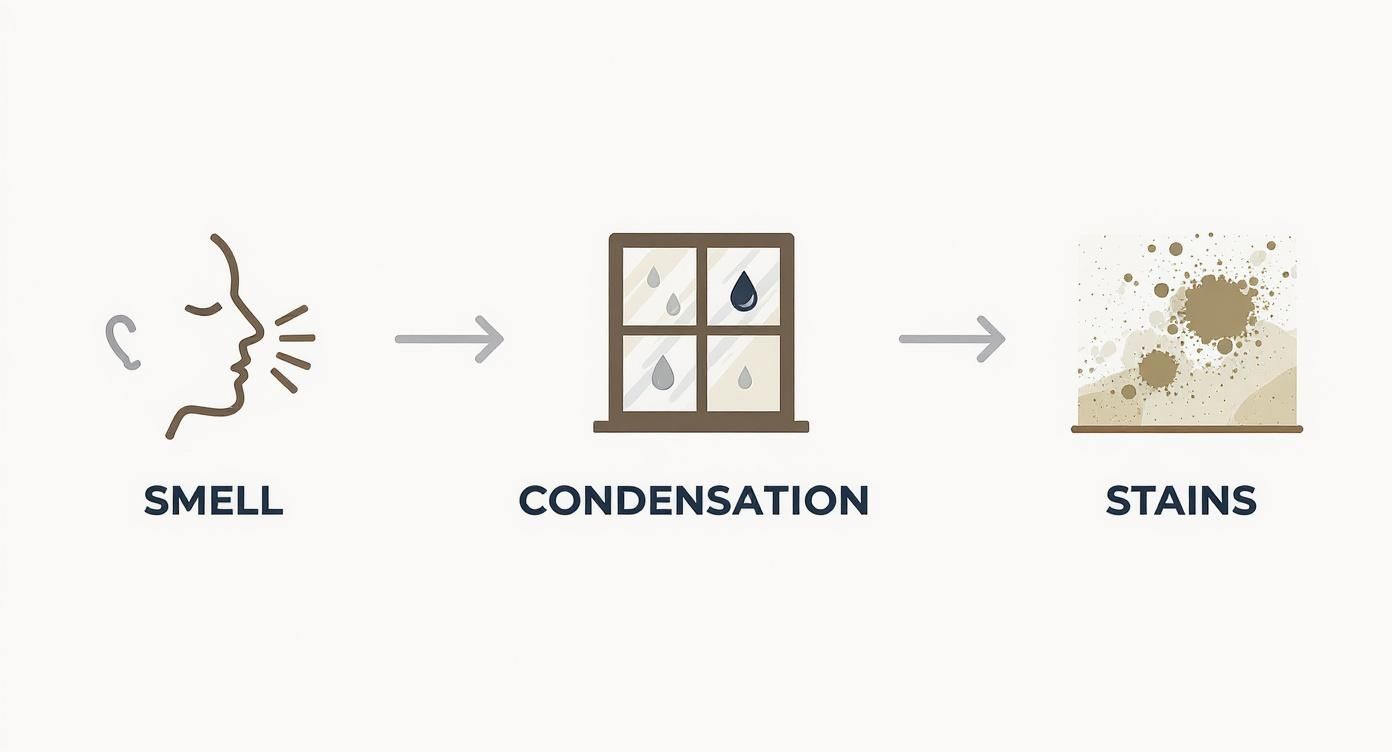
It often starts with a faint musty smell. That leads you to notice condensation on the windows, and finally, you spot the tell-tale water stains on the wall, confirming a real moisture issue is at play.
Scientific Sampling When Necessary
Sometimes, the visual inspection and moisture mapping tell the whole story. But in other cases—perhaps if the source isn't obvious, there are health concerns, or you need to verify a remediation job was done correctly—scientific sampling is the next logical step. It’s a bit like a doctor ordering tests to confirm a diagnosis. For a deeper dive into the technical side, a comprehensive mold testing guide can offer some great insights.
The point of sampling isn't just to find mould—it's pretty much everywhere in the natural environment. The real goal is to figure out if you have elevated levels or specific types of mould inside compared to the normal background levels outside.
Here are the most common methods used:
- Air Sampling: A specialised pump draws a precise amount of air through a small cassette. This traps airborne spores, which are then sent off to a lab to find out exactly what’s floating around in your indoor air and in what concentrations.
- Surface Sampling: This is for testing a specific patch of visible growth. It might be done with a sterile swab or a tape lift that pulls a sample directly from the surface. This definitively confirms if what you're seeing is mould and identifies the species involved.
From Data to Diagnosis
Once on-site work is done, any samples are sent to an accredited laboratory for analysis. This is where the true expertise of an occupational hygienist shines. They take the lab results and synthesise them with their visual findings and moisture data to build a complete picture of what's going on. This holistic approach is what makes an occupational hygienist's approach to mould assessment so robust.
The final piece of the puzzle is a detailed report. This isn't just a list of data; it’s your roadmap to a healthy home. It will pinpoint the root cause of the moisture, map out the extent of the contamination, and provide a clear, step-by-step remediation plan. This means any mould removal company you hire knows exactly what to do to fix the problem for good, not just paint over it.
Uncovering the Root Causes of Mould in Local Homes
If you see mould on a wall, that’s not the real problem. It’s just a symptom—a red flag pointing to a bigger, often hidden, moisture issue. To get rid of mould for good in any Melbourne home, you have to play detective and hunt down the water source. Just wiping the mould away without fixing the leak is like mowing over a weed; you know it's coming right back.
A professional mould assessment in Melbourne is all about this investigative work. It’s about figuring out why a certain spot in your house is damp enough for mould to thrive in the first place. The culprits can be surprisingly sneaky and often depend on the age and style of your property.
The Most Common Moisture Culprits
In all my years assessing homes across Melbourne, I've found that moisture problems almost always boil down to a handful of common issues. Each one needs a unique approach to diagnose and fix, which is why a proper investigation is so vital if you want a permanent fix.
The main causes we see time and again are:
- Building Defects and Failures: This is a huge category, covering everything from a leaky roof or poorly installed windows to tiny cracks in the foundation that let groundwater seep in.
- Plumbing Leaks: You'd be amazed how much damage a slow, steady drip from a pipe inside a wall can do. Over time, it saturates the plasterboard and timber, creating a perfect environment for mould.
- Inadequate Ventilation: Modern homes are often sealed up tight for energy efficiency, but this can trap humidity from cooking, showering, and even breathing. If that moist air has nowhere to go, it will cause problems.
- Condensation Issues: Melbourne’s climate is notorious for this. When warm, humid indoor air hits a cold surface—like a window pane or an uninsulated wall—water droplets form, creating persistent dampness.
Real-World Examples in Melbourne Homes
Let's look at how this plays out in real life. A classic scenario we often find is a modern apartment where the balcony wasn't waterproofed correctly. Rain seeps into the structure and dampens the inside walls of the living room, a problem you wouldn't even notice until mould starts appearing on the skirting boards.
Another common one, especially in older brick homes, is blocked weeping holes. Those little gaps in the external brickwork are designed to let moisture out of the wall cavity. But when they get clogged with dirt or painted over, they trap water inside, creating a mould paradise.
Think of it this way: Mould is like a plant. It needs water to grow. You can keep cutting the leaves off (cleaning the surface), but until you stop watering the roots (fixing the moisture source), it will always grow back.
This isn't just anecdotal. A major scoping study on Victorian homes looked at 2,178 domestic building insurance claims for water damage and mould. It found that a staggering 92% of these claims were tied to at least one water-related building defect. This confirms that flaws in construction are the number one driver. You can read more about the findings on water damage in Victorian buildings to see just how widespread the issue is.
Why Sub-Floor and Bathroom Ventilation Matter
Two areas of the home need special attention: under the house and in the bathroom. A damp, musty sub-floor with poor ventilation can pump litres of moisture up into the living space. This is often the hidden cause behind cupping floorboards, that persistent musty smell, and mould popping up in the bottom of wardrobes.
Bathrooms are another obvious hotspot for humidity. A key part of any investigation is understanding the importance of proper bathroom ventilation in renovations. An old, weak exhaust fan—or one that isn't ducted properly—just can't pull enough steam out of the room. This leaves walls and ceilings damp long after you've showered, giving mould the perfect opportunity to take hold. A thorough assessment always checks these systems to make sure they're actually doing their job.
How Indoor Mould Exposure Affects Your Health
When you spot mould, it’s easy to focus on the ugly stains or peeling paint. That visible damage is certainly a concern, but the real threat to your family's wellbeing is invisible. Mould colonies release microscopic spores and mycotoxins into the air, and that’s where the health risks truly begin. Tackling a mould problem is, at its core, about protecting the air you breathe at home.
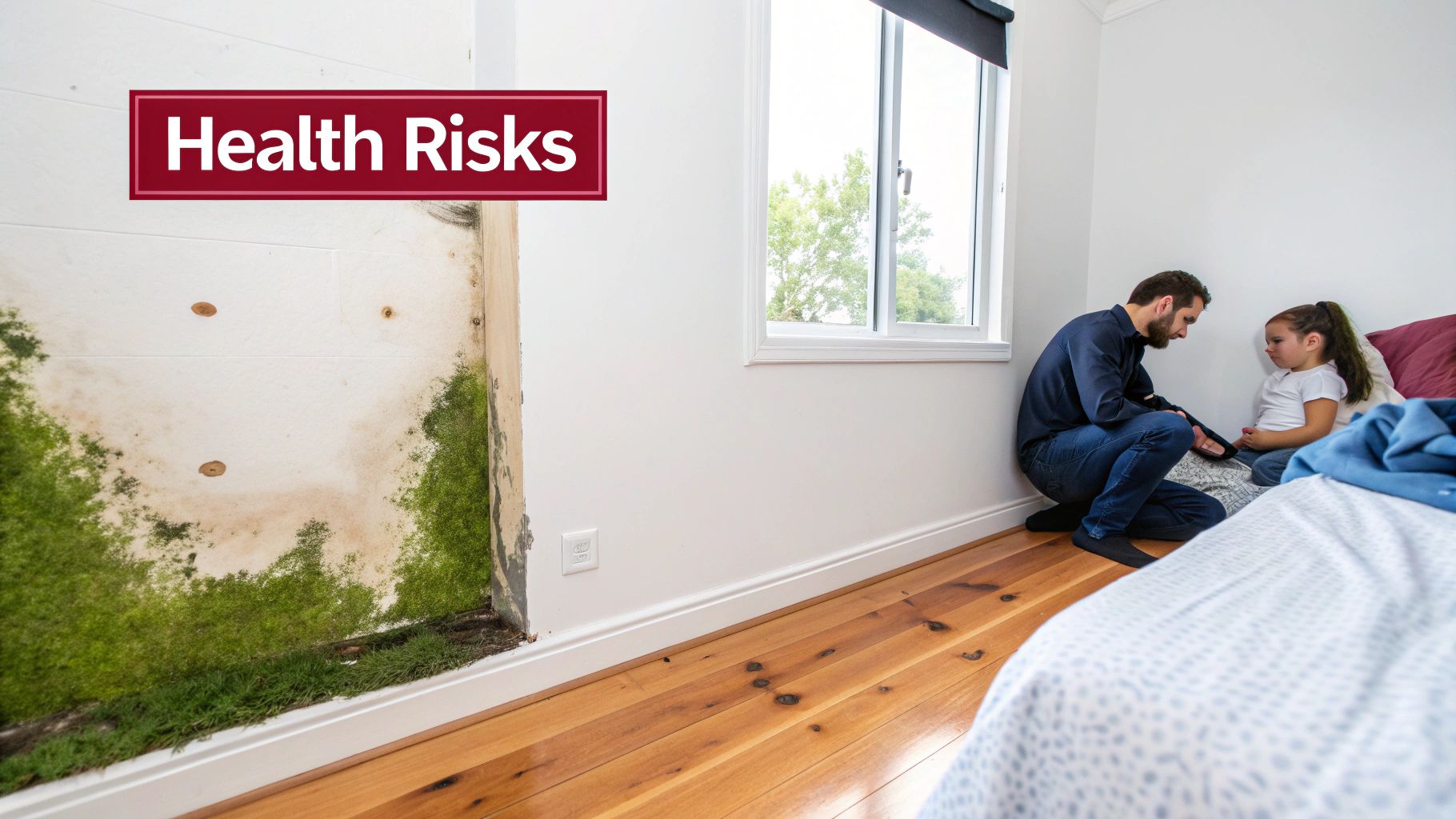
Think of a mould patch like a tiny, unwanted factory in your house, constantly pumping out spores. When you breathe them in, your body’s immune system often kicks into gear, treating them as foreign invaders. For many people, this leads to symptoms that feel frustratingly like a never-ending cold or a bad case of hay fever.
Common Health Reactions to Mould
How your body reacts depends on your own sensitivity and just how much mould is present. The symptoms can range from mildly annoying to genuinely debilitating.
Some of the most common reactions we see include:
- Allergic Reactions: This is the most typical response. Think sneezing fits, a runny or blocked nose, itchy eyes, and even skin rashes.
- Respiratory Issues: If you have asthma, mould is a notorious trigger. It can lead to more frequent and severe attacks, that all-too-familiar wheezing, and a feeling of breathlessness.
- General Irritation: Even if you don’t have a specific allergy, mould spores can irritate the delicate linings of your eyes, nose, throat, and lungs.
The link between mould and these health issues isn't just anecdotal; it's backed by solid research. Studies show a huge number of Australian homes are affected by indoor mould—somewhere between 10% to 50%. A survey focusing on this issue found that Victoria accounted for roughly 38.8% of participants reporting mould.
Worse still, 21.7% of those cases involved severe infestations, which were directly linked to a spike in both physical and mental health problems. You can dig into the research on mould severity in Australian homes to see the full scope of the issue.
Who Is Most at Risk?
While poor indoor air quality isn't good for anyone, some people are far more vulnerable to the effects of mould. If anyone in these groups lives in your home, acting quickly is absolutely critical.
The presence of mould transforms a home from a safe haven into a source of potential health risks. For vulnerable individuals, this risk is magnified, making a professional mould assessment in Melbourne an essential health and safety measure, not just a property maintenance task.
The groups at highest risk are:
- Children and Infants: Their immune systems are still developing, making them far more susceptible to respiratory problems triggered by mould.
- The Elderly: As we age, our immune systems can become less robust, reducing the body's ability to fight off environmental irritants.
- People with Pre-existing Conditions: Anyone with asthma, chronic allergies, or a compromised immune system can have a severe reaction to even minor mould exposure.
Understanding these health implications really highlights why a scientific approach is so important. A professional assessment does more than just find mould; it quantifies the risk to your family. If you'd like to learn more about how we measure airborne contaminants, our guide on mould and VOC testing explains the advanced methods used to ensure your air is truly safe to breathe.
How to Choose a Reputable Mould Assessor in Melbourne
Choosing the right professional for a mould assessment in Melbourne is easily the most important decision you'll make. This isn't just about hiring someone to look around; it's about bringing in a scientific expert who can give you an unbiased, accurate diagnosis of your home's health. The quality of this initial investigation sets the stage for everything that follows.
Think of it like getting a medical diagnosis. You wouldn't ask a surgeon who only gets paid for operating if you actually need surgery—you'd seek an independent opinion first. The same logic applies here. The integrity of your assessment hinges entirely on the expert's qualifications and, most importantly, their independence.
The Non-Negotiable Qualifications
Let's be clear: not all "mould experts" are created equal. A true professional has a solid background in building science and occupational hygiene, all backed up by credentials you can actually verify.
When you're vetting a potential assessor, there are a few key qualifications to look for. These aren't just fancy letters after a name; they represent a deep understanding of how moisture, buildings, and mould interact and a commitment to doing things the right way. Without them, you're just paying for guesswork.
The single biggest mistake a homeowner can make is hiring a company that offers both assessment and remediation. This is a massive conflict of interest. An independent assessor has only one job: to give you the unvarnished, scientific truth about your property.
Here are the key things to look for in a genuine professional:
- Industry Certifications: The gold standard comes from the Institute of Inspection, Cleaning and Restoration Certification (IICRC). You'll want to see qualifications like Applied Microbial Remediation Technician (AMRT).
- Comprehensive Insurance: Any assessor worth their salt will have both Professional Indemnity and Public Liability insurance. This protects you and shows they're serious about their business.
- Proven Experience: Don't be shy—ask for case studies or examples of similar jobs they've handled in Melbourne. Experience with local building types and our specific climate-related issues is priceless.
Why Independence from Remediation Is So Important
I can't stress this enough. An assessor who also sells mould removal services has a direct financial incentive to find a problem—or make a small one seem much larger than it is. Their "assessment" can quickly turn into a sales pitch for their own expensive remediation work.
An independent occupational hygienist, on the other hand, works for you and only you. They deliver an objective report based purely on scientific data. Their findings create a precise Scope of Work, which you can then take to several different remediation companies for quotes. This ensures you don't pay for work you don't need and holds the remediation company accountable for following a scientifically sound plan.
Key Questions to Ask a Potential Assessor
Before you sign anything, have a list of questions ready. How they answer will tell you everything you need to know about their expertise and professionalism. A confident, knowledgeable expert will have no problem giving you clear, detailed responses.
To help you out, here’s a quick checklist you can use to guide your conversation and verify you’re hiring the right person for the job.
Checklist for Hiring a Melbourne Mould Assessor
| Verification Point | What to Ask or Check | Why It Matters |
|---|---|---|
| Independence | "Do you or your company also perform the mould removal work?" | This is the make-or-break question. The answer must be no to guarantee an unbiased assessment. |
| Qualifications | "What specific IICRC or industry certifications do you hold?" | This confirms they have the proper formal training for microbial investigation. |
| Methodology | "What kind of tools do you use, like thermal cameras and moisture meters?" | This shows they use modern diagnostic gear for a thorough, non-invasive inspection. |
| Reporting | "Could I see a sample report to understand what's included?" | A quality report should be detailed, easy to understand, and include lab results, photos, and a clear plan. |
| Experience | "How many assessments have you done on homes like mine in the Melbourne area?" | Local experience means they know the common problems found in Melbourne's housing stock. |
By asking these pointed questions, you empower yourself to cut through the marketing fluff and find a true expert. Taking this methodical approach is the best way to ensure your investment in a mould assessment gives you a clear, actionable, and trustworthy result. For those looking for local expertise, finding a certified occupational hygienist near you is a crucial first step toward getting on top of any mould issues for good.
Understanding Your Mould Assessment Report
Getting your mould assessment report can feel a bit like trying to read a foreign language. It's packed with scientific terms, lab data, and diagrams that can look pretty intimidating at first glance. But don't worry—this document is your practical roadmap to a healthy property, and once you know what to look for, you'll be able to make confident, informed decisions.

Think of the report as telling a story in three simple parts: what we found, what it means for you, and what we need to do next. The first section usually covers the visual inspection, pinpointing every spot where our assessor found visible mould or signs of water damage. This part is always backed up with photos, so you can see the evidence for yourself.
Decoding the Lab Results
If we took air or surface samples, this is where things get scientific. You'll see a section breaking down the laboratory analysis, listing mould species like Aspergillus, Penicillium, or the infamous Stachybotrys (often called "black mould").
Seeing these names shouldn't cause alarm on its own. The real story isn't just their presence, but their concentration, which is measured in spores per cubic metre (spores/m³).
- Spore Counts: The report will compare the spore counts inside your home to an outdoor "control" sample we took on the day. If the indoor counts are significantly higher, or if we find types of mould inside that aren't present outside, it’s a clear sign of an active, internal mould source.
- Indicator Species: Some mould types are well-known as "water damage indicators." Finding them strongly suggests a history of serious moisture issues, even if the area feels dry to the touch now.
A good assessor’s job is to translate this raw data into a clear risk assessment. For instance, elevated levels of certain species can point directly to the type of water problem you have—some moulds love consistently damp materials, while others thrive after a major one-off event like a flood.
Visualising the Hidden Problem
Beyond the lab numbers, your report will bring the invisible issues to life with visual diagnostics. These tools are fantastic for helping you grasp the true scale of what’s happening behind the scenes.
- Moisture Maps: These are straightforward diagrams of your rooms. We'll shade the areas where moisture meters detected high levels of dampness inside walls, floors, or ceilings, effectively mapping out the exact footprint of the water damage.
- Thermal Images: You’ll also see pictures from our thermal imaging camera. These highlight temperature differences across surfaces. Colder patches, which usually show up as blue or purple, are tell-tale signs of hidden moisture from a slow leak or condensation build-up.
Finally, the most critical part of the report is the Scope of Work. This is the action plan. It lays out a clear, step-by-step strategy for remediation, specifying exactly which materials need to be removed, what containment measures are necessary to protect the rest of your home, and the criteria for the final clearance testing. This detailed plan is what you’ll hand over to a remediation company to ensure the problem is fixed properly, once and for all.
Your Mould Assessment Questions Answered
Even with a good overview, you probably still have a few practical questions about what to expect. That's completely normal. Here are some straightforward answers to the questions we hear most often from Melbourne homeowners and tenants.
How Much Does a Mould Assessment Cost in Melbourne?
The investment for a professional mould assessment in Melbourne really depends on the size and complexity of your property. For a typical family home, you can generally expect the cost to be somewhere between $500 and $1,500.
This price usually covers the hygienist's time on-site for a detailed visual inspection, moisture mapping with their specialised gear, and the comprehensive report you get at the end, which includes a clear remediation plan. Keep in mind that scientific sampling adds to the cost, so if air or surface samples need to be sent to a lab, each one will be an additional charge. Always get a detailed quote upfront so there are no surprises.
How Long Does the Whole Process Take?
For most Melbourne homes, the on-site visit itself will take around 2 to 4 hours. This gives the assessor plenty of time to be thorough, checking everything from the sub-floor and wall cavities to the roof space, all while mapping out any moisture problems.
Once the inspection is done, the next step is waiting for lab results if samples were taken. This typically takes about 3-5 business days. From there, you can expect to receive the final, detailed report within a week of the initial visit.
What About Those DIY Mould Testing Kits? Are They Any Good?
It's tempting to grab a DIY kit from the hardware store, but honestly, they often cause more confusion than they solve. Sure, they can tell you that mould spores are present, but spores are always in the air, both indoors and out. These kits can't tell you how much mould there is, where the source is hidden, or the type of water damage that's feeding it.
A DIY kit is like a smoke alarm that just beeps faintly to tell you smoke exists somewhere in the city. A professional assessment is the firefighter who pinpoints the exact location of the fire in your home and gives you the plan to put it out for good.
In Victoria, Who Is Responsible for Mould – Tenants or Landlords?
This is a big one. Under Victorian law, landlords have a clear duty of care to ensure their rental property is kept in good repair and is safe to live in. This absolutely includes fixing the root causes of mould, like a roof leak or rising damp.
Tenants also have a role to play. They're responsible for keeping the property reasonably clean, ensuring there’s good ventilation to prevent condensation, and, crucially, reporting any leaks or mould problems to their landlord or property manager as soon as they spot them.
If you're ready to move past the guesswork and get a definitive, science-based solution for your mould problem, the team at Anitech Ltd Pty is here to help. Our independent occupational hygienists deliver unbiased assessments that protect both your property and your health. To book your consultation, visit us at https://occhygiene.com.au today.


