
Quick Summary: When assessing methamphetamine contamination, standardised forensic swabbing provides precise, legally defensible, quantitative results from a NATA-accredited lab. This is mandatory for regulatory compliance and official clearance. In contrast, field testing kits offer only a quick, qualitative (yes/no) indication, are prone to inaccuracies, and hold no legal standing.

When it comes to assessing meth contamination, the choice of testing method is critical. This methodology breakdown of standardised forensic swabbing vs. field testing accuracy will clarify the two primary options. On one hand, standardised forensic swabbing gives you quantitative, lab-verified results. These are the numbers you absolutely need for legal proceedings and regulatory compliance.
On the other hand, field testing kits provide a quick, preliminary indication—think of them as a simple yes/no. The problem is, they're known for inaccuracies and can't be relied on for a final clearance certificate.
For any situation requiring definitive proof that meets Australian workplace safety standards, lab-based forensic swabbing is the only way to go. This fundamental difference in accuracy and regulatory acceptance is what we'll explore, helping you make the right call to ensure a safe, compliant environment.
Why Accurate Meth Contamination Testing is Non-Negotiable
Methamphetamine residue isn't just a problem for homes; it's a serious threat in commercial and industrial settings. The invisible toxic residue left behind can cause severe health issues for workers, from respiratory damage to neurological problems, creating a massive liability for any business.
Industries like manufacturing, mining, and property management have to tackle this risk head-on. If you fail to accurately detect and clean up contamination, you're not just risking your employees' health—you're looking at serious breaches of Work Health and Safety (WHS) obligations. This can lead to hefty legal penalties, forced shutdowns, and a tarnished reputation. That's why having a reliable testing protocol is absolutely essential.
This brings us to a critical choice: do you opt for a quick field screening or a definitive laboratory analysis? This decision isn't just a procedural tick-box; it directly impacts worker safety, regulatory compliance, and whether your business can keep its doors open.
Understanding the Two Main Approaches
Getting a handle on the fundamental difference between the two main testing methods is the first step in any solid risk management plan. Each has its place, but they offer vastly different levels of reliability and legal standing.
-
Standardised Forensic Swabbing: This is the gold standard, period. A trained technician takes a surface sample using a specific swabbing pattern across a designated area (usually 10×10 cm). The swab is then securely sent to a NATA-accredited laboratory for analysis, typically using highly sensitive equipment like Liquid Chromatography-Mass Spectrometry (LC-MS). The result is a precise, quantitative measurement of contamination—you know exactly how much is there.
-
Field Testing Kits: These are all about speed and convenience. They use a chemical reaction that changes colour to give you an instant, on-the-spot result. Think of it as a simple 'yes' or 'no' for the presence of methamphetamine. Crucially, these kits tell you nothing about the concentration of the residue.
The choice between a quick field guess and a precise laboratory measurement is the core of our methodology breakdown of standardised forensic swabbing vs. field testing accuracy.
Here's the critical takeaway: field tests can flag a potential problem, but only lab-based forensic swabbing can confirm the true extent of it and verify that a site is safe according to Australian remediation guidelines. Relying solely on field kits for a final clearance is a common—and dangerous—mistake.
Ultimately, the goal isn't just to test; it's to test correctly. The accuracy of the method you choose determines whether you are genuinely protecting your people and complying with Australian standards, or just creating a false sense of security. Let’s dive into why one method is fine for a preliminary check, while the other is non-negotiable for legal and safety compliance.
Unpacking the Gold Standard: Forensic Swabbing Methodology
When you need results that are legally defensible and meet strict Australian regulations, standardised forensic swabbing is the undisputed gold standard. This method doesn't just give you a simple 'yes' or 'no'. Instead, it delivers precise, quantitative data that will absolutely stand up to scrutiny. It’s a meticulous process where every single step is geared towards guaranteeing sample collection efficacy and ultimate accuracy.
The whole process starts with sample collection, and this first step really sets the foundation for everything that follows. It's far more than just wiping a surface; it's a systematic, scientific protocol.

Precision in Sample Collection
The process kicks off with choosing the right gear. Technicians use sterile, forensic-grade swabs to eliminate any chance of cross-contamination. A template, usually defining a 10cm x 10cm area, is laid on the surface to make sure every sample is collected from a consistent, known area.
This standardisation is absolutely critical. The final lab results are reported in micrograms per one hundred square centimetres (µg/100cm²), so without a precisely measured sample area, the quantitative data would be completely meaningless.
The collection technique is also tightly controlled. Technicians are trained to apply consistent pressure and follow a specific swabbing pattern. This ensures the entire designated area is covered thoroughly, maximising the recovery of any residue present.
The Importance of Rotational Swabbing Techniques
How a swab is actually applied to a surface directly impacts how much material is picked up. In fact, Australian research has shown that the specific technique can dramatically influence the sample yield.
For example, studies have found that rotational standardised swabbing—where the swab is pressed and twisted at the same time—boosts surface area contact and significantly improves sample recovery. For clients in construction, food and beverage, or building materials, this is a vital detail, especially on tricky surfaces like concrete or stainless steel. This technique has been shown to increase cellular material transfer by up to 25-30% compared to simple back-and-forth stroking.
Key Takeaway: The meticulous nature of forensic swabbing isn't just for show. Every detail, from the size of the template to the twisting motion of the swab, is scientifically validated to maximise the accuracy and reliability of the final result.
Maintaining the Chain of Custody
Once a sample is collected, protecting its integrity is paramount. This is where the chain of custody becomes so important. Each swab is immediately sealed in a tamper-evident container and meticulously labelled with the date, time, location, and the sampler’s details.
This creates an unbroken, documented trail all the way from the collection site to the laboratory. It guarantees that the sample being analysed is the exact one taken from the property, with zero possibility of tampering or contamination. This rigorous documentation is non-negotiable for any result to be considered legally admissible.
Advanced Laboratory Analysis for Quantitative Results
After collection, the secured swabs are sent to a NATA (National Association of Testing Authorities) accredited laboratory. NATA accreditation is a crucial stamp of quality assurance, confirming the lab meets stringent Australian and international standards for technical competence.
In the lab, highly sophisticated analytical instruments get to work. The most common and reliable method is Liquid Chromatography-Mass Spectrometry (LC-MS). This powerful machine can separate chemical mixtures and identify methamphetamine residue with incredible precision, detecting it even at extremely low concentrations. You can learn more about how meth testing works in our detailed guide.
The output from an LC-MS analysis isn't just a positive or negative reading. It delivers a definitive, quantitative measurement of the contamination level, expressed in µg/100cm². This exact figure is what’s needed to compare against the thresholds set by the Australian Clandestine Drug Laboratory Remediation Guidelines, making it the only data acceptable for legal and regulatory clearance.
Where Instant Field Testing Kits Fall Short
While standardised forensic swabbing gives you definitive, legally defensible data, instant field testing kits play a completely different game. They’re all about speed and convenience, designed to give a rapid, on-the-spot sign of potential methamphetamine contamination.
The whole thing works on a simple colorimetric chemical reaction. You wipe a surface, and if the swab picks up methamphetamine or its precursors, a chemical reaction kicks off, causing a visible colour change. It’s a basic 'yes' or 'no' answer.
But that simplicity is precisely where the problems start. These kits are only ever useful for a quick, preliminary once-over. They might help you pinpoint a few potential hotspots in a large warehouse to figure out where you should take proper forensic swabs, but they are absolutely no substitute for proper lab analysis.
The Ever-Present Risk of False Positives
One of the biggest headaches with instant field tests is how often they get it wrong. They are incredibly prone to false positives. The chemical reagents inside aren't just sensitive to methamphetamine; they can also react with a whole host of common chemicals you'd find in any industrial or commercial setting.
This lack of specificity is a major issue. A positive result from a field kit doesn't actually confirm meth contamination. All it really tells you is that something is on that surface that happens to trigger the same chemical reaction.
So, what kind of things can throw these tests off? The list is surprisingly long:
- Cleaning agents: Many heavy-duty soaps and industrial detergents contain compounds that will set off a false positive.
- Pesticides: Leftover residue from routine pest control treatments is a well-known culprit.
- Certain paints and varnishes: Some solvents and additives in coatings are enough to trigger a reaction.
- Over-the-counter medications: Common cold and flu remedies containing pseudoephedrine can easily produce a positive result.
Making a critical business decision based on a test like this can be a costly mistake. You could end up kicking off an expensive and disruptive decontamination process based on completely flawed data.
They Can't Tell You "How Much"
Here’s the real deal-breaker, especially when it comes to compliance: field kits can't give you quantitative data. A colour change might suggest something is there, but it tells you absolutely nothing about how much of it there is.
This is a critical point. The Australian Clandestine Drug Laboratory Remediation Guidelines have a very clear, legally binding limit for surface contamination: 0.5 micrograms per 100 square centimetres (µg/100cm²). If the contamination is over that level, remediation isn't optional—it's mandatory.
An instant field test has no way of telling you if a surface is above or below that crucial 0.5 µg/100cm² guideline. It might react to a trace amount far below the legal limit, or it might fail to pick up on contamination hovering just above it. Either way, you're getting a false sense of security or a false alarm.
Without a precise measurement, you simply can't:
- Assess the genuine risk to your workers' health and safety.
- Put together an effective and compliant remediation strategy.
- Get an official clearance certificate to legally re-occupy the site.
Not Sensitive Enough for the Job
On top of giving you no real numbers, many instant kits just aren't sensitive enough to detect contamination at the low levels that matter for Australian regulations. The limit of detection (LOD) for many of these kits is often well above the 0.5 µg/100cm² guideline.
This creates a seriously dangerous blind spot. A surface could be contaminated at 0.6 µg/100cm²—a level that legally requires remediation—but the field kit shows a negative result because the concentration is too low for it to pick up. A site could be deemed "clear" by the field test, yet remain legally non-compliant and physically unsafe.
When you break it down, a comparison of standardised forensic swabbing vs. field testing accuracy shows this is a non-negotiable failure. At the end of the day, these kits are just not fit for the purpose of legal or regulatory clearance, making them a completely unreliable tool for any serious risk assessment.
A Head-To-Head Methodology Breakdown
Choosing between standardised forensic swabbing and instant field testing isn't just a technical matter—it's a critical business decision with very real operational and legal outcomes. To get it right, you need to understand how fundamentally different these two approaches are. One is built for definitive, legally-sound clearance, while the other is, frankly, just a preliminary screening tool.
Let's break them down and compare them on the metrics that actually matter to facility managers, safety officers, and property owners.

Defining the Battleground: Accuracy and Sensitivity
The biggest difference comes down to what each test actually measures. Standardised forensic swabbing is quantitative. It's designed to give you a precise measurement of contamination in micrograms per 100cm². In stark contrast, field testing is purely qualitative—it provides a simple "yes/no" guess based on a colour change.
This directly impacts sensitivity. A NATA-accredited lab using Liquid Chromatography-Mass Spectrometry (LC-MS) can detect methamphetamine residue well below the Australian regulatory limit of 0.5 µg/100cm². Many field kits, however, have a much higher detection threshold, meaning they can easily miss contamination that is still high enough to be a legal and safety issue.
Crucial Differentiator: Forensic swabbing answers the question, "How much contamination is there?" with lab-verified data. Field testing can only answer, "Is a reactive substance likely present?" and tells you nothing about concentration or legality.
Comparing Operational Trade-Offs: Cost and Speed
At a glance, field testing seems to have the edge on speed and upfront cost. You can get a result in minutes for a low price per kit, which is tempting when you need a quick answer.
But the real cost is often hidden. Field kits are notorious for false positives, which can trigger expensive and completely unnecessary remediation work. Even worse, a false negative can leave you exposed to massive long-term costs from non-compliance, health and safety breaches, and legal liability.
Forensic swabbing has a higher initial cost for the technician and lab analysis, and it takes a few days to get results. But that investment delivers legally defensible data that prevents costly mistakes, making it the far more economical choice in any serious situation involving compliance or due diligence.
The Role of Specificity and False Positives
Specificity is a test’s ability to correctly identify the target substance without being fooled by something else. This is a major weak point for field testing kits. Their basic chemical reactions are not very specific and can be triggered by common industrial chemicals, cleaning agents, and even some medications, leading to a high rate of false positives.
Forensic lab analysis, especially LC-MS, is incredibly specific. It isolates and identifies the unique chemical signature of methamphetamine, completely removing the ambiguity and risk of a false positive. That kind of precision is essential when you’re making decisions that affect people's safety and your bottom line.
The importance of proper collection methods is well-established. For instance, in criminal forensics, forensic swabs have been shown to produce full DNA profiles from touched objects over twice as effectively as alternative field methods. This makes proper forensic collection significantly more effective at getting a complete, reliable result—a principle that directly applies to meth testing where sample integrity is everything.
Regulatory Acceptance and Legal Standing
For most businesses, this is the bottom line. Australian authorities, including Work Health and Safety bodies, will only accept quantitative results from a NATA-accredited laboratory to issue clearance certificates or confirm that remediation has met official guidelines.
Results from an instant field testing kit hold zero legal or regulatory weight. You can't use them for post-remediation clearance, in a legal dispute, or for a pre-purchase property assessment. Trying to do so is a surefire way to end up non-compliant.
Just as it's crucial to understand the diverse methodologies in any complex field, the choice in forensic science is clear-cut. For any decision with legal or safety implications, you must use a methodology that regulators will stand behind.
The table below summarises the key differences, making the choice even clearer.
Comparison of Meth Contamination Testing Methodologies
| Criterion | Standardised Forensic Swabbing (Lab Analysis) | Instant Field Testing Kits |
|---|---|---|
| Test Type | Quantitative (Measures exact concentration) | Qualitative (Indicates presence/absence only) |
| Accuracy | High. Provides legally defensible data. | Low. Prone to false positives and false negatives. |
| Sensitivity | Extremely high (detects below 0.5 µg/100cm²). | Low. Often fails to detect legally significant levels. |
| Specificity | Very high (LC-MS isolates methamphetamine). | Very low. Reacts to many common chemicals. |
| Regulatory Standing | Accepted by Australian authorities for clearance. | Not accepted for legal or regulatory purposes. |
| Speed | 2-5 day turnaround for lab results. | Immediate (results in minutes). |
| Cost | Higher upfront cost per test. | Lower initial cost per kit. |
| Best Use Case | Post-remediation clearance, legal disputes, due diligence, compliance checks. | Unofficial, preliminary screening where accuracy is not critical. |
As the comparison shows, while field kits offer speed, they sacrifice the accuracy, reliability, and legal standing that are non-negotiable for any serious assessment. Forensic swabbing is the only methodology that provides the certainty required to protect your business, your people, and your legal obligations.
Navigating Australian Regulatory and Compliance Standards
Choosing a testing method isn't just a technical decision; it's a legal one. When you're dealing with methamphetamine contamination in Australia, the entire process is governed by a strict legal and regulatory framework. Getting it wrong can lead to serious legal and financial pain, because the whole system is built on one thing: data that is precise, verifiable, and legally defensible.
At the heart of it all are the Australian Clandestine Drug Laboratory Remediation Guidelines. These aren't just suggestions. They set a clear, legally binding action level for surface contamination.
That magic number is 0.5 micrograms per 100 square centimetres (0.5 µg/100cm²). If a sample shows a reading at or above this level, professional remediation is required by law. This hard line is precisely why a simple "yes/no" field test just doesn't cut it for compliance.
The Role of NATA Accreditation
To satisfy these strict standards, Australian authorities and Work Health and Safety (WHS) bodies will only accept results from a NATA (National Association of Testing Authorities) accredited laboratory. NATA accreditation is the gold standard, confirming that a lab operates with the highest scientific competence and produces data you can trust.
What this means in practice is that for a result to hold any weight in a legal setting—whether for clearing a site after remediation, finalising a property deal, or in a courtroom—it must come from a forensic swab analysed by one of these labs. Field test results simply have no standing.
A NATA-accredited lab report is the only way to legally prove a property is safe and compliant with Australian guidelines. Without it, you can't get an official clearance certificate, leaving you and your business wide open to liability.
The Legal and Financial Risks of Cutting Corners
Relying on a non-compliant field test is a massive gamble. The fallout isn't just about failing a compliance check; it's about exposing your business to serious legal and financial risks that can linger for years.
Think about what can go wrong when you use inaccurate or unrecognised testing methods:
- Failed Property Settlements: A pre-purchase inspection using a field kit could easily miss contamination. When the true levels are eventually discovered, it can torpedo the settlement or spark legal action long after the sale.
- Ongoing Health Risks: A false negative from an insensitive field test means people could continue to live or work in a contaminated space. This can lead to severe health problems and, inevitably, WHS claims.
- Breach of Duty of Care: As a business owner or manager, you have a legal duty to provide a safe environment. Knowingly or negligently using the wrong testing method is a clear breach of that duty.
- Wasted Remediation Costs: Spending thousands on a professional cleanup is pointless if you can't legally prove the site is clean afterwards with a compliant test.
This principle—that legally defensible results demand standardised, lab-verified collection methods—is already well-established in other forensic fields. For example, data from New South Wales shows a direct link between robust evidence collection and better legal outcomes. You can explore more about the impact of standardised collection on legal outcomes.
Choosing the Right Testing Method for Your Situation
Deciding on the right meth testing approach isn't a simple technical choice—it's about managing risk, meeting legal obligations, and ultimately, keeping people safe. The best method for you really comes down to one simple question: what do you need to achieve with the result?
When the stakes are high—think legal disputes, regulatory sign-offs, or major financial decisions—the path forward is clear. You absolutely need the precision and legal defensibility that only lab-verified results can offer. There’s no room for shortcuts.
On the other hand, field testing kits have their place, but it's a limited one. Think of them as a preliminary screening tool, something to point you in the right direction for a more serious investigation, not as the final word.
When Forensic Swabbing is Non-Negotiable
Some situations demand the kind of quantitative, legally sound data that only standardised forensic swabbing can deliver. Using anything less in these cases opens you up to massive liability and simply won't pass muster with Australian regulatory standards.
These are the moments when you can't compromise:
- Post-Remediation Clearance: After a professional decontamination, the only way to legally confirm a property is safe and meets the 0.5 µg/100cm² guideline is with a report from a NATA-accredited lab.
- Legal Disputes: If you end up in court over an insurance claim or a workplace safety issue, field test results will be thrown out. Only forensic data is considered credible evidence.
- Pre-Purchase Due Diligence: Before investing in a commercial or industrial property, forensic swabbing gives you the hard data needed to avoid unknowingly buying a very expensive contamination problem.
- Regulatory Sign-Off: Any time you need an official green light from a body like Work Health and Safety, they will require accredited laboratory analysis. No exceptions.
This decision tree shows just how different the paths are for a quick screen versus an official clearance.
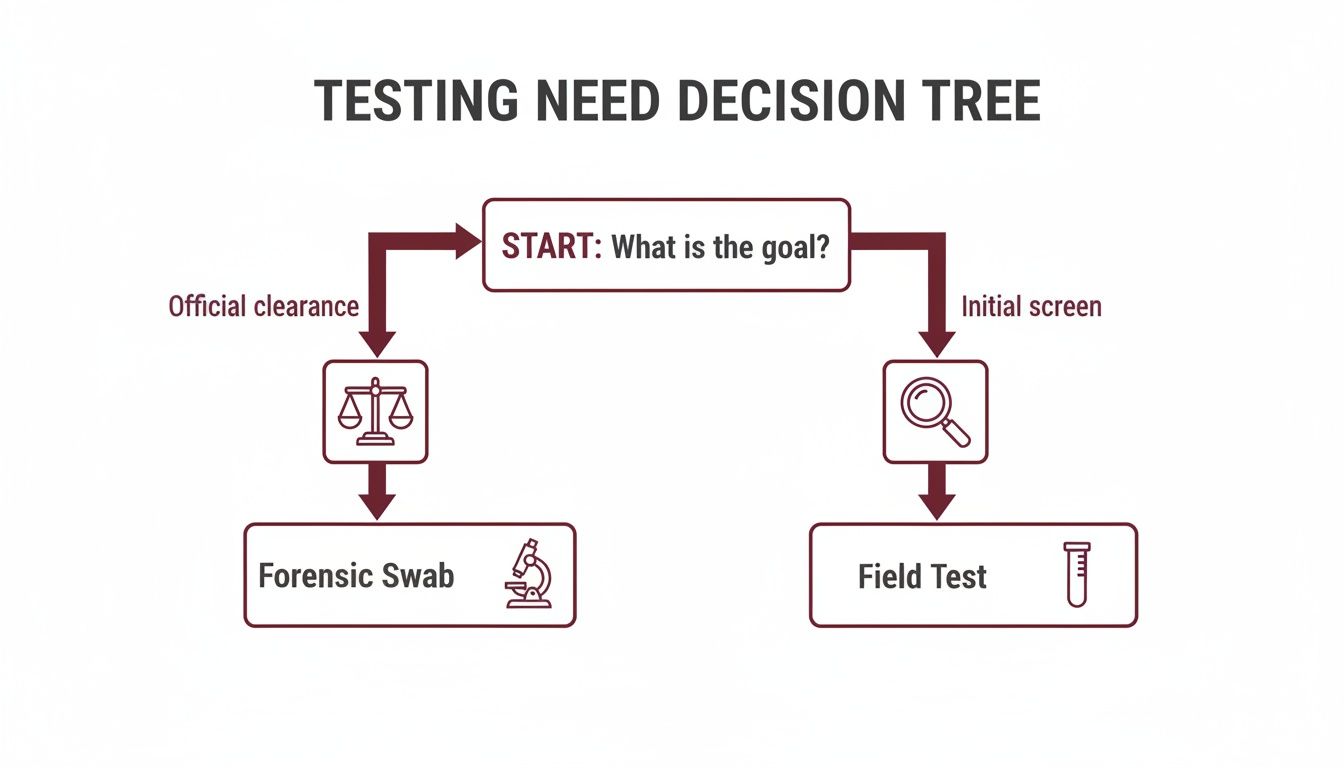
The takeaway is simple. If the result needs to be official, verifiable, or legally binding, you have to go with a forensic swab.
Positioning Field Testing Correctly
It’s crucial to understand what field tests are not. They are not a final answer. Their proper role is as a low-cost, indicative tool to get an initial lay of the land.
A classic example is a facility manager using them to quickly check several spots across a large warehouse. The results help them pinpoint where to focus their resources for official forensic sampling, saving time and money.
Final Recommendation: For any facility manager or safety officer, the decision has to be a risk-averse one. Use field tests only to guide your initial investigation. For every decision that truly matters—be it clearance, compliance, or legal proof—standardised forensic swabbing is the only responsible choice. It protects your people, your assets, and your organisation's legal standing.
Got Questions? We've Got Answers
When you're dealing with something as serious as meth contamination, it's natural to have a few questions. We get asked a lot about the nuts and bolts of testing, so we've put together some straight answers to the most common ones we hear.
Why Do Field Tests Seem to Give So Many False Positives?
It all comes down to the chemistry. Those instant field testing kits work by creating a simple colour change, but the reaction they use isn't exclusive to methamphetamine. A whole range of other common chemicals can set them off, leading to a false positive.
We've seen everything from industrial cleaners and certain pesticides to paints and even cold-and-flu tablets containing pseudoephedrine cause a positive result. This is a key difference in methodology; unlike standardised forensic swabbing which isolates the specific chemical fingerprint of meth in a lab, these kits are simply not specific enough, which severely limits their field testing accuracy.
How Long Does It Take to Get Lab Results Back?
Once our forensic swabs arrive at the NATA-accredited laboratory, you're looking at a turnaround time of about 2 to 5 business days for the final, quantitative report. This gives the lab technicians the time they need to properly log the samples, prepare them, and run them through highly sensitive equipment like Liquid Chromatography-Mass Spectrometry (LC-MS) to get a precise, legally defensible result.
Are DIY Test Kits Legally Admissible?
In a word, no. In Australia, the results from DIY or instant field testing kits have no legal standing and are not accepted for any official or regulatory matters.
Whether it's for a post-remediation clearance certificate, a legal dispute, or a property settlement, Work Health and Safety regulators and other authorities will only recognise quantitative results from a NATA-accredited laboratory.
What's the Process if Contamination Is Over the Limit?
If the lab results confirm methamphetamine contamination at or above the Australian guideline of 0.5 µg/100cm², professional remediation becomes a legal requirement. The site must be properly decontaminated by a trained and qualified specialist.
After the cleanup, another round of forensic swabbing is mandatory to verify that the contamination has been removed and the area is safe to be occupied again.
Make sure your workplace is safe and fully compliant with Australian standards. For definitive, legally sound testing, get in touch for an expert occupational hygiene assessment. Find out more at https://occhygiene.com.au.


