
When you’re looking at a property, it’s what you can’t see that often poses the biggest risk. Meth testing your property is the only way to be certain it’s free from the invisible, toxic residue that can be left behind by previous occupants. It’s a crucial step to protect your family’s health and safeguard your financial investment from some truly devastating consequences.
Why Meth Testing Your Property Is Essential
It's easy to get caught up in the appealing features of a home—the brand-new kitchen, the big backyard, or the fresh coat of paint. But beneath that perfect surface, a serious danger could be lurking. Methamphetamine contamination is an invisible threat that clings to walls, carpets, and even ventilation systems long after the drug was last used or manufactured on-site.
This toxic residue doesn't just fade away with time. It remains potent and can trigger serious health problems for anyone living in the space, quickly turning a dream home into a health hazard. For property buyers, owners, and tenants across Australia, getting your head around this risk is the first step toward ensuring a safe home.
The Unseen Dangers and Staggering Costs
The risks tied to meth contamination hit you on two fronts: your family's health and your finances. Even low-level exposure, which can come from something as simple as previous tenants smoking the drug, can lead to a whole host of health issues.
These effects are especially severe for children, as their developing bodies are far more vulnerable to toxic chemicals. Symptoms can include things like:
- Persistent respiratory problems like a constant cough or shortness of breath.
- Irritating skin rashes and eye sensitivity.
- Severe headaches and trouble sleeping.
- Behavioural changes, such as unusual irritability and confusion.
From a financial perspective, finding contamination after you’ve already bought a property can be catastrophic. In Australia, the national standard for a property to be considered safe for habitation is 0.5 µg per 100 cm². If testing shows levels above this mark, professional decontamination is mandatory. The cleanup bill can run anywhere from $3,500 to over $50,000, depending on how bad the contamination is.
A Critical Step in Property Due Diligence
For real estate agents and property managers, confirming a property is safe and habitable is a core part of the job. This duty of care goes beyond general maintenance and includes tackling specific health hazards like meth residue, which is a specialised aspect of real estate and property cleaning services.
For any prospective buyer or landlord, meth testing should be a non-negotiable part of the due diligence process. It's a small upfront investment that delivers priceless peace of mind and protects against potentially life-altering health and financial disasters.
Think of this guide as your practical roadmap to navigating the world of property meth testing. We’ll give you clear, actionable advice to help you protect what matters most—your family’s well-being and your financial security.
What Meth Contamination Actually Is (And Why It's So Dangerous)

Think of methamphetamine contamination as an invisible film of toxic dust that coats absolutely everything inside a house. When meth is cooked or even just smoked, the chemical compounds go airborne and settle everywhere—on walls, floors, ceilings, carpets, and even deep inside the air conditioning system.
This isn't like normal dust or dirt you can just wipe away. It’s a stubborn chemical residue that doesn't really break down on its own. It can linger for years after the drug activity has stopped, posing a serious health risk to the next family who moves in, often completely unaware of the danger lurking in their new home.
To get why professional meth testing is so crucial for a property, you need to understand where this residue comes from. It really boils down to two main sources, each carrying a different level of threat.
Meth Labs vs. "Smoke Houses"
When most of us hear "meth contamination," we picture a Breaking Bad-style meth lab. These are places used for illegal manufacturing, and they produce incredibly high levels of toxic residue from all the volatile chemicals involved in the "cooking" process.
A former meth lab is the worst-case scenario. The chemical by-products can seep right into porous materials like plasterboard and timber frames, making the clean-up job (remediation) a massive and costly undertaking.
But there’s a far more common problem: properties known as "smoke houses." These are homes where people have regularly smoked meth, but not actually made it. Just like cigarette smoke, meth smoke carries tiny drug particles that settle and build up on every surface over time.
A smoke house might not have the same extreme contamination levels as a full-blown lab, but the health risk is still very real. Continuous, low-level exposure can be just as damaging, especially for kids and other vulnerable people.
The sheer number of smoke houses is a major issue across Australia. Shockingly, around 16% of homes tested for meth contamination each month come back with a positive result. What's more, a massive 80% of these positive cases are from people using meth in the home, not making it. Even with research showing average surface contamination in suspected smoke houses at 2.7 µg per 100 cm², the danger, particularly to children, makes testing non-negotiable.
The Real-World Health Consequences
Living in a meth-contaminated home means you’re constantly exposed to these toxic chemicals. You can absorb them through your skin just by touching surfaces, breathe them in, or even accidentally ingest them. This ongoing exposure can lead to a whole host of serious health problems that are often mistaken for common illnesses like the flu or allergies.
It creates a frustrating cycle of unexplained sickness where even doctors can struggle to pinpoint the cause if they don't know about the contamination. These health risks aren’t just theoretical—they are a harsh reality for countless families who unknowingly moved into a toxic environment.
The symptoms can show up in all sorts of ways, affecting both physical and mental health.
Common Health Problems Include:
- Respiratory Issues: A nagging cough, bronchitis, or shortness of breath are classic signs, as the lungs get irritated by the chemical particles you’re breathing in.
- Skin and Eye Irritation: Coming into contact with contaminated surfaces can trigger nasty rashes, red and itchy skin, and burning or watery eyes.
- Neurological Symptoms: It’s common for people to report constant headaches, dizziness, brain fog, and a persistent feeling of anxiety or being on edge.
- Behavioural Changes in Children: Kids are especially vulnerable. Because their bodies are still developing and they’re always touching things and putting their hands in their mouths, they can show sudden irritability, trouble sleeping, and attention problems.
Ignoring these silent threats is a gamble you just can't afford to take with your family's health. The only way to be absolutely sure a property is safe is through professional meth testing, which can uncover this invisible danger before it causes any harm.
What's Involved in a Professional Meth Test? Here’s the Process Explained
Thinking about getting a professional meth test can feel a bit daunting, but the process itself is surprisingly straightforward. It’s a structured, methodical service designed to give you a black-and-white answer about a property’s safety. Knowing what to expect takes the guesswork out of the equation and empowers you to make a confident, informed decision based on solid science.
From your first call to a specialist, you’re kicking off a clear, step-by-step journey. It all starts with a visit to the property for inspection and sampling, and it wraps up with a comprehensive lab report that turns complex data into clear, actionable advice. Let’s walk through exactly what happens at each stage.
This visual guide breaks down the core workflow, from the moment a technician steps on-site to the delivery of your final report.
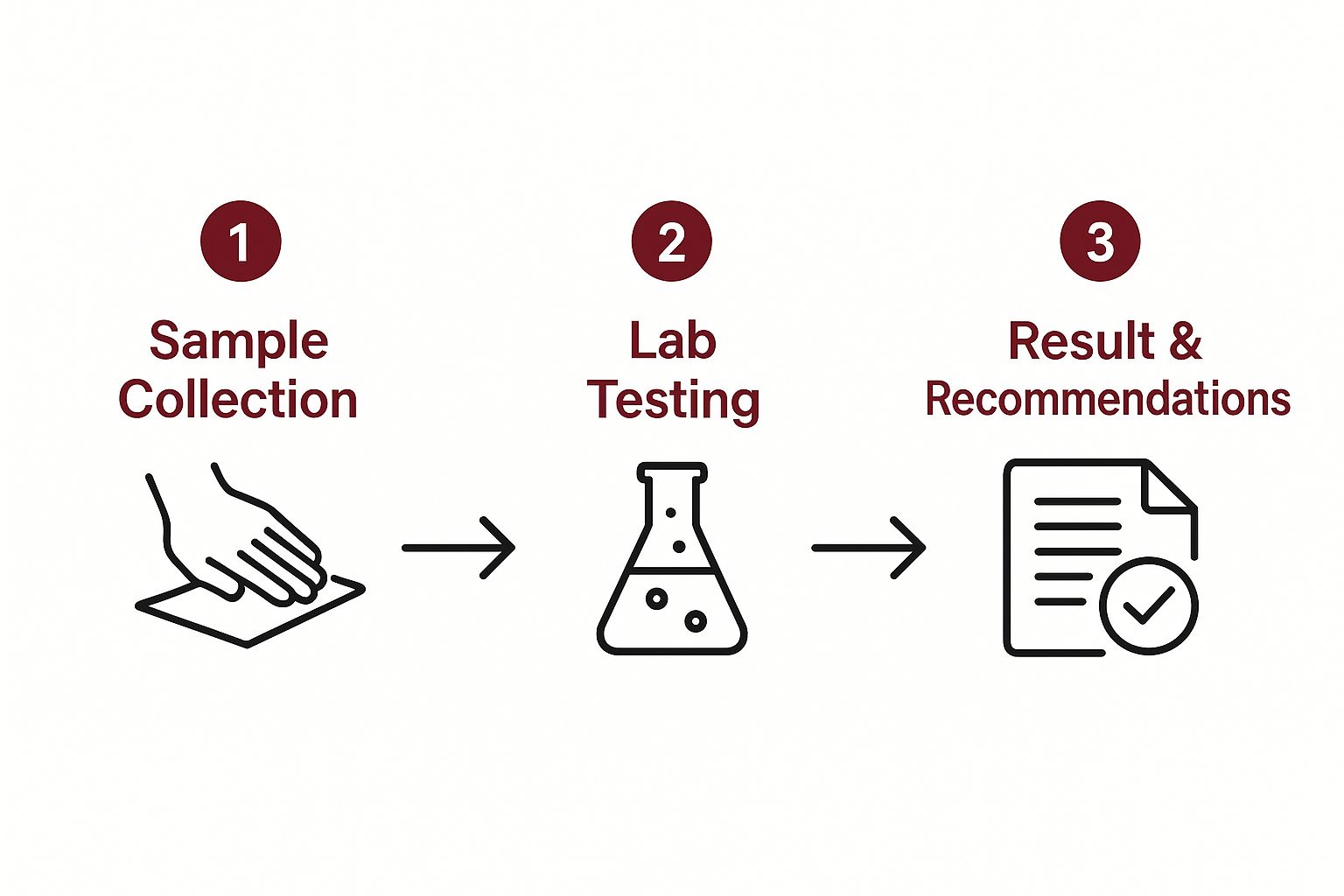
As you can see, the process flows logically from gathering physical samples at the property to conducting a precise scientific analysis, giving you the clarity needed to move forward.
A Homeowner's Guide to the Professional Meth Testing Workflow
To make it even clearer, let's break down the typical journey of a professional meth testing service. This table outlines each stage, showing you what happens and, more importantly, why it's a crucial part of getting a reliable result.
| Stage | What Happens | Why It's Important |
|---|---|---|
| 1. Initial On-Site Assessment | A qualified technician visits the property to perform a visual inspection and map out a sampling plan. | This expert assessment identifies potential 'hotspots' and ensures samples are taken from the most strategic locations for an accurate overall picture. |
| 2. Sample Collection | The technician uses a precise method, typically wipe sampling, to collect residue from surfaces in various rooms. | This non-destructive technique gathers the physical evidence needed for analysis. A strict "chain of custody" protocol ensures sample integrity. |
| 3. Laboratory Analysis | Samples are sent to an accredited laboratory where they are analysed using advanced equipment to quantify methamphetamine levels. | This is the scientific heart of the process. It confirms the presence of contamination and measures the exact concentration, removing all guesswork. |
| 4. Reporting and Recommendations | The lab results are compiled into a detailed report that explains the findings, compares them to safety standards, and provides clear next steps. | The final report translates the scientific data into a simple "pass" or "fail" and gives you the professional guidance needed to address any issues. |
Ultimately, this structured workflow is designed to give homeowners peace of mind. Every step is deliberate, ensuring the final report is not just a piece of paper, but a reliable tool for protecting your health and investment.
The Initial On-Site Assessment
The first real step happens when a qualified technician arrives at the property. Their job is to conduct a thorough visual inspection and create a smart sampling strategy. They’re trained to spot potential hotspots—the areas where contamination is most likely to have accumulated. This isn't just a casual walkthrough; it's a methodical evaluation.
During this visit, the technician will be on the lookout for tell-tale signs of past drug activity, like strange stains on walls and benchtops or disconnected smoke alarms. They’ll then map out the property to make sure samples are taken from a representative spread of locations. Rooms with poor ventilation or high traffic, like kitchens and bathrooms, are often given special attention.
A critical part of this stage is creating the most effective sampling plan. This ensures the test gives you a complete picture of the property’s health, not just a random snapshot of one room.
Sample Collection: The Wipe Sampling Method
The go-to method for collecting samples is known as wipe sampling. It’s the industry standard because it’s precise, doesn't damage the property, and provides the accurate, physical evidence needed for the lab to do its work.
A technician uses a sterile gauze pad, lightly dampened with a special solvent like methanol. They then wipe a very specific area—usually a 10cm x 10cm square—on a surface like a wall, floor, or benchtop. This tightly controlled process is what makes every sample consistent and reliable.
- Systematic Approach: To get a full picture, multiple samples are taken from different rooms throughout the house. This will typically include living areas, bedrooms, the kitchen, and sometimes even inside ventilation ducts.
- Composite vs. Individual Samples: For an initial screening, several wipes might be combined into a single "composite" sample. If that sample comes back positive, the technician will return to take individual samples to pinpoint exactly where the contamination is and how high the levels are.
- Chain of Custody: Every single sample is carefully sealed, labelled, and documented. This strict "chain of custody" procedure is non-negotiable; it guarantees the samples aren’t compromised on their way to the lab and ensures the final results are robust and legally defensible.
This methodical approach to sampling is a core principle in the field of occupational hygiene, which uses scientific rigour to manage health hazards. If you're interested in the expertise behind these practices, you can learn more about what occupational hygiene is and see how it applies to creating safe environments.
Laboratory Analysis and Reporting
Once collected and sealed, the samples head off to an accredited laboratory for analysis. This is where science takes over to determine the presence and exact concentration of any methamphetamine residue. The lab uses incredibly sensitive equipment, like gas chromatography-mass spectrometry (GC-MS), that can detect even microscopic traces of contamination.
The lab’s analysis measures the amount of meth in each sample, reporting it as micrograms per 100 square centimetres (µg/100cm²). This number is the single most important piece of information you’ll get.
Finally, all the findings are pulled together into a formal report. This document will show you where each sample was taken, the precise contamination level found in that spot, and how it stacks up against the Australian Guideline value of 0.5 µg/100cm². A quality report won’t just throw numbers at you; it will explain what they mean in plain English, give a clear "pass" or "fail," and outline the recommended next steps if contamination is confirmed.
Choosing the Right Type of Meth Test
When you're looking into meth testing a property, it's crucial to know that not all tests are created equal. The path you choose—whether it's a simple off-the-shelf kit or a full-blown forensic analysis—can have massive implications for your health, finances, and even your legal position. This isn't a decision to take lightly; it's about figuring out what you truly need to know.
Think of it like this: a cheap DIY screening kit is your home smoke detector. It’s great for giving you an early warning that something might be wrong, but it can't tell you how big the fire is or where it's coming from. On the other hand, a professional lab analysis is like calling in the fire brigade for a complete, detailed investigation. They give you the hard data you need to understand the real risk and figure out a safe way forward.
A DIY kit might tell you meth is present, but it won't have the accuracy to say if the level is actually dangerous by Australian standards. That difference is everything, because a simple "positive" result doesn't give you enough information to plan or budget for a proper cleanup.
DIY Screening Kits: The First Alert
DIY meth testing kits are an easy and affordable starting point if you just want an initial check. They're designed for anyone to use—homeowners, landlords, property managers—and usually involve a quick surface swab that gives you a 'yes' or 'no' answer. They can be a handy tool if you have a nagging suspicion but aren't quite ready to invest in a full forensic workup.
But you have to be aware of their significant limitations.
- No Real Numbers: They can't tell you how much contamination is there. A property could have a tiny trace well below the 0.5 µg/100cm² safety guideline, but the kit could still scream "positive" and cause a whole lot of unnecessary panic.
- No Legal Power: Results from a DIY kit won't hold up in court. You can't use them for property disputes, insurance claims, or to legally require a seller or landlord to take action.
- A False Sense of Security: Testing just one or two spots could easily miss contamination hiding in other rooms. You might get a negative result and assume you're in the clear when the real problem is just a few metres away.
A DIY kit is a decent first step, but it should never be the last. If a screening kit comes back positive, consider it a definite signal to bring in the professionals immediately.
Professional Lab Analysis: The Gold Standard
When you absolutely need results that are definitive, reliable, and legally solid, professional laboratory analysis is the only way to go. This process goes far beyond a simple 'yes' or 'no' to give you precise, quantitative data on the actual contamination levels. A trained technician will collect samples following strict, standardised protocols, which are then sent to an accredited lab for analysis.
This is considered the industry gold standard for a few very important reasons. It delivers the precision required to not only confirm contamination but to map out exactly how bad it is and where it's located throughout the property. That kind of detailed information is vital for creating a remediation plan that is both effective and cost-efficient.
Ultimately, these results are about protecting the health and safety of anyone living in the home. The detailed data helps you make informed decisions about buying, selling, or renting, and it ensures any cleanup actually fixes the problem, which also leads to better methods for improving indoor air quality.
Unfortunately, Australia’s meth testing and decontamination industry is a bit of a regulatory wild west, without the strict government oversight seen in other countries. This means standards can vary dramatically. While some DIY kits might claim to detect levels below the accepted 0.5 µg/100cm² Australian standard, they simply aren’t reliable enough for planning a decontamination. This situation underscores why rigorous, forensic testing is so critical for accurately assessing the problem and protecting property owners from huge costs and serious health risks.
How to Decode Your Meth Test Results
Getting a lab report back from a professional meth testing service can feel a bit like trying to read a foreign language. You’re faced with a document packed with technical jargon, chemical names, and a bunch of numbers that, at first glance, don’t mean much.
But don't get overwhelmed. The whole report really comes down to one critical value. If you know what to look for, you can quickly cut through the noise and understand exactly what's going on with your property.
The Most Important Number on Your Report
In Australia, the national guideline that determines whether a property is safe to live in is 0.5 micrograms per 100 square centimetres (µg/100cm²).
Think of that number as the official safety line in the sand. Any sample result below this level is considered safe for habitation. Anything at or above it signals a potential health risk, and you’ll need to take action.
Your report will list the contamination levels for every sample taken on the property. The lab measures the amount of methamphetamine residue found in a 10cm x 10cm square, and that’s the figure you’re looking for.
It’s actually pretty straightforward: if all the readings on your report are below 0.5 µg/100cm², your property gets a pass. If even one reading hits or exceeds that number, the property has failed, and decontamination is needed to make it safe again.
Understanding Different Levels of Contamination
Now, a "fail" isn't just a simple yes or no answer. The degree of contamination is just as important as the fail itself. The specific numbers tell a story about what was likely happening on the property and will dictate just how urgent and extensive the cleanup needs to be. A result that’s just a little bit over the limit is a completely different beast from one that's sky-high.
Let's walk through a couple of real-world examples to make this crystal clear.
Scenario A: The Minor Fail
- Lab Result: 1.2 µg/100cm²
- What It Means: This result is more than double the acceptable limit, so it's definitely a health concern that needs to be sorted. Contamination at this level usually points to a "smoke house," where meth was used frequently but not actually manufactured.
- Next Steps: You'll need to bring in professional decontaminators. The good news is that the cleanup for this level of contamination is often more straightforward and less expensive than for a major event.
Scenario B: The Major Hazard
- Lab Result: 15.0 µg/100cm²
- What It Means: Okay, this is a much more serious situation. A reading this high – a whopping 30 times the safe limit – strongly suggests heavy, long-term meth use or, more likely, some small-scale cooking. The health risks are significant, and the chemical residue has probably seeped deep into porous surfaces like walls and carpets.
- Next Steps: This calls for an intensive, highly specialised cleanup. The costs will be significantly higher, and the process will be far more disruptive. It could even involve stripping out and replacing carpets, plasterboard, and other materials.
Getting your head around the difference between these scenarios is vital for any property owner. It helps you grasp the true scale of the problem, plan your budget, and set realistic expectations for what it will take to fix it. Your meth testing report is the roadmap you need to navigate these next steps safely and effectively.
Your Action Plan After a Positive Meth Test
Getting a positive meth test result can feel like a punch to the gut. It's overwhelming, for sure, but it's a problem with a clear solution. Think of that report not as a final verdict, but as the starting point for a clear, structured plan to make the property safe again.
The very first thing you need to do is stop anyone else from being exposed. That means securing the property immediately. No one should enter without proper personal protective equipment (PPE). The chemical residues are invisible but pose a very real health risk, so treat the site like a hazardous area until it's been professionally cleared.
Engaging Certified Decontamination Specialists
Let’s be clear: this is not a DIY project. Trying to scrub away meth residue with household cleaners is like trying to put out a grease fire with water—it’s not only completely ineffective, but it can make things much, much worse by spreading the contamination.
You need to bring in a company that specialises in meth decontamination. These pros have the right training, chemicals, and equipment to neutralise and remove the contaminants safely. When you're looking for a company, make sure you ask for proof of their certification and insurance for this specific kind of hazardous work.
This is where getting the right advice is absolutely critical. You're dealing with complex hazardous materials, and your remediation plan needs to be both effective and compliant with Australian safety standards. For expert guidance on managing environmental hazards, consider reaching out to qualified occupational hygiene consultants who can provide specialised support.
Understanding the Decontamination Process
Once you've hired a certified team, they won't just start spraying. They'll create a tailored remediation plan based on the exact contamination levels found in your property. While every site is unique, the process generally follows a few key stages.
- Site Prep and Removal: The crew will first seal off the contaminated zones to stop any nasties from spreading. They'll then begin removing porous items that can’t be saved—think carpets, curtains, soft furnishings, and unsealed timber. These materials absorb the residue and are almost impossible to clean effectively.
- Specialised Cleaning: This is a multi-step chemical wash-down. It often starts with a deep vacuum using HEPA filters to pick up any loose particles. Then, they apply powerful, peroxide-based cleaning agents designed to chemically break down the methamphetamine molecules on every single surface—walls, ceilings, floors, and fixtures.
- Rinsing and Neutralising: After the heavy-duty cleaning, every surface is meticulously rinsed to wash away any remaining chemical residue, both from the meth itself and the cleaning agents used. This is often done multiple times to ensure nothing is left behind.
The Importance of Post-Remediation Testing
The job isn't done when the cleaning crew leaves. The final, non-negotiable step is post-remediation verification testing. This is your proof that the clean-up actually worked.
Crucially, this testing should be done by an independent, third-party company—not the same one that did the cleaning. This avoids any conflict of interest and gives you an unbiased result. They will take new samples from the cleaned areas to confirm residue levels are now safely below the Australian guideline of 0.5 µg/100cm².
This final clearance report is your official all-clear. It’s the document that gives you peace of mind and proves the property is safe and habitable for insurance companies, future tenants, or buyers. It's what allows you to finally close the book on the contamination and move forward.
We Get Asked This a Lot: Your Meth Testing Questions Answered
Even after getting the facts, it's natural to have a few lingering questions about meth testing. Let's tackle some of the most common ones we hear from property owners, clearing up myths and giving you the practical answers you need.
How Long Does Meth Residue Stick Around in a House?
This is the scary part: meth residue doesn’t just go away on its own. It’s incredibly persistent and won't break down or fade over time.
Without a proper, professional clean-up, these toxic chemical traces can cling to walls, carpets, and even seep into the ventilation system for years. They remain a very real health risk long after any drug activity has ceased.
Can’t I Just Give the Place a Good Scrub Myself?
Absolutely not. Trying to clean up meth residue yourself isn't just ineffective, it's downright dangerous. Your standard supermarket cleaning products won't even touch these chemicals.
Worse still, trying to wipe or scrub the surfaces can smear the contamination around, making the problem bigger and kicking harmful particles into the air you’re breathing.
This isn’t a housekeeping job; it's a hazardous materials clean-up. Only trained professionals using specialised, peroxide-based chemicals can properly neutralise and remove the contamination.
They have the right gear, the right training, and the right techniques to handle these toxic substances safely and verify the property is back under the Australian safety guideline of 0.5 µg/100cm².
Is It Really a Big Deal if People Were Only Smoking It, Not Making It?
This is probably the most dangerous myth out there. While a meth lab causes the most extreme contamination, a house where meth was just regularly smoked is still a serious health hazard.
Think of it like cigarette smoke, but far more toxic. The particles from the smoke land and build up on every single surface over time. Even at these "lower" levels, the residue is more than enough to cause significant health issues, particularly for young children. If a property tests above the national guideline, it's considered unsafe – no matter how the contamination got there.
Wouldn’t I Be Able to Smell It if the House Was Contaminated?
Relying on your nose is a terrible idea for detecting meth. You might get a whiff of chemicals like ammonia in a former meth lab, but contamination from personal use is almost always completely odourless.
That’s what makes it so insidious. The danger is invisible and has no smell, so you could be exposed without having a clue. The only way to know for certain if a property is safe is to get it professionally tested. There's really no substitute for a lab result.
At Anitech Ltd Pty, we provide expert occupational hygiene services to ensure your environment is safe. Our scientific approach and nationwide team are here to offer the clarity and support you need. For professional guidance on identifying and managing hazardous materials, visit our occupational hygiene specialists.


