
Methamphetamine residue is a nasty, invisible contaminant that can stick around in a home long after any drug activity has stopped, creating some serious health risks. The only way to know for sure if a property is safe to live in is through proper meth testing for residential properties. It’s what gives buyers, renters, and homeowners genuine peace of mind by identifying the presence and concentration of toxic residues you simply can't see.
Key Facts: Meth Testing for Residential Properties
- Australia’s meth safety threshold is 0.5 µg/100cm² — any result above this level requires professional remediation before re-occupancy.
- Meth residue is invisible and odourless — it cannot be detected by standard building and pest inspections.
- Professional meth testing for a residential property costs $250–$450 and takes 15–30 minutes on site.
- Houses, units and apartments of any age or condition carry contamination risk based on occupant history, not property age.
- Only NATA-accredited laboratory results are legally defensible in Australian property disputes.
- If contamination is discovered before settlement, buyers can negotiate vendor-funded remediation or walk away from the purchase.
The Invisible Risk Hiding in Your Home
Picture this: you've just moved into what you think is your dream home, but it's holding onto a toxic secret from its past. Meth residue isn't something that just airs out or fades away. It stubbornly clings to walls, carpets, furniture, and even gets into the ventilation system.
Think of it as the invisible, odourless version of smoke damage. It seeps into everything, creating a constant health hazard that you can't see, smell, or taste.
This hidden danger is exactly why professional meth testing should be a non-negotiable part of any property check. Without it, families can be unknowingly exposed to contaminants that lead to a whole host of health problems. The financial fallout can be just as bad, with cleanup costs easily soaring into the tens of thousands of dollars—a shocking burden for any new homeowner.
Health Risks for Your Family
It’s the most vulnerable members of the family—children and pets—who are at the greatest risk here. Because they’re smaller and spend a lot of time playing on the floor, they come into much closer contact with contaminated surfaces.
Exposure can trigger a range of worrying symptoms, such as:
- Breathing difficulties and a cough that just won't quit
- Nasty skin irritation and rashes
- Headaches, dizziness, and confusion
- Unexplained behavioural changes and irritability
The trouble is, these symptoms often look like everyday illnesses. This means the real cause can go unnoticed, and the exposure continues day after day.
Manufacturing vs Smoking Contamination
It’s really important to get that the contamination can stem from two very different sources: making it or smoking it. A clandestine meth lab creates widespread, highly concentrated contamination as the toxic chemicals used in the cooking process become airborne and settle on literally every surface. This is the worst-case scenario and always requires a massive, specialised cleanup.
But even just repeatedly smoking the drug inside leaves behind harmful residue that builds up over time to unsafe levels. While it's usually less intense than a full-blown lab, this residue is still a real threat.
Since you can’t tell the difference just by looking, professional meth testing for residential properties is the only way to know for certain if a home is safe. It's also smart to think about other potential toxins in a home. For instance, being mindful of keeping your furniture safe from toxins is another big step toward a healthier living space. In the same way, identifying other old building material hazards, like asbestos, is crucial for total property safety. You can find out more about how asbestos is identified in our other guide.
Understanding Australian Meth Contamination Rules
Trying to get your head around the rules for meth contamination in Australia can feel a bit like wading through legal jargon. But the good news is, the core principle is actually quite simple and it’s there to protect everyone involved in a property transaction. National guidelines give us a clear, science-backed benchmark to figure out if a home is safe or if it’s hiding a health risk from leftover drug residue.
These standards aren't just numbers plucked from thin air; they're grounded in solid health risk assessments. It's a bit like the safety limits for chlorine in a swimming pool or the acceptable levels of contaminants in drinking water. There’s a specific number that separates safe from unsafe, and knowing this number is absolutely crucial for making smart decisions about a property.
This consistent standard is a game-changer in real estate. It gives buyers a vital layer of protection, stopping them from accidentally buying a toxic property. On the other hand, it also shields sellers from potential future liability by providing clear, documented proof that their property met national safety requirements before they sold it.
The Crucial Safety Benchmark
If there's one number you need to remember in Australian meth testing, it's this: 0.5 micrograms per 100 square centimetres (you'll often see it written as 0.5 µg/100cm²). This is the nationally accepted guideline for investigating and cleaning up homes where meth has been smoked, but not manufactured.
When a lab result comes back at or above this level, the property is officially considered contaminated and needs a professional clean-up. A result below this threshold generally means the property is safe to live in.
This benchmark is the clear line in the sand. It takes all the guesswork out of the equation and gives us a uniform standard that applies everywhere, ensuring that "safe" means the same thing whether you're in Perth, Brisbane, or Melbourne.
This national guideline is what makes meth testing for residential properties such a reliable tool for due diligence. It gives property managers, homeowners, and potential buyers a solid, scientific foundation to base their decisions on, making sure health and safety always come first.
Applying the National Guidelines
So, how does this all work in practice? In Australia, the whole process for assessing meth contamination in a home is guided by protocols from the Australian Crime Commission. A trained technician will come in and take at least five separate wipe samples from different surfaces. They're not just swabbing randomly; they focus on high-risk areas like surfaces with visible staining, spots linked to drug activity, and rooms where kids under 16 spend their time. That magic number—0.5 micrograms per 100 square centimetres—is the trigger point for needing remediation. You can find more detail on how these contamination assessments are conducted.
This systematic approach makes sure the testing is thorough and gives a true picture of the entire property’s status.
Why a National Standard Matters
Having one unified national guideline is so important for keeping the real estate market consistent and trustworthy. Imagine the chaos if every state had its own rules. It would create a mess of confusion for anyone buying or selling property across state lines. A single, science-backed number means fairness and clarity for everyone.
This standardisation brings a few key benefits:
- Buyer Protection: It gives prospective buyers real confidence that a property has been checked against a recognised safety level.
- Seller Security: It lets sellers provide a clearance certificate, proving the property is safe and limiting their liability down the track.
- Tenant Safety: It makes sure landlords are meeting their duty of care to provide a safe and healthy home for their tenants.
At the end of the day, these regulations turn the vague threat of contamination into something we can measure and manage. They give people the information they need to protect their health, their families, and their financial investments.
Choosing the Right Meth Testing Method
If you have a feeling a property might be contaminated with meth residue, the big question is: what now? Figuring out how to test for it comes down to two main paths, and each is designed for a very different purpose. It’s a bit like the difference between a home-use first-aid kit and a trip to the emergency room—one is for initial checks, the other is for getting a definitive, professional diagnosis.
Understanding which path to take is crucial. It ensures you get the right information for your specific situation, whether you're a homebuyer wanting to do your due diligence or a property manager getting a rental ready for new tenants. The right choice protects your health, your investment, and your peace of mind.
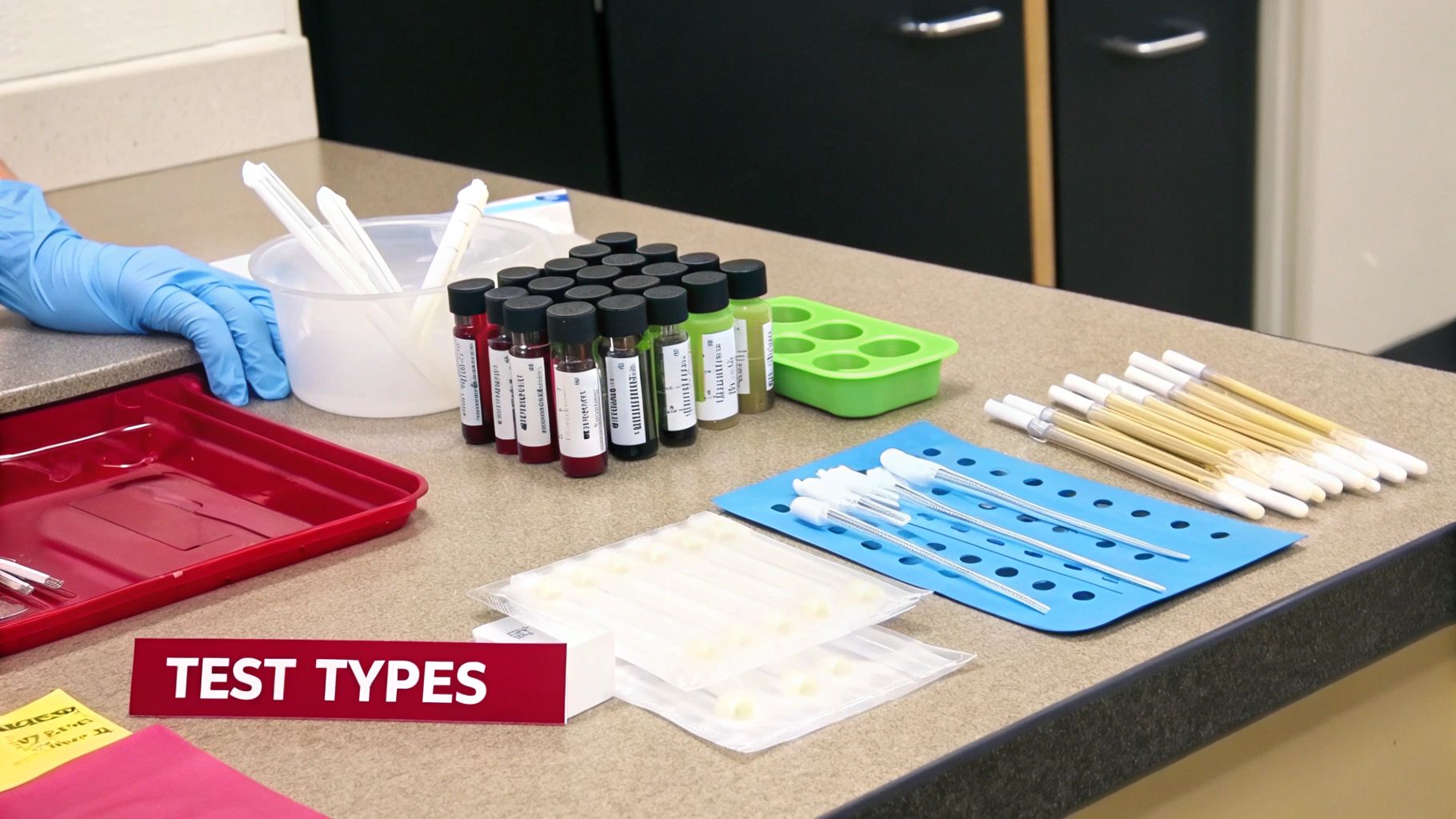
The testing method you select directly impacts the reliability of the results and what you can legally do with them. Let's dig into the two main approaches for meth testing in residential properties so you can make an informed decision.
Professional Surface Wipe Sampling: The Gold Standard
When you need results that are accurate, reliable, and legally sound, professional surface wipe sampling is the only way forward. It’s considered the undisputed gold standard in our industry for a reason—it delivers precise, lab-verified data you can actually act on.
A trained technician operates like a detective at a crime scene. They don’t just take random samples; they use their experience to pinpoint high-risk areas where contaminants love to settle, like kitchen range hoods, air conditioning vents, and porous surfaces like unsealed timber.
Each sample is methodically collected from a standardised 100cm² area, then carefully sealed and couriered to a NATA-accredited laboratory. In the lab, highly sensitive equipment is used to measure the exact concentration of meth, giving you a result in micrograms (µg). This isn't just a 'yes' or 'no'; it's a specific number.
This level of detail is everything. It’s the difference between being told you have a fever and being told your temperature is precisely 39.5°C. Knowing the exact number is what allows you to compare it directly against the Australian national clean-up guideline of 0.5 µg/100cm².
This rigorous process gives you concrete evidence that holds up in real estate negotiations, insurance claims, or legal proceedings. The detailed report you get provides clarity and a clear path forward. If you need that level of certainty, bringing in experienced occupational hygiene consultants should be your first call.
DIY Instant-Result Kits: A Preliminary Screening Tool
At the other end of the scale, you have do-it-yourself (DIY) instant-result kits. These are designed to be a cheap and cheerful first step—a quick way to screen a property if you have a nagging suspicion. Think of them like a home pregnancy test; they give you a simple positive or negative reading.
You swab a surface, apply the sample to a test cassette, and within a few minutes, you get a result. They're convenient, but it's absolutely vital to understand their limitations.
DIY kits are purely qualitative. They can flag the likely presence of meth, but they cannot tell you how much is there. A positive result from a kit can't distinguish between a tiny trace amount of 0.1 µg/100cm² (well below the guideline) and a dangerously high reading of 15 µg/100cm².
On top of that, these kits are highly susceptible to user error. Things like swabbing the wrong spot, not using enough pressure, or accidental cross-contamination can easily throw off the result, leading to false positives or, even worse, false negatives. Because of this, the results from a DIY kit are not legally defensible and can never be used to officially declare a property safe.
Comparing Meth Testing Methods
Choosing between a professional test and a DIY kit really comes down to what you're trying to achieve. Do you just want a quick, informal check to ease your mind, or do you need hard data for a serious decision? This table breaks it down.
| Feature | Professional Lab Testing | DIY Instant-Result Kits |
|---|---|---|
| Result Type | Quantitative (Tells you the exact amount) | Qualitative (Simple yes/no result) |
| Accuracy | High, lab-verified and legally defensible | Lower, prone to user error and false results |
| Guideline Comparison | Directly compares results to the 0.5 µg/100cm² limit | Cannot determine if contamination exceeds the safe limit |
| Best Use Case | Pre-purchase due diligence, post-remediation clearance, legal disputes | Initial low-cost screening, satisfying personal curiosity |
| Cost | Higher initial investment | Lower initial cost |
In the end, while a DIY kit can be a handy first move if you just have a hunch, a positive result from one should always be followed up with professional lab testing to find out what you're really dealing with. For any serious matter like a property transaction or a health concern, starting with the gold standard is the smartest and most direct way to get a conclusive answer.
How to Read Your Meth Test Results
Getting a lab report back can feel a bit daunting. It’s usually packed with scientific terms and figures that don't mean much at first glance. But this document is the key to knowing whether your property is safe, and it's simpler to decode than you might think. Think of it as the translator, turning complex lab data into a straightforward answer about your home's health.
The whole point of the report is to measure the level of methamphetamine residue found on a surface and stack it up against Australia's national safety guideline. This benchmark gives you the context you need to make a smart decision, so you don't end up overreacting to a tiny reading or, worse, underestimating a serious problem.
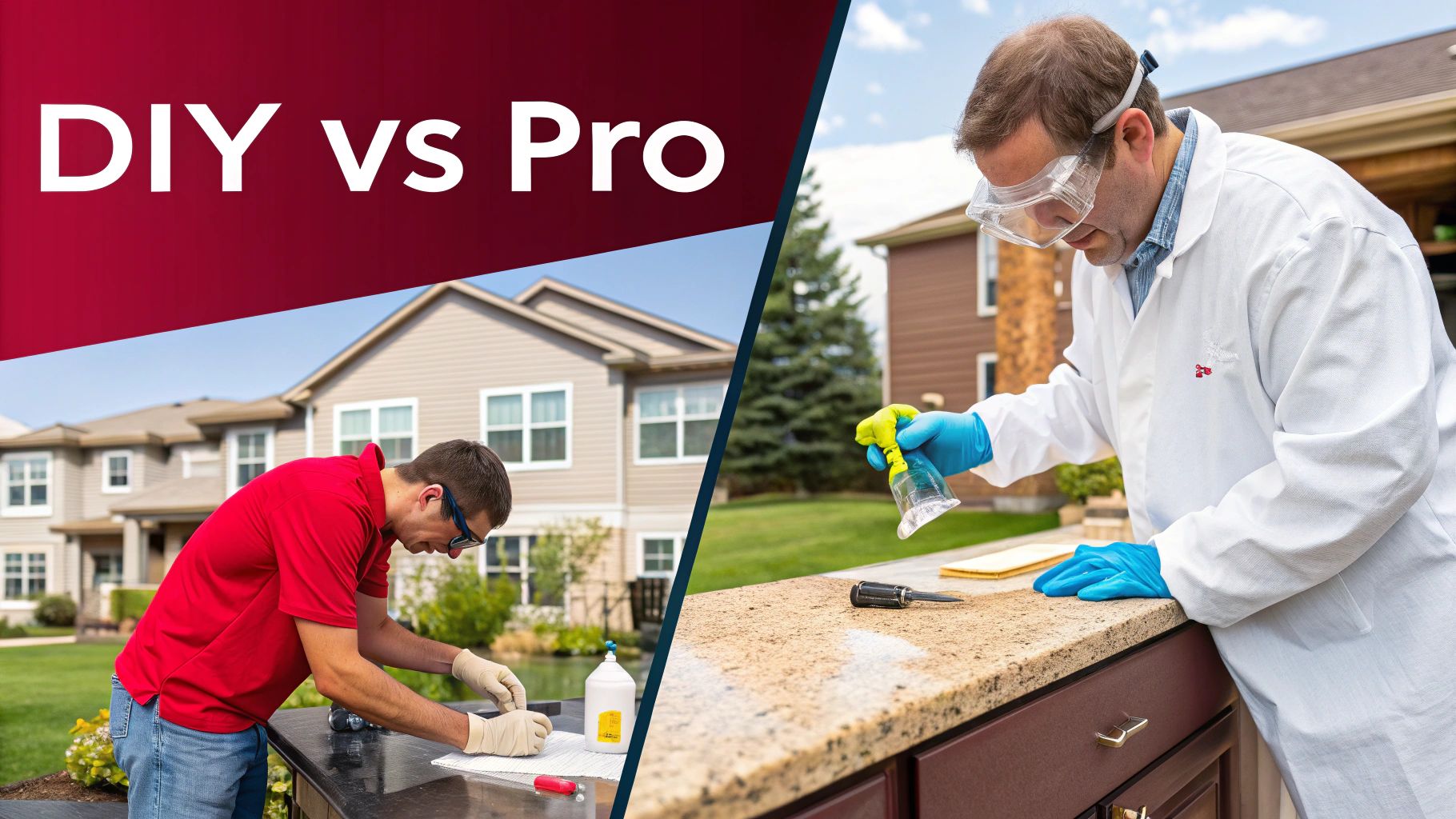
Honestly, understanding your results is the most important part of the entire meth testing for residential properties process. It's the moment that tells you whether you can move forward with peace of mind or if you need to take action to protect your family and your investment.
Understanding the Numbers
The single most important figure on your report is the methamphetamine concentration, which is measured in micrograms per 100 square centimetres (µg/100cm²). This number tells you precisely how much residue was picked up in the sampled area. The Australian national guideline sets the official action level at 0.5 µg/100cm².
A good way to think about this guideline is to compare it to a speed limit. If the limit is 60 km/h, driving at 59 km/h is perfectly fine and safe. But the moment you hit 61 km/h, you've crossed a legal and safety line. It’s the same principle here: a test result of 0.4 µg/100cm² is under the limit and considered acceptable, whereas a result of 0.6 µg/100cm² signals contamination that needs professional cleaning.
Decoding Different Result Types
Your lab report will generally show one of three potential outcomes for each sample. Each one tells a different story about the property and what might have happened there.
-
Non-Detect (ND): This is the best news you can get. It means the lab's highly sensitive equipment couldn't find any trace of methamphetamine residue. A 'non-detect' result gives that part of the property a clean bill of health.
-
Positive but Below the Guideline: A result somewhere between 0.1 µg/100cm² and 0.49 µg/100cm² is considered a low-level positive. While this does confirm that meth residue is present, the amount isn't high enough to trigger a mandatory cleanup. This kind of reading often points to past casual use, not heavy contamination.
-
Positive and Above the Guideline: Any reading that comes in at 0.5 µg/100cm² or higher means the property is officially contaminated. This is a clear signal that professional remediation is needed to make the home safe to live in again.
It's also useful to look at these results with some perspective. For example, back in 2017, New Zealand raised its guideline to a higher benchmark of 1.5 µg/100cm². They realised that low-level contamination doesn't always point to a major health risk or a former meth lab. Many Australian experts agree, raising concerns about homeowners facing unnecessary remediation costs. This highlights how crucial it is to distinguish between residue from manufacturing versus personal use to avoid massive stress and expense. You can dive deeper by reading the research on methamphetamine contamination guidelines.
The Importance of Location and Concentration
Beyond just the raw numbers, where the contamination was found and the pattern of the results can give you vital clues. A good hygienist knows how to read between the lines to figure out the most likely source of the problem.
Understanding the where is just as important as the how much. The distribution of residue can paint a picture of past activity, helping to differentiate between minor exposure and a more serious contamination event.
Think about these two different scenarios:
- Isolated Low-Level Reading: Imagine a single, low positive result (say, 0.3 µg/100cm²) is found in one bedroom and nowhere else. This could suggest someone smoked in that room occasionally in the past.
- Widespread High Readings: Now, picture multiple high positive results (like 5.0 µg/100cm² or more) popping up in several rooms, especially in the kitchen, basement, or near extractor fans. This pattern is a much stronger red flag for a past meth manufacturing operation.
This kind of contextual analysis is what helps you grasp the true severity of the issue. It gives you the power to respond appropriately, saving you from the huge expense of a full-scale decontamination when all that might be needed is a targeted clean for a few spots with low readings. At the end of the day, a detailed report empowers you to make a logical, evidence-based decision, not one based on fear.
A Step-By-Step Guide to Property Remediation
Getting a positive meth test result that’s over the national safety guideline can feel overwhelming. But it’s not a death sentence for your property. Think of it as a clear diagnosis—now you have the information you need to create a structured treatment plan. This section will walk you through the entire remediation process, turning what seems like a massive challenge into a series of manageable steps.
The road from a contaminated property to a safe, healthy home is methodical. It’s a job that demands specialist expertise, a keen eye for detail, and official sign-off to prove the problem is gone for good. With the right team and a solid understanding of the process, you can bring your property back to a safe state and restore its value.
This flowchart breaks down the simple decision-making process that kicks in after a residential property is tested for meth.
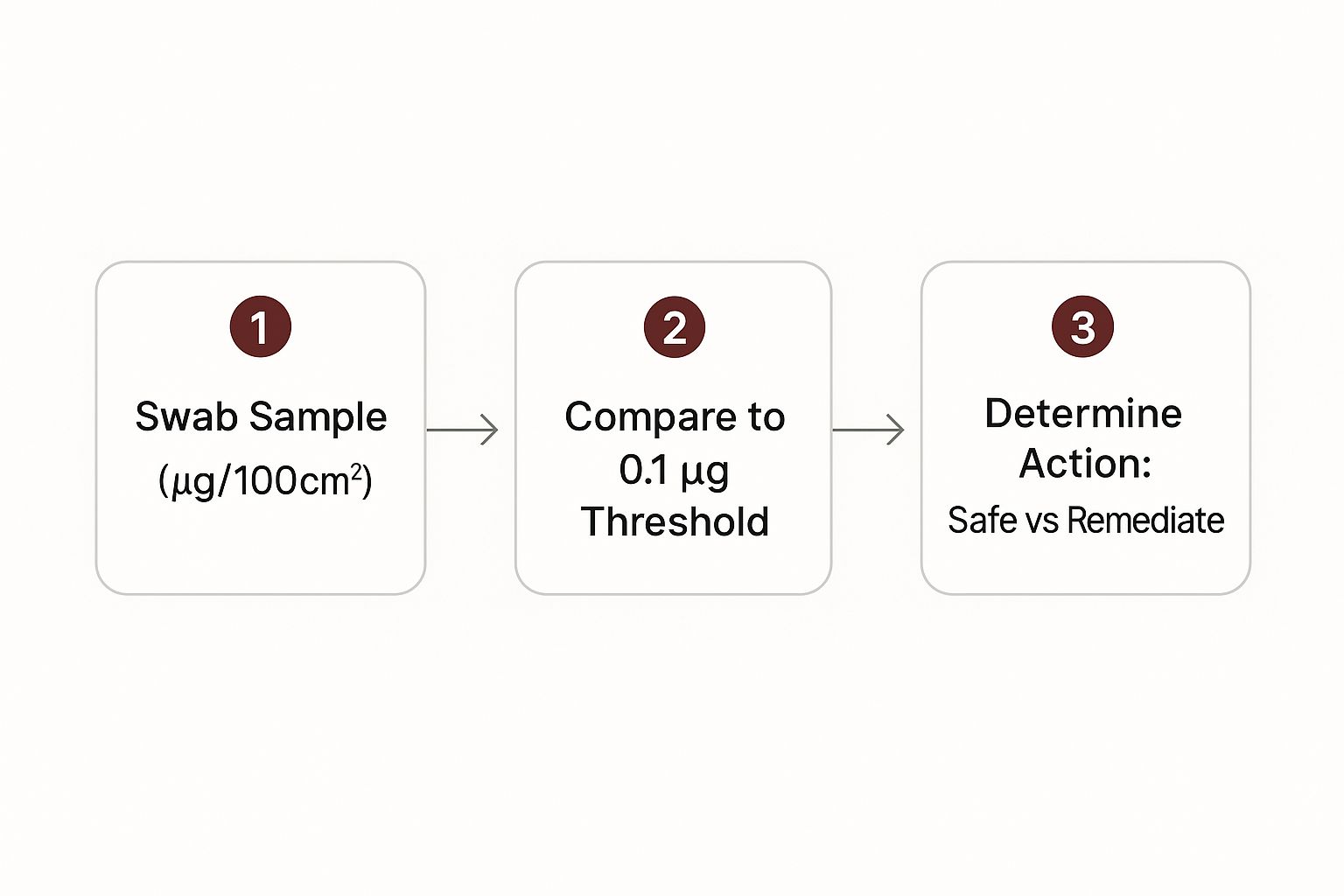
As you can see, the swab sample result is simply compared against the guideline. This one comparison determines whether or not remediation is needed.
Finding a Certified Decontamination Specialist
Your first and most important step is to bring in a certified and experienced decontamination specialist. This isn’t a task for your regular cleaning company, and it's definitely not a DIY weekend project. Meth remediation is a highly specialised field that deals with hazardous materials and requires specific training, gear, and strict safety protocols.
When you're vetting a professional, make sure to ask for:
- Proof of Certification: They should be able to show you credentials for clandestine drug lab cleaning or hazardous material removal.
- A Detailed Remediation Plan: A reputable specialist won’t just give you a quote. They’ll conduct their own assessment and provide a written plan detailing the scope of work, the methods they’ll use, and a clear cost breakdown.
- References and Case Studies: Don't be afraid to ask for examples of past jobs. Speaking to their former clients is a great way to gauge their professionalism and effectiveness.
Choosing the right team is everything. An experienced specialist doesn’t just clean the property; they document the entire process correctly. This paperwork is crucial for legal reasons, insurance claims, and any future sale of the property.
What to Expect During the Cleanup Process
Once you’ve hired your specialist, the real work begins. It's an intensive process that’s tailored to the level of contamination found in the initial tests. While meth cleanup has its unique demands, the underlying principles often align with general strategies for effective deep cleaning.
The remediation process usually unfolds in several key stages:
- Site Security and Ventilation: First, the property is sealed off to stop anyone from entering. High-powered air filtration systems are often set up to create negative air pressure, which is a fancy way of saying it stops any airborne contaminants from escaping the work zone.
- Removal of Porous Materials: Meth residue is incredibly persistent and soaks deep into porous surfaces. Things like carpets, underlay, curtains, unsealed timber, and plasterboard are often impossible to clean properly. They have to be carefully removed and disposed of as hazardous waste.
- Specialised Chemical Washing: Hard, non-porous surfaces like sealed floorboards, metal fixtures, and glass are treated with industrial-grade chemical solutions. These are specifically designed to break down and neutralise meth residue. It’s not a one-and-done scrub; it’s usually a multi-step process with several rounds of washing and rinsing.
The Importance of Post-Remediation Verification
The job isn’t over when the cleaning crew packs up. The final, absolutely non-negotiable step is post-remediation verification testing. This is where an independent hygienist—someone not affiliated with the cleaning company—comes back to take a fresh set of samples from all the treated areas.
This final test is your proof that the remediation worked. The goal is to get a report confirming that all tested surfaces are now well below the 0.5 µg/100cm² national guideline. This clearance certificate is the official document that declares your property is safe to live in again.
Believe it or not, this issue is more common than people think. A 2020 report estimated that around 1.5% of Australian homes, or roughly 140,000 residences, could have some level of meth smoke contamination. This often comes from people smoking the drug inside, which leaves a lower but still worrying amount of residue, highlighting just how important these remediation standards are.
Costs and Timelines
So, what’s this all going to cost and how long will it take? The answer really depends on a few key factors:
- The size of your property.
- How high the contamination levels are.
- How much porous material needs to be ripped out and replaced.
A minor cleanup might only cost a few thousand dollars and be done in a couple of days. But a heavily contaminated property, especially one used as a meth lab, could need to be stripped back to its frame. In those severe cases, costs can climb past $50,000, and the work could take several weeks.
On the bright side, a thorough remediation dramatically improves the entire living environment. That’s why we also suggest looking into other methods for improving indoor air quality to ensure your home is as healthy as it can possibly be once the cleanup is complete.
Common Questions About Meth Testing
If you're dealing with a property that might have a meth problem, you've probably got a lot of questions. It's completely normal. As a property owner, buyer, or landlord, you need clear, straightforward answers to make the right call for safety and compliance. Let's walk through some of the most common queries we hear from people in your exact situation.
How Much Does Professional Meth Testing Cost?
This is usually the first thing people ask, and the honest answer is: it depends. There's no single price tag for professional, lab-verified meth testing in Australia because a few key things can change the cost.
The size of the property is a big one—a sprawling four-bedroom house will naturally take more time and resources to assess than a small apartment. The number of samples we need to take also directly affects the final price, as each one has to be carefully analysed in a lab. A simple screening might only need a few samples from key areas, but a deep-dive investigation will require more, which adds to the cost.
As a ballpark figure, you can expect professional testing to cost anywhere from a few hundred to over a thousand dollars. It might feel like a big expense upfront, but it's a small price to pay for peace of mind and a legally defensible result that proves a home is safe to live in.
Do I Need to Test If I Only Suspect Meth Smoking Occurred?
This is a really important question, and the answer is a firm yes. There’s a common myth that only meth labs are dangerous. The truth is, while a lab creates the highest levels of contamination, residue from repeated meth smoking can easily build up to unsafe levels, pushing past the Australian safety guideline of 0.5 µg/100cm².
When meth is smoked, the vapour doesn't just vanish into thin air. Those toxic particles land on every surface—walls, floors, benchtops—and get absorbed into porous materials like carpets, curtains, and even plasterboard. Over time, especially in poorly ventilated rooms, this buildup can pose a very real risk to anyone living there.
The thing is, you can't see, smell, or taste meth residue. The only way to know for sure if a property is contaminated is to test it. It doesn't matter if it was a lab or just heavy use; testing is the only path to certainty.
Are Landlords Legally Required to Test Their Properties?
There isn't a single, blanket law in Australia that forces every landlord to conduct meth testing. However, every landlord operates under a strict duty of care. This is a fundamental legal principle that says you must provide your tenants with a home that is safe and healthy to live in.
If you knowingly—or even negligently—rent out a property contaminated with meth, you are breaching that duty. Should a tenant get sick from exposure, you could find yourself in serious legal trouble, facing lawsuits and footing the bill for their health costs.
So, while the law might not explicitly say "you must test," it’s absolutely considered best practice, especially if you have any reason to suspect drug activity took place. Testing your property is the clearest way to show you’ve done your due diligence and are meeting your obligations to keep your tenants safe.
Can I Sell a Property That Has Tested Positive for Meth?
Yes, you can still sell a property that has tested positive, but you have to be completely upfront about it. In Australia, sellers are legally and ethically required to disclose any "material facts" to potential buyers, and a positive meth test is definitely one of them.
Trying to hide it is a bad idea. Failing to disclose this kind of information can lead to the sale being voided, not to mention serious legal action from the buyer down the track.
A positive test result doesn't have to be a deal-breaker, though. The best way to handle it is by following two simple steps:
- Professional Remediation: Bring in a certified decontamination company to properly clean the property according to national standards.
- Get a Clearance Certificate: Once the cleanup is done, an independent hygienist needs to come back and do more testing. This is to verify that the contamination is now safely below the 0.5 µg/100cm² limit.
With that clearance certificate in hand, you can show potential buyers solid proof that the problem has been professionally dealt with. This not only ticks the box on your disclosure duties but also restores the property's value and lets you move forward with the sale confidently.
At Anitech Ltd Pty, we provide expert occupational hygiene services to ensure your property is safe and compliant. Our team offers professional assessments and clear guidance through every step of the meth testing process. For expert consultation you can trust, visit our website at https://occhygiene.com.au.


