
When a property has been contaminated by methamphetamine, a standard clean-up is not enough. You need definitive proof that the space is truly safe for re-occupation. That's where meth testing for clearance is essential—it's the final, critical step to verify that decontamination was successful. This guide focuses on the crucial Australian health investigation level of 0.5 µg/100 cm².
Key Facts: Australia’s 0.5 µg/100cm² Meth Testing Standard
- Australia’s meth testing threshold is 0.5 micrograms per 100cm² (µg/100cm²) of surface area.
- This standard is based on health risk modelling for continuous residential exposure, particularly for children and vulnerable people.
- The 0.5 µg/100cm² level aligns with New Zealand’s NZS 8510 standard and international best practice.
- Properties testing above 0.5 µg/100cm² are classified as unsafe to inhabit without professional decontamination.
- Post-remediation clearance testing must confirm levels are below 0.5 µg/100cm² before re-occupancy is permitted.
- Some state guidelines apply stricter thresholds for sensitive environments such as childcare centres and aged care facilities.
The magic number here is 0.5 micrograms (µg) per 100 square centimetres (100 cm²). If meth testing results come in below this Australian health investigation level, you're in the clear. If not, more work is needed. This isn't just a guideline; it's a critical safety and compliance standard for any Australian business, ensuring a property is safe for people to re-enter.
Understanding Methamphetamine Clearance Testing
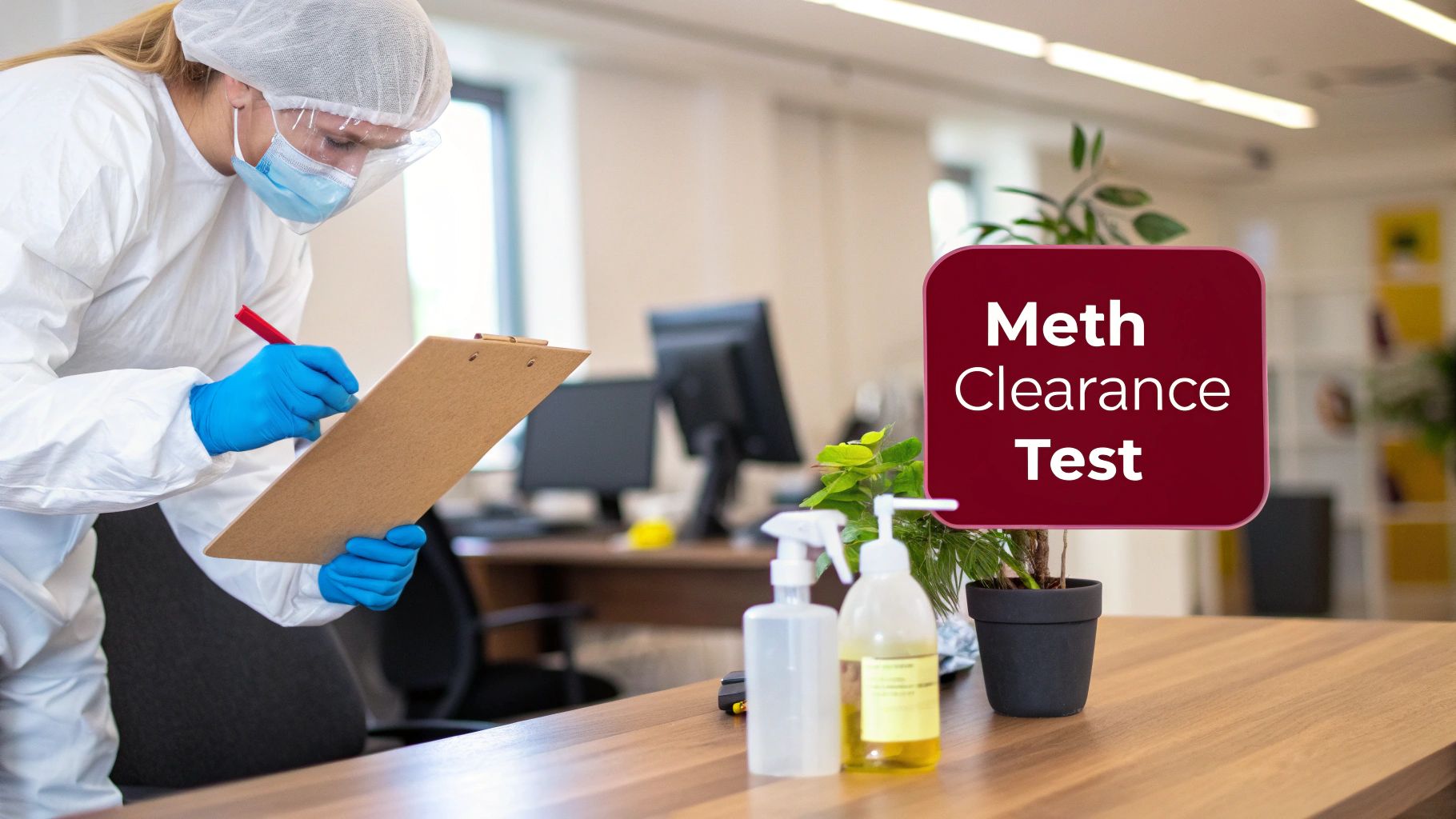
Think of it this way: even after a space looks clean, invisible chemical residues from meth use or manufacturing can linger on walls, floors, and other surfaces. Meth clearance testing is the scientific process used to detect and measure these hidden dangers, providing documented proof that a site meets Australia's strict health and safety standards.
The national benchmark of 0.5 µg/100 cm² acts as a non-negotiable line in the sand. Any reading at or above this level during clearance testing signifies a failure, meaning further professional remediation is required before the area can be considered safe.
To give you a better handle on the terminology, here’s a quick rundown of the core concepts we'll be discussing.
Key Terms In Meth Clearance Testing
This table breaks down the fundamental concepts and standards you'll encounter, putting them into simple, practical terms.
| Term | What It Means In Simple Terms | Why It Matters For Your Business |
|---|---|---|
| Clearance Testing | The final round of testing after decontamination to prove a space is safe. | This is your official proof of compliance and safety, protecting you from liability. |
| 0.5 µg/100 cm² | The maximum acceptable level of meth residue on a surface in Australia. | Staying below this threshold is the ultimate goal of any remediation effort. |
| Decontamination | The specialised cleaning process to remove hazardous meth residues. | This is the "fix" that happens before clearance testing can even begin. |
| Third-hand Exposure | Health risks from touching surfaces contaminated with meth residue. | This is the primary danger to employees in a contaminated workplace. |
| Chain of Custody | The documented trail showing who handled a sample, from collection to analysis. | It ensures your test results are legally defensible and haven't been tampered with. |
Understanding these terms is the first step toward managing the risks associated with meth contamination effectively.
The Growing Need for Workplace Vigilance
The risk of meth exposure isn't some far-off problem; it's a very real and growing issue for Australian workplaces. Shockingly, amphetamine-type substances (including meth) were found in 53.2% of all positive workplace drug tests in the third quarter of 2025.
This trend is especially concerning in industries like mining, manufacturing, and oil and gas. As you can see from the latest workplace drug trends report, the risk is pervasive and highlights why robust safety protocols are no longer optional.
Ignoring this could have devastating consequences for your business. It's not just about the direct health hazards to employees from third-hand exposure; the legal and financial fallout can be immense.
Under Work Health and Safety (WHS) regulations, every employer has a strict duty of care to provide a safe working environment. Failing to address potential meth contamination is a clear breach of this duty, opening the door to severe penalties and legal liability.
Why This Process Is Essential for Your Business
Getting professional clearance testing done isn't just about ticking a box. It's a foundational part of responsible business management. Here’s why it’s so important:
- Protecting Your People: First and foremost, it eliminates the risk of long-term health issues for your staff, which can range from respiratory problems to neurological symptoms caused by exposure to toxic residues.
- Ensuring Legal Compliance: This process gives you the official documentation needed to prove you've met your WHS obligations, shielding your business from hefty fines and legal battles.
- Safeguarding Your Investment: Proper clearance ensures your property is safe for ongoing use. It prevents long-term operational shutdowns and protects the value of your asset.
In this guide, we’ll walk you through every part of the process, from the science behind the 0.5 µg/100 cm² standard to how to choose a qualified team to handle the testing.
Why The 0.5 µg/100 cm² Threshold Matters
When we talk about meth testing and clearance, one number is absolutely crucial: 0.5 µg/100 cm². This isn't just some arbitrary figure plucked from thin air. It’s the official safety limit, backed by Australian health authorities, that tells us whether a property is safe for people to be in.
To get a sense of just how tiny this amount is, think about a single grain of salt. Now, imagine crushing it into a fine powder and spreading it evenly across a 10cm by 10cm square. That’s the microscopic level of contamination this threshold is designed to catch.
This strict limit exists because even invisible residue can create serious health problems over time. We call this third-hand exposure—the risks that linger on surfaces long after any drug activity has stopped.
Health Risks of Lingering Residue
Continuous exposure to meth residue, even at levels you can't see or smell, can cause a range of health issues for your employees. The 0.5 µg/100 cm² threshold is specifically designed to protect people from these risks, which fits into the broader context of indoor air pollution.
Some of the documented health problems from long-term, low-level exposure include:
- Respiratory Issues: Things like a persistent cough, shortness of breath, or symptoms that feel like bronchitis.
- Skin Conditions: Irritation, rashes, and even chemical burns from touching contaminated surfaces.
- Neurological Symptoms: Unexplained headaches, dizziness, confusion, and noticeable behavioural shifts.
- Eye Irritation: Constant redness, a burning sensation, or watery eyes.
It's important to remember that children and anyone with a weaker immune system are far more susceptible, making this safety standard non-negotiable in any workplace.
Setting a Clear Safety Standard
Of course, not all contamination is the same. A property where meth was simply smoked will have much lower residue levels than a clandestine lab where it was cooked. The tricky part is that both situations can easily push a property over the safe limit.
The 0.5 µg/100 cm² standard gives us a clear, legally defensible benchmark. It takes the guesswork out of the equation, ensuring that every cleanup job is measured against a consistent national health guideline. This makes it an essential tool for ensuring workplace safety and compliance.
Meeting this standard isn't just about ticking a box. It’s about fulfilling your duty of care under Work Health and Safety (WHS) regulations. Ignoring it means exposing your team to preventable harm and your business to serious legal risks. You can learn more about these obligations and the reasons to test properties for methamphetamine contamination.
Ultimately, this threshold delivers peace of mind, confirming a space is verifiably safe for everyone.
A Step-By-Step Guide To The Clearance Testing Process
So, what does meth clearance testing actually involve on the ground? It's not just a quick swab and a thumbs-up. The entire process is a carefully structured path designed to give you accurate, legally defensible results and, most importantly, peace of mind that a space is truly safe.
Let's walk through it. Each step is methodical, taking you from the initial walkthrough right through to the final certificate that confirms a site meets the crucial 0.5 µg/100 cm² standard.
This visual guide breaks down the core workflow, showing how we get from a potentially contaminated site to one that’s verified as safe for re-entry.

As you can see, it all comes down to comparing the contamination level against that established safety benchmark.
Initial Site Assessment And Sampling Plan
It all kicks off with a qualified occupational hygienist visiting the site for a thorough assessment. This isn't about taking random swabs and hoping for the best; it's a strategic evaluation. The hygienist will identify high-risk areas where meth residue is most likely to settle—think walls, benchtops, carpets, and even inside ventilation systems.
Based on this hands-on inspection, the hygienist develops a detailed sampling plan. This is essentially a map that dictates exactly where samples need to be taken to get a complete and accurate picture of the contamination across the entire area. Getting this step right is fundamental to the integrity of the whole process.
Precise Sample Collection
With the plan in hand, trained technicians get to work collecting the samples. This is a very precise job. Using specialised solvent wipes, they meticulously swab a 100 cm² surface area at each location marked on the plan.
This methodology is standardised for a reason—it ensures every sample is consistent and the results are reliable. For a deeper dive into the science behind this, you can read our detailed explanation of how meth testing works. This precision is what makes the findings stand up in any legal or regulatory context.
Chain Of Custody And Laboratory Analysis
Once a sample is collected, it’s immediately sealed, labelled, and documented under a strict chain of custody protocol. Think of this as the sample's passport. It creates an unbroken, legally binding record of everyone who has handled the sample, from the moment it's collected to its arrival at the lab. This critical step completely eliminates any possibility of tampering and guarantees the integrity of your results.
The sealed samples are then sent to a NATA-accredited laboratory. Here, they're analysed using incredibly sensitive methods like Gas Chromatography-Mass Spectrometry (GC-MS). This technology is powerful enough to detect even the tiniest traces of methamphetamine, giving a definitive measurement that can be compared against the 0.5 µg/100 cm² clearance level.
Reporting And Final Certification
The final step is the report from the laboratory, which details the findings for every single sample. It will clearly state whether the residue levels are safely below the acceptable threshold.
If all samples come back clear, a formal clearance certificate is issued. This document is your official proof that the property has been properly decontaminated and is safe for people to re-enter, ensuring you’ve met your obligations under Work Health and Safety (WHS) laws.
This rigorous process is absolutely essential. Testing against the 0.5 µg/100 cm² standard ensures that the invisible risks from third-hand exposure are managed and mitigated. This is becoming increasingly important across Australia, not just in hotspots like Adelaide, which is why Anitech provides these services nationwide—from remote mine sites to urban pharmaceutical labs. As peer-reviewed toxicology shows, meeting this threshold significantly reduces your liability. Ignoring it and allowing levels above 1.5 µg/100 cm² can lead to serious consequences, including fines of up to $100,000.
How To Interpret Your Meth Testing Results
Once our team has taken the samples and the lab has done its work, you'll get a detailed report. The good news is, you don’t need a science degree to understand it. The report is designed to give you a straight answer to one crucial question: is the area safe to use?
Ultimately, it all boils down to how the lab results stack up against the national health investigation level. Every sample is measured against that all-important safety line: 0.5 µg/100 cm². Your results will land on one side of that line, telling us exactly what needs to happen next.
Understanding A 'Pass' Result
This is the result everyone wants to see. A 'Pass' means the lab found that any methamphetamine residue is well below the 0.5 µg/100 cm² threshold. It’s the scientific all-clear, confirming the space is free from hazardous contamination and safe for your team to get back to work.
When you get a passing report, the process is wrapped up with two simple steps:
- You'll get a Clearance Certificate: We'll issue an official certificate that formally documents the site's safety. This is your proof that you've met your Work Health and Safety (WHS) obligations.
- You can re-open the area: With that certificate, you can confidently allow people back in. It’s not just a piece of paper; it’s your assurance that you’ve done the right thing, protecting both your people and your business.
Getting this certificate is the final step, giving you documented proof and complete peace of mind that the job is done.
Navigating A 'Fail' Result
A 'Fail' means the lab detected meth residue at or above the 0.5 µg/100 cm² limit in at least one of the areas we sampled. This isn't a judgement, just a clear signal that a hazardous level of contamination is present and the area isn’t safe to occupy yet. It might feel like a setback, but it’s really just a signpost pointing toward the next logical step: professional remediation.
A failed test isn't the end of the story. Think of it as a clear set of instructions. The report will show you precisely which areas need attention, so the cleanup can be targeted and efficient.
If your site doesn't pass, the path forward is clear and non-negotiable:
- Bring in Professional Decontamination Specialists: This is far beyond a typical cleaning job. You need to hire a team that specialises in meth remediation and understands the national guidelines inside and out.
- The Remediation Work Begins: The specialist team will get to work, using specific chemical solutions and proven techniques to break down and remove the hazardous residue from all affected surfaces.
- We Come Back for Verification Testing: After the cleaners have finished, a second round of clearance testing is mandatory. There's no other way to prove the decontamination was successful and the site is now genuinely below the 0.5 µg/100 cm² standard.
A clearance certificate can only be issued once the site has passed this final verification test. This two-stage process—remediation, then re-testing—is fundamental to guaranteeing the area is truly safe and compliant.
How To Choose A Qualified Testing Provider
When it comes to methamphetamine testing, not all providers are created equal. Making the right choice is about more than just getting a report—it’s about protecting your people, ensuring legal compliance, and having complete confidence in your results. Think of it as choosing a specialist for a critical job, because that's exactly what it is.

An informed decision here shields your team and your business from the fallout of shoddy testing. A truly professional partner will handle every single step with meticulous care, from the moment they take the first sample to delivering a legally defensible final report.
Look For NATA Accreditation
Let’s get straight to the point: the first thing you should look for is NATA (National Association of Testing Authorities) accreditation. This is the absolute gold standard for laboratory analysis in Australia. It’s not just a nice-to-have; it's a fundamental requirement.
NATA accreditation is your guarantee that the laboratory processing your samples adheres to the highest possible scientific and technical standards. Without it, your results could be challenged in court, leaving your business dangerously exposed. So, always insist that any potential provider uses a NATA-accredited lab for their meth testing – clearance testing, 0.5 µg/100 cm² analysis. It's a non-negotiable.
Prioritise Real-World Experience
Accreditation is the foundation, but experience is what builds a solid structure on top of it. Look for a team that has walked the walk, preferably in environments similar to yours. A provider who understands the logistical challenges of a remote mining camp or the stringent protocols of a commercial property will be far more effective than a generalist.
This kind of hands-on experience translates into smarter sampling strategies and reports that make sense in the context of your operations. An experienced team also brings a level of professionalism that makes the whole process smoother. For a deeper dive into what makes an expert effective, it's worth understanding the role of professional occupational hygiene consultants and the value they bring to workplace safety.
To help you cut through the noise, we've put together a simple checklist. Use it to vet potential providers and ensure you're partnering with a genuine expert.
Checklist For Selecting Your Meth Testing Partner
| Criteria To Check | Why It's Non-Negotiable | What To Ask For |
|---|---|---|
| NATA-Accredited Laboratory | This is your guarantee of scientific validity and legal defensibility. It’s the highest standard in Australia. | "Can you provide a copy of the NATA accreditation for the laboratory you use for analysis?" |
| Industry-Specific Experience | A team that knows your world can anticipate challenges and provide more relevant, practical advice. | "What experience do you have working in our industry (e.g., mining, commercial property, transport)?" |
| Clear Chain-of-Custody | An unbroken, documented trail for your samples is essential to prove the integrity of the results. | "Can you walk me through your chain-of-custody protocol from sample collection to the final report?" |
| Comprehensive Reporting | You need more than just a number. The report must be clear, detailed, and offer actionable next steps. | "Could you share a de-identified sample report so we can see the level of detail you provide?" |
| Qualified Technicians | The person taking the samples needs to be properly trained to avoid cross-contamination and ensure accuracy. | "What qualifications or training do your field technicians hold for meth testing?" |
Choosing the right partner really comes down to these key pillars: verifiable qualifications, relevant experience, and a proven track record of delivering reliable, compliant results. Taking the time to ask these questions upfront will save you from major headaches down the road.
Common Questions We Get About Meth Clearance Testing
Even with a good grasp of the process, it's the practical, real-world questions that often pop up when you're dealing with methamphetamine clearance testing. Workplace safety can be a tricky field to navigate, so getting clear, straight answers is crucial for making the right call. We've compiled some of the most common queries we hear from businesses trying to get their sites compliant.
Think of this as the practical side of things—from the tools you can (and can't) use to how long you should expect the process to take. The goal is to give you the on-the-ground knowledge you need to protect your workplace.
Can I Just Use A DIY Meth Test Kit For The All-Clear?
We get asked this a lot, and the short answer is a firm no. While those DIY or instant-result kits you see online might seem like a quick fix, they are completely unsuitable for official clearance testing.
They’re just not built for the job. Here's why they fall short for WHS compliance:
- They aren't sensitive enough: A DIY kit can't accurately measure contamination down to the legally required 0.5 µg/100 cm² standard. Most just give you a simple "yes" or "no" result, which isn't nearly enough detail for a proper assessment.
- They won't stand up in court: To get an official clearance certificate, you need a report from a NATA-accredited laboratory. The results from a DIY kit carry zero legal weight and won't be recognised by regulators or insurance companies.
If you need a result that offers real legal protection and genuine peace of mind, professional sampling followed by accredited lab analysis is the only way to go for meth testing – clearance testing, 0.5 µg/100 cm².
How Long Does The Whole Clearance Process Take?
The timeline can shift a bit depending on the specifics of the site, but there's a general schedule you can expect. The on-site sample collection itself is usually quite quick, taking anywhere from a few hours to a full day for larger, more complex areas.
After the samples are collected, they head to the lab. The analysis typically takes about three to five business days to get you precise, verified results you can count on.
If the test results come back with a 'Pass,' a clearance certificate can be issued almost immediately. However, a 'Fail' result will extend the timeline. The process will then need to include professional remediation, followed by a second round of verification testing before final clearance can be granted.
What Happens If Contamination Is Only Found In One Small Area?
Finding contamination doesn't automatically mean you have to shut down the entire facility. If testing shows the meth residue is contained within a specific, isolated spot, the clean-up efforts can often be focused squarely on that zone.
Taking this targeted approach has some big advantages for a business:
- It saves money: Containing the cleanup to one room or section is far more affordable than decontaminating an entire building.
- It keeps you running: Unaffected parts of your workplace can often stay operational, as long as the right controls are in place to stop any cross-contamination.
This is where an experienced occupational hygienist is invaluable. They can help you map out the exact boundaries of the affected area and develop a smart remediation plan that gets rid of the risk without causing unnecessary disruption to your business. It's about finding a path forward that's safe, compliant, and practical.
At Anitech, we provide the expertise and NATA-accredited testing you need to handle every step of the meth clearance process. Our qualified occupational hygienists deliver legally defensible results and practical solutions to make sure your workplace is safe, compliant, and ready for business. Protect your people and your operations by partnering with Australia’s trusted experts in occupational hygiene. Find out how we can help.
Need Professional Meth Testing?
Anitech Group provides NATA-accredited meth testing and decontamination services across Australia. Our qualified occupational hygienists deliver legally defensible results with fast turnaround.
Get a Free Quote

