
Trying to get your head around meth regulations in Australia can feel like you're untangling a knotted fishing line. There's no single, nationwide rulebook for meth testing and cleanup. Instead, what we have is a patchwork of state-specific laws, where each state and territory calls its own shots on legal thresholds, testing methods, and what you need to disclose. Understanding state-specific meth testing legislation and the associated mandatory disclosures is crucial for property owners to navigate their legal obligations.
This fragmented system can create some serious compliance headaches, no matter what industry you're in. This guide will serve as a regional mapping of legal obligations to ensure you remain compliant.
Why A National Approach To Meth Regulations Falls Short
Let's be blunt: staring at the tangled web of state and territory laws for methamphetamine contamination can be overwhelming. While the federal government lists meth as a controlled substance, all the practical stuff—testing, remediation, and disclosure—is handled by individual jurisdictions. This creates a really confusing landscape for property owners, businesses, and anyone managing facilities across state lines.
Think of it like this: the national framework says "drive on the left," but each state then sets its own speed limits, parking rules, and demerit points. The rules that actually matter for your property are the ones set at the state level.
The Impact Of A Fragmented System
This decentralised approach means your legal obligations can change the second you cross a border. An acceptable contamination level for a commercial property in Victoria could be completely different from the standard required at a remote mining camp in Western Australia.
This lack of uniformity causes real problems:
- Legal Liability: It’s easy to unknowingly break local laws when there’s no clear national standard, opening you up to fines and legal action.
- Health and Safety Risks: A property deemed "safe" in one state might not pass muster in another. This inconsistency puts people's health at risk.
- Operational Complexity: If your business operates nationally—think property management or mining—juggling different compliance rules becomes a massive administrative burden.
The real challenge is the lack of a single, unified voice in legislation. It forces industries to become experts in multiple sets of rules, which only increases the risk of getting it wrong and makes proactive risk management much harder.
Understanding The 'Why' Behind State Differences
So why the variation? It often boils down to how each state government reacts to local drug use trends and public health data. Nationally, methamphetamine is a Schedule 8 controlled drug under the Poisons Standard. But from there, states take the lead.
New South Wales, for example, has its own detailed surveillance framework to track the drug's impact. Data from NSW shows a concerning jump in high-frequency use, with the number of users reporting daily or near-daily consumption climbing from 9.3% in 2010 to 16.9% in 2019. This kind of local data directly influences policy and regulation at the state level.
This guide is designed to be your roadmap through this complex system, helping you understand the state-specific legislation, protect people's health, and meet your legal duties. If you're curious about how Australia stacks up globally, you might also want to check out our global compendium of meth contamination standards.
Understanding The National Meth Contamination Framework
Before we get tangled in the web of state-specific meth testing laws, it’s vital to start with the national foundation. While Australia doesn’t have a single, binding federal law for meth contamination, there's a key document that guides almost everything: the National Clandestine Drug Laboratory Remediation Guidelines.
Think of these national guidelines as the architect's master blueprint for a house. They lay out the core structure, the best-practice principles, and the essential safety features needed to make a property safe after contamination. Each state then acts as the builder, choosing the specific materials and finishes to meet local codes, but they all start from that same blueprint.
This national framework introduces the key ideas you’ll see again and again in state laws. Getting a handle on this baseline makes understanding the regional differences a whole lot easier.
Core Concepts In The National Meth Guidelines
The national guidelines are built on a few central pillars designed to protect public health. These are the building blocks state regulators use to create their own specific meth regulations.
Before we dive into the state-by-state details, getting familiar with the language of meth regulation is crucial. The table below breaks down the essential terms you'll encounter.
Key Methamphetamine Regulatory Concepts at a Glance
| Concept | Description | Why It Matters for Your Business |
|---|---|---|
| Contamination Thresholds | The maximum acceptable level of meth residue on a surface after cleanup. It's measured in micrograms per 100 square centimetres (µg/100cm²). | This number is the pass/fail line. Exceeding it triggers mandatory cleanup and reporting, directly impacting your costs and operational timelines. |
| Remediation Standards | The required processes for cleaning a contaminated site, from initial assessment and waste disposal to final clearance testing. | These are the exact steps you must follow. Non-compliance can lead to fines, failed clearances, and even legal liability for health issues. |
| Mandatory Disclosure | The legal obligation for property owners to inform potential buyers, tenants, or workers about known meth contamination history. | Failing to disclose can void contracts, lead to lawsuits, and result in significant financial penalties. It's a cornerstone of transparency. |
By getting these terms straight, you'll be far better equipped to navigate the specifics of your state's legislation. While the thresholds or disclosure rules might change from one state to another, the underlying concepts remain the same.
The Role Of Contamination Thresholds
Of all the numbers involved, the contamination threshold is the most important one. It's the line in the sand.
The national guidelines suggest a health investigation level of 0.5 µg/100cm² for high-contact surfaces in residential settings. This figure wasn't picked out of a hat; it’s based on health risk assessments and is set conservatively to protect the most vulnerable people, like children.
It's absolutely crucial to remember that this 0.5 µg/100cm² figure is a recommendation, not a federal law.
Many states have adopted it as their legal standard, but this is where the state "builder" really makes their mark. Some have modified it, while others apply different levels for different situations, like a lower-traffic commercial or industrial site versus a family home.
This variation is exactly why a national overview is just your first step. As we break down the rules state by state, you’ll see how this single number is interpreted and enforced differently, proving just how critical it is to know your local meth regulations inside and out.
A State-By-State Breakdown Of Meth Testing Laws
Think of Australia's meth regulations like a national road map where the main highways are clear, but once you cross a state border, the local street rules change completely. One set of laws in Perth is entirely different from what you'll find in Brisbane.
For any business or property manager, getting your head around these state-specific details is non-negotiable. The contamination levels that trigger action, the way you have to test, and what you’re legally required to disclose can all shift dramatically. This isn’t just about ticking boxes; it's about managing real-world risk and avoiding some very serious legal and financial headaches.
Let’s dive into what this looks like on the ground in a few key states.
Western Australia: A Unique Regulatory Environment
Western Australia is a different beast altogether. You won't find a single, dedicated law for meth testing in properties here. Instead, the obligation comes directly from the state's Work Health and Safety (WHS) laws, which creates a powerful, if indirect, responsibility for employers.
This is especially critical for WA’s massive mining, oil, and gas industries. Under WHS, every employer has a non-negotiable duty of care to provide a safe workplace. If there’s meth residue in a donga, a company vehicle, or an on-site office, it’s classified as a workplace hazard that must be managed.
The situation is made more urgent by WA's unfortunate reputation as a hotspot for meth use. Wastewater analysis from the Australian Criminal Intelligence Commission consistently flags regional WA for having some of the highest detection rates in the nation. On top of that, recent workplace hair testing by Brassets Group found that a staggering 45.4% of tests came back positive for drugs, including meth—a 3.3% jump from 2023.
South Australia and Its Public Health Focus
South Australia tackles the problem from a public health angle. The regulations here are steered by SA Health, which gives very clear guidance on how to handle properties contaminated by meth.
Here’s what you need to know about the SA framework:
- A Clear Threshold: The state sticks to the national guideline, setting the contamination limit at 0.5 µg/100cm² for residential properties.
- Mandatory Reporting: Health authorities take a hands-on role. If contamination is found to be a risk to public health, reporting it is often mandatory.
- Focus on Tenancy: There are specific rules for rental properties, putting the onus squarely on the landlord to provide a safe and liveable home.
What does this mean in practice? For a commercial landlord in Adelaide, compliance is less about general workplace safety and more about following direct public health orders, especially if the building has any residential component.
The real difference comes down to enforcement. In WA, it’s all about WHS obligations. In SA, the driving force is public health and housing standards.
New South Wales and Victoria: The Eastern States' Approach
Over in New South Wales and Victoria, the rules around meth contamination are woven into broader property and tenancy laws. The big thing to watch out for in these states is mandatory disclosure.
If you're selling or leasing a property in Sydney or Melbourne and you know it was a former meth lab or has significant contamination, you are legally obligated to tell potential buyers or tenants. Trying to hide it can get you into deep trouble, potentially voiding a sales contract or lease and opening you up to being sued for damages. For anyone managing rentals, understanding this is essential. Our detailed guide on meth testing in rental properties breaks down exactly what landlords need to do.
Both states generally use the 0.5 µg/100cm² guideline, but they can be particular about who is qualified to perform testing and remediation. It's crucial to hire professionals certified by the relevant state bodies to make sure your reports will hold up in a legal dispute.
Queensland: A Focus on Remediation Standards
Queensland’s system is built around the clean-up process itself. The state has incredibly detailed guidelines on what a compliant remediation looks like, with a heavy emphasis on the qualifications of the specialists and the methods they use.
A landlord in Brisbane who finds meth residue can't just call in a regular cleaning crew. They need to hire a specialist contractor who will follow a strict, documented protocol:
- Initial Site Assessment: A complete evaluation to map out the extent and severity of the contamination.
- Remediation Action Plan (RAP): A formal plan detailing the entire clean-up strategy, from safety protocols to waste disposal.
- Post-Remediation Verification: After the clean-up, an independent third party must test the property again to prove that contamination is back below the legal limit.
This process-driven approach ensures the property is genuinely safe, not just superficially clean.
To make these differences clearer, the table below offers a side-by-side look at how the rules stack up.
Comparative Analysis of State Meth Testing Thresholds and Disclosure Rules
This table provides a direct comparison of key regulatory requirements across different Australian states to highlight the critical variations businesses must navigate.
| State | Contamination Threshold (µg/100cm²) | Mandatory Disclosure Rule | Primary Governing Body |
|---|---|---|---|
| Western Australia | No legislated standard; WHS principles apply. | Varies; tied to WHS duty of care and common law. | WorkSafe WA |
| South Australia | Generally follows 0.5 µg/100cm². | Yes, under public health and tenancy laws. | SA Health |
| New South Wales | Generally follows 0.5 µg/100cm². | Yes, strong emphasis in property and tenancy laws. | NSW Fair Trading, NSW Health |
| Queensland | Generally follows 0.5 µg/100cm². | Yes, with a focus on remediation compliance. | Queensland Health |
| Victoria | Generally follows 0.5 µg/100cm². | Yes, required in property sale and lease agreements. | Consumer Affairs Victoria |
As you can see, this patchwork of state-based laws means a "one-size-fits-all" approach to meth testing and compliance is guaranteed to fail. For any business operating nationally, getting a handle on these regional differences isn’t just smart—it’s a legal necessity.
The Remediation Playbook: From Positive Test to Clearance
Getting a positive meth test result isn't the end of the road for a property. Think of it as the starting pistol for a very structured, legally-guided process. Navigating this journey successfully means having a clear playbook that takes you from the initial hazard assessment right through to the final clearance, all while following your state's specific laws to the letter.
The very first thing you need to do is secure the site. This is non-negotiable. Restricting access is crucial to prevent anyone else from being exposed, because even low levels of residue can pose serious health risks. Once the area is locked down, a qualified occupational hygienist needs to come in and conduct a thorough hazard assessment. Their job is to map out the full extent of the contamination—which areas are affected and just how badly.
Decontamination and The Science of the Cleanup
With the contamination mapped out, the actual cleanup can begin. And let me be clear: this is not a job for your average cleaning company. It takes professional remediation specialists who use very specific techniques and chemical solutions designed to break down and remove methamphetamine residue from every nook and cranny.
The process is pretty intensive and usually involves several key stages:
- Initial Deep Cleaning: This means getting rid of all porous materials like carpets, curtains, and unsealed wood that simply can't be saved. They have to be removed and disposed of safely.
- Chemical Treatment: Specialised cleaning agents are applied to neutralise the meth residue. This is often a multi-step process involving several rinses.
- Structural Cleaning: Every non-porous surface, along with the HVAC system and plumbing, needs to be meticulously cleaned to make sure no contaminants are left behind.
Following these steps with precision is absolutely critical. We go into much greater detail on the technical side of things in our guide on methamphetamine decontamination guidelines.
Navigating State-Specific Regulations
The urgency and strictness of this whole process are heavily influenced by what's happening on the ground in each state. This infographic gives a snapshot of how different states handle investigation and legal enforcement, often based on their own unique circumstances.
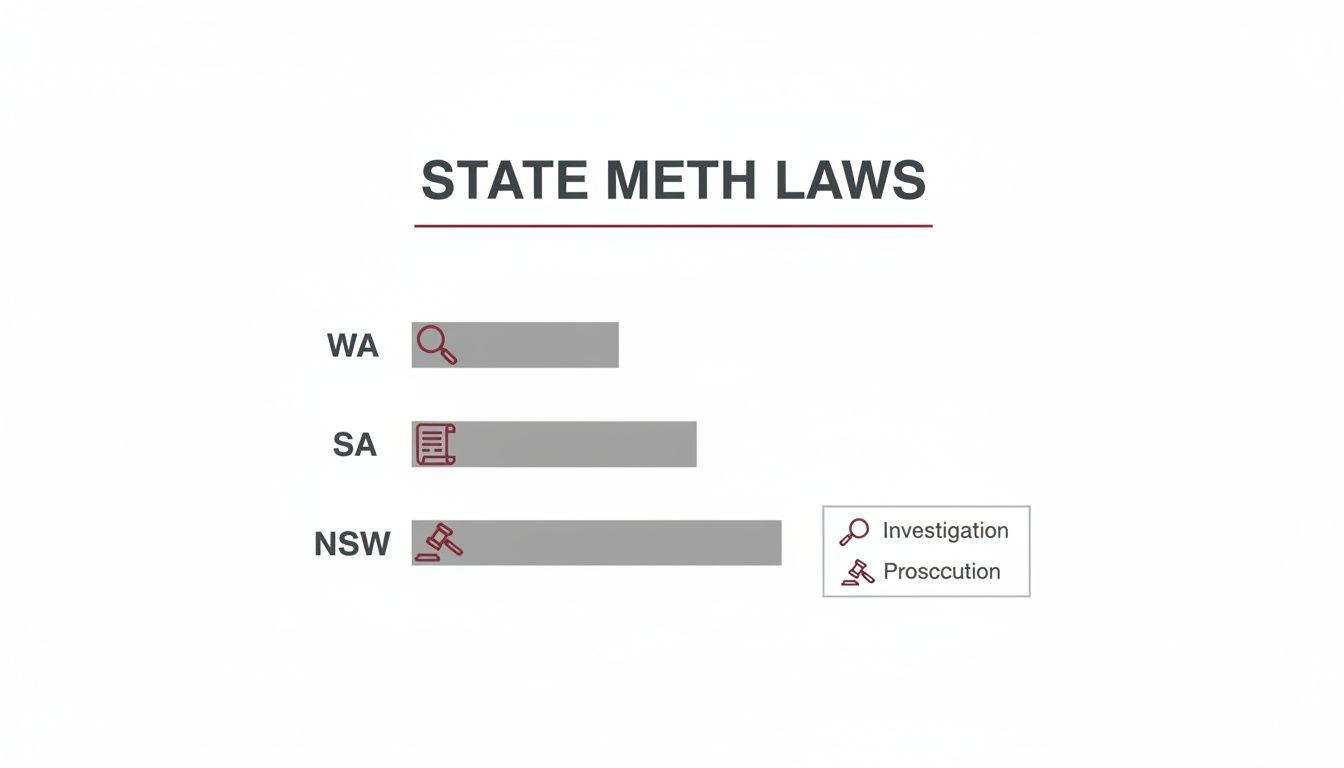
As you can see, states with higher rates of meth detection tend to have more robust regulations. It's a direct link: public health data drives the legal obligations for property owners.
Take South Australia, for example. Its focused legislation is a direct response to being a high-risk area. National wastewater reports frequently flag SA and WA for having peak detections. These local trends are part of a bigger national picture; by 2019, lifetime meth use had reached 5.8% (1.2 million people), and the number of people seeking treatment had tripled in the sixteen years before that. These aren't just numbers—they're the reason why understanding state-specific meth testing legislation is such a critical part of keeping people safe.
The Final Step: Clearance Testing and Certification
Once the remediation work is done, you’re not quite at the finish line. The property can't be reoccupied just yet. First, an independent, third-party tester must perform what's known as post-remediation verification, or clearance testing. They'll take new samples from all the cleaned areas to prove the meth residue levels are now safely below the legal threshold for your state.
Only a successful clearance test allows for a clearance certificate to be issued. This document is your official, legal proof that the property has been professionally decontaminated and is safe for human habitation. It’s what closes the loop on your compliance duties.
Without that certificate, you remain legally exposed. The property can't be safely—or legally—sold, leased, or lived in. This final step is arguably the most important part of the entire playbook, giving you the conclusive evidence you need to show you’ve met all your obligations under the law.
Building Your Meth Contamination Response Plan
Knowing the various state laws is one thing, but being prepared is what really protects your business and its assets. A solid meth contamination response plan is your playbook, moving you from a reactive scramble to a position of control. It means you're ready to act quickly, legally, and effectively the moment you suspect contamination.
This isn't just about having a cleaner's number handy. A proper response plan is a strategic framework. It weaves together your company policies, staff training, and professional expertise to shut down risk before an incident even happens. Think of it as your best defence against legal headaches, costly operational downtime, and any potential harm to your people.
Establishing Proactive Policies And Protocols
The bedrock of any good response plan is a clear, written policy. This document can't be a generic template; it needs to be customised to your specific operations, whether you’re managing a portfolio of rental properties, a remote work camp, or a busy industrial site.
Your policy needs to spell out your company’s stance on illicit drug use and the exact procedures for testing a property. Make sure it includes:
- A Comprehensive Drug and Alcohol Policy: This should state in no uncertain terms that making or using illicit drugs on company property is forbidden and will trigger a specific set of actions, including a full property assessment.
- Defined Triggers for Testing: What kicks off the testing process? Lay it out clearly. It could be part of a standard post-tenancy inspection, a response to reports of suspicious activity, or even routine checks in higher-risk environments.
- A Clear Chain of Command: When contamination is suspected, who gets the call? Who has the authority to bring in a professional tester? Defining these roles ahead of time stops confusion from turning a crisis into a catastrophe.
Getting this down on paper ensures your team follows a consistent and legally defensible process, every single time.
The Role Of Baseline Assessments And Staff Training
For any high-risk assets, waiting for a problem to pop up is a risky bet. Scheduling baseline or pre-emptive assessments gives you a clean snapshot of a property's condition, which is incredibly valuable for liability purposes. This is particularly smart for properties with high turnover, like rentals or temporary worker accommodation.
Just as vital is training your staff to be your eyes and ears on the ground. They don't need to be forensic scientists, but they do need to know the potential red flags of drug activity.
A trained team is your first line of defence. Empowering employees to spot unusual chemical smells, stained fixtures, or suspicious tenant behaviour allows you to intervene early, often before a minor issue becomes a major contamination event.
Beyond the specifics of meth rules, your plan should fit into a broader safety and compliance culture. For more on creating a safe and well-managed environment, it's worth reviewing established Safety And Compliance Best Practices For Facility Managers. This wider perspective helps ensure your plan is truly comprehensive.
Engaging Experts And Maintaining Records
The moment contamination is confirmed, you'll see just how valuable having a qualified occupational hygienist on your side is. These experts do far more than just take samples. They provide expert risk assessments, help map out a remediation action plan, and ensure everything you do lines up perfectly with state-specific meth testing legislation. Their involvement makes the entire process scientifically sound and legally bulletproof.
Finally, remember that meticulous record-keeping is your ultimate safeguard. Every single step—from the first report to the final clearance certificate—must be documented.
Keep a detailed file for each property, including:
- Initial Reports: Note any complaints or staff observations that started the investigation.
- Testing Results: Hold onto all lab reports from both the initial and final clearance tests.
- Remediation Plans: File the formal Remediation Action Plan (RAP) from the decontamination company.
- Clearance Certificates: This is the golden ticket. It's the official document proving the property is legally safe to occupy again.
This paper trail is your proof of due diligence. It shows you acted responsibly and followed all legal requirements, protecting your business from future claims and reinforcing your commitment to a safe environment.
Frequently Asked Questions About Meth Regulations
When you're dealing with meth regulations, the questions that come up are usually urgent and very practical. Property owners and employers need to know exactly what to do and what their legal responsibilities are to manage risk properly. Let’s tackle some of the most common questions we hear about meth contamination, testing, and staying compliant across Australia.
Immediate Actions and Legal Reliability
The first question is always the most pressing: what do you do if you even suspect a property is contaminated?
Your absolute first step is to vacate and secure the area. This is non-negotiable, as it prevents anyone from being exposed to potential health risks. Whatever you do, don't try to clean it yourself. Your very next call should be to a certified occupational hygienist who understands the local meth regulations. They’ll be able to walk you through the correct, state-compliant testing process.
That brings us to another common query: what about those DIY testing kits you can buy online? While they might give you a quick "yes" or "no" indication, they are not legally reliable. For any formal clearance, disclosure, or legal purpose, state laws are very clear. Official testing must be done by a qualified, independent expert who sends samples to a proper lab for analysis. This process ensures the results are accurate, defensible in court, and free from any conflict of interest, which is vital for meeting your legal duties.
Understanding Legal and Remediation Timelines
Ignoring these rules can have serious consequences. So, what happens if you know about contamination but don't disclose it? The penalties differ from state to state, but they can be severe.
You could be looking at:
- Termination of sales or lease contracts, leaving you holding a property you can't legally sell or rent out.
- Lawsuits from buyers or tenants who could sue you for cleanup costs and damages related to health problems.
- Fines and enforcement actions from government bodies like the local health department or fair-trading office.
When it comes to meth contamination, transparency isn’t just good practice—it's your primary legal defence. Full and honest disclosure is the only way to protect yourself from the huge financial and legal fallout.
Finally, people often want to know how long a cleanup actually takes. The answer really depends on how bad the contamination is, the size of the property, and the specific rules in your state. A minor residue issue might be sorted out in just a few days. But if the property was a former clandestine lab, you could be looking at several weeks of intensive decontamination, ventilation, and multiple rounds of clearance testing before it can be certified as safe to live or work in again.
Navigating the complex maze of state-specific meth regulations isn't something you should do alone. The team at Anitech offers comprehensive occupational hygiene services, from legally defensible testing to risk assessments, making sure your business stays compliant and your properties are safe. Visit our Occupational Hygiene Services page to see how our nationwide experts can help you build a solid compliance strategy.
📚 More in This Series: Regulations & Compliance
- Global Meth Contamination Standards 2026: Key Comparisons
- NIOSH Meth Testing Protocols: Step-by-Step Compliance
- Why Occupational Hygienists Are Essential for Meth Clearance
- Reclaiming a Meth Property Portfolio Under Compliance
- Future of Meth Testing Regulations & Safety Benchmarks
- How New Meth Laws Affect Property Decontamination Costs


