
TL;DR: Australia is shifting its view on meth contamination from a purely criminal issue to a public health crisis, driven by advances in toxicology. Stricter residential safety benchmarks, like the 0.5 µg/100cm² guideline, are becoming the standard to protect against chronic, low-level exposure. For property managers, this means proactive, lab-based testing and professional remediation are now essential for legal compliance and risk management.
For years, the story of methamphetamine in Australia was told through flashing blue lights and police tape. It was a law enforcement issue, centred on clandestine labs and criminal activity. But that narrative is changing, and fast. We're now looking at meth contamination through a public health lens, driven by huge leaps in toxicology. This guide to meth regulations: the future of toxicology and residential safety benchmarks explores this critical shift.
This isn't just an academic change. It's creating new, science-backed safety benchmarks for homes and workplaces, which has big implications for industries like mining, construction, and manufacturing. If you manage properties or are responsible for worker safety, you need to understand what's changing, why it's changing, and what it means for you.
From Crime Scene to Health Hazard: A New Perspective on Meth Regulations
The conversation around methamphetamine contamination is moving from the police station to the public health department. For a long time, the focus was on the immediate dangers of a meth lab bust. Now, we understand the real, lasting threat comes from the invisible residue left behind, even from heavy use.
Think of it like invisible smoke damage. These tiny, toxic particles seep into everything—drywall, carpets, furniture, and even the HVAC system. This residue doesn't just go away. It lingers, creating a long-term health risk for anyone who moves in later, whether it’s a family in a new home or a crew in a remote worksite donga.

Why the Sudden Change? A Public Health Reality Check
This isn't just a change in attitude; it’s a response to some pretty sobering numbers. Australia has been grappling with this for decades, but the sheer scale of the problem eventually forced a rethink.
The wake-up call started in the late '90s. Between 1996 and 2002, seizures of amphetamine-type stimulants (including meth) shot up from 156 kg to over 1.8 tonnes—a tenfold increase. This marked the beginning of the ‘ice’ epidemic, which pulled policy focus toward the hidden dangers of contamination and chronic exposure.
By 2011, the problem was undeniable. Australian Customs detected 1,075 kg of these stimulants at the border, a staggering 1,414% increase over just 14 years. This surge led to national policies like the National Amphetamine-Type Stimulant Strategy (2008–2011), which officially began treating meth as a priority toxin and pushed for stronger health controls. For a deeper dive, UNSW has published some excellent research on the history of Australia's methamphetamine situation.
For anyone managing assets like worker accommodation, site offices, or transportable buildings, this evolution has direct, on-the-ground consequences. The key drivers behind this regulatory shift are clear:
- Smarter Science: Modern toxicology gives us a much clearer picture of how low-level chemical exposure affects our health over time. This new understanding is pushing regulators to adopt a more cautious, "better safe than sorry" approach to safety limits.
- Workplace Safety Obligations: The duty of care for employers is getting stricter. Providing a workplace free from chemical hazards isn't just good practice; it's a legal and moral obligation. Meth residue is now firmly on that list of hazards.
- The Bottom Line: A contaminated property is a massive liability. It tanks property values, complicates insurance, and opens the door to expensive legal action.
The following table breaks down this fundamental shift in how Australia is tackling meth contamination.
Key Shifts In Australian Methamphetamine Regulation
This table summarises the evolution of regulatory focus from law enforcement to a public health and toxicology-based approach.
| Regulatory Era | Primary Focus | Key Drivers | Implication For Businesses |
|---|---|---|---|
| Pre-2000s | Criminal Justice & Clandestine Labs | Illicit drug manufacturing, immediate explosion/fire risks. | Minimal, unless a property was a confirmed drug lab. Focus was on criminal cleanup. |
| 2000s–2010s | Emerging Health Awareness | Massive increase in seizures, growing evidence of residue risks. | Increased awareness of OHS risks, first guidelines appear. Asset liability becomes a concern. |
| Present & Future | Public Health & Toxicology | Advanced toxicology, established links to chronic illness, duty of care legislation. | Mandatory testing, clear remediation standards, significant financial & legal compliance risks. |
What this all points to is a future where managing meth contamination is a standard part of property and asset management.
So, let's get into the science. In the next section, we’ll explore the core concepts of toxicology and explain exactly why this new data is setting a higher standard for everyone.
The Science Behind Meth Residue: Why It's More Than Just a Mess
To really get a handle on today's meth regulations, you first need to understand the science that shapes them. It’s less about the dramatic scenes of a lab explosion and more about the quiet, invisible threat left behind.
Think of it like trying to clean up after a party where someone sprayed a can of aerosol paint. You can’t see the tiny droplets in the air, but you know they’ve settled on every single surface—the walls, the floor, the furniture. Methamphetamine residue is a lot like that. It’s a chemical contaminant that blankets an environment, and it's incredibly stubborn.
This is the core idea behind the toxicology that informs residential safety benchmarks. We're not just worried about the immediate dangers of a drug lab; we're dealing with the long-term health risks from the chemical footprint it leaves behind from either cooking or heavy smoking.
Acute Dangers vs. Chronic Exposure: A Critical Difference
In the world of toxicology, we draw a clear line between acute and chronic exposure. Acute exposure is what happens when someone actively uses the drug—a big, single dose with immediate and powerful effects. That's the scenario most people picture when they think about meth.
But for property contamination, that’s not our focus. We’re concerned with chronic, low-level exposure. This is what happens when people live or work in a space where meth residue coats the surfaces and hangs in the air. Over weeks, months, or even years, they unintentionally breathe in or absorb tiny amounts of this toxin. It’s this slow, steady drip of exposure that can lead to subtle but serious health issues like respiratory problems, skin rashes, and neurological symptoms.
The old saying in toxicology is that "the dose makes the poison." With meth residue, the danger isn't one big hit. It's thousands of tiny, cumulative doses absorbed from the environment over time. This is precisely why safety benchmarks are so strict.
Understanding this distinction is crucial for anyone responsible for property or workplace safety. It explains how a home can look spotless but still be dangerously contaminated, making professional, science-based testing non-negotiable.
How Meth Residue Sticks Around
Methamphetamine residue isn’t just stubborn; it’s chemically designed to be. When it's smoked, the vapourised drug doesn't simply vanish. It cools, settles, and forms a chemical bond with nearby surfaces. It’s similar to how nicotine stains the walls in a long-time smoker’s house, except meth residue is completely invisible.
It gets into everything:
- Porous Materials: Things like drywall, timber, carpets, and curtains act like sponges, soaking the residue deep into their structure. A simple wipe-down won't even begin to touch what's trapped inside.
- Hard Surfaces: The residue also forms a sticky film on countertops, tiles, and metal. This film can easily be disturbed, sending the toxic particles back into the air.
- HVAC Systems: This is a big one. Air conditioning and heating systems are perfect conduits, sucking in contaminated air and blowing it into every room, effectively poisoning the entire building.
This process of particles becoming airborne again is called off-gassing. A change in temperature or a bit of humidity can cause the residue to vaporise again, long after the property was first contaminated. This means people can be continuously exposed, even in a house that’s been empty for months. It’s this persistent cycle of contamination that has pushed regulators, armed with the latest toxicology data, to set safety limits at such incredibly low microgram levels. These benchmarks are all about protecting people from the long-term fallout of living with an invisible chemical threat.
Decoding Residential Safety Benchmarks Across Australia
The science of toxicology tells us why we need to be concerned about meth contamination, but it's the specific numbers—the residential safety benchmarks—that draw the line between a safe environment and a hazardous one.
In Australia, this isn't as straightforward as you might think. We don't have a single, federally mandated national standard. Instead, we're navigating a patchwork of state and territory guidelines, which can create some serious compliance headaches for anyone managing properties across the country.
At the heart of it all is a simple measurement: micrograms per 100 square centimetres (µg/100cm²). This tiny unit is what we use to quantify the amount of invisible methamphetamine residue on a surface. It gives us a clear, data-driven line in the sand, and for property owners and safety managers, knowing this number for your jurisdiction is the first step toward managing risk.
The Numbers Behind The Rules
While there is a nationally recognised guideline, how it's adopted and enforced varies from state to state. The Australian Clandestine Drug Laboratory Remediation Guidelines recommend a post-cleanup clearance level of 0.5 µg/100cm². This figure isn’t just pulled out of thin air; it’s based on toxicological studies to protect people from the chronic health risks of long-term, low-level exposure.
The trouble is, the lack of uniform laws means some states set their own triggers and requirements. You could have a property with a certain contamination level that requires urgent action in one state, while the exact same reading across the border might not. This is why getting advice from a qualified occupational hygienist who knows the local rules inside and out is so important.
To understand what these benchmarks are designed to prevent, it helps to see the two main types of exposure risk side-by-side.

This visual shows the stark difference between the immediate danger of acute, high-dose exposure and the slow-burn threat from chronic exposure in a contaminated home. It’s this latter, persistent risk that modern meth regulations are primarily focused on.
Comparison Of Meth Contamination Guidelines Across Australian Jurisdictions
The table below gives you a snapshot of the regulatory landscape, highlighting how guideline values for investigation and remediation can differ depending on where your property is located.
| State/Territory | Investigation Guideline (µg/100cm²) | Remediation Guideline (µg/100cm²) | Reference/Governing Body |
|---|---|---|---|
| National (Guideline) | Not specified | 0.5 | Australian Clandestine Drug Laboratory Remediation Guidelines |
| Western Australia | 0.5 | 0.5 | Guidelines for Remediation of Clandestine Drug Laboratories |
| New South Wales | Not specified | 0.5 | Clandestine Drug Laboratory Remediation Guidelines |
| Queensland | 0.5 | 0.5 | Public Health Act 2005 / Local Council |
| Victoria | Not specified | 0.5 | Clandestine Laboratory Remediation – General Information |
| South Australia | Not specified | 0.5 | Guidelines for the Remediation of Clandestine Drug Lab Sites |
| Tasmania | Not specified | 0.5 | Guidelines for the Management of Clandestine Drug Laboratories |
As you can see, while 0.5 µg/100cm² is the common target for a final clean-up, the triggers for starting an investigation aren't always consistent. This reinforces the need for local expertise to ensure you're meeting your specific obligations.
The Health Data Driving Stricter Standards
So, why are these benchmarks so stringent? It’s not a case of regulators being overly cautious. This is a direct response to some pretty alarming public health data.
Starting around 2010, Australian health statistics began to show meth not just as a law enforcement problem, but as a serious public health crisis. During this time, the proportion of crystal meth users reporting weekly use more than doubled, jumping from 12% in 2010 to 29% in 2019. This pattern is directly linked to higher exposure levels and more significant contamination of indoor spaces.
The knock-on effect on our health system was massive. Meth-related hospital admissions across Australia shot up by around 270% between 2010 and 2016. The data out of New South Wales is even more confronting, with hospitalisations climbing more than eleven-fold in under a decade—from 12.2 per 100,000 people in 2010–11 to 137.9 per 100,000 in 2018–19. You can dig into the full health data and its implications in this detailed study.
This mountain of evidence is exactly why health authorities have set conservative safety limits. These benchmarks are a crucial preventative measure, designed to protect the public from the very real and severe health outcomes documented in these reports.
The core principle is simple: if a property can't be scientifically proven to meet the established safety benchmark, it is considered unfit for people to live in. This puts a clear duty of care on property owners and managers to get it tested and verified.
For businesses, particularly in sectors like mining or construction that manage residential assets, professional testing isn't just a "nice-to-have"—it's a critical part of risk management. Understanding the specific meth testing and clearance standards is the only way to ensure you're compliant.
Ultimately, these benchmarks give us the practical, data-driven framework we need to protect both people and property from the lasting damage of meth contamination.
Expert Interview: The Future of Toxicology and Residential Safety Benchmarks
To understand where meth regulations are heading, we sat down with leading industry experts to discuss the science, technology, and policy shifts that will define safety standards tomorrow. Their insights provide a clear roadmap for what's next in toxicology and residential safety.
The Push For A Unified National Standard
Q: Australia has a nationally recognised guideline, but its application varies by state. Do you see a move towards a single, federally mandated standard?
"Absolutely. The current patchwork of state rules creates unnecessary confusion and risk. The industry consensus is that we need a unified national standard, most likely formalizing the existing 0.5 µg/100cm² guideline, to provide clarity for industries like mining and manufacturing."
"For companies managing assets across multiple states, a single benchmark eliminates guesswork. A level of contamination that requires a full shutdown in one jurisdiction could be a non-issue in another. A federally enforced standard would streamline compliance and guarantee a consistent level of safety for everyone, everywhere."
How New Technology Will Change Risk Assessment
Q: How will emerging technologies influence the way we assess and manage meth contamination risks?
"Technology is the next frontier. We're on the cusp of real-time, on-site analysers that provide instant, quantitative results. Imagine a handheld device an occupational hygienist can use to get a precise reading in micrograms on the spot, rather than waiting days for lab results."
"This would revolutionise risk assessment. You could screen large facilities rapidly, pinpoint hotspots immediately, and get clearance testing done faster after remediation. For a business, this translates to less downtime, lower costs, and quicker, more informed decision-making."
"The future of toxicology isn't just about lowering limits. It's about making the measurement of those limits faster, more accurate, and more accessible. That's how we'll move from a reactive cleanup model to proactive risk management."
Setting Practical and Scientific Benchmarks
Q: What are the main challenges in setting benchmarks that are both scientifically sound and practically achievable?
"The biggest challenge is balancing hard science with real-world logistics. Toxicology data tells us what level of exposure is safe, but we also have to ask if that level is realistically achievable and, just as importantly, measurable with current technology."
"It's a constant dialogue between public health demands and what's practical on the ground. For example, a benchmark near zero might be scientifically ideal but impossible to verify. The goal is a limit that robustly protects health while being a clear, attainable target for remediation teams. This is where the public health data, like the alarming rise in meth-related hospitalisations in NSW from 12.2 to 137.9 per 100,000 people in under a decade, provides the justification for these stringent but necessary standards. You can discover more about how NSW health data is shaping policy in their detailed reports."
Proactive Strategies for Industry Leaders
Q: What is your key advice for industries like mining or construction to stay ahead of evolving meth regulations?
"Don't wait to be told what to do. The most forward-thinking companies are already adopting the strictest standard—the 0.5 µg/100cm² benchmark—as their internal policy, regardless of location. It’s about future-proofing assets and fulfilling your duty of care."
"My recommendations are:
- Establish a Proactive Testing Program: Implement a baseline testing schedule for high-turnover assets like remote worker accommodation. Don't just test when you suspect a problem.
- Develop a Contamination Response Plan: Know exactly who to call and what steps to take the moment contamination is confirmed to minimise downtime and liability.
- Invest in Education: Ensure your WHS and facility managers understand the risks of chronic, low-level exposure. An informed team is your best defence."
A Practical Guide to Meth Testing and Remediation
Thinking your property might be contaminated with methamphetamine is a heavy burden. It’s a serious issue that requires a methodical, scientific approach—not guesswork. Getting it right from the start doesn’t just protect the health of future occupants; it shields your business from massive legal and financial headaches.
Let's walk through a clear, actionable roadmap for handling this, from the first inkling of a problem right through to a professionally verified clean-up.
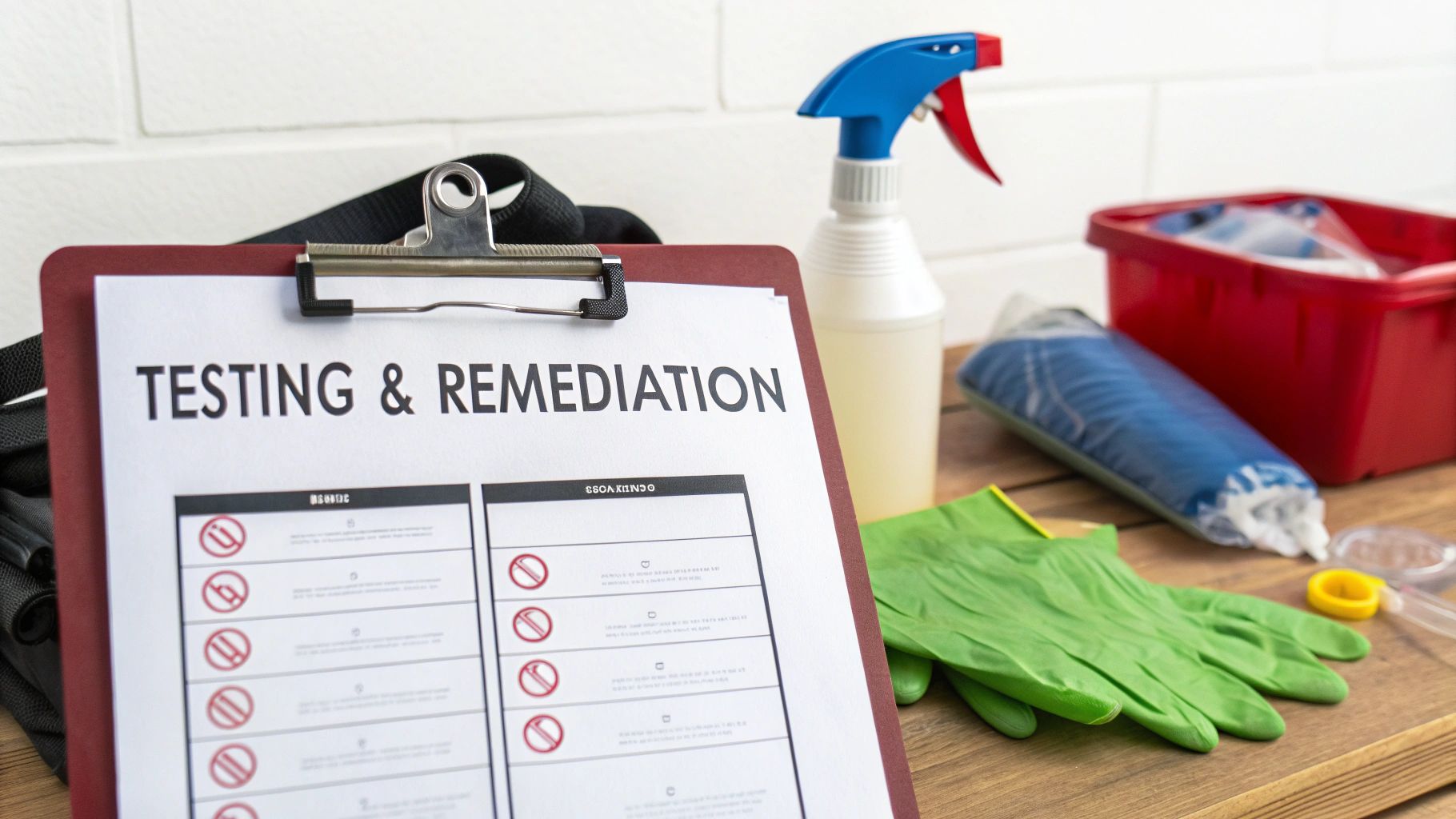
Before you do anything else, the first phone call you should make is to a qualified occupational hygienist. Their expertise is absolutely essential. They’ll build a testing plan that’s not only scientifically sound but will also stand up to legal scrutiny, forming the very foundation of your risk management strategy.
The Two Tiers of Testing
When it comes to assessing a property for meth residue, testing methods are split into two distinct categories. Each serves a different purpose, and understanding the difference is crucial for making smart, compliant decisions under Australian regulations.
- Presumptive Field Kits (DIY Kits): You've probably seen these. They're cheap, give an instant result, and can tell you if meth might be present. But that's where their usefulness ends. Their biggest flaw is that they can't measure how much contamination there is. This means they are completely useless for proving a property is below Australia's 0.5 µg/100cm² safety benchmark and can never be used for final clearance.
- Definitive Lab Sampling: This is the gold standard and the only method that matters in the eyes of Australian regulators. A trained hygienist takes precise wipe samples from 100cm² grids on various surfaces. These are then sealed and sent to an accredited lab for analysis, giving you a precise, quantitative measurement. This is the hard data you absolutely need to assess the real risk and, later, to prove a clean-up was successful.
Here’s a simple way to look at it: a DIY kit can tell you if there might be smoke, but only professional lab analysis can tell you if there’s a raging fire. For legal and safety reasons, you need to know the size of the fire.
Principles of Effective Remediation
If the lab results come back showing contamination above the legal limit, professional remediation isn't just a good idea—it's non-negotiable. Forget about DIY cleaning with household products like bleach. It simply doesn't work. Methamphetamine residue is incredibly stubborn and seeps deep into porous materials like plasterboard, wood, and concrete.
A proper decontamination job is a highly specialised, multi-stage process.
- Site Isolation and Hazard Removal: First, the contaminated area is completely sealed off to stop the residue from spreading. Any porous items that are beyond saving—like carpets, curtains, and soft furnishings—are carefully removed and disposed of as hazardous waste.
- Specialised Chemical Treatment: Next, technicians use specially formulated chemical agents designed to break down and neutralise the methamphetamine molecules. This is a forensic-level clean that hits every surface, from walls and ceilings to the insides of ventilation systems.
- Post-Remediation Verification: Once the cleaning is done, an independent occupational hygienist must come back to conduct a final round of lab sampling. This "clearance testing" is the only way to legally prove the property is now under the 0.5 µg/100cm² safety standard and is genuinely safe to occupy again.
This meticulous approach is vital. While we're talking about meth here, the core principles apply to many hidden contaminants. For instance, the same level of expertise is seen in professional mould remediation services, where specialised techniques are crucial for truly eliminating the hazard.
To get a full picture of how this all comes together, you can learn more about our comprehensive property meth testing and decontamination cleaning. It will empower you to manage a contamination event properly from start to finish.
Managing Your Compliance And Risk Management Strategy
Let's be blunt: connecting toxicology science to your bottom line starts with a solid risk management strategy. Ignoring methamphetamine contamination isn't just a potential health issue; it's a direct threat to your business that can unleash serious legal, financial, and reputational storms. With meth regulations and safety benchmarks constantly evolving, waiting for a problem to appear is a risk you can't afford to take.
Under Australian Work Health and Safety (WHS) laws, if you're a person conducting a business or undertaking (a PCBU), you have a non-negotiable duty of care. This is your legal obligation to ensure a safe environment for everyone—employees, contractors, tenants, you name it. A property tainted by meth residue is a recognised chemical hazard, and turning a blind eye is a clear breach of that duty.
Navigating Key Business Risks
The fallout from non-compliance can be catastrophic, hitting everything from the value of your assets to your very ability to operate. A proactive contamination management plan is your single best defence.
Think about the specific threats you face:
- Property Transactions: Disclosure laws are getting tougher. If you don't disclose known contamination, you could see a sale or lease agreement collapse and find yourself tangled in expensive legal battles.
- Insurance Coverage: Dig into the fine print of your policy—many have specific exclusions for contaminants like meth. A contamination event might not just lead to a denied claim; it could make it much harder and more expensive to get insured in the future.
- Diminished Asset Value: A property with a meth history, especially one that hasn't been professionally cleared and certified, carries a heavy stigma. This translates directly to a lower valuation on your balance sheet.
Building an effective risk strategy means getting familiar with the general principles of handling hazardous materials. A good starting point is to review comprehensive hazardous materials cleanup guidelines, which can help shape your own approach to meeting compliance and safety standards.
Imagine this real-world scenario: meth residue is found in a remote mining camp's accommodation block. The entire building is immediately declared unsafe, forcing a complete shutdown. The company is now on the hook for not only the six-figure cost of professional remediation but also crippling operational losses from housing workers elsewhere and massive project delays.
Your Path To Proactive Compliance
A truly proactive strategy is all about getting ahead of the problem—identifying and neutralising risks before they blow up into full-blown liabilities. This means knowing your legal obligations inside and out and, just as importantly, partnering with genuine experts who can guide you through the maze of state-specific laws and scientific standards.
An experienced occupational hygiene partner is indispensable here. They bring the scientifically-backed testing and remediation oversight you need to tick every legal box, safeguarding your people, your assets, and your company's reputation.
Getting a handle on the nuances of local laws is the critical first step. You can dive deeper by reading our guide to state-specific meth testing legislation in Australia. This will ensure your compliance strategy is built on a solid, informed foundation from day one.
Your Top Questions About Meth Regulations, Answered
When you're a property owner or manager, the idea of meth contamination can bring up a lot of urgent, practical questions. It's a complex area, so let's cut through the noise and tackle some of the most common things people ask.
Can I Just Look and See If a Property Is Contaminated?
Relying on a visual check is a massive risk, and frankly, it just doesn't work. Sure, sometimes you might find obvious red flags—a weird chemical smell, yellow-brown stains on the walls, or leftover drug paraphernalia. But more often than not, there are no signs at all.
The real danger is the invisible residue that gets absorbed into everything from drywall and carpets to the ventilation system. The only way to know for certain if a property is safe and meets legal standards is to get it professionally tested. A qualified occupational hygienist needs to take quantitative surface samples to get the real story. A simple walkthrough won't protect you or your tenants.
What About Those DIY Meth Testing Kits? Are They Good Enough for a Clearance Certificate?
In a word: no. While a DIY kit might give you a quick "yes/no" heads-up that there could be a problem, it’s not accurate enough for a legal clearance. Think of it like a smoke alarm—it tells you there might be a fire, but it doesn't tell you how big it is or if it's out.
Australian regulations are built around specific contamination levels, measured in micrograms per 100cm². A DIY kit can't give you that number. To prove a property is safe and legally compliant, you need a detailed report from an accredited lab that quantifies the exact residue levels. That's the only evidence that will stand up.
Is There a Difference Between Contamination from a Meth Lab vs. Heavy Use?
Absolutely, and it’s a crucial distinction. Both are dangerous, but a former clandestine lab (or "clan lab") is on another level entirely. It's not just meth residue you're dealing with; it's a toxic soup of the precursor chemicals used to cook it. These substances can be volatile, acidic, and incredibly hazardous.
Residue from heavy personal use is primarily just methamphetamine. While both situations require professional remediation, cleaning up a former lab is a far bigger, more complex, and more expensive job because of the sheer range of dangerous chemicals involved.
Who's Actually on the Hook Legally for the Contamination?
In Australia, the buck usually stops with the property owner or manager. Under Work Health and Safety (WHS) laws, you're considered the 'Person Conducting a Business or Undertaking' (PCBU). That title comes with a strict duty of care to ensure the environment is safe for anyone who sets foot on the property—tenants, contractors, you name it.
Ignoring suspected contamination isn't an option. It can lead to hefty fines, civil lawsuits, and could even void your insurance. Being proactive with testing isn't just about ticking a box; it's about meeting your legal and moral responsibilities.
At Anitech, we provide the expert occupational hygiene services you need to navigate these complex meth regulations and ensure your properties are safe, compliant, and secure. Our team offers scientifically-backed testing and clear guidance to protect your assets and people. Learn more about our services.
Need Professional Meth Testing?
Anitech Group provides NATA-accredited meth testing and decontamination services across Australia. Our qualified occupational hygienists deliver legally defensible results with fast turnaround.
Get a Free Quote

