
When you're faced with reclaiming a property portfolio from methamphetamine contamination, the very first step—before you even think about remediation—is getting your head around Australia's complex web of meth regulations. This isn't just bureaucratic box-ticking. This legal framework dictates everything from what's considered a "safe" level of contamination to the specific steps you must take to make a property habitable again, especially under strict enforcement from authorities. Getting this wrong can be costly, not just in fines but in project delays and legal headaches. Getting it right protects your assets, ensures your tenants are safe, and keeps you on the right side of the law.
The Foundation of Compliance: Navigating Meth Regulations
Tackling a meth-contaminated property portfolio is a serious undertaking, and its success hinges entirely on understanding the rules of the game. The biggest thing to grasp right away is that Australia doesn't have a single, nationwide law for meth contamination. Instead, we have a patchwork of state and territory-based regulations.
This means a one-size-fits-all approach is doomed to fail. What passes as compliant in one state could get you a cleanup order in another. This is where a localised, expert-led strategy becomes absolutely essential for anyone managing properties across multiple regions.
At the heart of these regulations are the guideline values for surface contamination. These are the make-or-break numbers, usually measured in micrograms per 100 square centimetres (µg/100cm²), that officially determine if a property is safe to live in. If your test results come back over that threshold, you're legally required to begin a professional, fully documented remediation and clearance process.
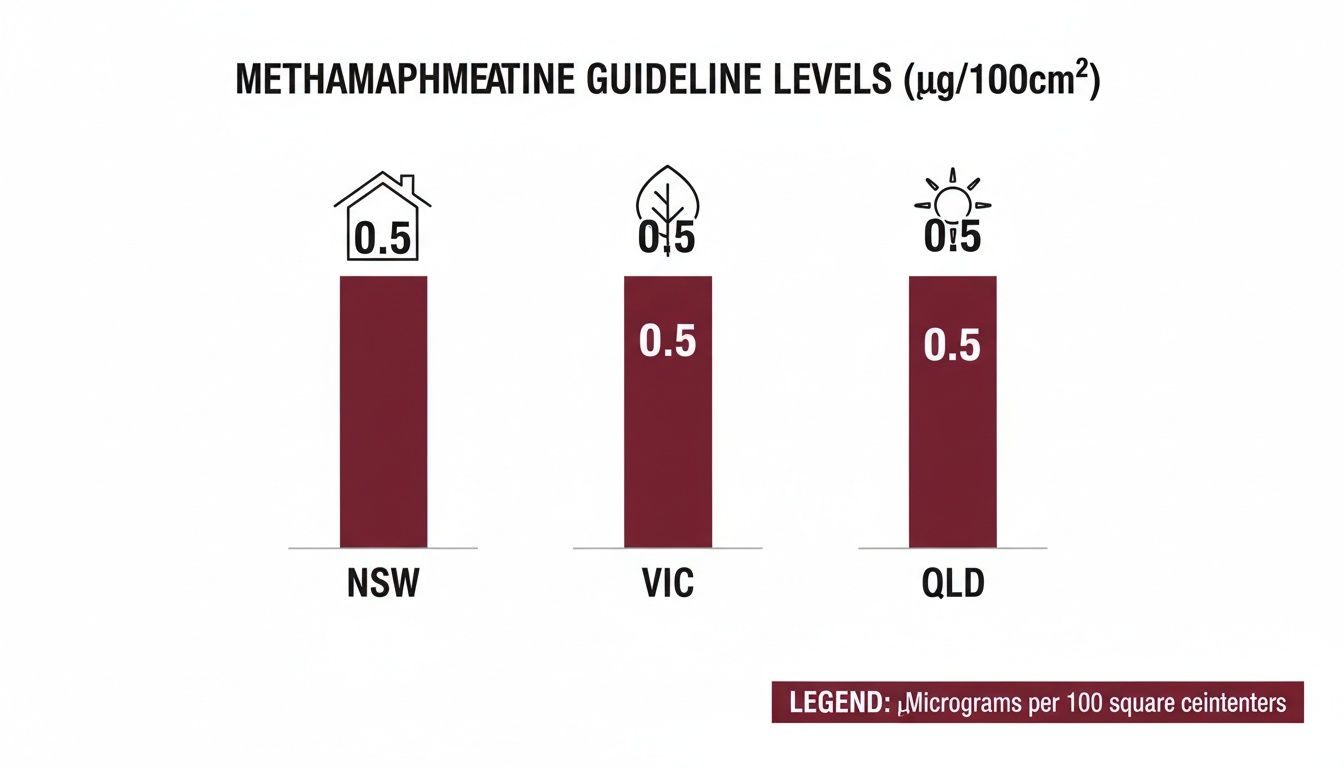
As you can see, major states like New South Wales, Victoria, and Queensland have settled on a remediation guideline of 0.5 µg/100cm². This alignment provides some consistency, but you can’t assume it applies everywhere.
To give you a clearer picture of the regulatory landscape, here’s a breakdown of the current guideline levels across Australia.
State-By-State Meth Contamination Guideline Levels (ng/100cm²)
This table summarises the acceptable surface contamination levels for methamphetamine across various Australian jurisdictions, highlighting the differences property owners must navigate.
| State/Territory | Guideline Level (µg/100cm²) | Governing Body/Legislation |
|---|---|---|
| New South Wales | 0.5 | Clandestine Drug Laboratory Remediation Guidelines |
| Victoria | 0.5 | Clandestine Laboratory Remediation – Guidance for Dwellings |
| Queensland | 0.5 | Public Health Act 2005 / Queensland Health Clandestine Drug Laboratory Remediation Guidelines |
| Western Australia | 0.5 | Guidelines for the Remediation of Clandestine Drug Laboratories |
| South Australia | Varies | Controlled Substances Act 1984 / Guidelines for Testing and Remediation of Drug Contamination |
| Tasmania | 0.5 | Guidelines for the Management of Clandestine Drug Laboratories |
| ACT | 0.5 | Clandestine Drug Laboratory Remediation Guideline |
| Northern Territory | Varies | Public and Environmental Health Act 2011 |
As you can see, while there's a trend towards the 0.5 µg/100cm² mark, variations still exist. This reinforces the need for localised expertise to ensure compliance for every single property in your portfolio.
Key Regulatory Bodies and Their Roles
Knowing the rules is one thing; knowing who enforces them is another. Several authorities can get involved, and their actions can directly shape your reclamation plan.
- Local Councils: They are often on the front line. Councils have the power to issue cleanup orders, officially declare a property uninhabitable, and hit you with hefty fines for non-compliance.
- Public Health Units: These state-level health departments step in when there's a serious risk to public health. They can issue public health orders, which are legally binding and must be followed.
- Environmental Protection Agencies (EPAs): When dealing with significant contamination, the EPA will likely get involved to oversee the safe and legal disposal of hazardous waste from the cleanup.
With public awareness of meth-related health risks growing, these authorities are enforcing the rules more strictly than ever. You can no longer afford to be reactive.
Why Is There No National Standard?
This is a question I get asked all the time. The lack of a unified national standard is one of the biggest frustrations for portfolio owners. It forces you to develop a flexible strategy that can adapt to different rules in different postcodes.
For anyone managing a property portfolio, this regulatory fragmentation is precisely why you need to bring in qualified occupational hygienists. They have the on-the-ground, localised knowledge to ensure every property is handled correctly according to its specific jurisdiction. It’s your best defence against compliance failures.
Ultimately, the responsibility falls squarely on the property owner to know and apply the correct local rules. This is where having a deep understanding of state-specific meth testing legislation becomes your most powerful tool. It’s the bedrock of any successful reclamation strategy, ensuring every step you take is compliant, defensible, and moves you closer to restoring your asset's value.
Putting a Portfolio-Wide Risk Assessment Strategy into Action
Once you have a handle on Australia's meth regulations, it’s time to roll up your sleeves and put that knowledge to work. This means creating a practical, portfolio-wide risk assessment strategy. We're not talking about ad-hoc testing here; this is about building a systematic, legally defensible framework to pinpoint and prioritise at-risk properties. Getting this right is the foundation for reclaiming your portfolio, ensuring you spend your money wisely and meet your duty of care.
A solid strategy is your best defence against the chaos that hidden contamination can unleash. A crucial piece of this puzzle is an effective business continuity risk assessment, which helps you get ahead of potential disruptions. For property owners, this means proactively flagging which assets are most likely to be contaminated long before they become a major headache.
Sorting Your Properties for Targeted Action
One of the biggest mistakes I see is people treating every property as if it has the same risk profile. That's a surefire way to waste money. A much smarter approach is to segment your portfolio into risk categories based on hard evidence and past history. This lets you focus your attention and budget exactly where they're needed most.
A simple tiered system works best:
- High-Risk Properties: These need your immediate attention. Think of properties with a known history of police raids, links to criminal activity, or a high tenant turnover in postcodes known for drug issues. Any asset with strange and frequent maintenance requests, like modified ventilation, should go straight into this bucket.
- Medium-Risk Properties: This is your "watch list." It might include properties in areas with rising crime rates or those that have seen a string of short-term tenancies for no obvious reason. I'd also flag any property where arranging routine inspections has been a struggle or where tenants have been consistently difficult to deal with.
- Low-Risk Properties: These are typically your stable, long-term tenancies with a proven track record. But don't get complacent. "Low risk" doesn't mean "no risk." These properties still need to be part of a baseline screening program, especially when a tenant moves out.
This simple act of categorising your portfolio becomes the blueprint for your entire testing schedule and budget.
Choosing the Right Tools for the Job: Testing Protocols
With your properties sorted, the next move is deciding how you're going to test them. There are two main types of tests, and each has a distinct role to play in your strategy.
1. Initial Screening Tests
These are your first line of defence. They're cost-effective field test kits that give a straightforward "yes" or "no" for the presence of meth. They're perfect for casting a wide net across your low-to-medium-risk properties or as a quick check at the end of a tenancy. A negative result gives you peace of mind, while a positive one tells you it's time to dig deeper.
2. Detailed Laboratory Analysis
This is the gold standard, the one that stands up in court. If a screening test comes back positive, or if a property is high-risk from the get-go, you go straight to quantitative lab analysis. An expert will collect composite samples from multiple areas and send them to an accredited lab. The report you get back will show the exact contamination level (in µg/100cm²), which is the legally binding evidence you need to prove a breach of regulatory guidelines.
The sheer scale of methamphetamine seizures in Australia highlights just how widespread this problem is. It makes proactive screening less of a "nice-to-have" and more of an essential risk management step. It's a direct response to a national issue that impacts communities and, inevitably, rental portfolios.
This tiered approach—screen first, then follow up with detailed analysis only when necessary—is hands down the most financially sensible way to manage a large portfolio.
Making Sure Your Sampling is Legally Bulletproof
When it comes to sampling, the integrity of the process is everything. If you end up in a dispute with regulators, insurers, or a former tenant, you must be able to prove your methodology was flawless. This boils down to two non-negotiables: hiring a qualified professional and maintaining a strict chain of custody.
For detailed testing, bringing in an independent, qualified occupational hygienist is a must. These are the experts trained to identify high-risk contamination zones, follow nationally recognised sampling protocols (like NIOSH 9111), and correctly interpret lab results. Their third-party report is the unbiased, expert evidence you can rely on.
Just as critical is maintaining a meticulous chain of custody for every single sample. This is the chronological paper trail that documents who collected, handled, transported, and analysed each sample. It's your proof that nothing was tampered with and that the results you have are irrefutably linked to that specific property. It's what makes your findings legally defensible.
Creating a Compliant Remediation Action Plan
So, the lab results are in, and they’ve confirmed meth contamination above the legal limit. That positive test isn’t a dead end; it’s the starting line for a structured, legally required recovery process. Your next, most critical move is to develop a formal Remediation Action Plan, or RAP.
This isn't some simple cleaning checklist. It’s a detailed, scientific document that maps out every single action needed to get the property back into a safe, compliant state. It's the blueprint for reclaiming the asset and satisfying the regulators.
Honestly, this plan is your best defence against costly mistakes down the line. A properly developed RAP, put together with your occupational hygienist, shows regulators you’re taking this seriously. It also gives the remediation contractors a precise scope of work, bridging that crucial gap between finding the problem and proving you’ve fixed it.
Defining the Scope of the Cleanup
First things first: the RAP must lock down the exact scope of work. This is where those initial lab results really earn their keep. The plan needs to clearly identify every affected area, spelling out which surfaces need cleaning, which materials are too far gone and have to be ripped out, and where the contamination zone begins and ends.
Getting this level of detail right from the start is what stops "scope creep"—that painful situation where contractors do too much, or even worse, too little. It ensures every action is targeted, backed by data, and focused squarely on getting contamination levels below the 0.5 µg/100cm² guideline.
A solid scope of work will always include:
- A full inventory of contaminated items: This means everything from carpets, curtains, and light fittings right down to the plasterboard.
- Specific cleaning protocols for different surfaces: You can't treat porous wood the same way you treat non-porous glass or metal. The RAP specifies the right technique for each material.
- Waste disposal procedures: All contaminated material is considered hazardous waste. The RAP must detail exactly how it will be handled and disposed of according to strict EPA guidelines.
Selecting the Right Decontamination Methods
Not all cleanup methods are created equal, and your RAP must specify scientifically-backed techniques that actually work. The whole point is to chemically break down and neutralise the meth residue, not just move it around. Standard household cleaners won't even touch it.
Commonly approved and effective methods include:
- Chemical Stripping and Neutralisation: This is a two-step process. First, specialised detergents and surfactants are used to lift the residue from surfaces. Then, a separate chemical agent is applied to neutralise it.
- Physical Removal: For items that are heavily contaminated or too porous to clean effectively—think carpets, untreated timber, or insulation—the only real solution is to remove and dispose of them completely.
- Encapsulation: In very specific situations, a surface can be sealed with a specialised coating to permanently lock in any trace contamination. Our guide on the encapsulation method for methamphetamine remediation dives into when this is a suitable option.
A word of warning: a common mistake is hiring a contractor who suggests "fogging" or just painting over the problem. These methods are completely ineffective, do not comply with Australian guidelines, and will almost guarantee a failed clearance test. That means you’ll be starting—and paying for—the whole process all over again.
Finding and Vetting Qualified Remediation Contractors
A brilliant RAP is useless without the right team to bring it to life. Choosing a qualified, experienced, and certified remediation contractor is absolutely non-negotiable. This is a highly specialised job, not one for a general cleaning company or your local handyman.
Since official guidance can sometimes be hard to come by, your own due diligence is paramount. You need to ask potential contractors some tough, direct questions before you even think about hiring them:
- What specific training and certifications do your technicians have?
- Can you show me case studies or examples of similar jobs, including the final clearance certificates?
- How do you document your process to prove compliance with the RAP?
- What are your health and safety protocols for your team, including Personal Protective Equipment (PPE)?
A true professional will have no problem answering these questions and providing the documentation to back it up. Their ability to follow the RAP to the letter is what will ultimately decide whether your property passes its final clearance test and can be safely returned to your portfolio.
Getting the All-Clear: Verification and Clearance Testing
After all the hard work of decontamination, it’s tempting to think you’re at the finish line. But the most crucial checkpoint is still ahead: the verification and clearance process. This is the final, non-negotiable step that proves, with scientific certainty, that the property is once again safe for people to live and work in.
This isn’t just a quick once-over. It’s the official validation that closes the loop on your compliance journey. A successful clearance test gets you that all-important clearance certificate—the document that satisfies regulators, reassures insurers, and finally lets you bring the property back into your portfolio. Without it, all your previous effort and expense count for nothing.
Why Independent Verification is Non-Negotiable
Here’s one of the golden rules of meth remediation: the company that does the cleaning cannot be the one that tests the results. It's a fundamental conflict of interest, and it’s there to protect you. The process has to be unbiased and legally sound.
Imagine a student marking their own exam—you just couldn't trust the result. That’s why clearance testing must be handled by a completely independent, third-party occupational hygienist. They act as an impartial scientific auditor, using precise methods to confirm the contamination is below the legal guideline, which is 0.5 µg/100cm² in most parts of Australia. We go into more detail on this critical distinction in our guide on the role of an occupational hygienist for clearance testing.
How Clearance Testing Actually Works
The testing process itself looks a lot like the initial assessment, but the stakes are much, much higher. The hygienist will revisit the property and take a series of composite wipe samples from the exact areas that were targeted for cleaning in the Remediation Action Plan (RAP).
The aim is to get a complete picture and confirm the clean-up was effective everywhere. These samples are carefully sealed, documented under a strict chain of custody, and sent off to an accredited lab. The lab's analysis provides the final verdict: a clear pass or fail based on the hard numbers.
A failed clearance test is a serious blow. It’s not just a disappointment; it’s a costly setback that sends you straight back to the remediation phase. This is precisely why meticulous planning and using qualified, experienced professionals from day one is so important. Trying to cut corners here is a false economy that almost always costs more in the long run.
So, What If a Property Fails the Test?
A fail means at least one sample came back with meth residue above the legal threshold. When this happens, the hygienist’s report will pinpoint exactly which areas are still contaminated and by how much. This isn't guesswork; it's data-driven.
You then have to get the remediation contractor back in to re-clean those specific problem spots. After they've finished, the hygienist returns to re-test only the areas that previously failed. This cycle repeats until every single part of the property gets the green light. Only then can a final clearance certificate be issued.
A Pre-Clearance Checklist for a First-Time Pass
To give yourself the best shot at passing on the first attempt and avoiding those extra costs and delays, run through this simple checklist before you book the final clearance testing:
- Check the RAP, Then Check it Again: Grab the Remediation Action Plan and physically walk through the property. Tick off every single task, from chemical cleaning to the removal of carpets or plasterboard. Make sure the contractor hasn't missed anything.
- Get the Contractor’s Paperwork: The remediation company should give you a post-remediation report. This needs to detail what they did, the chemicals they used, and proof that all contaminated waste was disposed of correctly.
- Do Your Own Visual Inspection: Have a good look around. Are there any dusty corners, strange residues, or signs an area was overlooked? Critically, make sure every surface is bone dry, as lingering moisture from the cleaning can skew the test results.
- Ventilate, Ventilate, Ventilate: Open the windows and air the property out thoroughly. This helps get rid of any lingering chemical smells from the cleaning products before the hygienist arrives.
Mastering Your Documentation for Legal and Insurance Audits
When you're up against strict enforcement bodies, your documentation is your best line of defence. It’s that simple. For anyone reclaiming a property portfolio from methamphetamine contamination, keeping meticulous records isn't just 'good practice'—it's the only way to navigate the process without hitting a legal or financial brick wall.
Being able to produce a complete, chronological file for each property is what stands between a smooth recovery and a potential disaster. This file is your proof of due diligence for regulators, your golden ticket for a successful insurance claim, and your shield against legal action.
Building Your Compliance File
Every single property that goes through this process needs its own dedicated compliance file. Think of it as the property's official story, told through a series of crucial documents. This file needs to be organised and absolutely complete, ready for a council, public health unit, or insurance assessor to audit at a moment's notice.
Your file should be a fortress of evidence, leaving no room for anyone to question the steps you took.
Your Essential Documentation Checklist
I've seen firsthand how a missing document can derail the entire process. Here’s a rundown of the non-negotiable paperwork you need to keep your file audit-proof, especially when navigating Australia's tough meth regulations.
To help you stay organised, I've put together a checklist of the critical documents you'll need to maintain for each property. This will help you track the paper trail from the moment you first suspect a problem right through to getting the final all-clear.
Essential Documentation Checklist for Property Reclamation
| Document Type | Purpose | Who Provides It |
|---|---|---|
| Initial Test Results | This is your starting point. It's the scientific proof confirming contamination levels are above legal guidelines, justifying all your subsequent actions. | Independent Occupational Hygienist |
| Remediation Action Plan (RAP) | The detailed blueprint for the entire cleanup. It outlines the scope, methods, and safety protocols that must be followed. | Independent Occupational Hygienist |
| Remediation Contractor's Report | A post-job summary from the cleaners detailing the work they did, the chemicals they used, and how they followed the RAP. | Remediation Contractor |
| Hazardous Waste Disposal Receipts | Legal proof that all contaminated materials (like carpets and plasterboard) were disposed of according to strict environmental regulations. | Remediation Contractor / Waste Facility |
| Final Clearance Certificate | This is the most important document of all. It's the official declaration that the property is safe for people to live in again after passing independent testing. | Independent Occupational Hygienist |
Following this checklist transforms a messy pile of paperwork into a powerful legal and financial asset. It proves you did everything by the book.
Contamination is a form of property damage, and your insurance policy is a key part of the financial recovery. For a practical guide on making a successful claim, check out this excellent resource on navigating home insurance claims in Australia. It’s a must-read.
Communicating with Key Stakeholders
Once your paperwork is in order, the next challenge is managing all the people involved. Transparency and evidence are your best friends here.
- Regulators and Local Councils: Keep communication formal, prompt, and always backed by your compliance file. If they ask for documents, provide them with the RAP and the final clearance certificate without delay. Never ignore a cleanup order. Instead, respond with a clear timeline and proof of your planned actions.
- Insurance Providers: Submitting a claim is all about telling a clear, evidence-based story. Give your insurer the full picture, supported by every document in your file—from the initial lab results to the final invoices. A well-documented claim is much, much harder to dispute.
- Tenants and Legal Counsel: If things get legal, your organised file becomes the core evidence for your defence. It demonstrates you acted responsibly, followed all meth regulations, and took every required step to make the property safe.
At the end of the day, mastering your documentation is about taking back control. It lets you confidently manage the process of reclaiming a property portfolio under strict enforcement, turning a chaotic situation into a structured, defensible, and ultimately successful operation.
Case Study: Reclaiming a Property Portfolio Under Strict Enforcement Regulations
Theory is one thing, but the real test comes when you're faced with a genuine crisis. This case study explores proprietary data on the logistics of large-scale regulatory compliance, based on a property management firm dealing with widespread meth contamination across a portfolio of twelve residential townhouses. This wasn't just a simple cleanup job. It was a complex, multi-layered problem that demanded a cohesive, portfolio-wide strategy to handle tricky regulations, coordinate multiple teams, and get the properties back on the market—all while the clock was ticking.
From a Single Complaint to a Portfolio-Wide Crisis
It all started with something seemingly minor: a tenant in a recently vacated unit complained about a lingering chemical smell. A basic, inexpensive screening test came back positive for methamphetamine, and that's when everything escalated. This positive result immediately triggered the firm’s risk management plan. Because the townhouses shared ventilation systems and were in such close proximity, the entire complex—all twelve units—was flagged as high-risk. This was a critical, and correct, call to make.
The portfolio manager then made the decisive move to order comprehensive lab testing for all twelve properties at once. The results were a shock:
- Four units were well above the 0.5 µg/100cm² regulatory limit. One was a real mess, with levels hitting 8.2 µg/100cm².
- Another five units showed trace amounts, thankfully below the legal threshold but still a concern.
- Only three units were completely in the clear.
The data painted a stark picture. This was a multi-property contamination event, and it needed a serious, coordinated response that went far beyond what you'd do for a single property.
Mobilising a Coordinated Response
With nine properties contaminated and four legally uninhabitable, the portfolio manager had to move fast. The biggest headache was logistics: how do you manage multiple hygienists and remediation crews across several sites without accidentally cross-contaminating the clean units?
They built their strategy around three key pillars:
- Centralised Project Management: A single person was put in charge of communicating with the occupational hygiene firm and the lead remediation contractor. This simple step was crucial—it stopped conflicting instructions and kept everyone on the same page.
- Staggered Remediation Schedule: They didn't just clean units at random. The team started with the most heavily contaminated properties first. This allowed them to throw their full resources at the biggest problems before moving on to the less-affected units.
- Strict Site Isolation Protocols: Each contaminated unit was sealed off to stop airborne particles from escaping. They used negative air pressure machines and set up strict decontamination zones for workers moving between the properties.
The decision to test the entire complex at once, though a bigger upfront cost, was a strategic masterstroke. It gave them a complete picture of the problem from day one, allowing for accurate budgeting and preventing the nightmare of finding more contamination weeks or months later. It turned a scary, unknown liability into a defined, manageable project.
This systematic approach was absolutely vital for reclaiming a property portfolio under strict enforcement. It provided regulatory bodies with a clear, defensible plan they could actually understand and approve.
Navigating the Inevitable Hurdles
Of course, no project this complex goes off without a hitch. The first remediation contractor’s timeline was far too optimistic, threatening to blow out the loss-of-rent budget. On top of that, the insurance company was dragging its feet, asking for more documents to prove the contamination was a recent event.
The portfolio manager didn't wait around. They brought in a second, pre-vetted remediation team to work in parallel on the units with lower contamination levels, which effectively cut the projected timeline in half. At the same time, they dug up historical property inspection reports and end-of-tenancy screening results from previous years. This created a clear timeline that satisfied the insurer's requirements and got the claim moving.
In the end, the total cost to reclaim the four non-compliant units—covering everything from testing and remediation to clearance and lost rent—came to just over $95,000. But by taking a proactive, portfolio-wide approach, the firm avoided a much bigger financial and legal disaster. They contained the problem, documented every step, and in doing so, protected the value of the other eight assets while meeting all their insurance and regulatory obligations.
This case really drives home the point that successfully reclaiming a property portfolio from meth contamination is less about the cleaning itself and more about sharp project management. It demands a solid strategy, decisive leadership, and an unwavering commitment to the process laid out by Australia’s stringent meth regulations.
Getting to Grips with Property Contamination: Your Questions Answered
When you discover a property has been contaminated, or you’re trying to prevent it, a flood of questions usually follows. If you're managing an entire portfolio under Australia's strict meth regulations, you need straightforward answers from someone who’s been in the trenches. Let's tackle some of the most common issues property owners and managers run into.
How Often Should I Be Testing Properties for Meth Contamination?
Honestly, there’s no one-size-fits-all answer here. It really boils down to the specific risk profile of your portfolio.
As a solid rule of thumb, conducting a baseline screening test at the end of every tenancy is a smart move. It’s a simple, cost-effective way to catch a problem before it spirals into a major remediation project.
Now, if you have properties in known high-risk areas or have dealt with suspicious tenants in the past, you'll want to be more proactive. The best approach is to sit down with an occupational hygienist and map out a formal, risk-based testing program. This lets you be strategic with your budget, focusing comprehensive lab testing on the higher-risk assets while maintaining a consistent screening schedule across the board.
Can I Just Clean Up Minor Meth Contamination Myself?
I get why people ask this, but the answer is a firm no. Attempting a DIY cleanup is a bad idea for a few critical reasons.
Australian meth regulations are incredibly specific: remediation must be carried out by trained, accredited professionals. They use specialised chemicals and follow documented procedures to actually neutralise the contamination, not just smear it around or paint over it.
More importantly, you can’t get the property legally cleared without an independent hygienist signing off on the work. They have to verify that a separate, qualified remediation company did the job correctly. A DIY effort will never meet that standard, leaving you exposed to massive health risks and serious legal trouble.
Trying to save a few dollars with a DIY cleanup is a classic false economy. You won't get a valid clearance certificate, which means the property remains legally uninhabitable. You'll end up paying for professional remediation anyway, just with more costs and delays piled on top.
What Happens if I Ignore a Cleanup Order From the Council?
Ignoring an official cleanup order is one of the worst mistakes you can make. Local councils and public health units have real teeth, and they will act.
If you don't comply, you're looking at a cascade of problems:
- Hefty Fines: These can be issued for every single day the property remains non-compliant. The bill can rack up incredibly fast.
- Property Condemned: The council can officially declare the property uninhabitable. This immediately cuts off all rental income.
- Forced Cleanup on Your Dime: In serious cases, the council will hire their own contractors to do the work and then send you the bill, which will almost certainly include steep administrative fees.
On top of all that, you’ll torch your relationship with your insurance provider and do lasting damage to your professional reputation. It's just not worth it.
How Does Meth Contamination Affect My Landlord Insurance Policy?
This is a massive point of confusion, and for good reason—coverage varies wildly from one policy to the next. Some standard landlord policies specifically exclude any damage from illegal drug activities, which would leave you footing the entire bill for remediation.
These days, many insurers expect you to show you’ve been doing your due diligence. To even be eligible for a claim, you might need to provide proof of regular property inspections or a history of pre- and post-tenancy meth testing. You absolutely have to read the fine print of your policy and talk to your provider. Ask them directly what’s covered for testing, remediation, and loss of rent. If you don't follow the proper regulatory process for reclaiming a property portfolio, your insurer might have grounds to deny the claim or even cancel your policy.
Navigating the complexities of property contamination requires expertise and precision. We provide independent, expert occupational hygiene services to guide you through every stage of assessment, remediation, and clearance, ensuring your portfolio is reclaimed safely and in full compliance with Australian regulations. Protect your assets and ensure peace of mind by partnering with a leader in the field. Find out how we can help.


