
When methamphetamine contamination is suspected in a workplace, navigating the complex web of meth regulations becomes a top priority. While often associated with residential properties, this issue poses a significant and frequently overlooked health and safety risk in commercial and industrial settings. To address this, a specific expert is required: an occupational hygienist. These qualified scientists are essential for conducting verified clearance testing, providing the only legally recognised evidence that a site has been successfully decontaminated and is safe for employees to re-enter.
Why Meth Regulations Are a Workplace Essential
In any commercial or industrial space, meth contamination presents serious operational, financial, and legal threats that extend far beyond a simple cleaning bill. For businesses in sectors like manufacturing, transport, logistics, or mining, understanding and adhering to meth regulations is a fundamental component of Work Health and Safety (WHS) compliance.
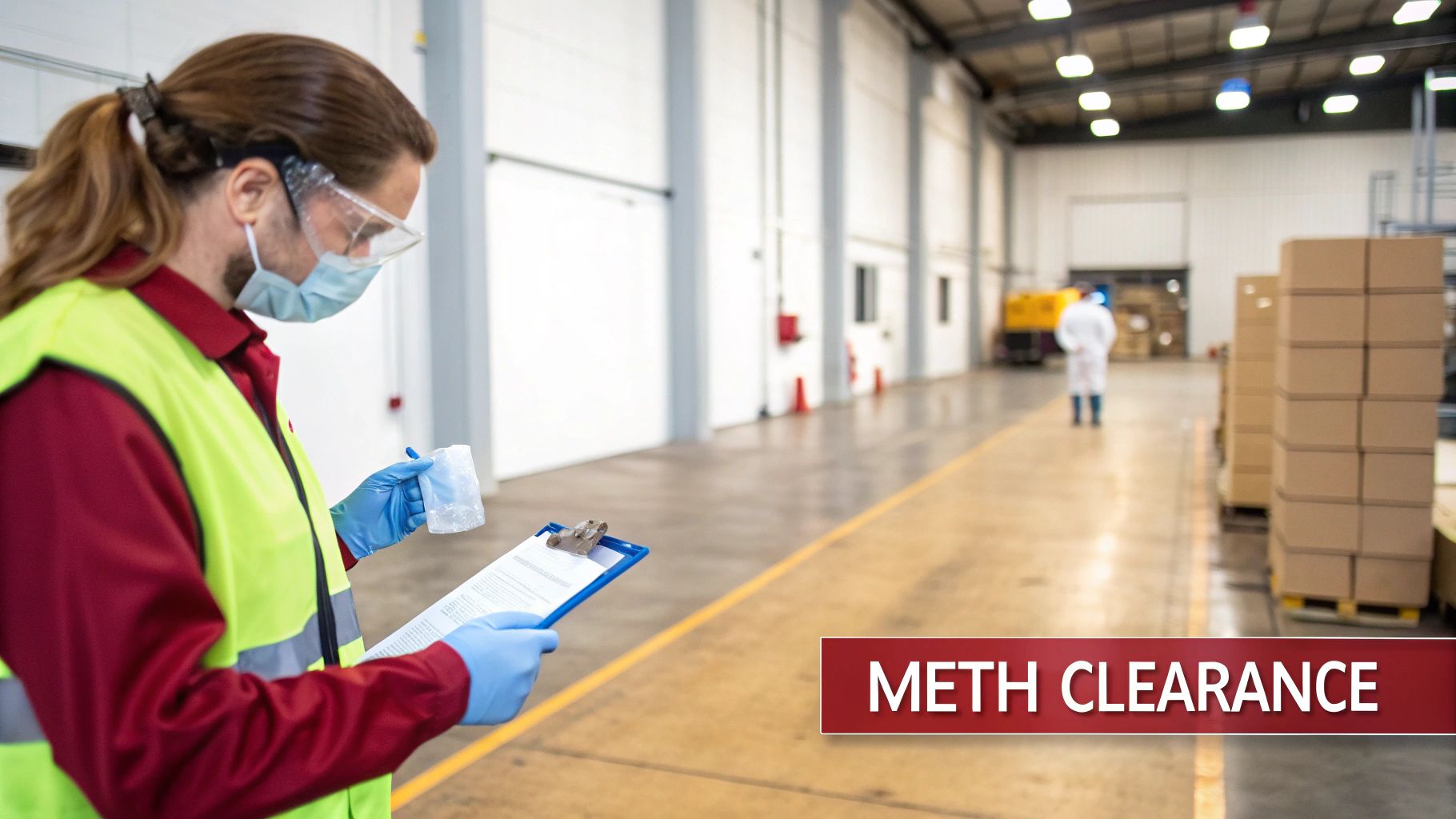
The invisible chemical residues left behind from meth use do not simply dissipate. They can settle on surfaces, circulate through HVAC systems, and absorb into porous materials, creating a persistent toxic environment. This hidden danger can cause significant health problems for staff, from skin irritation and respiratory issues to more severe, long-term neurological damage.
The True Cost of Non-Compliance
Ignoring the potential for meth contamination can be a catastrophic decision for any business. The risks are not abstract; they are tangible threats that can severely impact your bottom line and bring operations to a standstill.
- Production Shutdowns: Discovering contamination can trigger an immediate work stoppage, leading to costly downtime and missed deadlines.
- Legal Liability: As an employer, you have a duty of care to provide a safe workplace. If an employee's health is compromised by exposure, your business could face substantial legal and financial penalties.
- Asset Devaluation: A property with a history of contamination that has not been professionally cleared can plummet in value, directly impacting your company's balance sheet.
- Reputational Damage: News of a contamination incident can devastate your brand's reputation with customers, suppliers, and the community.
It's crucial to understand that standard cleaning methods are completely ineffective against methamphetamine residue. This is a specific chemical hazard requiring a scientifically controlled management process, which is precisely why the expertise of an occupational hygienist is indispensable.
The Role of Clearance Testing
This brings us to clearance testing. It is a formal, scientific process conducted after a site has undergone professional decontamination to verify that the remediation was successful. An occupational hygienist develops a stringent sampling plan, collects samples according to precise protocols, and submits them to an accredited laboratory for analysis.
The objective is to confirm that any remaining residue is below the national safety standard of 0.5 µg/100 cm². While meth-specific rules are paramount, a comprehensive hazardous drug handling checklist can provide a broader framework for managing chemical risks in the workplace. Ultimately, the clearance certificate issued by the hygienist is the only definitive proof that you have fulfilled your WHS obligations, safeguarding your people and your business from the hidden fallout of meth contamination.
How Australia's Meth Contamination Standards Came To Be
To fully appreciate the stringent meth regulations in place today, it's helpful to understand their evolution. Australia’s approach was not developed overnight; it emerged from a growing awareness of the latent dangers of meth residue, both in residential homes and, critically, in workplaces.
The transition from a collection of informal guidelines to a clear, science-backed national standard was not merely a bureaucratic exercise. It was a direct response to the genuine health threats posed by invisible contamination. What was once considered a niche issue for real estate is now a fundamental aspect of Work Health and Safety (WHS) across numerous industries.
Essentially, the development of Australia's standards reflects a systematic effort to manage a dangerous chemical hazard, ensuring safety is defined by empirical evidence, not assumptions.
From Vague Guidelines To A Hard Benchmark
In the early stages, defining a "safe" level of meth residue was ambiguous. Differing expert opinions led to confusion and inconsistent decontamination outcomes. This lack of clarity was a significant problem for businesses, as there was no clear benchmark for successful remediation.
The establishment of a nationally recognised, health-based investigation level was a game-changer, providing the necessary clarity for all stakeholders.
The current Australian guideline is set at 0.5 micrograms per 100 square centimetres (0.5 µg/100 cm²). This is not a suggestion; it is the definitive pass/fail criterion that an occupational hygienist for clearance testing uses to declare a site safe for re-occupation.
This single, measurable standard revolutionised the industry. A clean-up was no longer considered complete when a site appeared clean; it was only finished when scientific testing proved it met this strict safety limit. To explore how different states and territories apply these rules, you can delve deeper into state-specific meth testing legislation.
Why The Shift To Strict Standards Was So Important
The adoption of the strict 0.5 µg/100 cm² benchmark was not arbitrary. It was based on an improved scientific understanding of the risks associated with long-term exposure. Researchers determined that even minute, invisible amounts of residue could cause chronic health problems for individuals spending significant time in a contaminated space—the exact scenario for employees at a worksite.
This has been absolutely critical for protecting Australian workers. While meth contamination in buildings began to gain attention in the late 2000s, it was the state-based guidelines in the 2010s that cemented the role of occupational hygienist clearance testing in risk management. Remarkably, these guidelines saw acceptable residue levels become three times stricter in less than a decade.
Consider this: with 67.1% of Australians in the workforce, the majority of people potentially exposed in a contaminated building are workers, not residents. This reality has compelled regulators and insurance companies to demand independent, professional verification after any remediation, especially in high-stakes sectors like mining and manufacturing.
The Workplace Becomes The New Front Line
This evolution in understanding has solidified the need for professional verification. Today’s regulatory landscape acknowledges that the risks in commercial and industrial environments are exceptionally high.
- Complex Environments: An industrial site is far more complex than a simple room. It contains intricate HVAC systems, machinery, and production lines where residue can become trapped and dispersed.
- Legal Defensibility: In the event of a WHS investigation, a clearance certificate from a qualified occupational hygienist serves as legally defensible proof that you have met your duty of care as an employer.
- Worker Confidence: A scientifically verified "all clear" is the only way to genuinely reassure your team that their workplace is safe, helping to prevent disputes and maintain morale.
Ultimately, the standards evolved because our understanding of the problem did. Australia now has a world-class framework that prioritises scientific proof, making it clear that when it comes to workplace safety, there is no room for guesswork.
What An Occupational Hygienist Actually Does
When facing a potential methamphetamine issue, you need more than just someone with a testing kit. The complexity of modern workplaces and the stringency of meth regulations demand a genuine scientific expert. This is where an occupational hygienist for clearance testing becomes essential, and their expertise is vastly different from that of a basic sampling service.
An occupational hygienist is a scientist trained to anticipate, recognise, evaluate, and control workplace health hazards. Think of them as a detective for anything that could make your employees sick. While a technician might simply take a sample, a hygienist understands the entire context—how a substance like meth aerosolizes, how it deposits on various surfaces, and where it is most likely to concentrate.
Their entire methodology is based on a systematic, four-step scientific process. This framework ensures that the testing is professional, legally defensible, and not just a superficial exercise.
Anticipating and Recognising Hazards
The first two steps—anticipation and recognition—are about proactive risk assessment. A skilled hygienist begins considering potential issues long before arriving on site. They will analyse your business operations, the building's layout, and even typical human behaviour to predict likely contamination points. For example, in a transport depot, they know from experience that residue is more probable in truck cabs or staff break rooms than in a large warehouse bay.
Once on-site, their training allows them to identify subtle clues that others might miss. This is not about looking for drug paraphernalia but about understanding how the HVAC system distributes air, identifying high-touch surfaces that pose a greater risk, or noting porous materials that could have absorbed contaminants. This initial walk-through is critical; it informs the development of an effective testing strategy that targets the actual areas of risk.
Evaluating and Controlling Risks
This is where the hard science comes in. The evaluation stage is the core of what an occupational hygienist does during clearance testing. They do not swab surfaces randomly; they create a sampling plan that is both statistically valid and legally defensible.
This typically involves:
- Strategic Sample Locations: Pinpointing the exact spots to test based on their initial risk assessment, ensuring coverage of hotspots like ventilation returns, shared equipment, and common areas.
- Correct Sampling Methods: Using discrete sampling as mandated by Australian standards. Each 100cm² area is tested individually to provide precise results that are not diluted by combining samples.
- Understanding Toxicology: Interpreting laboratory reports in the context of human health. They understand what the 0.5 µg/100 cm² limit means for worker safety and can explain these risks in clear, understandable terms.
Finally, the control phase is about providing a solution. If contamination is confirmed, the hygienist offers independent, expert advice on remediation. They can review a decontamination contractor’s proposed plan to ensure it is scientifically sound and, most importantly, will return to perform the final, independent clearance testing to verify that the site is truly safe.
An occupational hygienist doesn't just give you a "pass" or "fail" certificate. They deliver a comprehensive risk assessment, a scientifically robust testing process, and the final verification you need to prove you've met your duty of care under Australian WHS laws.
The Critical Difference A Hygienist Makes
Here’s a simple analogy: hiring a basic testing technician is like getting a blood pressure reading without a doctor to interpret it. The technician provides a number, but the hygienist explains what that number means for the health of your workplace and what actions are necessary. To gain a broader perspective on their responsibilities, you can explore in detail what an occupational hygienist does across various industries.
In high-stakes industrial environments, this distinction is not just beneficial—it's non-negotiable. An occupational hygienist's deep knowledge of toxicology, risk assessment, and Australian meth regulations is your assurance that the clearance process is thorough, defensible, and genuinely protects your team. They provide the scientific certainty that your business is not just clean, but verifiably safe.
Your Step-By-Step Guide To The Clearance Testing Process
Discovering potential meth contamination can be incredibly stressful, but the subsequent clearance testing is a logical, step-by-step scientific process. For anyone in a WHS or management role, understanding this workflow is crucial for managing downtime and fulfilling your obligations under Australia’s meth regulations.
An occupational hygienist for clearance testing does not simply show up and take random swabs. They execute a systematic plan from start to finish, designed to deliver legally sound and scientifically valid results. Think of it as a meticulous safety audit for your building's health, where each stage builds upon the last to confirm a remediated area is genuinely safe for your team.
Stage 1: The Initial Site Assessment And Sampling Plan
The entire process begins not with a swab, but with a robust strategy. A qualified occupational hygienist will first conduct a thorough on-site assessment. They will walk the site, consult with relevant staff, and review any incident reports to understand the history and layout of the potentially affected area.
This initial reconnaissance is vital. The hygienist uses their expertise to identify high-risk zones, considering factors like HVAC airflow, common areas, and frequently touched surfaces. Based on this professional evaluation, they create a formal Sampling and Analysis Quality Plan (SAQP). This document serves as the blueprint for the entire project, detailing:
- Sample Locations: Pinpointing the exact spots to test for a truly representative overview of the area.
- Number of Samples: Calculating the appropriate number of samples to ensure the results are statistically significant.
- Sampling Methodology: Specifying the use of discrete sampling, a mandatory requirement under Australian guidelines for post-remediation testing.
This detailed planning ensures the testing is targeted and scientifically robust, not merely a speculative exercise.
Stage 2: Meticulous Sample Collection
Once the sampling plan is finalised, the hygienist proceeds with collecting the physical samples. This is a precise and carefully documented phase of the process. In accordance with Australian standards, each sample is collected from a discrete 10 cm x 10 cm area.
The core skills of an occupational hygienist are evident here, as they move from anticipating risks to scientifically evaluating and finally controlling them.
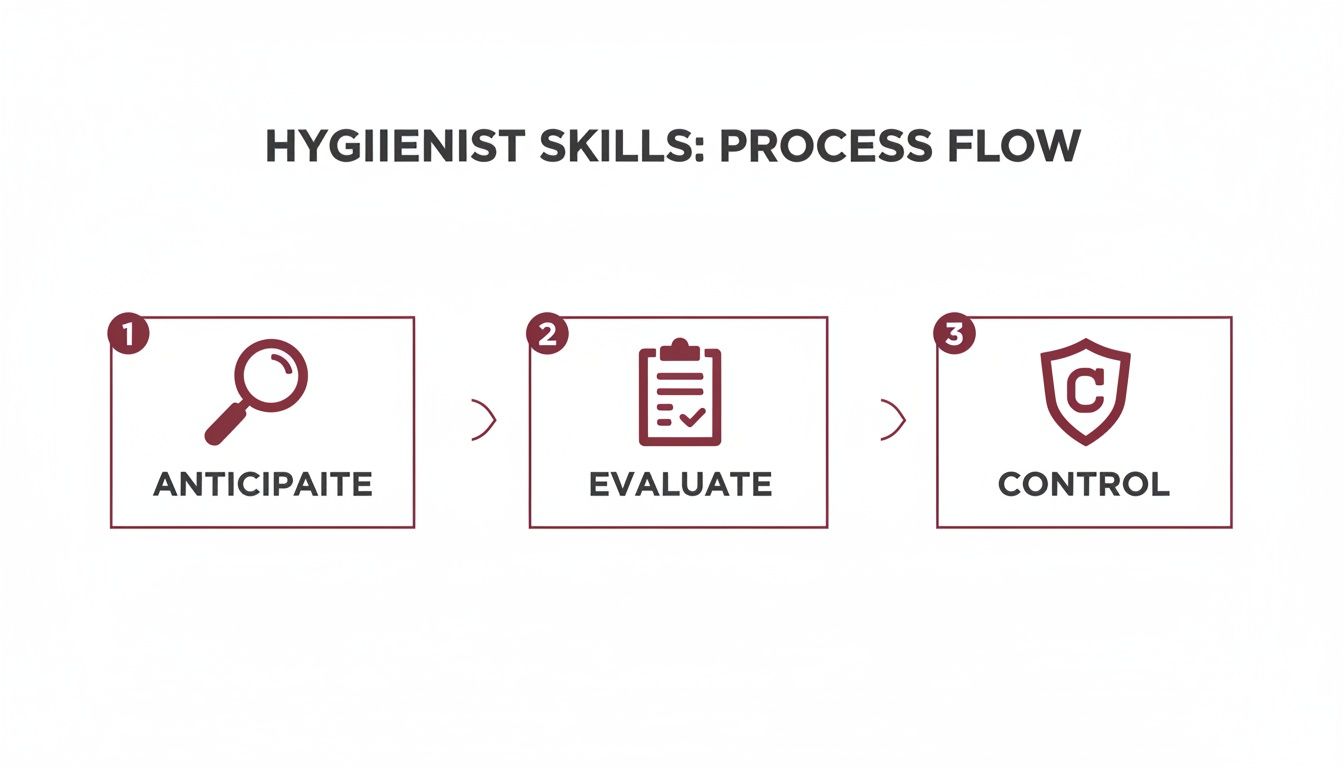
This methodical approach is essential for maintaining the integrity of the process from start to finish.
It is also important to understand the distinction between discrete and composite sampling. While composite sampling—where multiple swabs are combined into a single test—may seem like a cost-saving measure, it is not compliant for post-remediation verification in Australia. This is because it can dilute a hotspot and produce a misleadingly low result. A true expert will always use discrete samples for the final clearance to obtain an accurate reading for each specific area.
This table outlines the typical workflow an occupational hygienist follows.
Key Stages Of A Meth Clearance Testing Project
| Stage | Key Activities | Purpose |
|---|---|---|
| 1. Site Assessment | On-site walkthrough, review of site history, identification of high-risk areas. | To develop a targeted and scientifically valid sampling plan (SAQP). |
| 2. Sample Collection | Precise swabbing of 10×10 cm discrete areas as per the SAQP. | To gather physical evidence from specific locations for laboratory analysis. |
| 3. Lab Analysis | Samples are sent to a NATA-accredited lab for analysis using methods like LC-MS. | To accurately measure the quantity of methamphetamine residue on each swab. |
| 4. Data Interpretation | Hygienist compares lab results against the national standard of 0.5 µg/100 cm². | To determine if the area passes or fails the safety threshold. |
| 5. Final Reporting | A comprehensive clearance report is issued with all findings and conclusions. | To provide official, legally defensible documentation that the area is safe. |
Each step is a critical link in the chain, leading to a reliable and definitive outcome.
Stage 3: NATA-Accredited Laboratory Analysis
After collection, every sample is carefully labelled, recorded in a chain-of-custody document, and securely transported to a NATA-accredited laboratory. This accreditation is non-negotiable; it is your guarantee that the laboratory operates under strict national standards for quality, accuracy, and impartiality.
At the lab, scientists employ sophisticated analytical techniques such as liquid chromatography-mass spectrometry (LC-MS) to measure the amount of methamphetamine residue on each individual swab. The results are reported in micrograms (µg), providing the hygienist with the hard data required for the final assessment.
Stage 4: Interpreting Results And The Final Report
The laboratory provides the raw data, but it is the occupational hygienist's responsibility to interpret it. They take the result from each sample and compare it against the nationally recognised safety benchmark. You can learn more about the specifics of the meth clearance testing standard of 0.5 µg/100 cm² and why this threshold is so important.
If every single sample returns a result below this limit, the hygienist will issue a comprehensive clearance report. This is much more than a simple pass/fail certificate. It is a detailed document that includes the initial sampling plan, site photographs, laboratory results, and the hygienist’s final expert conclusion that the area is safe for re-occupation.
This report is your official record of due diligence. Just as in other areas of workplace safety where adherence to strict testing procedures like fire door drop testing protocols is essential, this final, documented verification is the crucial last step that officially closes the loop on a contamination event.
Why Meth Contamination Is a Real Risk in Aussie Workplaces
When most people think about meth regulations, their minds jump to rental properties or clandestine labs. But the truth is, Australian workplaces are a massive, and often overlooked, hotspot for contamination. If you're running a business in mining, construction, or hospitality, the danger isn't just a hypothetical scenario—it's a direct result of drug use patterns in the workforce.
It's a two-pronged problem. You have the immediate safety risk of an employee working while impaired, which could lead to a serious accident. Then there's the invisible threat of environmental contamination, a silent hazard that can put your entire team at risk long after the fact.
The Numbers Don't Lie
The push for professional meth clearance testing in workplaces is backed by some pretty sobering national data. The 2022–23 National Drug Strategy Household Survey revealed that 19% of employed Australians had used an illicit drug in the last year.
When you drill down into specific industries, the numbers get even more concerning. Hospitality workers reported a rate of 28%, construction hit 26%, and the mining sector came in at 24%. These are the very industries that often involve enclosed spaces, remote accommodation, and heavy machinery—all places where secret drug use can easily lead to hidden contamination. You can dig into the specifics by reading the official government survey analysis.
This data really throws two major challenges at employers. First, you've got to deal with the immediate safety issues of impairment. But just as critical is the need to treat any suspected contamination as a serious environmental hazard, which means calling in an occupational hygienist for clearance testing to ensure the site is safe.
The Hidden Danger Left Behind
Most drug and alcohol policies are built to manage people who are actively under the influence, but they completely miss the chemical footprint that gets left behind. When someone uses methamphetamine indoors, the residue doesn't just vanish into thin air.
Invisible meth particles settle on every surface imaginable, from the control panel of a factory machine to the benchtops in the site office kitchen. This residue is incredibly persistent and can pose a real health risk long after the drug use has stopped.
This is exactly why an occupational hygienist is so crucial. They're trained to look for the dangers you can't see.
- HVAC Systems: Tiny meth particles can get sucked into heating, ventilation, and air conditioning (HVAC) units. From there, the system can spread these toxic residues throughout the entire building, exposing people who were nowhere near the original source.
- Porous Surfaces: Materials like office chairs, carpets, unsealed wood, and even concrete can soak up meth residue like a sponge. Over time, they slowly release it back into the air, and a simple wipe-down won't get rid of it.
- Long-Term Health Effects: Ongoing, low-level exposure to these residues can cause some serious health problems for your staff, including respiratory issues, skin irritation, persistent headaches, and even neurological symptoms.
At the end of the day, the stats tell a clear story. Illicit drug use is a real issue in the Australian workforce, particularly in high-risk industries. This makes professional clearance testing more than just a box-ticking exercise; it’s a non-negotiable step to protect your people from an invisible and persistent workplace hazard.
How To Choose A Qualified Provider And Ensure Compliance
When you're dealing with Australia's strict meth regulations, you need more than just a clean-up crew. You need a partnership with a true scientific expert. Choosing the right occupational hygienist for clearance testing is arguably the most important decision you'll make to meet your Work Health and Safety (WHS) obligations and protect your business. Think of it less as an expense and more as a critical investment in risk mitigation.
Getting this wrong can be catastrophic. The costs of failing to engage a qualified expert can spiral far beyond the initial contamination problem, leading to extended operational shutdowns, hefty legal penalties, and lasting damage to your company's reputation. A qualified professional is your assurance that the entire process is scientifically sound, legally defensible, and actually works.
Your Compliance Obligations Under WHS Law
Under Australian WHS law, every employer has a primary duty of care to provide a safe workplace, free from hazards that could cause harm. Make no mistake, methamphetamine residue is legally classified as a chemical hazard. This means if you know or even suspect contamination, you are legally bound to take all reasonably practicable steps to eliminate or minimise that risk.
Bringing in a qualified occupational hygienist is the single most effective way to demonstrate you've met this duty of care. Their independent, scientific verification is the kind of proof that holds up under regulatory scrutiny and shields you from liability.
Checklist For Selecting The Right Expert
Not all testing providers are created equal, and it's crucial you can tell the difference. Use this checklist to vet potential candidates and ensure you're hiring a genuine professional. A true expert will have no problem providing clear answers and evidence for each of these points.
- Professional Certifications: The gold standard is a Certified Occupational Hygienist (COH) credential from the Australian Institute of Occupational Hygienists (AIOH). Don't settle for less.
- Appropriate Insurance: Ask to see their certificates for both Professional Indemnity and Public Liability insurance. This protects your business from any errors or omissions during the assessment.
- NATA-Accredited Lab Use: This is non-negotiable. Confirm they only use labs accredited by the National Association of Testing Authorities (NATA) for sample analysis to ensure your results are legally defensible.
- Industry-Specific Experience: Do they understand your world? Ask about their direct experience in your sector, whether it’s food and beverage, manufacturing, or mining. Different industries face unique challenges that demand specialised knowledge.
A great question to ask is: "Can you provide a separate, independent validation service if we use a different company for the clean-up?" A reputable hygienist will always insist on this separation to avoid any conflict of interest.
The Economic Case For Professional Clearance Testing
For high-stakes industries like manufacturing, aerospace, and pharmaceuticals, meth regulations are directly tied to liability and productivity. The cost of professional clearance testing is a drop in the ocean compared to the financial fallout from a single contamination incident. National data shows drug misuse costs Australian workplaces an estimated $6 billion annually in lost productivity and accidents.
Furthermore, recent workplace drug screening data showed that amphetamine-type substances, including meth, accounted for a staggering 53.2% of all positive tests. When drugs are found, more than half the time it’s meth or a related stimulant—substances directly linked to aggression and safety failures in high-hazard environments. For businesses in these sectors, clearance testing by a qualified hygienist isn't just a compliance task; it's a critical economic decision to prevent shutdowns, recalls, and regulatory investigations.
Got Questions About Meth Clearance Testing? We've Got Answers
Even when you understand the basics, the practical side of dealing with meth regulations can throw up a lot of questions. Getting your head around the specifics of clearance testing can feel like a big task, so let’s clear up some of the most common queries we hear from businesses.
What’s the Difference Between Pre-Remediation and Clearance Testing?
Think of it like this: a pre-remediation test is the diagnostic stage. It’s the initial investigation we carry out to confirm if meth contamination is actually present. If it is, this first round of testing helps us map out exactly where the contamination is and how bad it is, which then dictates the entire clean-up strategy.
A post-remediation clearance test, on the other hand, is the final check-up. This is done by an independent occupational hygienist after the professional decontamination crew has finished their work. The whole point is to scientifically prove that the clean-up worked and the space is safe for people to come back to. We're looking for confirmation that any remaining residue is well below the Australian guideline of 0.5 µg/100 cm².
How Long Does Meth Clearance Testing Actually Take?
While the on-site part of the job can be pretty quick, the full process has a few moving parts. An occupational hygienist can usually collect all the necessary samples from a typical commercial property in a day. But that's just the beginning.
Those samples then have to be carefully transported to a NATA-accredited lab for proper analysis. As a general rule, businesses should budget for about 3-5 business days to get the final, detailed clearance report back from the hygienist. Of course, this can shift a little depending on how complex the site is and how busy the lab is at the time.
A critical point to remember: the hygienist who does the final clearance testing must be completely independent of the company that did the remediation work. This is non-negotiable. It removes any conflict of interest and ensures the results are impartial and can stand up in a legal setting.
Is Professional Clearance Testing a Legal Requirement in Australia?
This is a fantastic question, and the answer isn't a simple yes or no. There isn't one single national law that says, "you must do a clearance test." However, it’s deeply rooted in an employer's duty of care under the Work Health and Safety (WHS) acts in each state and territory.
If you know or even reasonably suspect there’s been meth contamination, just giving the place a wipe-down isn't going to cut it. You have a legal responsibility to make sure the hazard is gone. If you can't prove it with scientific evidence, you could be seen as breaching your WHS duties. Because of this, regulators, insurance companies, and legal advisors all see independent clearance testing by a qualified professional as the standard, expected practice for making a workplace certifiably safe.
Finding your way through the maze of meth regulations to ensure your workplace is genuinely safe takes real expertise. The team at Anitech offers professional occupational hygiene services across Australia, giving you the scientific certainty needed to protect your people and your business. For expert advice and legally sound clearance testing, contact Anitech today.


