
When navigating Australian meth regulations, the critical number is 0.5 µg/100 cm². This isn't just a recommendation; it's the official governmental testing benchmark for methamphetamine contamination. For anyone in property management, industrial safety, or public health, understanding the tactical steps to meet this standard is essential for ensuring a space is safe and compliant. Proving you have met this standard requires a deep dive into not just the 'why' behind the number, but also the scientifically sound NIOSH testing protocols used to verify it.
Decoding Australian Meth Regulations and NIOSH Protocols
In the occupational health and safety field, methamphetamine residue is treated as a serious chemical hazard. While often associated with illicit drug use, the primary workplace concern is the invisible, persistent contamination left behind in buildings, vehicles, and on equipment. This residue can cause significant health problems through skin contact, inhalation, or accidental ingestion, placing a clear duty of care on employers under Australian Work Health and Safety (WHS) laws.
Australia has adopted a strong, proactive stance, aiming to protect workers and the public from these hidden risks. The national guideline establishes a firm action level for surface contamination, providing a clear trigger for intervention.
- The Australian Benchmark: The nationally accepted investigation level is 0.5 micrograms of methamphetamine per 100 square centimetres (0.5 µg/100 cm²).
- Trigger for Action: A test result at or above this level signifies unacceptable contamination. This immediately triggers the need for professional remediation and subsequent clearance testing to verify decontamination.
- Legal Standing: Initially a guideline, this threshold is now so widely adopted by state health and safety regulators that it functions as the de facto standard for demonstrating due diligence and ensuring compliance.
Why NIOSH Methods Are the Gold Standard
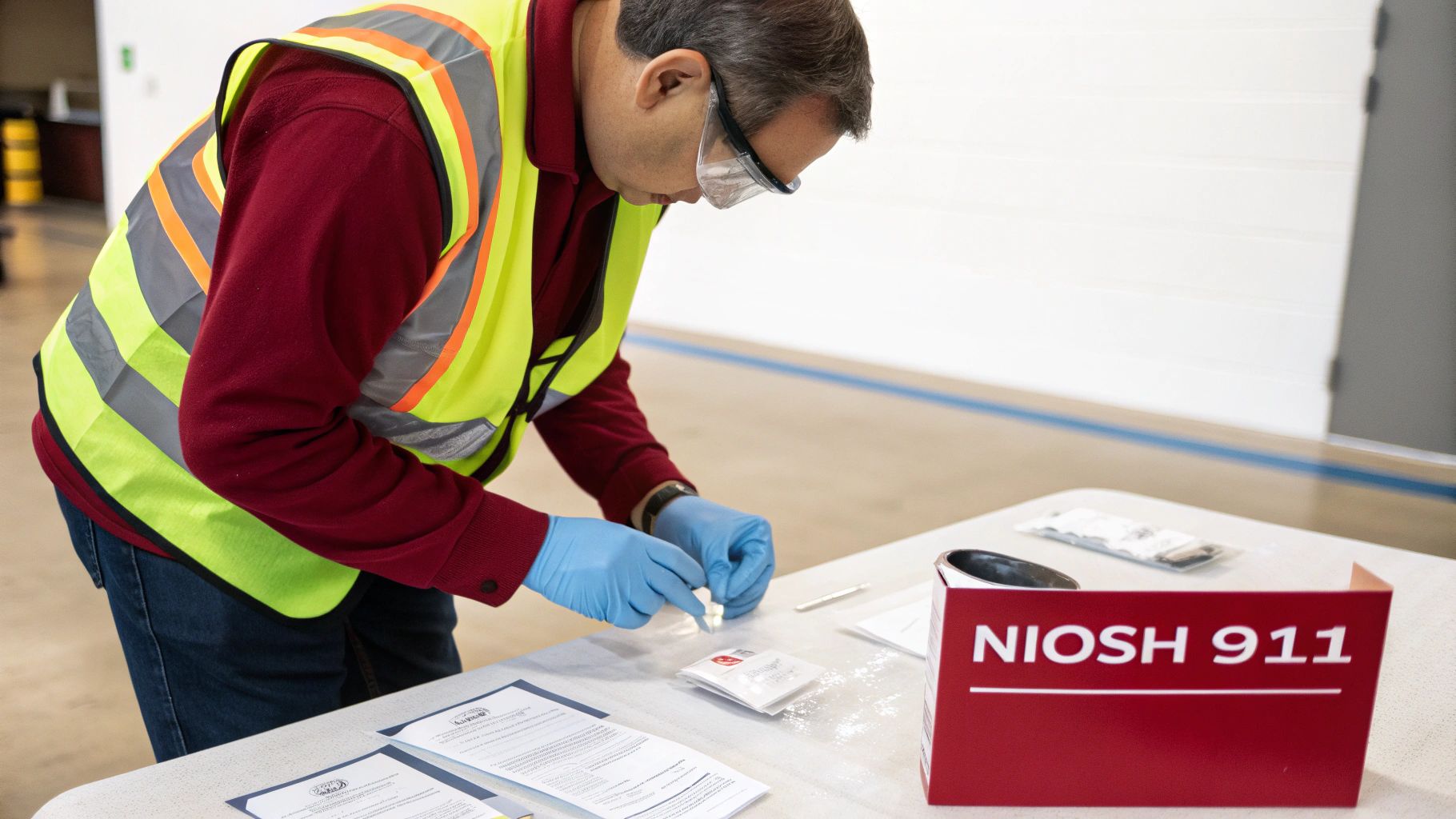
Achieving scientifically accurate, legally defensible results is about the methodology. This is where the National Institute for Occupational Safety and Health (NIOSH) protocols are indispensable. NIOSH provides internationally respected, peer-reviewed methods for sampling and analysing various workplace contaminants.
For methamphetamine, NIOSH Method 9111 is the undisputed industry standard. It outlines a meticulous process for wipe sampling that ensures every test is consistent, reliable, and repeatable. This is why it is the required method for occupational hygienists and NATA-accredited laboratories across Australia. Its precision is critical for confidently declaring a site safe and meeting regulatory expectations.
The core principle is simple: You cannot manage a risk you cannot accurately measure. NIOSH 9111 provides the robust, scientific framework needed to quantify methamphetamine residue, turning an invisible threat into actionable data.
The National Picture of Testing Practices
Australia's approach is notably cautious from a global perspective, highlighting our national commitment to occupational and public health. This strictness underscores the importance of rigorous testing.
A 2021 study of Australian testing firms confirmed that NIOSH Method 9111 was the most frequently cited guideline for sampling. Professionals prefer it because it standardises the collection process—a precise wipe over a 10 cm x 10 cm area—and pairs it with analysis via liquid chromatography/mass spectrometry (LC/MS) for unmatched accuracy. This combination ensures that results are both reliable and comparable across different sites and practitioners.
For those who wish to delve deeper into the science behind the protocols and research, mastering the art of reading scientific papers is a valuable skill. A solid understanding of these foundational documents empowers professionals to navigate compliance effectively.
The following table summarises how official Australian governmental testing procedures align with the recommended NIOSH protocol, providing a clear reference for ensuring your testing strategy is compliant.
Australian Meth Contamination Guidelines vs NIOSH Protocol
| Parameter | Australian Guideline | Recommended NIOSH Protocol |
|---|---|---|
| Surface Contamination | 0.5 µg/100 cm² | NIOSH Method 9111 |
| Sampling Area | 10 cm x 10 cm (100 cm²) | Specifies wipe sampling over a 100 cm² area |
| Analysis Method | Laboratory analysis | Liquid Chromatography/Mass Spectrometry (LC/MS) |
Ultimately, using NIOSH Method 9111 isn't just best practice; it is the most reliable way to confirm that a site meets the stringent 0.5 µg/100 cm² standard, protecting both people and your organisation from liability.
Developing a Strategic Methamphetamine Sampling Plan
Before a single sample is taken, a robust plan is required. A well-designed sampling strategy is your best defence against inaccurate results and wasted resources. This is not a mere administrative exercise; it is the foundation of your entire compliance program, ensuring every action is deliberate, defensible, and aligned with NIOSH protocols.
The real work begins long before a sample kit is opened. It starts with a thorough investigation of the site's history and an understanding of potential contamination pathways. A smart strategy saves time and resources, yielding data that can withstand scrutiny.
The All-Important Preliminary Site Walk-Through
Your first action on site should always be a thorough inspection. The objective is to identify potential contamination hotspots based on known methamphetamine residue behaviour and accumulation patterns. This is a methodical search for high-risk zones, not a casual stroll.
During the walk-through, focus on these key areas:
- Ventilation Systems: Examine air conditioning units, heating vents, and exhaust fans. These systems are notorious for distributing and concentrating airborne residue particles.
- Non-Porous Surfaces: Pay close attention to hard, smooth surfaces where residue settles and persists. This includes benchtops, tiles, metal fixtures, and sealed concrete floors.
- Communal and Hidden Areas: Inspect beyond the main work areas. Check shared spaces like break rooms, kitchens, and bathrooms. Crucially, inspect out-of-the-way spots—inside cupboards, on top of door frames, and along skirting boards where dust accumulates.
A common mistake is testing only obvious, high-traffic areas. Often, the highest concentrations are found in quiet, undisturbed corners where residue can settle and accumulate without being removed by routine cleaning.
Discrete vs. Composite Sampling: Choosing Your Approach
After assessing the site, you must decide on your sampling method. The choice between discrete sampling and composite sampling depends on your objective.
Discrete sampling involves one wipe for one specific location, providing a precise contamination level for that exact spot. This is the preferred method for investigating a known spill or confirming suspected contamination in a targeted area identified during your walk-through. For instance, a discrete sample from a specific workbench can provide a definitive result.
Composite sampling is an efficiency-driven approach. It involves taking multiple wipes (typically up to four) from different locations and combining them into a single sample for laboratory analysis. This method is effective for screening large areas, like an entire warehouse floor, cost-effectively. It provides an average contamination level for the combined area. However, if a composite sample returns a positive result, you must then conduct discrete sampling to pinpoint the exact source of contamination.
Document Everything: The Chain of Custody
A rock-solid chain of custody is non-negotiable. This formal document creates an unbroken paper trail, tracking each sample from collection to analysis. It meticulously records who handled the sample, when, and for what purpose.
A proper chain of custody form must include:
- Unique sample identification numbers.
- The exact date and time of collection.
- A clear, unambiguous description of the sample location (e.g., "Kitchen benchtop, 1m from sink").
- The name and signature of the sample collector.
This documentation serves as evidence that samples were handled correctly and their integrity was maintained. Without it, even the most accurate lab results can be challenged. To understand the entire process in more detail, learning how does meth testing work is crucial. This paperwork is fundamental to ensuring your compliance efforts are defensible.
Putting Your Plan into Action: On-Site NIOSH-Compliant Wipe Sampling
With your sampling plan finalised, it's time for fieldwork. This is where your theoretical knowledge of meth regulations and NIOSH testing protocols is put into practice. Executing on-site wipe sampling correctly is non-negotiable; every detail matters for collecting data that is accurate, reliable, and legally defensible.
The precision demanded by NIOSH Method 9111 exists for a reason: to produce consistent, repeatable results, regardless of the sampling environment. From personal protective equipment (PPE) to the specific wiping technique, each step is critical to sample integrity.
The NIOSH 9111 Wiping Technique: A Step-by-Step Guide
At its heart, NIOSH 9111 is about a standardised wipe sampling process. This is not a quick swipe but a methodical procedure designed to collect all available residue from a specific area.
First, you must measure and delineate a 10 cm x 10 cm (100 cm²) square on the surface. Use a disposable template and a marker that will not interfere with the sample analysis. This precise area is crucial, as Australian regulatory limits are based on contamination levels per 100 cm².
With the area marked, you can begin wiping. Using a NIOSH-compliant wipe wetted with a solvent like methanol or isopropanol, the technique is highly specific:
- First Pass: Press firmly and wipe the entire 100 cm² area with overlapping, parallel strokes in an 'S' pattern from top to bottom.
- Fold: Carefully fold the wipe in half with the used side facing inward. This traps collected residue and exposes a fresh surface.
- Second Pass: Rotate the template 90 degrees. Wipe the same area again with the clean side of the folded wipe, using an 'S' pattern from side to side.
- Store It: Fold the wipe one last time (used side in) and place it immediately into a sterile, pre-labelled sample vial. Seal it securely.
Adhering to this structured process is fundamental for ensuring maximum residue collection and compliance with NIOSH protocols.
This flowchart illustrates the key stages, from the initial site walk-through to final chain of custody documentation.
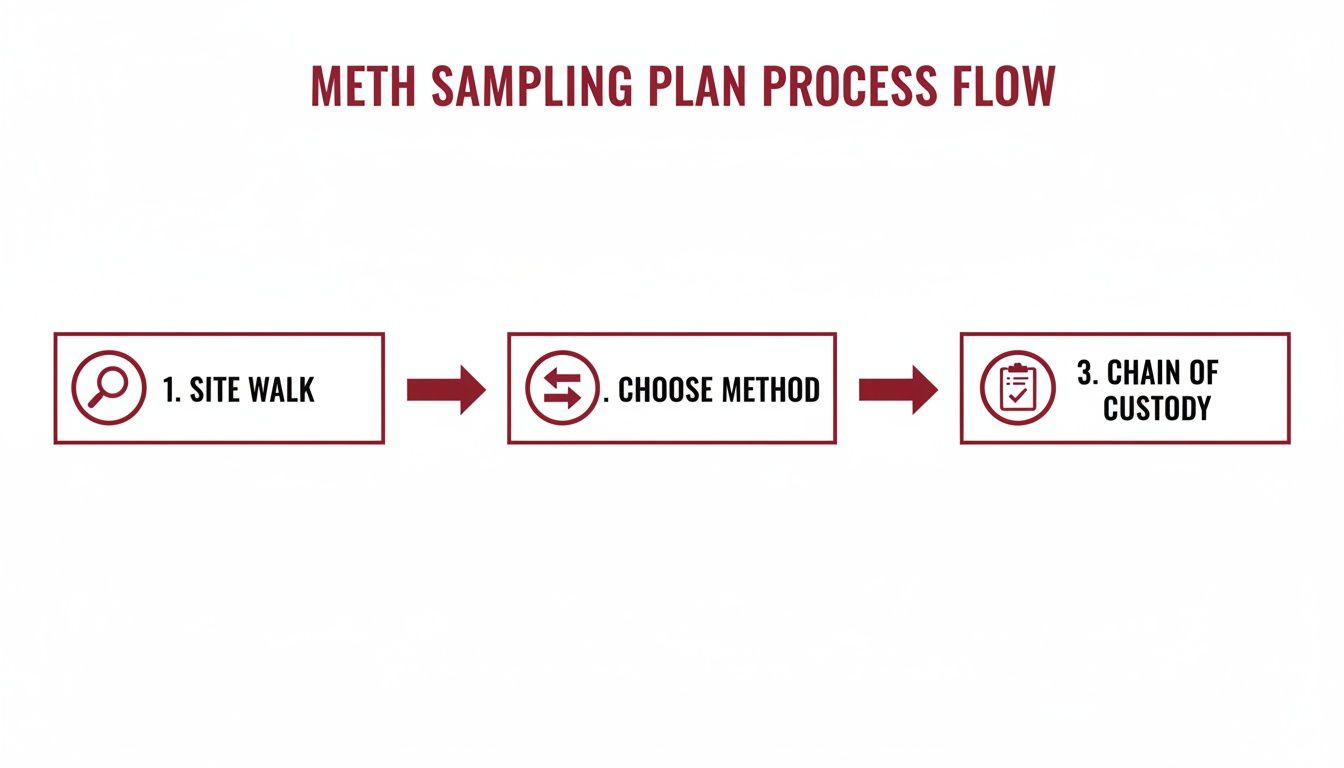
As the visual demonstrates, proper sampling is a systematic journey where each step builds upon the last to ensure data integrity.
Field Tips for Bulletproof Sampling
Beyond the official procedure, several field-tested practices can significantly impact the quality of your samples. These are learned through experience.
Tailor Your PPE to the Site
Not all sites carry the same risk. The PPE for a dusty workshop differs from that needed in a clean office, but skimping is never an option.
- Dusty/Dirty Environments: Disposable coveralls, booties, and at least a P2 respirator are recommended to avoid inhaling contaminated dust.
- Cleaner Environments: Nitrile gloves are the bare minimum. The most important rule is to change gloves between every single sample to prevent cross-contamination.
Documentation is Everything
Your field notes and photographs must be as meticulous as your sampling technique. A detailed photo log is invaluable. For each sample, capture an image of the location showing the template and the sample ID. This creates an unassailable visual record tying the vial to its exact origin.
Laboratories have rejected samples because the ID on the vial did not perfectly match the chain of custody form. It’s a costly rookie mistake. Always double-check every number and detail before sealing the sample bag.
This level of diligence is critical. NIOSH Method 9111 is the gold standard for surface testing for good reason, and guidance like the Environmental Health Australia Voluntary Code of Practice specifically warns against bad practices like improperly averaging composite samples, which can mask a genuine hazard.
By following these hands-on steps, you can be confident that your samples are not only compliant with meth regulations but are also robust enough to withstand the scrutiny of any NATA-accredited laboratory. This disciplined approach ensures your results accurately reflect the site’s condition.
Picking the Right Lab and Nailing Your Quality Control
Your fieldwork can be flawless, but if the laboratory analysis is subpar, the effort is wasted. The integrity and legal defensibility of your results depend on two factors: selecting a competent laboratory partner and implementing rigorous Quality Assurance and Quality Control (QA/QC) in the field.
Think of your samples as evidence collected from a scene and the lab as the forensic team. You need an expert you can trust, one whose processes are as stringent as your own. In Australia, NATA accreditation is the starting point.
How to Properly Vet a NATA-Accredited Lab
For any laboratory analysing methamphetamine samples in Australia, NATA accreditation is the minimum requirement. It certifies that the lab meets strict technical and quality benchmarks. However, not all NATA-accredited labs are equal, particularly concerning NIOSH 9111.
When selecting a lab, go beyond price. Ask probing questions to assess their expertise.
- Real-World Meth Experience: Ask how many NIOSH 9111 samples they process monthly. A high-volume lab likely has refined methods and experienced analysts.
- Realistic Turnaround Times: Can they meet your project's timeline without compromising quality? Clarify their standard and priority service options.
- Clear, Usable Reports: Request a sample report. Is it easy to interpret? Does it clearly present the results against the Australian action level of 0.5 µg/100 cm²? A confusing report is a liability.
- Access to a Human Expert: Can you speak with a technical specialist if you have questions about the results? This support is invaluable.
Choosing the right lab is about finding a partner who enhances your compliance position. They should function as an extension of your team, providing results you can confidently stand behind.
Your Secret Weapons: Field Blanks and Duplicate Samples
Quality control begins on-site. Integrating QA/QC samples into your plan is how you prove your data is reliable. These samples validate the integrity of the entire process, from sample collection to laboratory analysis.
The most critical QC samples are field blanks, duplicates, and sometimes spikes.
Here’s a quick rundown of essential QA/QC samples.
Essential QA/QC Samples for NIOSH Testing
| QC Sample Type | Purpose | Implementation Protocol |
|---|---|---|
| Field Blank | Checks for contamination introduced during sampling, transport, or from the sampling media itself. | Take a clean wipe from the same batch. Handle it exactly like a real sample (uncap, expose to air, recap) but do not wipe any surface. |
| Duplicate Sample | Confirms the consistency of your sampling technique and the lab's analysis. | Take two separate samples from the exact same surface area, right next to each other. The results should be very close. |
| Spike Sample | Verifies the lab's ability to accurately recover a known amount of methamphetamine from the sample media. | You provide a blank wipe to the lab, and they "spike" it with a known concentration of meth before analysing it. |
Incorporating these samples is about building a robust, defensible data set.
A clean field blank and closely matching duplicate results are your best defence. They prove you have exercised due diligence and add a powerful layer of credibility to your findings.
When dealing with complex workplace hazards, a solid framework is paramount. For advice on broader safety strategies, the expertise of experienced occupational hygiene consultants can be invaluable in creating a comprehensive health and safety program.
Making these QA/QC steps a non-negotiable part of your routine is what elevates a simple test to a verifiable, high-integrity compliance process.
Making Sense of Lab Results and Taking Action
The arrival of the lab report is the moment of truth. Sifting through technical data can seem daunting, but this is where your meticulous planning culminates. This document provides the objective evidence needed to make informed decisions, protect personnel, and ensure organisational compliance.
Ultimately, every result must be compared against the single critical benchmark: the Australian action level of 0.5 micrograms per 100 square centimetres (0.5 µg/100 cm²). This is a hard line with no room for ambiguity.

Reading the Report: What to Look For
When you open a report from a NATA-accredited lab, focus first on the summary table of results. This section contains the core findings, typically organised by sample ID.
For each sample, identify two key pieces of information:
- Sample ID: This connects the lab result directly back to a specific location on your site map and the corresponding entry on your chain of custody form.
- Methamphetamine Concentration: This is the crucial figure, reported in µg/100 cm². It quantifies the level of contamination detected on that surface.
You will also see the lab’s limit of detection (LOD). A result reported as <LOD or "Not Detected" is excellent news, meaning any contamination present is below the instrument's measurement capability.
Three Common Scenarios and Your Next Steps
Your lab results will typically fall into one of three categories. Your response to each is critical for maintaining compliance with Australian meth regulations.
Scenario One: Below the Limit
This is the best-case scenario. When all samples, including your field blanks, return results well under the 0.5 µg/100 cm² threshold, you have confirmation that the area is safe and compliant.
Your work is not quite finished. Documentation is key.
- Build a Compliance File: Consolidate the final lab report, chain of custody forms, site sampling plan, and photo log into a single, organised file.
- Report Formally: Draft a clear summary for management or the safety committee, stating that the area was tested according to NIOSH protocols and found compliant with national guidelines.
- Archive it Securely: This complete record is your proof of due diligence and will be invaluable if questions arise later.
Scenario Two: Clearly Above the Limit
A result at or above 0.5 µg/100 cm² is an immediate call to action. It confirms a hazardous level of contamination, and you must move quickly to control the risk.
Once you have a confirmed positive result, the area is a known hazard. Your legal duty of care under WHS law requires you to control access and begin remediation without delay.
Your next steps are non-negotiable:
- Isolate the Area: Immediately restrict all access to the contaminated zone using physical barriers and clear signage.
- Engage a Remediation Specialist: Hire a professional contractor with proven experience in methamphetamine decontamination. This is not a task for an in-house cleaning crew.
- Communicate Upwards: Alert management and safety leadership immediately. Provide the report and a brief on your containment and remediation plan.
Scenario Three: Uncomfortably Close to the Limit
What if a result is technically compliant but close to the limit, such as 0.4 µg/100 cm²? This is a major red flag. It indicates that contamination is present and could easily be higher in an adjacent, unsampled spot.
In this situation, a proactive approach is the best defence. Revisit your initial risk assessment. It may be prudent to conduct more targeted sampling in the immediate vicinity to identify a potential hotspot.
Whatever you decide, document your reasoning carefully. Demonstrating that you recognised the potential risk and took considered, additional steps to investigate it reflects a mature and responsible approach to safety management.
Answering Your Questions on Meth Regulations and NIOSH Protocols
Navigating potential meth contamination raises numerous questions. The landscape of meth regulations and NIOSH testing protocols is filled with technical jargon and legal duties that can be daunting. Here are practical answers to the most common questions.
What's the Difference Between a Presumptive Test and NIOSH Wipe Sampling?
A presumptive test is an initial, on-the-spot screening tool, like a colour-change kit, designed for a quick 'yes' or 'no' indication of meth residue. They are useful for a preliminary assessment.
However, they have significant limitations. They are qualitative, not quantitative—they cannot tell you how much contamination is present. They are also prone to false positives from common household substances.
A NIOSH wipe sample is a precise, scientific analysis. A sample is collected from a specific 100 cm² area and sent to a NATA-accredited lab for quantitative analysis using advanced equipment like liquid chromatography/mass spectrometry (LC/MS).
The bottom line: To prove legal compliance in Australia, only a quantitative lab result from a NIOSH-compliant method is sufficient. A presumptive test can guide your investigation, but it can never replace a proper wipe sample for making safety and remediation decisions.
Are Australian Meth Regulations Mandatory for All Workplaces?
This is a critical point. The 0.5 µg/100 cm² action level originates from national health-based guidelines, not a single standalone "meth law." However, this does not make it optional in a professional context.
Under the Work Health and Safety (WHS) Act, which applies in every state and territory, employers have a primary duty of care to eliminate or minimise health and safety risks so far as is reasonably practicable. Methamphetamine residue is classified as a chemical hazard.
Therefore, adhering to the national guidelines has become the accepted industry standard for demonstrating compliance with WHS obligations. Regulators and courts use these guidelines as the benchmark for what a reasonable and responsible entity would do.
Can We Do NIOSH Testing In-House, or Do We Need a Professional Hygienist?
While NIOSH methods are publicly available, correct execution requires technical skill far beyond simply wiping a surface.
An experienced occupational hygienist ensures the integrity of your results by providing:
- Smart Sampling Strategy: Knowing precisely where to sample based on a scientific risk assessment.
- Aseptic Technique: Meticulously preventing cross-contamination between samples, as a simple error like failing to change gloves can invalidate an entire batch.
- Rock-Solid Documentation: Correctly completing legally critical documents like chain of custody forms and field notes.
- Built-in Quality Control: Implementing field blanks and duplicates to scientifically validate the entire process.
A minor error in area calculation, wiping pattern, or documentation can render expensive lab results useless. Engaging a qualified professional provides assurance that the process is scientifically sound and legally defensible, yielding data you can trust.
What Happens If Our Worksite Tests Positive for Meth Contamination?
A result at or above the 0.5 µg/100 cm² guideline demands immediate action focused on risk control.
- Secure the Area. Your first priority is to prevent further exposure. Restrict access with physical barriers and clear, unambiguous signage.
- Call in the Remediation Experts. Hire a specialist contractor experienced in methamphetamine decontamination. This requires specific chemicals, equipment, and safety protocols beyond the scope of regular cleaners.
- Verify the Clean-Up. After remediation, an independent hygienist must conduct clearance testing. This involves taking new wipe samples to prove the decontamination was successful and the area is now safely below the action level.
Throughout this process, maintain a detailed paper trail of all actions, from the initial test report to the final clearance certificate. This documentation is your proof of responsible action and fulfilment of your duty of care.
Navigating the complexities of meth regulations and NIOSH protocols requires expert guidance. A qualified occupational hygienist can provide the hands-on support needed to manage workplace health hazards, ensuring your environment is both safe and compliant. Contact a professional today to see how they can help at https://occhygiene.com.au.


