
Navigating the complex and often patchwork regulations for meth contamination standards in 2026 is a critical task for ensuring public safety, property value, and legal compliance. As a high-level pillar resource, this compendium covers the international and regional safety thresholds for methamphetamine residue, which are essential for determining when a property is safe for re-occupation after contamination from either a clandestine lab or heavy user activity. Understanding these global meth regulations is the first step toward effective risk management.
A Global Look at Meth Contamination Thresholds
The health risks from methamphetamine contamination are not confined to residential properties; they present serious, often overlooked, challenges in commercial and industrial environments. Residue from illicit manufacturing or persistent use doesn’t simply vanish. It settles on surfaces, circulates through HVAC systems, and can absorb into building materials, posing a latent threat to anyone occupying the space.
Exposure to these toxic chemical remnants can lead to a host of health issues, ranging from immediate effects like respiratory distress and skin irritation to more severe, long-term neurological damage.
For specialised sectors such as manufacturing, food processing, or aerospace, the stakes are even higher. Contamination can compromise products, damage sensitive and expensive equipment, and necessitate costly shutdowns for decontamination. It is this reality that has prompted governments worldwide to establish safety standards, yet the result is a set of regulations that are far from uniform.
Key Variables in Meth Regulations
As we explore this global compendium, it’s crucial for compliance officers, property owners, and occupational hygiene managers to grasp the core variables that define these regulatory frameworks. The differences between national, state, or even local guidelines can be substantial, influencing everything from how a site is tested to when remediation is legally mandated.
You’ll find that most regulations are structured around a few key components:
- Contamination Limits: This is the cornerstone—the maximum allowable level of meth residue. It’s almost universally measured in micrograms per 100 square centimetres (µg/100cm²), but the specific numerical value can vary wildly between jurisdictions.
- Sampling and Analysis Methods: The rules often dictate precisely how samples must be collected. For instance, they might specify discrete versus composite sampling or mandate certain laboratory analysis techniques to ensure the results are accurate and legally defensible.
- Remediation Triggers: This is the contamination level that legally requires action. If a property tests above this trigger, it must be professionally decontaminated, followed by post-remediation testing to verify the cleanup was successful.
To help you keep these terms straight as we move through different regions, here’s a quick-reference table.
Quick Reference Guide to Key Regulatory Concepts
This table summarises the fundamental concepts you’ll encounter in global meth contamination regulations. Think of it as an at-a-glance overview before we get into the detailed regional sections.
| Regulatory Concept | What It Means | Common Variations to Note |
|---|---|---|
| Contamination Limit | The maximum acceptable level of meth residue on a surface. | Commonly expressed as µg/100cm². Some regions have different limits for residential vs. commercial properties. |
| Remediation Trigger | The specific concentration of meth residue that legally requires professional decontamination. | In some places, this is the same as the contamination limit. In others, there’s a higher “action level.” |
| Discrete Sampling | Collecting one sample from a single, defined area (e.g., a 10cm x 10cm square). | Provides precise data for specific hotspots but can be more expensive than composite sampling. |
| Composite Sampling | Combining multiple samples from different areas into a single sample for analysis. | Used for screening larger areas to reduce lab costs, but can dilute a high reading from a small hotspot. |
| Post-Remediation Verification | The process of re-testing a property after cleanup to confirm it meets the required safety standard. | This is almost always a non-negotiable step to legally declare a property safe for re-occupancy. |
Understanding these concepts is the first step toward navigating the different standards you’ll face globally.
Why Harmonised Standards Matter
The absence of a single, universally accepted standard creates significant challenges for multinational organisations. A company’s internal safety protocols might be perfectly adequate in one country but fall short in another, opening the door to legal action and financial penalties.
A clear understanding of regional meth regulations is not just a compliance exercise; it is a fundamental part of risk management. Failing to adhere to local standards can result in severe penalties, devalued assets, voided insurance claims, and, most importantly, putting people’s health at risk.
This guide is designed to be your central resource, laying the groundwork for the detailed regional analysis that follows. By breaking down these international safety thresholds, we’re giving you an immediate and actionable summary of the critical concepts that govern property safety in 2026. For a deeper dive into cleanup specifics, you can learn more about Australia’s stringent methamphetamine decontamination guidelines.
Australia’s Benchmark for Meth Contamination Standards
When examining meth regulations globally, Australia sets a formidable standard. The country has established one of the most stringent and well-defined frameworks available, making it a critical reference point for our 2026 global compendium. This isn’t a vague set of guidelines; it’s a clear, science-backed approach applied with impressive consistency nationwide.
At the core of the Australian strategy is a very specific post-remediation clearance level. This threshold isn’t merely a recommendation—it’s a hard rule that determines when a property is officially safe for re-occupation after contamination has been identified and remediated.
This strict standard provides much-needed clarity for everyone, from industrial site managers to commercial property owners, by creating a single, uniform safety target for the entire nation.
The 0.5µg/100cm² National Standard
The linchpin of Australia’s meth regulations is the nationally accepted standard of 0.5 micrograms per 100 square centimetres (0.5µg/100cm²). This number isn’t arbitrary. It’s the maximum amount of meth residue that can remain on a surface after a professional decontamination has taken place. It’s a health-based guideline, specifically designed to protect people from the chronic health risks linked to lingering toxic chemical residues.
In any Australian setting—be it a home, a factory, or an office—if meth contamination is found, this is the number that matters. Properties that test above this limit must be professionally remediated to tackle risks like respiratory problems, skin irritation, and the effects of long-term exposure. This is particularly crucial in high-risk sectors like manufacturing and mining. You can explore the background of this standard with additional insights on meth regulations.
Having a single, unambiguous metric like this cuts through the confusion often seen in other countries’ regulations. It doesn’t matter if you’re dealing with a former meth lab or just residue from heavy use; the clean-up target is always the same. To get a better handle on how this works in practice, you can learn more about the application of the 0.5µg/100cm² clearance testing standard in our detailed guide.
Implications Across Commercial and Industrial Sectors
While many people first think of residential properties when they hear about meth contamination, the 0.5µg/100cm² standard is just as vital in commercial and industrial workplaces. Ignoring it can lead to massive financial and operational headaches that go far beyond the initial clean-up bill.
For any business, the consequences of failing to meet this regulation can be severe:
- Asset Devaluation: A property with a history of contamination that hasn’t been properly remediated and certified clean can lose a substantial amount of its value.
- Operational Disruption: Discovering contamination can trigger an immediate work stoppage. This means costly downtime, which is especially damaging in sensitive industries like food processing or aerospace, where the slightest contamination can ruin products.
- Insurance and Liability: Failing to follow the national standard can easily void your insurance policies. More importantly, it exposes the business to huge legal liability if employees or visitors suffer health problems from being exposed.
The Australian standard isn’t just about cleaning a building; it’s about managing risk. For industries handling sensitive materials or complex machinery, ensuring a facility is verifiably free of toxic residues is a fundamental aspect of operational integrity and workplace safety.
This strict, health-first approach serves as a clear model for effective risk management. By establishing a low, non-negotiable threshold, Australian meth regulations put the long-term health of occupants first and give remediation teams a definite target to hit. This clarity is precisely why Australia is such a key reference point as we compare and contrast different international standards.
Mandatory Testing Protocols and Sampling in Australia
Meeting Australia’s strict meth regulations is about more than just hitting a target number. It demands a rigorous, science-backed approach to testing. The entire process for assessing a property is built on getting accurate, reliable, and legally defensible data, a commitment that really sets the Australian framework apart.
The gold standard here is discrete surface sampling. This means taking a sample from a very specific, measured area—almost always a 10cm x 10cm square (100cm²)—using a standardised wipe. Each of these swabs is then individually analysed by a lab, giving you a precise contamination level for that exact spot. This method is absolutely critical for finding where the contamination is hiding.
Why Discrete Sampling is a Non-Negotiable
So, why does this level of detail matter so much? Meth residue doesn’t just spread evenly across a room. It tends to concentrate in hotspots, especially in places with high airflow like air conditioning vents or on surfaces that are touched often.
Discrete sampling gives hygienists the ability to pinpoint these high-concentration zones. In a commercial or industrial setting, this could mean swabbing specific points on a machine, a control panel, or a breakroom benchtop. That kind of precision is what you need to build a remediation plan that actually works because it targets the problem directly instead of just guessing.
The Problem with Composite Sampling
You might hear about another method called composite sampling, where several swabs from different areas are all combined into one container for a single lab test. On the surface, it seems cheaper because you’re running fewer analyses. But it has a massive flaw.
This approach can easily dilute a very high reading from one small, heavily contaminated spot. The result? The combined sample might test below the 0.5µg/100cm² action level, giving you a false sense of security. This dilution effect can lead to a dangerous false negative, leaving significant contamination behind. When it comes to regulatory compliance and legal liability, the defensible data from discrete sampling is the only way to go.
Sticking to NIOSH-Approved Methods
Australian guidelines are firm on using NIOSH-approved methods for both collecting and analysing samples. While NIOSH (the National Institute for Occupational Safety and Health) is a US agency, its validated methods are the international benchmark for accuracy in our field.
Following these strict procedures ensures every test is consistent and the results are comparable, no matter who is doing the work. This standardisation is what makes the data solid enough to stand up in any legal or regulatory review. For a full rundown of the step-by-step process, take a look at our guide on how meth testing works.
Ultimately, testing for meth in Australian workplaces requires this discrete, 100cm² sampling approach. It’s the only way to accurately assess contamination on surfaces like benchtops, vents, and floors and properly apply the 0.5µg/100cm² clean-up guideline. For occupational hygiene teams, sticking to these protocols isn’t just about ticking a box—it’s about genuinely protecting people’s health and maintaining the integrity of the workplace.
A Look at Meth Regulations Around the World
While Australia has a clear, national standard of 0.5µg/100cm², step outside its borders and the picture gets far more complex. For any organisation with a global footprint, navigating the patchwork of international meth regulations is a serious compliance challenge. What’s considered safe in one country might trigger a mandatory, expensive clean-up in another.
This is why the methodology behind testing is so critical. You need results you can stand behind, no matter the jurisdiction.
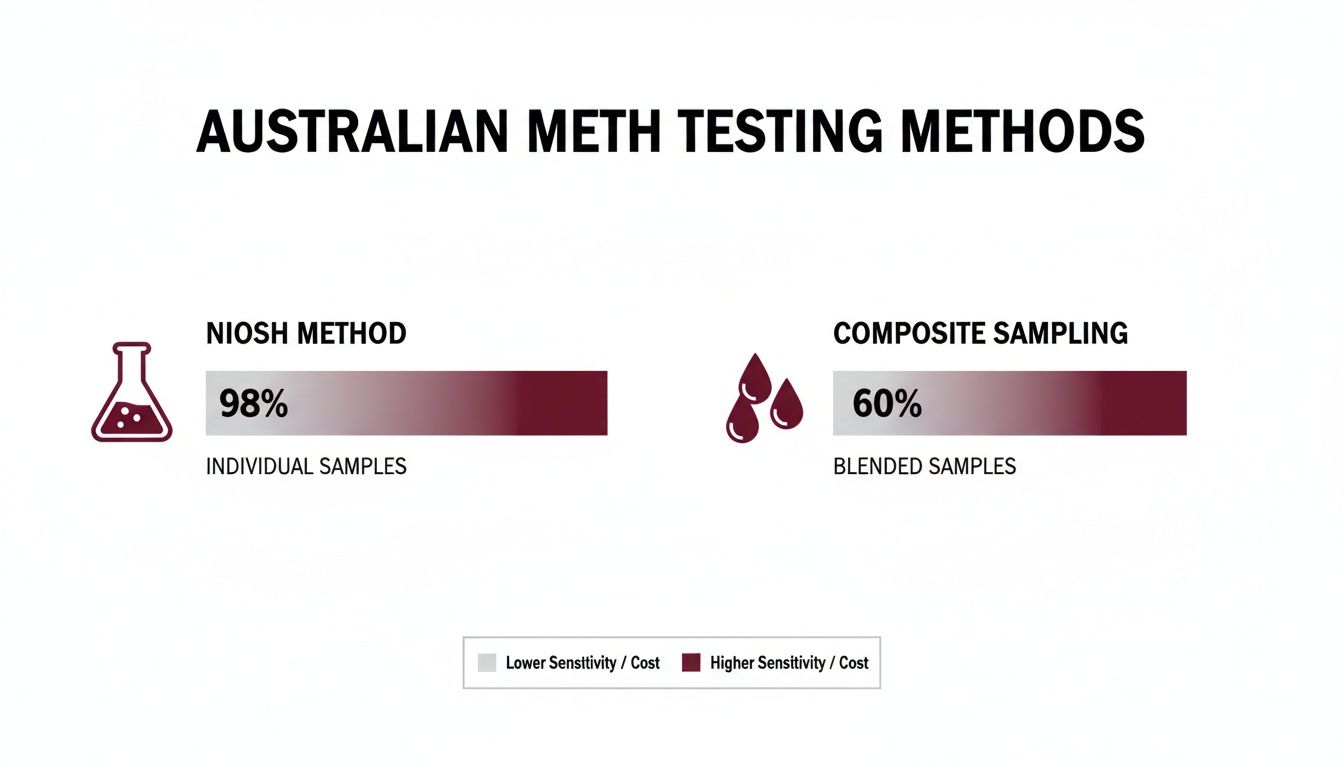
The infographic really drives home why discrete, lab-based sampling is the gold standard. Composite sampling might seem faster or cheaper, but its lower sensitivity means it can easily miss dangerous hotspots and give you a false sense of security.
The Fragmented Landscape of the United States
When it comes to meth regulations, the United States is a patchwork of inconsistency. There’s no single federal standard to follow. Instead, it’s a state-by-state affair, creating a bewildering array of clean-up limits.
You’ll find some states enforcing a highly cautious 0.1µg/100cm², while others are far more relaxed at 1.5µg/100cm². For a business operating across the country, this means a property could be compliant in one state yet require immediate remediation for the same contamination level just one state over. Crafting a uniform internal policy in this environment is almost impossible, so occupational hygiene teams must verify the specific local rules for every single site.
New Zealand’s Distinct Risk-Based Approach
Just across the Tasman, New Zealand has carved its own path with a risk-based model. It used to have a standard similar to Australia’s, but recent updates have brought a more nuanced approach. The main remediation trigger is now set at 1.5µg/100cm² for most properties.
But here’s the clever part: the limit changes based on risk. In high-traffic areas or places where children are present, a stricter limit applies. Conversely, in low-contact areas of a building, the guidance can allow for levels as high as 15µg/100cm². This system channels resources into cleaning the areas that pose the biggest threat to human health, a stark contrast to Australia’s one-size-fits-all rule. It does, however, demand a much more detailed site assessment to apply correctly.
Emerging Guidance in Europe
Europe has traditionally been a blind spot for meth contamination regulations, with no consistent, continent-wide guidance. That’s finally starting to change. As awareness of the problem grows, individual countries are now beginning to develop their own national standards and advisory levels.
These new frameworks are often influenced by the Australian and US models, but they’re very much in their infancy. For companies with a European presence, this means keeping a close eye on developing legislation is absolutely essential. To ensure you’re on the right side of these evolving rules, understanding the requirements for a global compliance certification is a smart move.
The bottom line for any multinational organisation is that a single, rigid corporate policy on meth contamination simply won’t work. A successful strategy has to be flexible, adapting to the unique legal standards, remediation triggers, and sampling protocols required in every jurisdiction.
To help you get a quick handle on these global differences, here’s a summary of the key variations.
Comparing Global Meth Contamination Standards
This table provides a side-by-side comparison, highlighting the key differences in methamphetamine contamination limits across several major regions.
| Region or Country | Standard Limit (µg/100cm²) | Applies To | Key Regulatory Notes |
|---|---|---|---|
| Australia | 0.5 | All properties (Residential, Commercial, Industrial) | A stringent, nationally consistent post-remediation clearance standard. |
| New Zealand | 1.5 – 15 | Risk-based (e.g., high-contact vs. low-contact areas) | A tiered system where the limit depends on the specific use and risk profile of an area. |
| United States | Varies (0.1 – 1.5) | State-specific regulations | A highly fragmented system with no federal oversight; limits vary significantly by state. |
| European Union | Emerging / Varies | No unified standard | Guidance is inconsistent and country-specific, with regulations still under development. |
As you can see, this comparative look at meth regulations and their global compendium of meth contamination standards for 2026 underscores just how crucial localised, expert knowledge is for staying compliant.
Developing a Practical Compliance and Remediation Strategy
Knowing the numbers in the global compendium of meth contamination standards is one thing, but translating that data into a real-world, workable strategy for your business is a whole different ball game. A proactive plan is really the only way to get a handle on the significant operational, financial, and legal risks that come with methamphetamine contamination. This goes well beyond just reacting to a positive test; it’s about building a structured framework for risk assessment, testing, and a swift response.
The bedrock of any solid strategy is a forward-thinking risk assessment. This process is all about identifying which of your assets or areas are most vulnerable, which then tells you exactly where to focus your testing resources. For an industrial site, that might mean prioritising common areas, locker rooms, or even specific machinery where an operator’s behaviour could be a factor.
From there, you need a clear protocol for scheduled testing. This gives you a baseline and helps catch problems before they spiral out of control. Your plan should also lay out the emergency response procedures to kick in the moment contamination is confirmed, ensuring a fast, controlled, and compliant reaction that keeps workplace disruption to a minimum.
The Professional Decontamination Process
When testing confirms contamination above the legal threshold, professional remediation isn’t just recommended—it’s essential. Your standard cleaning crew and products simply won’t cut it. The job demands trained technicians using specialised chemical agents and forensic cleaning techniques to properly neutralise and strip away hazardous residues from every surface, both porous and non-porous.
Australia’s meth decontamination protocols, for instance, enforce a strict post-remediation ceiling of 0.5µg/100cm², a benchmark that’s been in place since around 2015. This is especially critical in sectors like construction and mining, where experts are brought in to conduct efficacy verifications and sign off on a site’s safety. When contamination is severe—often the case with former meth labs producing corrosive byproducts—it necessitates a forensic clean that can run into the tens of thousands. The financial sting is even worse for uninsured operations in food, pharma, or aerospace, where sensitive equipment is at risk.
A typical professional remediation project will follow a few key steps:
- Site Isolation: First, the contaminated area is completely sealed off. This is crucial to stop cross-contamination from spreading to other parts of the facility.
- Removal of Porous Items: Anything that can’t be effectively cleaned, like carpets, soft furnishings, or untreated timber, is often removed and disposed of as hazardous waste.
- Chemical Treatment: Technicians apply specially formulated decontaminating agents designed to chemically break down the methamphetamine residues.
- Forensic Cleaning: This is a painstaking, multi-stage physical clean, wiping down all surfaces to remove the neutralised chemicals and any lingering residue.
- HVAC System Decontamination: The heating, ventilation, and air conditioning systems get a thorough clean-out to ensure they don’t just recirculate contaminants back into the space.
A robust remediation strategy isn’t just about cleaning up a mess; it’s a critical business continuity measure. Executing it properly protects your employees, preserves the value of your assets, and demonstrates due diligence to regulators and insurers alike.
Verification and Documentation Are Key
The final, and arguably most critical, stage is post-remediation verification testing. After the cleaning is done, an independent occupational hygienist must come in to conduct another round of discrete surface sampling. This testing is the only way to prove that the remediation was successful and the area now meets the legal clearance standard, like Australia’s 0.5µg/100cm² limit.
Without this independent verification, you have no legally defensible proof that the property is safe for re-occupancy. It’s absolutely vital to maintain comprehensive documentation, including the initial test results, the remediation contractor’s report, and the final clearance certificate. This paper trail is what protects your business from future liability. For a more detailed walkthrough of what’s involved, have a look at our complete guide to methamphetamine decontamination guidelines.
What’s on the Horizon for Meth Regulations After 2026?
Looking past the current regulatory map, the future of methamphetamine regulations seems to be pointing in one clear direction: greater international alignment. The global compendium of meth contamination standards for 2026 certainly highlights the patchwork of rules we have today, but there’s a definite trend towards harmonisation, pushed along by globalised business and a deeper, shared understanding of the health risks.
This shift suggests that companies working across different countries might soon find themselves dealing with a more consistent, and probably stricter, set of compliance rules. The days of wrestling with wildly different regional requirements could be numbered, replaced by a global baseline standard. This would simplify things in one way, but it would also raise the safety bar for everyone.
How New Science and Health Data Will Shape the Rules
Future changes will undoubtedly be driven by new scientific research. Our knowledge of the long-term health impacts of low-level exposure to meth residue is constantly growing, and you can bet that international health organisations will be watching closely and re-evaluating what they consider a “safe” threshold.
Fresh studies on toxicology and how people are exposed to residues will almost certainly trigger updated guidance. For businesses, this means the standards we’re discussing now—even tough ones like Australia’s 0.5µg/100cm² limit—might not be the last word. Being able to anticipate these changes is crucial for future-proofing your occupational hygiene program.
Smart organisations should treat today’s best-practice standards as a starting point, not a finish line. A truly resilient compliance framework is one that’s built for a future where safety limits will likely get even tighter as more scientific evidence comes to light.
Building a Compliance Program That’s Ready for Anything
To stay ahead of the game, the best thing to do is start embedding best practices into your operations now. Taking a proactive stance means you can adapt to new rules without the headache and expense of a last-minute scramble.
- Go for the Gold Standard: Think about aligning your internal policies with the most stringent regulation out there (like Australia’s) across all your sites. This sets a high safety benchmark that will probably meet or even beat any future harmonised standards.
- Keep Your Team Sharp: Make sure your occupational hygiene and facilities teams get regular, ongoing training. They need to be up-to-date on emerging research, new testing tech, and whispers of regulatory changes.
- Set a Review Schedule: Put a recurring review of your meth contamination management plan in the calendar. This makes sure your procedures stay current and effective as science and regulations evolve.
Taking these steps helps you build an occupational hygiene program that doesn’t just tick the boxes for the meth contamination standards for 2026, but is also agile enough to handle whatever comes next.
A Closer Look at Meth Contamination FAQs
When you’re dealing with meth contamination, a lot of questions come up. It’s a complex area, and it’s easy to feel unsure about the risks and the right steps to take. Let’s break down some of the most common queries we hear from property managers and business owners.
What are the primary health risks of meth residue in a workplace?
Health risks from exposure to meth residue include respiratory problems, skin and eye irritation, headaches, nausea, and dizziness. Long-term exposure, especially for sensitive individuals, can lead to more severe neurological and behavioral issues. The risks are amplified in enclosed spaces and depend on the level and duration of exposure.
How often should an industrial property be tested for meth contamination?
Testing frequency depends on risk factors. For high-risk properties (e.g., rentals, facilities with high staff turnover, or locations in known high-use areas), baseline testing and periodic checks are recommended. A risk assessment should guide the schedule, but testing is crucial before a new lease, after suspicious activity, or as part of a regular workplace safety audit.
Can standard cleaning remove meth contamination?
No. Standard cleaning methods are ineffective at removing or neutralizing toxic meth residues, which can permeate porous surfaces. Professional decontamination by certified technicians using specialized chemical solutions and forensic cleaning protocols is required to ensure the property is safe and compliant with health standards like the 0.5µg/100cm² threshold.
I hope these answers provide some clarity on the key issues. Having the right information is the first step in managing this risk effectively.
Getting this right isn’t just about ticking boxes; it’s about protecting people. The team at Anitech lives and breathes this stuff. We offer the full suite of occupational hygiene services—from risk assessments and professional testing to overseeing the entire remediation process—ensuring your business is not only compliant but genuinely safe. Head over to our website to see how we can help protect your team and your assets.


