
When you're searching for "mask fit testing near me," you're looking for more than just a box-ticking exercise. You're looking for peace of mind. A poorly fitted respirator gives a dangerous, false sense of security, whether you're on a construction site dealing with silica dust or in a hospital facing airborne pathogens.
Let’s be clear: ensuring your mask has a proper seal is your first and most critical line of defence. It’s not just about compliance; it's about staying safe.
Why a Proper Mask Fit Is Your Top Priority
Pulling a respirator out of a box and putting it on is simply not enough to protect you from invisible hazards. Without a perfect seal against your face, contaminated air will find a way in through the gaps, completely bypassing the mask's filter.
This is why professional fit testing is a non-negotiable step for anyone who relies on respiratory protective equipment (RPE) in a high-risk environment. It's like wearing a seatbelt—it only works if it’s fastened correctly.
The Two Types of Fit Tests Explained
Before you book a test, it helps to know what you're signing up for. There are two main methods, and they're quite different.
- Qualitative Fit Test (QLFT): This is a basic pass/fail test that relies on your sense of taste or smell. The tester will spray a sweet or bitter aerosol around your head while you wear the mask. If you can't detect it, you pass. It's quick, but subjective.
- Quantitative Fit Test (QNFT): This is the gold standard. It uses a machine, like a TSI Portacount, to get a precise, numerical measurement of the seal. The machine measures the concentration of tiny particles inside and outside the mask to calculate a "fit factor."
While a qualitative test is better than nothing, quantitative testing gives you the hard data to prove your mask fits properly. There's absolutely no guesswork involved.
Not All Masks Are Created Equal
It's a common misconception that any P2 or N95 mask will do the job. The reality is that the specific model of your respirator has a massive impact on your chances of getting a good fit. Some designs just work better on a wider range of faces.
This infographic lays out the pass rates for some common respirator types, and the difference is striking.
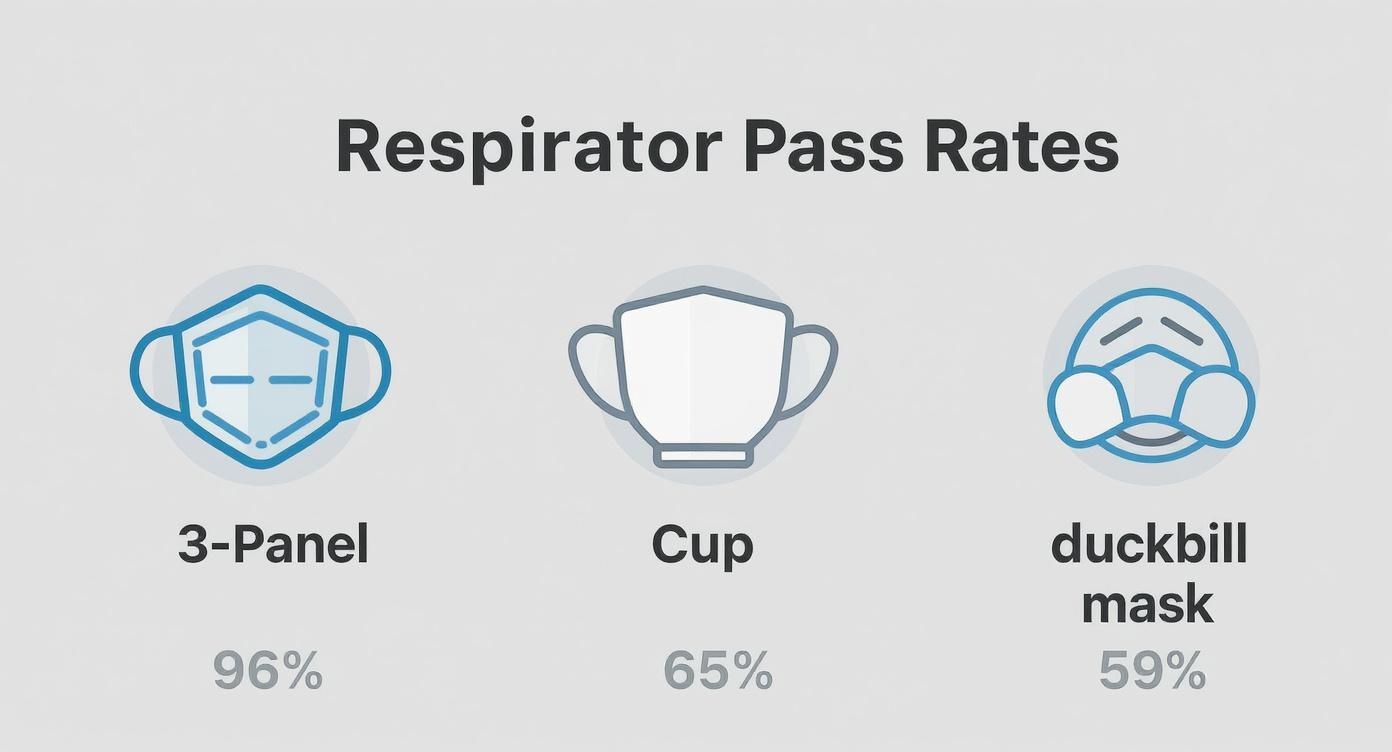
The data speaks for itself. Research from the Royal Melbourne Hospital, for instance, showed a huge difference in pass rates across common N95 respirators. The three-panel flat-fold style achieved an impressive 96.4% pass rate, but the semi-rigid cup masks? They only passed 65.0% of the time. You can read more about these study findings on respirator effectiveness.
How to Find Accredited Testing Services in Your Area
Typing "mask fit testing near me" into a search engine is a decent starting point, but let's be honest—it often brings up a jumble of results. You'll get everything from highly qualified hygienists to pop-up services that might not meet the mark. To find a truly reliable, accredited professional, you need to be a bit more strategic.
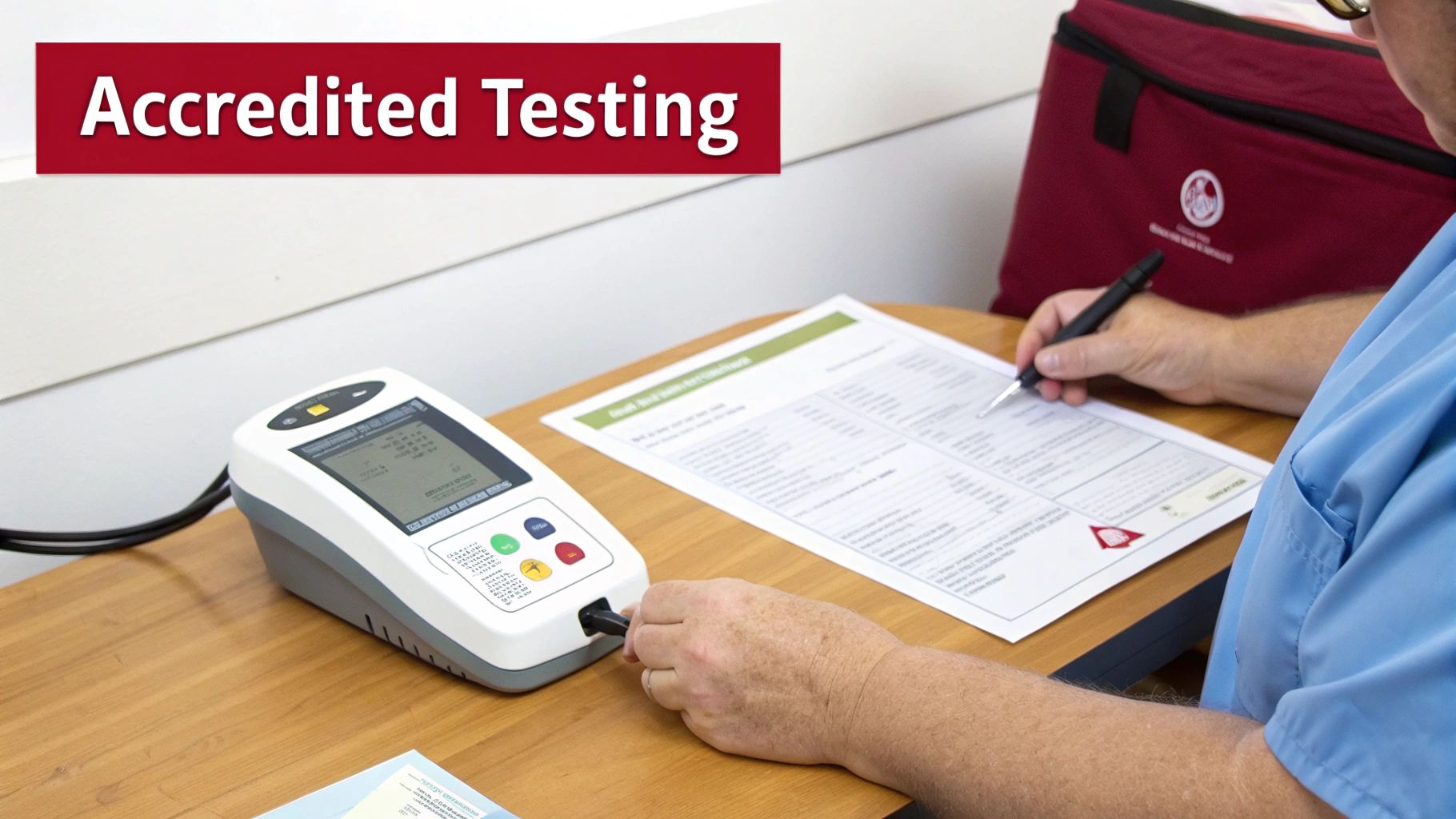
The first step is to get specific with your online search. Think about what you actually need. For instance, a nurse in Sydney shouldn’t just search for a generic test; they should be looking for 'quantitative N95 fit testing Sydney'. This immediately filters for providers who offer the precise, numerical testing required in healthcare settings.
Likewise, a construction site manager in Perth could search for 'mobile P2 mask test for construction Perth'. This tells Google you need someone who can come to your worksite, saving you the hassle of sending your team off-site.
Tap Into Your Industry Network
Sometimes, the best leads don't come from a search engine at all. The people and organisations you already work with are an invaluable source of information. They've been through this before and can point you toward providers they know and trust.
- Trade Associations: Groups like Master Builders Australia or other industry-specific bodies often maintain a list of preferred safety providers. They’ve done the vetting for you.
- Union Representatives: Your union is a fantastic resource for all things WHS. They almost always have a list of approved occupational hygienists and safety consultants they recommend to members.
- PPE Suppliers: Your regular safety gear supplier is another goldmine. Just ask your rep who their other clients use for fit testing. They know who's reliable and who isn't.
A personal referral from a trusted industry source is worth its weight in gold. It cuts through the online noise and connects you directly with professionals who have already earned the trust of your peers.
By combining a targeted search with a few well-placed phone calls, you shift from simply guessing to making an informed choice. This ensures you find a provider who doesn't just tick a box but truly understands the risks and rules specific to your line of work.
If you need more than just fit testing, it's also a great idea to find an occupational hygienist near you. These experts can offer a whole suite of workplace safety solutions, making them a fantastic partner for your business.
Choosing the Right Mask Fit Testing Provider
So, you’ve searched for "mask fit testing near me" and have a list of potential providers. Great start. But now comes the important part: figuring out which one is the right fit for you or your team. Not all services are the same, and picking the wrong one can be a costly mistake, both for compliance and for safety.
Before you even think about booking, you need to ask a few key questions. The absolute deal-breaker is this: "Is your testing process compliant with AS/NZS 1715:2009?"
This isn't just a technicality. It’s the Australian standard that underpins all respiratory protection programs. Any provider worth their salt will know this standard inside out. Given the rise in regulatory spot checks, ensuring compliance is non-negotiable. If you're not familiar with the specifics, it's a good idea to brush up on Australia's fit testing requirements.
Next, ask about their gear. For a quantitative test, you want them to be using industry-standard equipment. Hearing them mention a TSI Portacount machine is a very good sign. This kind of device gives you a concrete, numerical result—the fit factor—which takes all the guesswork out of the equation and provides solid proof of a secure seal.
On-Site Mobile Testing Versus Clinic Visits
One of the first practical decisions you’ll face is where the testing happens. Do you book a mobile service to come to your worksite, or do you send your staff to a dedicated clinic? Each has its pros and cons, and the best option really hinges on your specific situation.
For a large construction company with dozens of workers, bringing a mobile testing unit on-site is almost always the smarter move. It minimises downtime and keeps your project on track. On the flip side, if you're a sole trader or a small business with just a handful of employees, popping into a local clinic is often more straightforward and cost-effective.
To help you weigh it up, here's a quick comparison of the two service models.
Comparing On-Site vs Clinic-Based Fit Testing
| Feature | On-Site Mobile Testing | Clinic-Based Testing |
|---|---|---|
| Convenience | Excellent. The service comes to you, eliminating travel for your team. | Good. Flexible appointments, but requires individual travel. |
| Downtime | Minimal. Staff can be tested in batches, reducing time away from work. | Higher. Involves travel time and time spent at the clinic per person. |
| Cost Structure | Often involves a minimum call-out fee or day rate. Best for groups. | Typically a simple per-person fee. More economical for individuals. |
| Environment | Relies on finding a suitable, clean space on your site for testing. | A controlled, purpose-built environment ensures consistent testing conditions. |
| Group Size | Ideal for 10+ people. Becomes very cost-effective for large teams. | Perfect for individuals or small groups of 1-5 people. |
Ultimately, the choice between on-site and clinic-based testing comes down to a balance of convenience, cost, and logistics for your specific needs.
Choosing a provider isn't just about finding the cheapest or closest option. It's about partnering with an expert who can deliver accurate, compliant results that genuinely protect you or your team from workplace hazards.
Getting Ready for Your Fit Test Appointment
Showing up to your mask fit test unprepared is a surefire way to waste your time and money. After going through the effort of finding a "mask fit testing near me" service, the last thing you want is an automatic fail. A few simple steps beforehand can make all the difference.
Think about it this way: certain activities can interfere with the test's sensitivity, especially if you're doing a qualitative test that uses your sense of taste or smell. To be safe, try to avoid eating, drinking (plain water is fine), or smoking for at least 30 minutes before you walk in the door.
The Clean-Shaven Rule: It’s Not Negotiable
This is the big one. For any tight-fitting respirator to do its job, it needs to form a perfect seal directly against your skin. Even a little bit of stubble can create tiny, invisible gaps that let contaminants sneak in.
Safety standards are crystal clear on this. Regulators and health research bodies have shown time and again that any facial hair along the mask's sealing surface compromises its effectiveness. Being clean-shaven on the day of your test isn't just a recommendation—it's a must.
This means a close shave is needed anywhere the mask touches your face. Pay close attention to:
- Beards and stubble
- Sideburns that creep into the seal area
- Moustaches that droop below the upper lip
So, What Actually Happens During the Test?
Knowing what to expect can help take the edge off. A fit test isn't just about sitting still; you'll be asked to move around to mimic the kinds of movements you'd make on the job. The goal is to challenge the seal and make sure it holds up under realistic conditions.
The whole process is pretty straightforward. The tester will guide you through a series of simple exercises, each lasting about a minute.
You'll likely be asked to do things like:
- Breathe normally
- Take a few deep breaths
- Turn your head from side to side
- Nod your head up and down
- Bend over as if you're touching your toes
- Talk for a minute (they'll usually have you read a short passage)
If you get through all these without the seal breaking, you've passed! That specific mask model and size is a good fit for you. And if you don't pass? No stress. The tester will simply grab a different size or another model and you'll try again until you find one that works.
Understanding Australian Safety Standards and Compliance
Trying to get your head around the regulations for mask fit testing can feel a bit overwhelming, but it's more straightforward than you might think. For years, the go-to standard has been AS/NZS 1715:2009, which lays out everything you need to know about selecting, using, and looking after respiratory protective equipment (RPE). It’s been the foundation of workplace compliance across Australia for a long time.
Of course, safety standards don't stand still. They evolve as we learn more, so staying on top of the latest changes is essential for any business where RPE is a daily reality.
The Shift to Newer Standards
Lately, Australia has been moving towards updated global standards. The introduction of AS/NZS ISO 16975.3 is a clear sign of this, bringing our local practices more in step with international best practices. While the older AS/NZS 1715:2009 is still a common reference point, it's smart to get familiar with where the new guidelines are headed to keep your safety program current.
So, what does this mean for you on the ground? Well, one of the biggest takeaways from the newer standards is the strong recommendation for fit testing to be done at least every 12 months. This move shows we're getting more serious about respiratory protection. A key challenge, however, is that there are still only a limited number of accredited labs nationwide that are fully equipped for the new protocols.
For your business, this means annual re-testing isn't just a suggestion—it's now the accepted best practice. The game has changed from a one-off fit test to an ongoing program that verifies your team’s protection year after year.
This also puts a spotlight on the need for solid record-keeping. Keeping organised, easy-to-find records for every single fit test isn't just good housekeeping; it’s your evidence of compliance when a safety inspector comes knocking. To get into the nitty-gritty, check out our overview of respirator standards and fit test protocols in Australia.
Planning for Compliance
One of the most common hurdles I see, particularly for businesses in regional areas, is the simple act of finding an accredited provider. This is exactly why you should be searching for "mask fit testing near me" well before you’re staring down a deadline.
A bit of forward planning can help you sidestep the last-minute rush and keep your safety program ticking along without a hitch. To make sure you’re covering all your bases, it’s worth reviewing the official guidance on Australian Personal Protective Equipment (PPE) requirements.
Common Questions About Mask Fit Testing in Australia
When it comes to fit testing, a few questions pop up time and time again. Getting the right answers is key to making sure you're not just ticking a box, but are genuinely protected and meeting your obligations.
How Often Do I Need a Re-Test?
The official Australian standard is clear on this: you need a re-test at least once every 12 months.
But that's just the minimum. You'll need to book another test sooner if anything changes that could affect the mask's seal. This includes things like significant weight loss or gain, major dental work, or even getting a different model of respirator. Think of it this way: if your face shape changes, the fit of your mask might too.
What Is the Difference Between P2 and N95 Masks?
You'll hear both terms used a lot, but they are essentially counterparts from different parts of the world. P2 is the Australian/New Zealand standard, while N95 is the American one.
The performance is almost identical. P2 masks are rated to filter at least 94% of airborne particles, and N95s are rated for 95%. In the context of workplace fit testing in Australia, they're treated as equivalent, and both types absolutely require a proper fit test to be effective.
What Happens If I Fail the Fit Test?
First off, don't worry. A "fail" isn't a personal failure—it's actually a success for the testing process. It just means that particular mask isn't the right one for your unique face shape.
Your tester won't just send you on your way. They'll work with you to try a different size or even a completely different brand or model of respirator. The entire point is to find a mask that does give you a perfect seal. We just repeat the test until we find the one you can pass with, so you walk away with proven protection.
If you have more questions, our detailed mask fit testing FAQ page has you covered.
For expert, compliant mask fit testing services across Australia, trust Anitech Ltd Pty. We provide both on-site and clinic-based solutions to keep your team safe. Visit us at https://occhygiene.com.au to book your appointment.


