
When you hear the term "manual handling," you might just picture someone lifting a heavy box. But the hazards are much broader than that. In reality, any task that involves lifting, pushing, pulling, carrying, or even holding an object can put a strain on the body and lead to serious injury.
These risks aren't always about brute force. They creep into everyday work through repetitive movements, awkward postures, and sustained effort. This is why manual handling is a leading cause of musculoskeletal disorders (MSDs) across countless Australian industries.
Understanding the Core Risks of Manual Handling
It helps to think of your body as a high-performance machine. When you use it correctly—with good posture and within its limits—it's incredibly strong and resilient. But just like any piece of machinery, if you overload it, use it awkwardly, or put it under repetitive strain, things start to wear out. Breakdowns happen. That’s the core of what a manual handling hazard is.
These seemingly simple, everyday actions are a massive contributor to workplace injuries in Australia. The numbers don't lie. Manual handling is responsible for roughly 23.6% of all work-related injuries. With about 127,800 serious workers' compensation claims lodged across the country in 2023, the impact is undeniable. You can explore more data on the top causes of workplace injuries to see the full picture.
Why Hazard Identification Matters
Getting good at identifying hazards isn't just a box-ticking exercise for compliance; it's the most fundamental skill for keeping your team safe. When you can spot the potential for harm before an incident happens, you can actually do something about it. It’s a complete shift in mindset from reacting to injuries to preventing them from happening in the first place.
The goal is to see the workplace through a safety lens, identifying subtle risks in routine tasks that might otherwise go unnoticed until someone gets hurt. This proactive mindset is the foundation of a strong safety culture.
Breaking Down the Dangers
The real danger with manual handling is that the damage is often cumulative. A single awkward lift might just cause a temporary twinge. But repeat that same movement every day for months or years, and you're on a fast track to chronic pain and long-term disability. It’s this slow-burn effect that makes these hazards so sneaky.
The risks generally fall into four main categories:
- The Task Itself: Think repetitive motions, holding awkward or sustained postures, and having to use high force.
- The Load: This covers items that are heavy, bulky, unstable, or just plain difficult to get a good grip on.
- The Work Environment: Factors here include cluttered floors, poor lighting, uneven surfaces, and even extreme hot or cold temperatures.
- Individual Factors: This relates to a person’s own physical capacity, their level of training, and their overall experience with the task.
By understanding these categories, you can start building a solid plan to control manual handling hazards. Breaking the problem down like this allows you to create targeted, practical solutions that address the specific risks in your workplace, whether it's a bustling construction site or a quiet office.
How to Spot Manual Handling Risks
Learning to see your workplace through a safety lens is a crucial skill. It's about preventing injuries before they even have a chance to happen. Spotting manual handling hazards isn’t just about pointing out the obviously heavy box; it's about recognising the subtle, cumulative risks hiding in plain sight during everyday tasks.
Taking a systematic approach makes this whole process much less daunting.
To make things easier, we can break these hazards down into four key areas. Think of them as the four pillars holding up your manual handling safety: the Task, the Load, the Environment, and the Individual. If any one of these pillars is weak, the whole structure becomes unstable.
This framework helps you move from a vague feeling that something is risky to a specific, actionable checklist for your workplace. It’s how you turn abstract safety ideas into concrete observations on the ground.
The Task, The Load, and The Environment
These three areas are often closely linked. The Task is what you’re doing, the Load is what you’re moving, and the Environment is where you’re doing it. A simple task can become dangerous with a difficult load, and a straightforward lift can turn into a major hazard in a cluttered environment.
Let’s think about an office worker. Just sitting at a desk seems harmless, right? But if they spend hours craning their neck to look at a poorly placed monitor, that sustained awkward posture becomes a serious hazard. Or consider a retail employee stocking high shelves. The items might be light, but the repetitive reaching and twisting add up over a full shift, multiplying the risk.
The same goes for the environment. Imagine a warehouse worker using a pallet jack. If the floor is cluttered with rubbish, poorly lit, or uneven, the risk of a trip, slip, or collision goes through the roof.
It's the combination of these factors that often creates the biggest problems. A moderately heavy box is one thing. But carrying that same box up a flight of stairs while twisting to get around a corner? That’s an entirely different level of risk.
The Individual Factor
The final pillar is the Individual – the person actually doing the work. This is just as important as the other three. A perfectly designed task can still become dangerous if the person doing it isn’t properly prepared.
A new employee who hasn't had proper training is at a much higher risk than a seasoned veteran who knows the right lifting techniques inside and out. A person’s physical capability, pre-existing health conditions, and overall experience all play a massive part in whether they can perform a task safely.
To help you put this all together, the table below breaks down some common hazards you might see on the job.
Common Manual Handling Hazards and Their Risk Factors
This table breaks down the different hazard categories with real-world examples to help you identify the primary risks they pose to workers.
| Hazard Category | Example Scenario | Primary Risk Factor |
|---|---|---|
| The Task | An assembly line worker repeatedly twisting to grab parts. | Repetitive motion and awkward postures leading to strain injuries over time. |
| The Load | A courier trying to lift a large, smooth box with no handles. | Difficult grip and bulky size causing muscle fatigue and potential drops. |
| The Environment | A kitchen worker carrying a hot pot across a wet, slippery floor. | Slips, trips, and falls compounded by the danger of the load itself. |
| The Individual | A new employee asked to move heavy stock without any training. | Lack of knowledge and experience, leading to improper lifting techniques. |
By thinking in these four categories, you can start building a much clearer picture of where the real dangers lie in your workplace.
For example, complex jobs like storm damaged tree removal present huge risks across all four pillars—the loads are unpredictable, the environment is unstable, and the tasks are physically demanding. Proactively scanning your workspace for hazards related to the Task, Load, Environment, and Individual is the first and most important step to preventing a painful and costly injury.
The True Cost of Manual Handling Injuries
When we talk about manual handling hazards, it's easy to get caught up in the jargon of compliance and risk assessments. But let's cut to what really matters: what happens when things go wrong? The impact isn't just a number on an incident report. It's real, lasting damage to a person’s body, affecting their ability to earn a living, enjoy their life, and even stay independent.
The most common result of poor manual handling is a musculoskeletal disorder, or MSD. And no, we're not just talking about a few aches and pains. We're talking about debilitating conditions like chronic back pain, severe sprains, and agonising strains that can take months, sometimes years, to heal—if they ever fully do.
The Cumulative Damage Analogy
Think of a rubber band. Stretch it once, and it snaps right back. No problem. But what if you keep stretching it too far, day after day, or hold it in an awkward, stretched-out position for too long? It starts to lose its spring, tiny tears appear, and one day, it just breaks.
Our muscles, ligaments, and tendons work in much the same way. A single clumsy lift might only cause a minor twinge. But repeat that same bad movement every single day, and you’re creating a cumulative strain. Microscopic damage builds up quietly in the background until one seemingly normal lift causes a major injury. This slow burn is why so many manual handling injuries feel sudden, when they’ve actually been brewing for a very long time.
That sharp, sudden pain you feel when lifting a box? It’s rarely the start of the problem. More often, it's the final straw for a part of your body that has been quietly pushed to its limit for weeks, months, or even years. Overlooking these small, daily strains is one of the biggest mistakes we see in workplace safety.
The Body Parts Most at Risk
While an injury can happen anywhere, some parts of the body are far more vulnerable to the stresses of manual handling. The spine, in particular, often takes the biggest hit, which is why back injuries are the most common—and frequently the most severe—type of MSD.
The numbers from Australian workplaces tell a clear story. According to WorkSafe Victoria, around 35% of all manual handling-related injuries affect the back, putting it at the top of the list by a wide margin. Shoulders come in next, accounting for about 20% of cases. You can see a full breakdown and explore the injury distribution patterns in more detail on their website.
This data really drives home a crucial point: improper manual handling techniques put enormous pressure on the very parts of our body we rely on for basic movement and stability.
Beyond the Workplace Injury
A serious manual handling injury doesn't just stop at the factory gate or office door. It follows you home and fundamentally alters your quality of life.
Think about the ripple effect on daily life:
- Chronic Pain: Living with constant discomfort can ruin your sleep, spike your stress levels, and contribute to mental health issues like anxiety and depression.
- Loss of Mobility: Simple things you once took for granted—kicking a footy with the kids, playing a sport, or even just carrying the groceries—can become painful or impossible.
- Financial Strain: Being unable to work means a sudden loss of income, while the costs of medical treatment and rehabilitation can place a huge financial burden on your family.
- Dependence on Others: Severe injuries can force you to rely on family and friends for basic daily tasks, chipping away at your independence and straining personal relationships.
Understanding these profound, long-lasting consequences is the single best reason to get serious about prevention. When you identify and control manual handling hazards now, you're not just ticking a box on a safety form. You're protecting people's long-term health, their wellbeing, and their entire quality of life.
Industries Where Risks Are Highest
While you can find manual handling hazards in just about any workplace, the risk isn't spread evenly. Some industries are just plain tougher on the human body, with jobs that involve intense, relentless physical strain day in and day out. To create safety solutions that actually work, you first have to understand these specific, high-risk environments.
Generic advice simply doesn't cut it. So, let's take a closer look at three sectors where the dangers are especially sharp: healthcare, construction, and logistics. Each one has its own unique set of manual handling problems that demand a tailored approach.
The Complexities of Healthcare
It might be surprising, but the healthcare and social assistance sector consistently records some of the highest rates of manual handling injuries. Here, the biggest hazard isn’t lifting heavy boxes; it's lifting and moving people.
Patient handling is incredibly unpredictable. It's physically demanding, often forcing workers into awkward positions and requiring sudden bursts of strength. A patient might unexpectedly lose their balance, resist being moved, or need help in a cramped space like a bathroom. Each scenario multiplies the risk for the caregiver. Tasks like helping patients in and out of bed, repositioning them, or supporting them while they walk are done over and over again, creating the perfect storm for cumulative strain injuries to the back, shoulders, and neck.
The statistics tell a stark story. In Australia, manual handling is behind a staggering 58.9% of all workplace injuries in the healthcare sector—a rate far higher than most other industries. You can learn more about the impact of manual handling in Australian healthcare to grasp the full scale of this issue.
Dangers on the Construction Site
Construction sites are constantly changing, often chaotic environments where heavy lifting is just part of the daily grind. Workers are always handling cumbersome materials like timber, steel beams, and concrete blocks, frequently without any mechanical help. But it's the environment itself that adds another dangerous twist to the manual handling risks.
A construction site is nothing like a flat, predictable warehouse floor. You're dealing with uneven ground, mud, random debris, and constant changes in elevation. Try carrying a heavy, awkward load across that kind of unstable terrain—it forces your body to constantly adjust, putting enormous stress on your spine and joints.
On top of that, workers are often dealing with other physical stressors. For instance, operating heavy machinery exposes them to other risks. It’s crucial to understand these compounding factors, which is why conducting a whole body vibration assessment is so important for protecting your crew.
The combination of heavy loads, awkward postures required to navigate obstacles, and an unstable working surface makes construction one of the most physically punishing industries for manual handling.
The Relentless Pace of Logistics
In logistics, warehousing, and transport, speed is the name of the game. That relentless pace is what drives the biggest manual handling risks. Workers are under immense pressure to load, unload, and sort goods as quickly as possible, which means performing the same movements over and over, all day long.
Picture a worker in a distribution centre, grabbing hundreds of packages off a conveyor belt and stacking them onto a pallet. A single package might not be that heavy, but the sheer volume of lifting and twisting creates a massive risk for overuse injuries. When deadlines are tight, people rush. Safe lifting techniques often go out the window in the name of speed, and that’s when the danger really spikes.
A Practical Framework for Controlling Hazards
So, you’ve identified the manual handling hazards lurking in your workplace. That’s a fantastic first step, but what’s next? You need a solid game plan, a reliable way to take action. This is where the Hierarchy of Control comes into play. Think of it as the industry-standard playbook for managing workplace risks, and it’s especially powerful for tackling manual handling issues.
Instead of just putting out fires after an injury occurs, this framework gives you a systematic way to reduce risk. It forces you to start with the most effective solutions—the ones that truly eliminate the problem—and then work your way down. It’s about being proactive and creating genuine, lasting safety improvements, not just applying band-aids.
The image below breaks down the common culprits behind manual handling injuries, giving you a clear idea of where your efforts might be needed most.
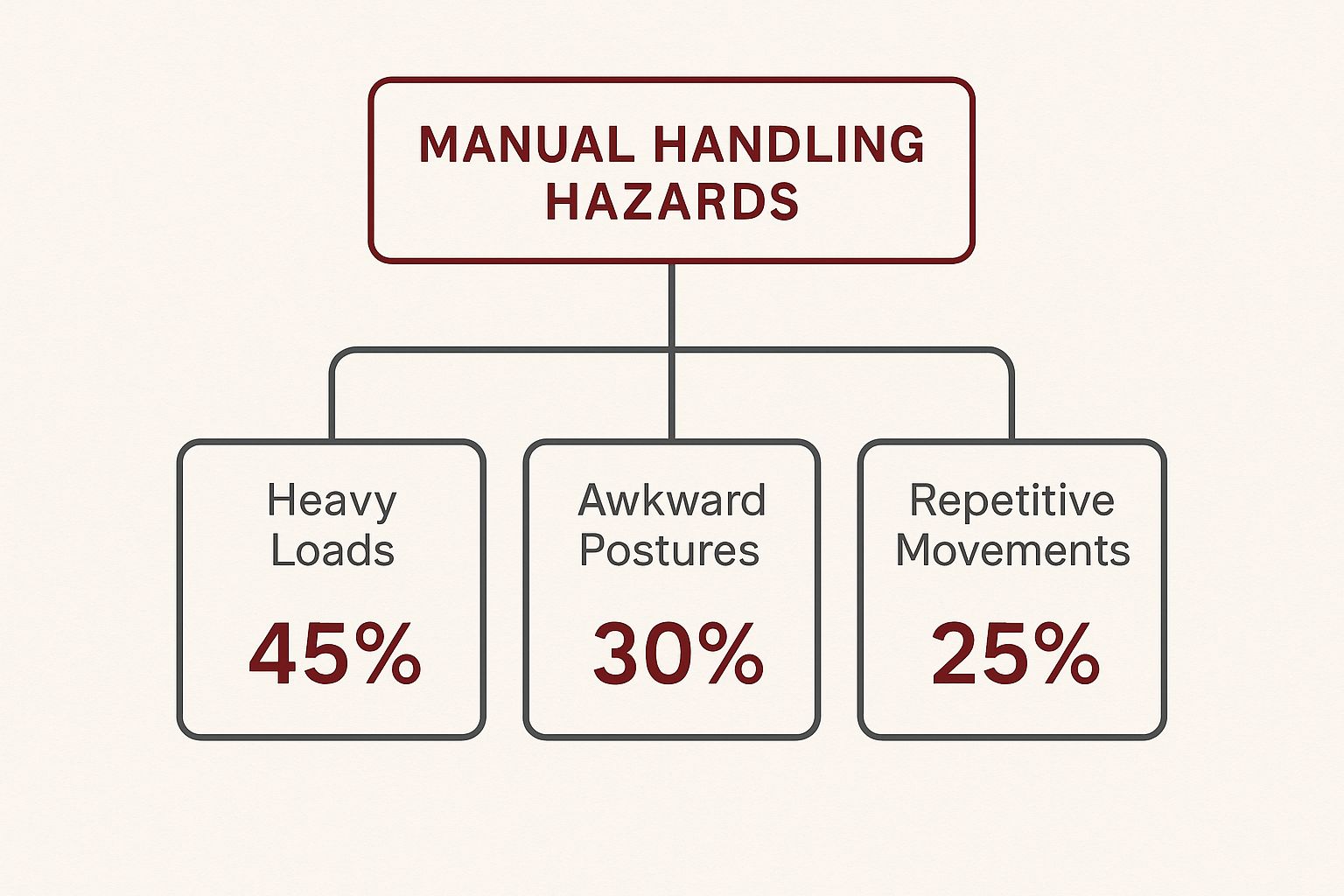
As you can see, nearly half of these hazards come from handling heavy loads. This makes it an obvious priority for any risk control plan.
Level 1: Elimination – The Gold Standard
Without a doubt, the most effective way to control a hazard is to eliminate it completely. If the dangerous task simply doesn't exist anymore, it can’t hurt anyone. It’s the ultimate goal, even if it's not always achievable.
Think of it this way: why train someone how to safely lift a heavy drum of chemicals when you could install a pumping system so no one ever has to lift it at all?
- Example 1: A manufacturing plant brings in a robotic arm to handle its palletising. This completely removes the need for workers to manually stack heavy boxes day in and day out.
- Example 2: A business works with its supplier to receive raw materials in smaller, lighter bags. This gets rid of the one-person, heavy-lift task that was a constant source of risk.
Level 2: Substitution and Engineering Controls
If you can’t get rid of the hazard entirely, the next best thing is to either substitute it with something safer or use engineering controls to physically separate people from the risk. These controls involve making tangible changes to the workplace, the equipment, or the materials.
Substitution is all about swapping out a hazardous process for a less dangerous one. Engineering controls, on the other hand, focus on redesigning the job or the workspace itself to reduce the physical strain on your team.
The core idea here is to change the work, not the worker. By modifying the environment, you create a system where the safest way to do the job is also the easiest and most obvious way.
Here’s how this looks in the real world:
- Substitution: Replacing a heavy, solid metal part with a lighter but equally strong composite alternative.
- Engineering: Installing mechanical lifting aids like hoists, cranes, or vacuum lifters to do the heavy lifting.
- Engineering: Designing ergonomic workstations with height-adjustable benches and tilt-top tables. This stops workers from having to bend or reach into awkward positions.
- Engineering: Using conveyors to move products between workstations instead of having employees carry them across the floor.
Level 3: Administrative Controls and PPE
The final rungs on the ladder are administrative actions and Personal Protective Equipment (PPE). These are considered the least effective because they rely entirely on human behaviour and don't actually remove the hazard from the environment. They are your last line of defence, not your first.
Administrative controls are about changing how people work. This includes things like proper training, rotating jobs to reduce repetitive strain, and writing up safe work procedures. PPE includes items like gloves for a better grip or steel-capped boots to protect feet from falling objects.
The table below provides some clear, practical examples of how to apply this hierarchy to common manual handling challenges.
Hierarchy of Control for Manual Handling Risks
| Control Level | Description | Manual Handling Example |
|---|---|---|
| Elimination | Physically remove the hazard completely. | Redesign the workflow so that bags of material are delivered directly to the hopper, removing the need to lift them. |
| Substitution | Replace the hazard with a safer alternative. | Swap out heavy 25kg bags of concrete for lighter 10kg bags. |
| Engineering | Isolate people from the hazard with physical changes. | Install a vacuum lifter or a scissor lift table to help workers move heavy items without manual strain. |
| Administrative | Change the way people work through procedures or training. | Implement job rotation to limit a worker's exposure to repetitive lifting tasks and provide training on safe lifting techniques. |
| PPE | Protect the worker with personal equipment. | Provide gloves with enhanced grip to prevent items from slipping and steel-toed boots to protect against falling objects. |
Remember, these controls are most effective when they are layered. One single solution is rarely enough.
A truly robust safety plan often involves a smart combination of different controls. For complex environments, working with an experienced occupational hygiene consultant can help pinpoint the most effective mix of solutions for your specific risks. Implementing a strong framework is non-negotiable, and you can explore more about effective strategies for construction project risk management in industries where manual handling is a daily reality. By applying this hierarchy, you can systematically dismantle hazards and build a genuinely safer workplace from the ground up.
Understanding Your Legal Duties in Australia
When it comes to workplace safety in Australia, it’s not just about doing the right thing—it’s a legal requirement. The Work Health and Safety (WHS) laws might seem a bit daunting at first, but the idea at their heart is simple: everyone has a part to play in keeping the workplace safe.
This means both employers and employees have specific legal duties to get on top of the risks that come with manual handling.
Under the law, you’ll often hear employers referred to as a PCBU, which stands for a "Person Conducting a Business or Undertaking." It’s a broad term that captures everyone from sole traders to large corporations. The biggest responsibility a PCBU has is its duty of care.
This duty means they have to do everything reasonably possible to protect the health and safety of their workers. It’s not about waiting for an accident to happen; it’s about taking proactive steps to find, assess, and control hazards before they can cause injury. Getting this wrong can result in serious penalties, from massive fines to, in the worst cases, jail time.
A crucial part of this duty isn't just putting safety measures in place, but being able to prove you've done it. Think documented risk assessments, records of staff training, and notes from meetings where you've discussed safety with your team.
Employer Responsibilities in Detail
For a PCBU, the legal duties are quite specific when it comes to managing the risks of musculoskeletal disorders (MSDs) from hazardous manual tasks. It's more than just providing a safe building.
It really boils down to a few key actions:
- Hazard Identification: Actively searching for tasks that have the potential to injure someone.
- Risk Assessment: Figuring out how serious the risk from each hazard actually is.
- Control Measures: Putting effective controls in place—using the hierarchy of control—to get rid of the risk or, at the very least, minimise it.
- Worker Consultation: Talking to your team and getting them involved in safety decisions. After all, they’re the ones on the ground who know the job inside and out.
To really get to grips with these obligations, it's worth reading up on the various Australian workplace safety standards that lay out all the requirements.
The Role of the Worker
Safety is a team sport, and workers have their own legal responsibilities under WHS law, too. While the PCBU has the main duty of care, employees need to do their bit to keep the workplace safe for themselves and their colleagues.
This includes:
- Taking reasonable care of their own health and safety.
- Making sure that what they do (or don't do) doesn't put others at risk.
- Following any reasonable safety instructions or policies from the PCBU.
- Speaking up and reporting any hazards or incidents to a supervisor straight away.
At the end of the day, Australian law sees workplace safety as a partnership. When PCBUs and workers both understand and carry out their duties, they can create a genuinely safer environment where manual handling hazards are properly controlled.
Got Questions About Manual Handling? We’ve Got Answers
Even with the basics covered, a few common questions always seem to pop up when we talk about manual handling. Let's tackle some of the most frequent ones to clear up any confusion and help you put this knowledge into practice on the job.
So, What Exactly Makes a Manual Task Hazardous?
Think of a hazardous manual handling task as any activity where you have to lift, push, pull, carry, or hold something – whether that's a person, an animal, or an object – that also ticks one or more high-risk boxes.
These risk factors are the real troublemakers. They include things like repetitive or sustained force, having to use sudden or high force, repeated movements, holding awkward postures, or being exposed to vibration.
It’s never just about how heavy something is. The real risk is a mix of the load itself, the actions you have to perform, how often you do it, and the environment you’re working in.
How Often Do We Really Need Manual Handling Training?
There isn’t a single, rigid timeline set in stone by Australian WHS law, but years of experience have shown us what works best. Training is non-negotiable at a few key moments:
- When someone starts: Every new employee needs training during their induction, before they even think about starting manual work.
- When things change: If a task is modified or new equipment is introduced, it's time for a training update.
- After an incident: A near-miss or an actual injury is a clear signal that a training refresher is needed to prevent it from happening again.
Beyond these points, regular refresher training is a must to keep safety front and centre. Most businesses find that running a session annually or every two years strikes the right balance. Ultimately, your own risk assessment should guide the schedule that’s right for your team.
Training isn't a "set and forget" task. Think of it as an ongoing conversation, constantly reinforcing good habits and adapting to new situations to keep everyone safe.
Is There a Legal Weight Limit for Lifting in Australia?
This is probably one of the biggest myths out there. The short answer is no, there are no specific legal weight limits for lifting in Australia.
Instead of a simple number, our WHS regulations require a much smarter, risk-based approach. What does this mean? It means employers have a legal duty to look at every single task and assess its specific risks.
They need to consider the weight, sure, but also the shape of the load, the movements involved, the workspace, and the physical capacity of the person doing the lifting. You might see guidelines suggesting extra caution for loads over 16-20kg, but these are just suggestions, not legal rules. The real legal obligation is to work through the hierarchy of controls to eliminate or reduce the risk as much as possible, not just to stay under a magic number.
We provide expert occupational hygiene services to help you identify, assess, and control manual handling hazards effectively. Our team helps create safer, more compliant workplaces across Australia. Learn how we can support your business at https://occhygiene.com.au.


