
Quick Summary: Managing long-term safety in buildings with low-level residual contamination, such as former meth labs, requires more than a one-time cleanup. A continuous safety strategy is essential, focusing on the ALARA principle (As Low As Reasonably Achievable). This involves site-specific risk assessments, ongoing environmental monitoring, robust engineering and administrative controls, and comprehensive occupant training to ensure the environment remains safe for its intended purpose over the long term.
Once the initial clean-up is done and the clearance certificates are issued, it's tempting to think the job is finished. But when it comes to long-term safety in a building with a history of contamination—whether from industrial use or something like a former meth lab—that’s really just the starting point for managing long-term occupancy safety for low-level residual contamination.
The real challenge is managing the low-level residual contamination that can linger. We're talking about the tiny, legally acceptable traces of hazardous substances that might remain embedded in materials like plasterboard, concrete, or deep within ventilation systems.
This is where the focus has to shift from a one-off decontamination event to a continuous, proactive safety strategy. The guiding principle here is keeping any potential exposure As Low As Reasonably Achievable (ALARA). It’s about creating a living safety plan that protects occupants for years to come, ensuring the building is not just clean, but truly safe for its intended purpose.
Establishing a Foundation for Lasting Workplace Safety

While these trace amounts of contaminants might not pose an immediate, acute danger, it's the potential for chronic, low-dose exposure over months or years that we need to manage carefully. This is especially true in places not typically thought of as hazardous environments, like commercial offices in repurposed industrial buildings or residential properties that have been remediated after illegal drug activity.
Moving Beyond a Simple Clean-up
The problem with residual contamination is that it's an invisible threat. You can't see it, smell it, or taste it. A simple "pass/fail" clearance test tells you the situation on a single day, but it doesn't guarantee future safety.
That’s why a more forward-thinking approach is essential. We need to build a framework that anticipates potential issues and includes regular checks to ensure the safety controls are still working as intended. This isn't just about protecting health; it's also about safeguarding property value and minimising future legal headaches.
A successful long-term safety plan is not a single event but a living process. It must adapt to changes in building use, scientific understanding, and regulatory standards to remain effective.
Core Components of a Safety Plan
A solid strategy for managing long-term occupancy is built on a few non-negotiable pillars. Getting these right from the start is the key to creating a program that is both robust and defensible.
Here's a quick look at the core components that form the backbone of a successful long-term occupancy safety plan. Each element plays a distinct role, but they all work together to create a comprehensive safety net.
| Component | Objective | Key Actions |
|---|---|---|
| Risk Assessment | To identify and understand potential exposure pathways and vulnerable groups. | Go beyond initial testing; map airflow, identify high-contact surfaces, consider occupant activities. |
| Monitoring Program | To verify that contaminant levels consistently remain below safe limits. | Schedule periodic air, surface, or dust sampling in targeted areas. |
| Engineering & Admin Controls | To physically minimise or prevent occupant exposure to contaminants. | Implement enhanced HVAC filtration, seal surfaces, restrict access, define safe work procedures. |
| Communication & Training | To ensure occupants are informed, engaged, and know their responsibilities. | Conduct regular briefings, provide clear documentation, post signage, establish reporting channels. |
This table shows how a plan moves from theory into practice. It’s not just about testing; it's a holistic system that combines scientific measurement with practical, on-the-ground actions.
By building your strategy on this foundation, you create a system that addresses both the technical realities of residual contamination and the crucial human elements of trust and confidence. It's how you turn a remediated site into a sustainably safe environment for everyone.
Setting Your Site-Specific Risk and Action Levels
Any solid plan for managing a site with low-level residual contamination has to start with a deep, site-specific risk assessment. This isn't about ticking boxes on a generic safety form; it's about building a robust, defensible framework that puts the health of your occupants first.
You have to get granular here. Think like a detective, carefully mapping out every possible way contaminants could interact with people over the long haul. This foundational work gives you the full picture of the risks you're actually dealing with.
Map Every Potential Exposure Pathway
Before you can even think about setting safety thresholds, you need to know exactly how people might come into contact with what’s left behind. For any non-lab environment—like a repurposed office building or a former industrial site—there are three main routes of exposure you absolutely must investigate.
-
Inhalation: This is almost always the biggest concern. Contaminants can get into the air from dust, off-gas from building materials like plasterboard or concrete, or get pushed around by the HVAC system. Your assessment needs to look at airflow, how good your ventilation is, and what kinds of activities (like cleaning or maintenance) could kick up settled dust.
-
Dermal Contact: People touching contaminated surfaces is another critical pathway. Think about all the high-touch spots: benchtops, door handles, light switches, and even the floor. You need to identify these areas and figure out how often different groups of people will be touching them.
-
Ingestion: It might seem less likely in a workplace, but accidental ingestion is a real risk. It usually happens when someone touches a contaminated surface and then transfers it to their mouth. Pay extra close attention to any areas where people prepare or eat food.
Pinpoint Vulnerable Groups
A one-size-fits-all approach to risk just won't cut it. Your assessment must specifically consider individuals who might be more susceptible to even low levels of exposure. This is how you make sure your safety plan truly protects everyone, not just the average healthy person.
These vulnerable populations could include:
- People with existing respiratory conditions like asthma.
- Anyone with a compromised immune system.
- Pregnant workers, where any exposure could pose a risk to a developing foetus.
Once you know who these groups are, you can put stronger controls or targeted protective measures in place just for them. It’s this kind of nuanced thinking that separates a passable safety plan from a great one.
Establish Data-Driven Action Levels
With a clear map of your exposure pathways and vulnerable groups, you're ready to set your action levels. These are specific, pre-determined contamination thresholds that, if crossed, automatically trigger a set response. Getting a handle on potential threats and setting the right benchmarks is a vital first step; you can learn more about the process of conducting an infection control risk assessment.
It’s crucial not to mix up action levels with regulatory clearance levels. A clearance level is usually the maximum amount of a contaminant allowed after a major clean-up. Your action levels should be set much, much lower. They're your early warning system.
Think of a regulatory limit as the speed limit on a motorway. Your internal action level is like your car's collision warning system—it alerts you to a potential problem long before you're in immediate danger, giving you time to react safely.
The acceptable risk for a former factory now used for storage, for example, is going to be wildly different from that same building if it’s been turned into a childcare centre. Setting these levels is a multi-step process:
- Dig into Health-Based Guidance: Start by reviewing guidelines from bodies like the World Health Organization (WHO) or national health and safety agencies. This gives you a baseline of scientifically established safe exposure limits.
- Factor in Site-Specifics: Now, adjust those guidelines for your reality. Consider the building's use, how long people are there (an 8-hour workday vs. 24/7 occupancy), and the vulnerable groups you’ve identified.
- Define Your Response Protocols: For every action level, write down exactly what happens when it’s triggered. This could be anything from increasing how often you monitor, to installing new engineering controls, or even kicking off a full re-assessment.
Writing all of this down is non-negotiable. A detailed report that explains your exposure pathway analysis, how you identified vulnerable groups, and the scientific rationale behind your action levels creates the transparent and legally defensible framework that will be the backbone of your entire management plan.
Designing an Effective Environmental Monitoring Program
Once you've mapped out your risk profile and set those crucial action levels, it's time to build your environmental monitoring program. Think of this not as a one-off task, but as your ongoing reality check. It’s the system that tells you whether your safety controls are actually working and protecting people from that low-level residual contamination. A well-designed program gives you the hard data you need to make smart decisions and tweak your strategy as things change.
This is about more than just taking a few random samples here and there. It's a strategic effort to collect data that genuinely reflects the conditions inside your facility, ensuring everyone on site stays safe for the long haul.
Choosing the Right Monitoring Techniques
First up, you need to pick the right tools for the job. The methods you choose must be able to detect the specific contaminants you're worried about. Each technique has its own strengths and is best suited for different situations, especially when you're managing long-term exposure.
Here are the main players:
- Surface Wipe Sampling: This is the go-to method for checking what’s lingering on surfaces. We're talking about wiping a defined area (usually 100 cm²) with a special medium and sending it off to a lab. It’s perfect for getting a read on high-touch surfaces like benchtops, door handles, and equipment controls.
- Air Quality Testing: If inhalation is a potential risk, air monitoring is non-negotiable. This involves measuring the concentration of contaminants floating around in the air. You can do this with passive samplers left out over time, or with active sampling, where a pump pulls a known volume of air through a filter. This is absolutely critical for checking how well your HVAC system is performing and for flagging issues in poorly ventilated spots.
- Bulk Sampling: Sometimes, you need to know if a material itself is holding onto contamination and slowly releasing it. This might mean taking a small, physical piece of plasterboard, carpet, or even concrete for analysis. It’s more destructive, of course, but it’s the only way to find out if a material is acting as a "sink" or an ongoing source.
The whole process flows from your initial risk assessment, where you've already figured out the likely exposure pathways, identified the people at risk, and set your action levels.
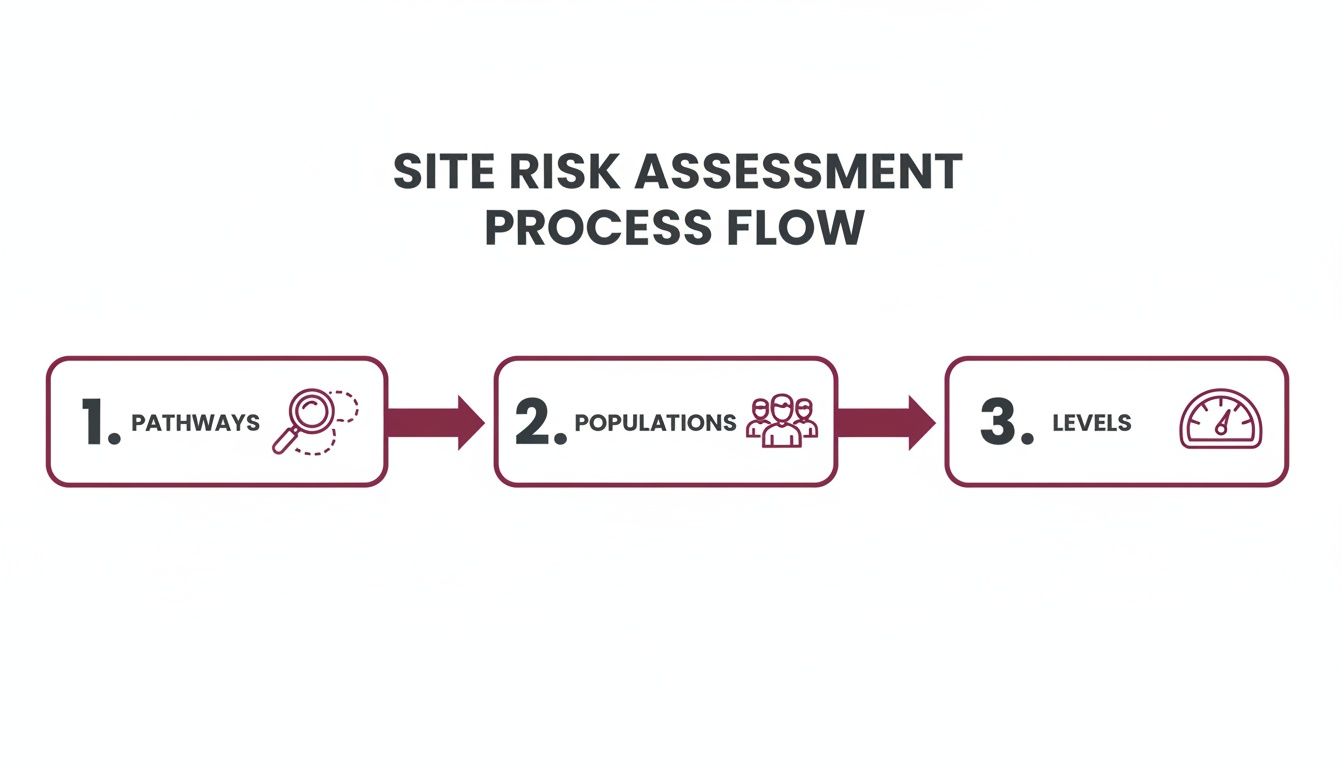
This visual really drives home the point: your monitoring plan isn't created in a vacuum. It’s a direct response to your risk assessment, making sure you’re looking in all the right places.
Determining Strategic Sampling Locations
Where you take a sample is just as important as how you take it. Forget random sampling; it’s a waste of time and money. Your locations need to be chosen strategically, based on that initial risk assessment and a real-world understanding of how people use the space.
Key areas to prioritise include:
- High-Touch Surfaces: Zero in on any spot with frequent human contact. These are your direct pathways for dermal exposure or ingestion. Go beyond the obvious like doorknobs and think about shared tools, keyboards in common areas, and control panels.
- HVAC Systems: Air handling units, vents, and ductwork can be real culprits for accumulating and then spreading contaminants through an entire building. A few well-placed samples in the HVAC system can give you a surprisingly good picture of the building’s overall air quality.
- Areas with Poor Ventilation: Any pocket of stagnant air—think storage rooms, basements, or enclosed offices—can allow contaminant levels to build up. These are always critical monitoring points.
- Known "Hot Spots": If the initial clean-up identified areas that were more heavily contaminated, keep them on your list for long-term monitoring. Even if they got the all-clear initially, you want to be sure they stay that way.
Establishing a Logical Monitoring Frequency
So, how often do you need to test? The classic consultant's answer is, "it depends." Your monitoring schedule shouldn't be set in stone; it needs to be a living document that you can adapt to your site's specific situation.
A common mistake is to set a rigid annual schedule and never deviate. An effective program adjusts its frequency based on data, occupant activity, and any changes to the building itself.
A sensible starting point is often quarterly monitoring for the first year after people move back in. If the results are consistently way below your action levels, you can confidently pull back to a bi-annual or even annual schedule. On the flip side, if a sample starts creeping up towards an action level, that’s your cue to increase the frequency and investigate.
Certain events should also be an automatic trigger for a fresh round of sampling:
- Major Renovations: The moment you start disturbing walls, floors, or ceilings, you risk releasing contaminants that were safely locked away.
- Changes in Building Use: If a storage room becomes an office or a lab is repurposed, you need a new assessment to match the new use.
- HVAC System Modifications: Any significant change to the ventilation system can completely alter airflow patterns and how contaminants move around.
This flexible, data-driven approach means you're using your resources wisely while keeping safety front and centre. You can see this kind of rigorous management in highly regulated industries. For example, Australia's robust framework has been incredibly successful in managing radiation risks at industrial and mining sites, allowing for safe long-term work. A Victorian parliamentary analysis noted that at operational uranium facilities, the average dose to workers is just a tiny fraction of natural background radiation. Recent maximum doses were under 10 mSv, well below the 20 mSv annual limit. In a single year, an incredible 73% of South Australian uranium mine workers received less than 0.5 mSv. That’s the power of a well-executed program. You can dig into more of these radiation risk findings in the official report.
Ultimately, pulling all this together is a specialised skill. The expertise of a qualified occupational hygienist is invaluable here. They can interpret complex lab results, spot subtle trends you might miss, and provide the scientific justification for adjusting your strategy, ensuring your monitoring program remains a robust and defensible part of your long-term safety plan.
Putting Practical Controls in Place: Engineering and Administrative Solutions
Once you've mapped out your risk profile and have a solid monitoring plan, it’s time to get practical. This is where we move from assessment to action, implementing controls that actively reduce or even eliminate potential exposure. When we're talking about managing long-term safety with low-level contamination, we use a layered approach—what we in the industry call the hierarchy of controls. The focus is always on sustainable, low-disruption solutions that work in the real world.
The aim here is simple: either physically separate people from the hazard or change how they work to minimise the risk. These are the day-to-day measures that ensure a building remains safe for its intended use.
Engineering Controls: The Physical Barriers
In my experience, engineering controls are your most reliable line of defence. Why? Because they physically change the environment to make it safer, and once they're in place, they work quietly in the background with minimal human effort. Think of them as the "set and forget" solutions.
-
Beefed-Up Ventilation: Clean air is your best friend, especially for inhalation risks. This could be as straightforward as upgrading your HVAC filters to a higher MERV rating to catch finer particles. In other cases, you might need to increase the air exchange rate to dilute and flush out airborne contaminants more effectively.
-
Surface Encapsulation: Got contaminants locked into porous materials like concrete or plasterboard? Specialised coatings are brilliant for this. Applying an epoxy or polymer sealant literally creates an impermeable barrier, locking the residue in place so it can't become airborne or get on anyone's hands.
-
Smart Access Control: Sometimes, the simplest solution is the best. If the residual contamination is stuck in a non-essential spot like a storeroom or old basement, just lock the door. Restricting access with clear signage and a good lock completely prevents exposure. It's low-tech but highly effective.
Administrative Controls: The Human Element
While engineering controls handle the building itself, administrative controls are all about how people behave within it. This is where your rules, procedures, and training come into play to build a genuine culture of safety.
An engineering control might make a building fundamentally safer, but it’s the administrative controls that ensure people interact with that environment in a safe manner. The two work hand-in-hand.
Getting these right means you really have to understand the daily rhythm of the building and how people use the space.
Developing Safe Work Practices
You need clear, written procedures for consistency. This isn't about creating pointless bureaucracy; it's about making the safe way the easy way.
A few real-world examples:
-
Designated "Clean" Zones for Food: A simple but powerful rule is to ban all food and drink outside of designated break areas. It drastically cuts the risk of someone accidentally ingesting contaminants from a surface.
-
Protocols for Disruptive Work: Any job that involves drilling into walls, cutting into floors, or poking around in ceiling voids needs its own specific protocol. This usually means using localised dust extraction, mandating the right personal protective equipment (PPE), and having a strict post-work clean-up process.
-
Clear Reporting Channels: Every single person in the building needs to know exactly who to call if they spot a problem or have a safety concern. A straightforward, no-fuss reporting system encourages people to speak up early.
Nailing Down Hygiene Protocols
Good personal hygiene is an incredibly powerful tool. These protocols need to be simple, highly visible, and something you genuinely enforce.
- Hand-Washing Rules: Making hand-washing mandatory after leaving certain areas or before entering the lunchroom is a non-negotiable basic.
- Well-Stocked Facilities: It sounds obvious, but make sure your hand-washing stations are always stocked and conveniently located. If it's a hassle, people won't do it.
If you ever doubt the power of these combined controls, just look at Australia's uranium mining sector—a fantastic case study in managing these very risks. Data from the Australian National Radiation Dose Register (ANRDR) shows that out of 72,000 monitored workers, an incredible 80% received an annual radiation dose below 1 mSv, and 98% stayed under 3 mSv. Even more telling, not a single worker’s dose went over 10 mSv, which is still only half the regulatory limit. That’s not luck; it’s proof that robust engineering and administrative controls work. You can dig deeper into these occupational safety achievements on the ARPANSA website.
By thoughtfully blending these physical safeguards and procedural rules, you create a truly resilient safety system. This integrated approach ensures that managing low-level residual contamination isn't a one-off task, but an ongoing commitment to everyone's wellbeing.
Building a Culture of Safety Through Open Communication and Solid Training
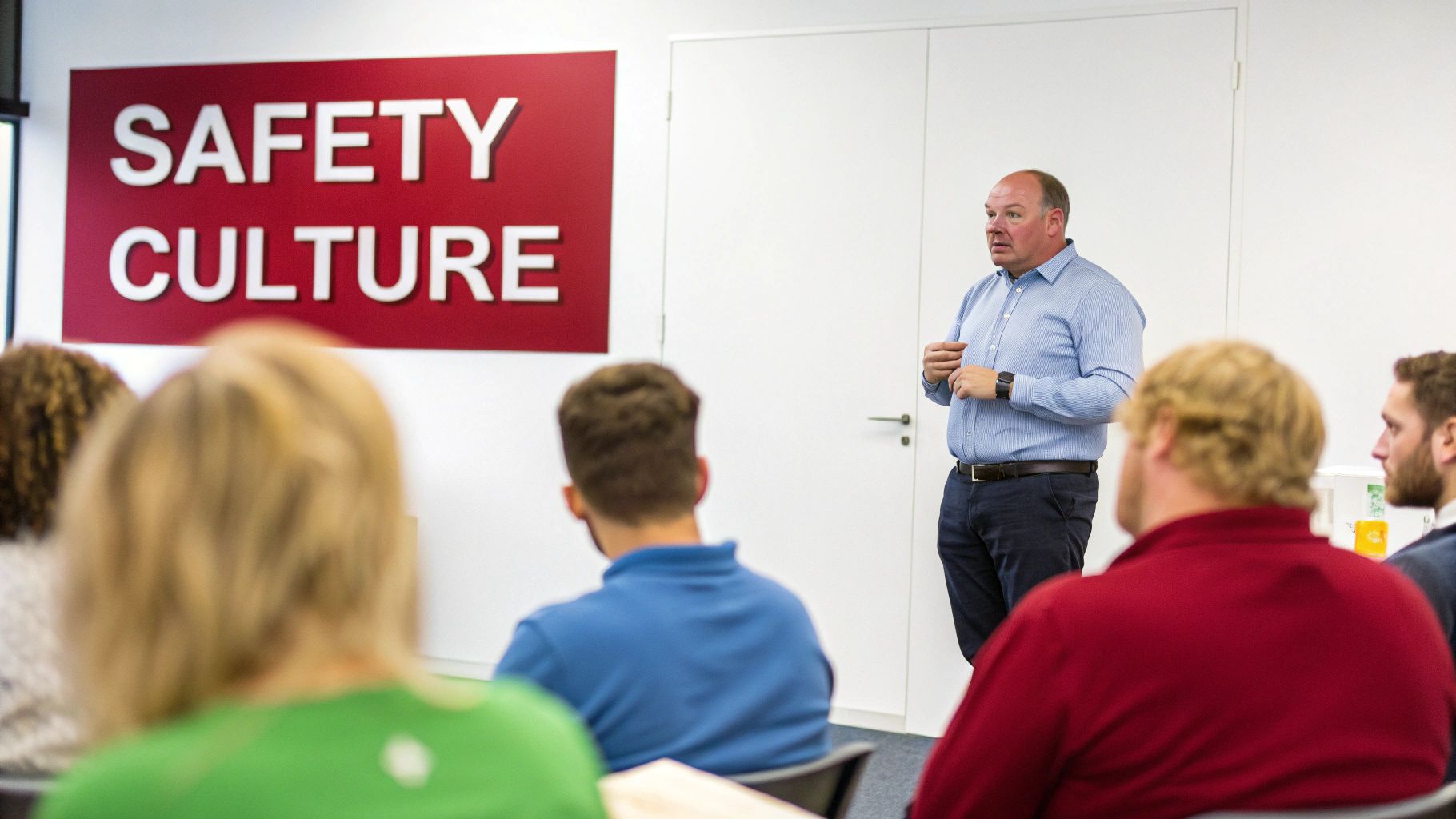
Engineering controls and administrative rules are the scaffolding of any safety program. But let's be honest—they only work if the people on site are clued in, engaged, and understand the part they play. The 'human element' is what makes or breaks your ability to manage long-term occupancy with low-level residual contamination.
The goal here isn't just to enforce rules from the top down. It’s about building a genuine culture where safety is a shared responsibility. This culture grows from two things: transparent communication and consistent training. It’s how you empower every single person with the knowledge to work safely, report concerns without a second thought, and trust that the environment is being actively managed.
A Clear and Transparent Communication Strategy
When you're dealing with a sensitive topic like residual contamination, how you communicate is everything. You need to be open and honest without sparking unnecessary alarm. A clear, factual, and consistent communication strategy is your foundation for building and keeping trust.
A solid strategy should:
- Get Out in Front of It: Don't wait for the rumour mill to start. Share information proactively before misinformation can take root. A welcome pack for new occupants or an initial safety briefing is the perfect time to introduce the site's management plan.
- Explain the 'Why': Simply listing rules isn't enough. People are far more likely to comply when they understand the reasoning. Explain why a certain hygiene protocol is necessary or why a specific entrance must be used.
- Make Information Accessible: Don't hide key documents. A summary of the risk assessment and recent monitoring results should be readily available to occupants. This could be a secure page on your intranet or even a clearly marked binder in a common area.
- Create Clear Reporting Channels: Everyone needs to know exactly who to call with a question or concern. This designated point of contact must be knowledgeable, approachable, and responsive.
Designing Training That Actually Sticks
Training is what turns passive occupants into active partners in the safety plan. It’s about ensuring that everyone, from a 20-year veteran to a contractor who’s on-site for a week, has the same baseline understanding of the risks and the controls.
A one-off induction session just doesn't cut it. Real-world, effective training means initial onboarding for all new personnel, backed up by regular refreshers to keep safety front-of-mind.
What to Cover in Your Training
Your training needs to be practical and directly relevant to what people do every day. The focus should be on empowering them with knowledge they can actually use.
Core topics must include:
- The Site's Story: A brief, non-technical rundown of the site's history, the nature of the residual contamination, and the action levels you've established.
- Controls and Why They Matter: Clear training on the purpose of engineering controls (like specialised ventilation) and the importance of following administrative rules (like hygiene protocols).
- Hygiene in Practice: A hands-on demonstration of proper hand-washing, clear rules for eating and drinking, and how to correctly use any required personal protective equipment (PPE).
- Emergency and Reporting Steps: Simple, clear instructions on what to do and who to contact if there’s a spill, a system failure, or if they simply have a safety concern.
Giving people the right skills and knowledge is fundamental to building a strong safety culture. For a deeper look into this, check out this guide on effective training strategies for employee engagement.
Why Meticulous Records are Non-Negotiable
Comprehensive documentation is your ultimate proof of due diligence. This isn't just about ticking a box for regulators; it’s your site’s institutional memory and a critical tool for continuous improvement. These records show that you are proactively managing the site and protecting everyone’s health.
Your records system must be organised and easy to access when you need it.
Your documentation should always include:
- All risk assessment reports.
- Environmental monitoring results, including the full lab reports.
- Maintenance logs for all engineering controls (e.g., HVAC filter changes).
- Signed attendance sheets and materials from every single training session.
- A detailed log of any reported incidents or concerns and, crucially, how you resolved them.
This level of detailed recordkeeping is standard practice in industries that live and breathe safety. Think of medical and industrial workplaces in Australia that successfully manage long-term occupancy with low-level residual radiation. In facilities using ionising radiation, the vast majority of staff get a zero measurable occupational dose. For those handling radioactive sources directly, the average annual dose is around 1 mSv, peaking at 3 mSv in high-activity areas—well below the 20 mSv worker limit.
This incredible level of control, all proven by meticulous records, is the gold standard for ensuring long-term safety and provides a powerful model for managing other types of residual contamination.
Your Questions Answered on Residual Contamination Safety
When you're dealing with the long-term safety of a building that has low-level residual contamination, a lot of questions pop up. It’s natural for property owners, facility managers, and employers to want clear, no-nonsense answers to guide their decisions. Let's tackle some of the most common ones we hear from our clients.
Getting these details right is crucial. It’s what shifts the focus from a one-off clean-up job to a sustainable, ongoing risk management strategy that truly protects people.
How Often Do We Need to Test a Property with Known Low-Level Contamination?
There’s no single, magic number for testing frequency; it really comes down to the specifics of your site. Things like the type of contaminant, the stability of the building's environment, and what the space is actually used for all weigh into the decision. Your initial risk assessment is what sets the baseline for your monitoring schedule.
For instance, a stable commercial office where the affected surfaces have been properly sealed or encapsulated might only need a check-up test once a year to make sure the controls are holding up. In contrast, a light industrial workshop, where daily activities could potentially disturb those surfaces, would likely need a more rigorous quarterly monitoring program to stay on top of any changes.
A critical rule of thumb: any major change on-site should automatically trigger a new round of testing. This could be anything from renovations and major HVAC repairs to a simple change in how a space is used, like converting a storage room into a new office area.
Can a Building Ever Be Truly Safe After Meth Contamination?
Yes, absolutely. The entire point of professional remediation is to bring contamination down to a level that poses no unacceptable health risk for the building's intended use. "Completely safe" isn't about hunting down every last molecule; it's about meeting, and preferably exceeding, the established health-based safety guidelines.
Safety is achieved through a diligent, verifiable process. A property is ready for people to move back in when:
- The initial clean-up meets or beats the relevant state or national guidelines.
- A solid, ongoing management plan is in place to keep an eye on the situation.
- Regular follow-up testing confirms that exposure levels are staying well below the action levels you've set.
It's this disciplined, structured approach that gives you the confidence—and the legal peace of mind—for safe, long-term occupancy.
What’s the Difference Between Engineering and Administrative Controls?
Getting your head around this distinction is fundamental to creating a safety plan that actually works. While they work hand-in-hand, they tackle risk from two completely different angles.
Engineering controls are physical changes you make to the building itself to minimise exposure. These are generally the most effective because they don't rely on people remembering to do the right thing.
- A classic example: Upgrading the HVAC system with high-efficiency HEPA filters to trap any airborne particles.
- Another common one: Sealing a contaminated concrete slab with an industrial-grade epoxy coating to lock the residue in place.
Administrative controls, on the other hand, are all about changing the way people act within that space. These are the rules, procedures, and training you put in place.
- A simple example: A strict policy requiring hand-washing before staff enter the lunchroom.
- A vital one: Running annual training sessions to refresh everyone on the site-specific hazards and safety rules.
The most effective, real-world strategies for managing long-term occupancy always blend both engineering and administrative controls together.
At Anitech, we provide the expert guidance and scientific support you need to develop and implement these critical safety plans. Our occupational hygienists specialise in assessing complex risks and designing practical, long-term solutions for properties with residual contamination. Make sure your workplace is safe and compliant by partnering with our experienced team. Learn more by visiting our Occupational Hygiene services page.


