
If your workplace is in a building constructed before 2004, you are legally required to have a comprehensive management plan for asbestos. This isn't just bureaucratic paperwork; it's a critical document that details exactly how you'll handle any asbestos-containing materials (ACMs) on-site—from identification and risk assessment to control and monitoring. Its purpose is to prevent exposure to airborne asbestos fibres and protect your team, contractors, and visitors from serious health risks.
Why a Written Asbestos Management Plan Is Non-Negotiable
In Australia, the Person Conducting a Business or Undertaking (PCBU) holds the primary duty of care. Under Work Health and Safety (WHS) regulations, the responsibility to manage asbestos risks is a strict, non-negotiable legal obligation. Failing to have a written plan is not only a compliance breach but also puts people’s lives at risk.
The consequences of inadequate asbestos safety management are severe:
- Devastating Health Risks: Inhalation of asbestos fibres can lead to incurable diseases like mesothelioma, asbestosis, and lung cancer. These conditions often have a long latency period, appearing decades after the initial exposure.
- Serious Legal Penalties: Australian regulators can issue substantial fines and prohibition notices for failures in asbestos management. These penalties can be directed at both the company and individual officers, reflecting the gravity of the offence.
A well-documented management plan for asbestos is your best evidence of due diligence. It demonstrates a systematic process for identifying hazards, assessing risks, and implementing effective control measures to ensure a safe work environment.
The Asbestos Register: Your Plan’s Foundation
At the core of any effective asbestos management plan is the asbestos register. This is the definitive inventory of all known or presumed ACMs in your workplace. More than a simple checklist, it's a dynamic, detailed record that must be kept current and easily accessible to anyone who might disturb building materials, especially maintenance staff and external contractors.
A compliant asbestos register must clearly identify:
- The precise location of the ACM (e.g., "Vinyl floor tiles, ground floor kitchen").
- The type of asbestos, if identified through analysis (e.g., chrysotile, amosite).
- The current condition of the material (e.g., "Intact and sealed" vs. "Damaged with visible fibres").
- The date of the most recent inspection or assessment.
Without an accurate, up-to-date register, your management plan is based on guesswork, making it impossible to implement informed safety protocols and asbestos control measures.
Any building constructed before 31 December 2003 is legally presumed to contain asbestos until a competent person proves otherwise. This presumption is the starting point for all your safety duties and risk management procedures.
Your Role in a National Strategy
Your workplace's management plan is part of a coordinated national strategy. The Asbestos National Strategic Plan (ANSP), overseen by the Asbestos and Silica Safety Eradication Agency (ASSEA), guides how all levels of government manage asbestos risks. This plan mandates that jurisdictions report on their progress with risk identification, maintaining registers, and implementing management strategies, underscoring the top-down commitment to asbestos safety in Australia.
Ultimately, your responsibility extends beyond documentation. You must actively use the plan to prevent exposure. This means verifying that control measures are effective, reviewing the plan regularly, and ensuring your team receives adequate training. For a broader look at compliance, a detailed guide to managing a building in NSW can provide context on wider maintenance obligations. Your plan is the active, living blueprint that transforms legal requirements into life-saving actions.
Building Your Asbestos Register and Risk Assessment
Understanding your legal duties is the first step; now it's time for practical implementation. This is where your management plan for asbestos becomes a tangible tool for workplace safety. The process begins with creating an asbestos register and conducting a thorough risk assessment—the cornerstones of preventing exposure.
The journey starts with engaging a competent person to survey your workplace. This is not a DIY task. A competent person is a qualified professional, such as an occupational hygienist or a licensed asbestos assessor, with the training and expertise to identify potential asbestos-containing materials (ACMs) that an untrained eye would overlook.
Attempting an asbestos survey without the necessary qualifications is a serious regulatory breach and, more importantly, puts everyone at risk of asbestos-related diseases.

As you can see, a solid management plan is a deliberate process. It flows from legal awareness right through to practical action, making sure every angle is covered.
What an Asbestos Assessor Looks For
During the inspection, the assessor methodically surveys the building, focusing on materials commonly used in construction before the 2004 nationwide ban. This detailed investigation covers obvious elements like wall sheeting and pipe lagging, as well as less apparent locations such as old vinyl tiles, backing boards in electrical panels, and insulation in ceiling cavities. To get a deeper insight into their process, our guide on how asbestos is identified breaks it down further.
A crucial part of their role is to classify any potential ACMs, as this directly relates to the level of risk. Materials are generally grouped into two types:
- Non-friable (or bonded) asbestos: Here, asbestos fibres are mixed with a bonding agent like cement or resin, locking them into a solid matrix. Examples include fibro cement sheets, roofing, and vinyl floor tiles. As long as these materials are in good condition and left undisturbed, the risk is relatively low because the fibres are tightly bound.
- Friable asbestos: This is the most dangerous form. Friable materials are soft and can be easily crumbled or reduced to dust by hand pressure, allowing dangerous fibres to become airborne with minimal disturbance. Old pipe insulation (lagging), spray-on insulation, and severely damaged asbestos boards fall into this high-risk category.
Key Takeaway: The distinction between friable and non-friable asbestos is critical. Any friable asbestos identified on-site must be treated as a top priority. It presents an immediate and significant risk that requires urgent control.
From Survey to Asbestos Register
After the survey, all findings are formally documented in your asbestos register. This becomes your central source of truth for all known or presumed ACMs. It is a living document that must be updated whenever conditions change, work is performed, or new information becomes available.
A compliant asbestos register is clear, detailed, and easy to understand. Here is what must be included:
Key Components of an Asbestos Register
This table outlines the essential information that must be recorded in your asbestos register for each identified or assumed ACM.
| Information Field | Description and Purpose | Example Entry |
|---|---|---|
| Location | Pinpoints the exact location of the ACM so it can be easily found. | "Storeroom B, ceiling cavity, insulation on hot water pipes." |
| Type of ACM | Identifies the material and whether it is friable or non-friable. | "Friable chrysotile (white asbestos) pipe lagging." |
| Condition | Describes the current state of the material, noting any damage. | "Poor. Flaking and damaged in several sections, fibres exposed." |
| Lab Analysis | Records the results from any samples sent for laboratory testing. | "Sample #ASB001 confirmed chrysotile at 15-20% concentration." |
| Date of Inspection | Logs when the material was identified and assessed. | "15 October 2023" |
This level of detail is non-negotiable. With estimates suggesting that around one in three Australian homes contain asbestos, particularly those built before the 1990s, the likelihood of it being present in a commercial building from that era is very high. A detailed register closes the knowledge gap and empowers everyone, from maintenance staff to emergency services, to work safely.
Conducting the Asbestos Risk Assessment
With your register complete, you can conduct the risk assessment. This process connects the presence of asbestos with the actual danger it poses to people. It involves evaluating the likelihood of asbestos fibres being released and inhaled.
Consider this real-world scenario. Your register lists asbestos cement sheeting in two different locations:
- Situation A: A large, intact sheet of non-friable fibro forms a wall in a locked storeroom accessed only once a month. The sheet is painted, sealed, and in perfect condition. Here, the risk of exposure is extremely low.
- Situation B: A damaged section of the same fibro sheeting is located in a busy factory corridor where carts and forklifts pass frequently. The broken edges are frayed and exposed. In this case, the risk of disturbance and fibre release is significantly higher.
By analysing the condition of the ACM, its location, and the activities occurring around it, you can prioritise your actions. The damaged panel in the corridor is a high-priority hazard needing immediate attention. The sealed panel in the storeroom can likely be managed with clear labelling and regular inspections. This practical, risk-based approach is what turns your register into a powerful safety tool.
Putting Your Asbestos Control Measures into Action
Once your asbestos register is complete and your risk assessment has identified the hazards, it's time to implement control measures. Your management plan for asbestos must detail exactly how you will control these risks. This is the crucial shift from planning to hands-on action, using real-world measures to prevent asbestos fibres from becoming airborne.
The ideal solution for high-risk Asbestos Containing Materials (ACMs) is complete removal by a licensed professional. However, this is not always immediately feasible due to budget, operational, or logistical constraints. Your plan must therefore include a range of control measures based on the hierarchy of controls, tailored specifically for asbestos hazards.

Locking Down ACMs: Sealing and Isolation
If immediate removal isn't an option, you can still effectively manage the hazard using engineering controls. Two of the most common methods documented in an asbestos management plan are enclosure and encapsulation.
- Enclosure: This involves building a permanent, airtight barrier around the ACM. For example, asbestos-insulated pipes in a plant room could be boxed in with a solid casing to seal them off completely. This prevents accidental contact or damage that could release fibres.
- Encapsulation: This method involves coating the surface of the ACM with a specialised sealant. This sealant penetrates the material and hardens, locking the fibres in place. It is an excellent option for non-friable materials like cement sheeting that are in good condition but may have minor surface degradation.
The success of these methods depends entirely on proper execution. A poorly performed encapsulation can disturb the very fibres you are trying to contain, making the situation far worse. This work must be undertaken by trained professionals.
The Power of Rules and Procedures: Administrative Controls
Beyond physical barriers, your plan must detail the administrative controls you will implement. These are the rules, procedures, and systems that govern how people work around known or suspected asbestos. They are essential for managing any lower-risk ACMs that will remain in the workplace.
These controls must be clearly documented and communicated to all on-site personnel, including staff and contractors.
Essential Administrative Actions to Implement
- Clear Warning Signs: Use compliant warning labels and apply them directly to any identified ACMs. For larger areas like plant rooms containing asbestos, place prominent signs at every entrance to ensure no one enters a hazardous area unknowingly.
- Restricted Access: Implement access restrictions for areas with higher-risk or easily disturbed ACMs. For instance, access to a ceiling space with old asbestos lagging should be limited to trained and authorised personnel only.
- Safe Work Procedures (SWPs): Develop robust SWPs for any task that could occur near asbestos, even if it doesn't involve direct contact with the material. This includes tasks like an electrician changing a light fitting near an asbestos ceiling or an IT technician running cables past ACM wall panels.
These steps ensure that even when asbestos remains in situ, you are actively minimising the risk of exposure through clear communication and safe processes.
Compliance is not always perfect. A South Australian audit of asbestos removal sites found that only 73.3% of those inspected were fully compliant. This sobering statistic, detailed in this study on asbestos compliance and risk management, highlights the importance of having multiple layers of control in your plan.
Finally, any work that could disturb asbestos fibres requires a specific safety protocol. A critical part of that protocol is verifying that the controls worked. Our guide to asbestos air monitoring explains how this step provides scientific proof that the air is safe to breathe after the job is completed. It offers the documented assurance you need to know your controls were successful.
Effective Training and Emergency Response Planning
A detailed management plan for asbestos is a crucial first step, but the document itself doesn't ensure safety—your people do. The most effective plans are those that are actively used by a well-informed team that understands their roles and knows how to respond in an emergency.
A plan that sits in a drawer is a liability. Your entire team, from maintenance staff to senior managers, must understand its contents. This is not about memorising the document but knowing how to use it as a practical, on-the-ground safety tool.
Who Needs Training and What Should It Cover?
Asbestos awareness training is essential for anyone whose work could potentially disturb the building’s fabric, including your employees and any external contractors on site.
While different roles require different levels of knowledge, everyone should be trained to:
- Understand the Risks: All personnel need a solid grasp of what asbestos is, where it might be located in your specific building, and the serious, long-term health consequences of exposure.
- Navigate the Asbestos Register: Your team must know where to find the register and how to interpret it before starting any work that could disturb building materials.
- Recognise Potential ACMs: While not trained assessors, staff should be able to recognise materials likely to contain asbestos and understand the visual difference between stable and damaged materials.
- Follow Safe Work Procedures: Training must cover the specific procedures outlined in your plan for working on or near known asbestos-containing materials.
- Know Emergency Protocols: Everyone must know the exact steps to take if they suspect asbestos has been disturbed.
Enrolling your team in a formal course is a sound investment. Our comprehensive asbestos awareness training is designed to provide workers with the practical skills needed to stay safe on site.
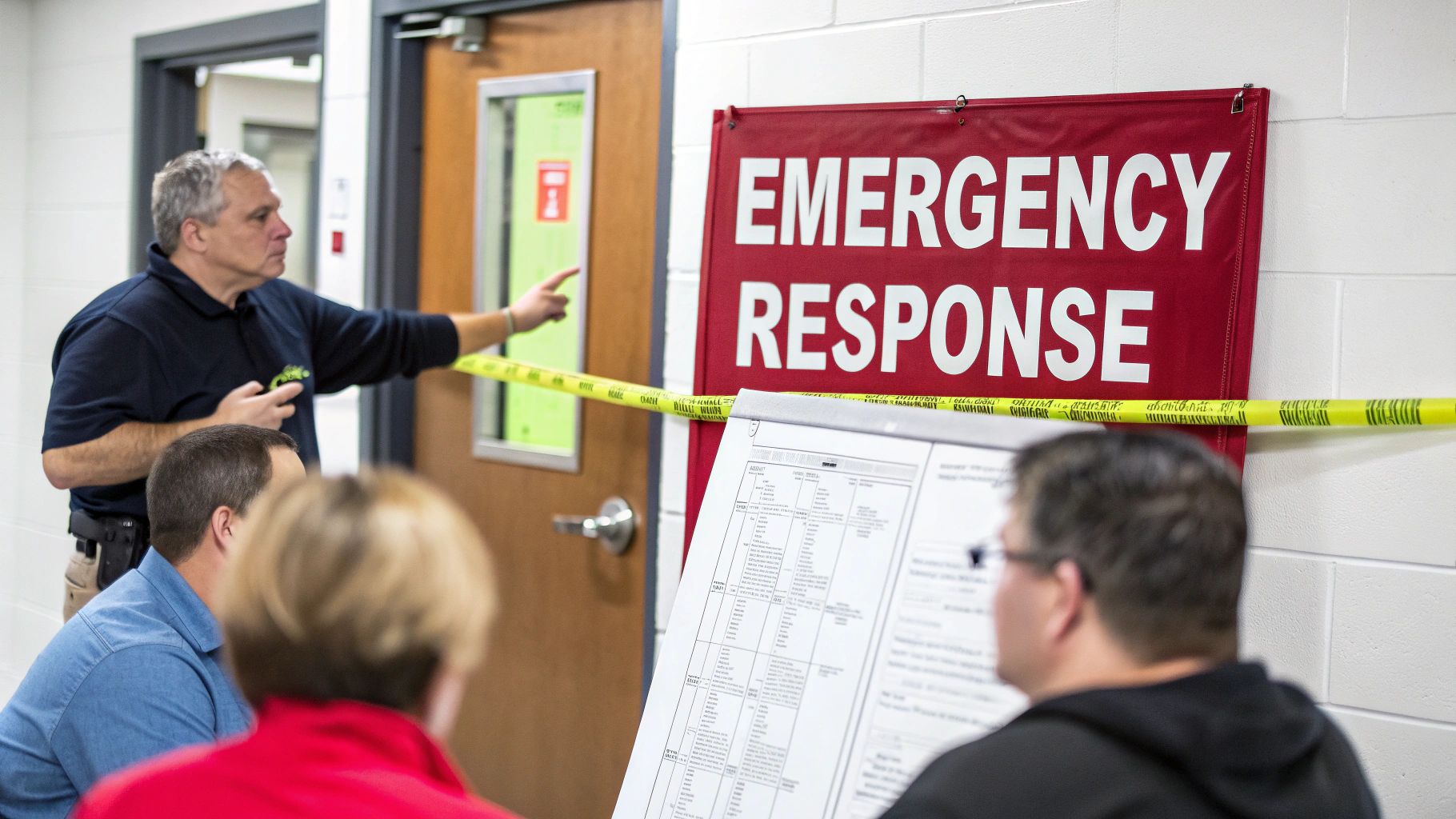
Crafting a Realistic Emergency Response Plan
Accidents can happen despite the best precautions. A plumber might unknowingly drill into an asbestos cement sheet, or a damaged ACM might be discovered during a minor renovation. Your emergency response plan is the clear, step-by-step playbook for these high-stakes moments. It must eliminate guesswork, enabling your team to act decisively to minimise fibre release and exposure.
Crucial Insight: The first few minutes after an accidental asbestos disturbance are the most critical. A fast, controlled response can prevent a minor incident from becoming a major contamination event.
Scenario: An Accidental Discovery
Imagine a maintenance worker is replacing a cracked tile and finds a crumbling, fibrous board behind it that is not noted in the asbestos register. Your emergency plan should guide them through these immediate actions:
- Stop All Work Instantly: The first action is to stop everything. No more pulling, drilling, or cleaning up.
- Leave the Area Calmly: The worker should exit the immediate area without running, which could stir up fibres. They should avoid spreading dust on their clothes or tools.
- Secure and Isolate the Area: Prevent others from entering. Close the door to the area and use barrier tape and warning signs to block access.
- Notify the Right People: The worker must immediately inform their supervisor or the designated safety officer, who will then take control of the situation.
- Engage Professionals: The safety officer's next step is to contact a licensed asbestos assessor or removalist. Do not attempt to clean up or assess the material yourself. A professional is needed to confirm if it is an ACM, determine the extent of contamination, and plan the remediation.
By drilling these simple, logical steps, you empower your team to handle a potentially dangerous situation with confidence and control. This practical readiness is what truly brings your asbestos management plan to life.
How to Review and Maintain Your Asbestos Plan
Your asbestos management plan is not a static document. It is a living blueprint for safety that must be regularly reviewed and updated. An outdated plan is a direct breach of your legal duties and can leave everyone dangerously exposed.
Think of it like servicing critical equipment. The plan is only as good as the information it contains, and workplaces are constantly changing. A robust review process ensures your plan accurately reflects the current conditions on the ground.
Understanding the Triggers for a Plan Review
Australian WHS regulations require that your asbestos management plan be reviewed to remain current. These reviews can be triggered by a set schedule or by specific events.
Legally, the plan must be reviewed at least once every five years. However, a review is required much sooner if an event occurs that changes the asbestos risk profile of your workplace.
You must act immediately if:
- Known Asbestos Containing Material (ACM) is disturbed or removed.
- An incident occurs, such as accidental damage to an ACM.
- The plan is found to be ineffective.
- A health and safety representative requests a review.
- Major changes are planned, such as refurbishments or demolition.
Juggling these responsibilities can be challenging. Modern tools like the leading property management apps can help streamline scheduling, record-keeping, and task assignment.
To clarify when a review is needed, here’s a breakdown of the triggers.
Asbestos Management Plan Review Triggers
A review is a proactive assessment to ensure the plan remains a reliable tool for protecting people. The table below outlines the key triggers that should prompt a formal review.
| Review Trigger Type | Description | Example Scenario |
|---|---|---|
| Scheduled Review | A routine, time-based review mandated by regulations to ensure the plan remains current and effective. | Your calendar reminder pops up for the 5-year statutory review, prompting a full re-inspection and documentation check. |
| Event-Based Review | An immediate review prompted by a specific incident, change, or request that may alter asbestos risks. | A forklift accidentally scrapes a wall clad in asbestos cement sheeting, requiring an immediate risk reassessment. |
Understanding these triggers is the first step. The next is ensuring your reviews are practical and thorough.
Conducting a Practical and Thorough Review
A proper review is more than a quick skim of the paperwork. It is an active, hands-on process to re-evaluate the plan's fitness for purpose.
Start with a physical walk-through of the site, visually re-inspecting every ACM listed in your asbestos register. The condition of these materials can change over time. An ACM noted as being in "good, sealed condition" two years ago might now show signs of damage. Any change must be documented.
Key Insight: The main goal of any review is to validate your risk assessment. If an ACM has deteriorated, your original risk rating is likely incorrect and must be updated to reflect the new, higher level of risk.
After the physical inspection, update the documentation. This is where meticulous record-keeping is vital.
The Critical Role of Long-Term Record-Keeping
Your duty to keep records extends for decades. This documentation is your proof of due diligence, creating a complete, auditable history of every decision and action.
Your records need to be thorough, capturing everything:
- Asbestos Survey Reports: Keep every survey, including NATA-accredited lab analysis results.
- Risk Assessments: File every risk assessment and any updates from subsequent reviews.
- Training Records: Maintain a log of who was trained, on what date, and the content covered.
- Air Monitoring Results: All air monitoring reports are essential for proving control measures were effective.
- Clearance Certificates: After any licensed removal work, this certificate is your official proof that the area is safe.
- Consultation Records: Note any discussions with workers or HSRs about the plan.
This paper trail is invaluable. It provides critical historical information for any future work, protecting everyone who enters your site for years to come. Your asbestos plan isn't just about today—it's about creating a safe history for your building.
Got Questions About Your Asbestos Plan? We've Got Answers.
When dealing with a hazard as serious as asbestos, questions are inevitable. Even with a robust plan, real-world situations can present challenges. Here are answers to some of the most common questions from business and property owners.
This practical Q&A session will help you clarify the details of your asbestos management responsibilities.
Do I Really Need a Plan for a Newer Building?
This is one of the most frequent questions we receive. If your building was constructed after the nationwide ban on December 31, 2003, the likelihood of it containing asbestos is extremely low. In most cases, a full asbestos management plan is not required.
However, the PCBU (Person Conducting a Business or Undertaking) is responsible for being 100% certain. If any imported materials of unclear origin were used during construction, there is a small risk. The safest approach is to have a professional confirm the building is asbestos-free. This official documentation is the best way to demonstrate due diligence.
A word of caution: always double-check before major renovations, even in a modern building. We have seen cases where older machinery containing asbestos parts was moved into a new facility. It is always better to be safe than sorry.
What's the Real Difference Between Friable and Non-Friable Asbestos?
Understanding this distinction is critical because it dictates how you manage risk.
-
Non-Friable Asbestos: Also known as 'bonded' asbestos, the fibres are locked into a solid matrix like cement or resin. Examples include fibro sheeting, vinyl floor tiles, and corrugated roofing. As long as it is in good condition and left undisturbed, it is stable. The danger arises when it is cut, drilled, sanded, or broken, which can release trapped fibres.
-
Friable Asbestos: This is the most dangerous form. It is soft, crumbly, and can be reduced to dust with hand pressure. Classic examples include old pipe lagging and sprayed-on insulation. Because the fibres are loosely held, they can become airborne with the slightest disturbance, creating an immediate and serious inhalation risk.
The discovery of friable asbestos is a red alert. Your management plan must treat it as the highest priority, demanding immediate and strict control measures. There is no room for delay.
Can My Own Team Do Minor Asbestos Work?
This is a significant grey area where compliance breaches can easily occur. Australian regulations are incredibly strict for a reason.
Your in-house team can only perform work on non-friable asbestos if a specific set of conditions are met:
- The total area involved is very small – less than 10 square metres.
- The work itself is minor and will not release fibres (e.g., no power tools, no breaking sheets).
- The staff performing the work have completed the required training in safe handling and are equipped with the correct personal protective equipment (PPE).
Any work beyond these limits – any work on friable asbestos, or removing more than 10 square metres of non-friable material – is strictly prohibited. That work must be performed by a licensed asbestos removalist. Your plan should clearly state this policy to prevent any violations.
How Do I Make Sure the Asbestos Register is Genuinely "Accessible"?
Regulations state that your asbestos register must be "readily accessible," meaning people must be able to find and consult it before they begin a job. A register locked in a manager's office is not compliant.
Here’s how to ensure accessibility:
- Physical Copy: A clearly labelled binder kept in a central, known location like a site office, maintenance room, or reception desk.
- Digital Access: A digital copy stored on a shared company server or a cloud-based safety management system. You must ensure every contractor and relevant employee knows how to access it.
A best practice is to make reviewing the asbestos register a mandatory, sign-off item in your site induction process for all contractors. The goal is simple: no one drills, cuts, or demolishes anything without checking that register first. It is the single most effective habit you can build to prevent an asbestos incident.
At Anitech Ltd Pty, our expert occupational hygienists specialise in asbestos management. We can help you develop a practical, compliant asbestos management plan that truly works for your site. We bring the scientific know-how and real-world experience to keep your workplace safe.
For everything from comprehensive asbestos assessments to air monitoring and strategic safety consulting, see how we can protect your business and your people.


