
Quick Summary: New Australian environmental laws, including the Environment Protection Reform Bill and PFAS NEMP 3.0, are set to significantly increase property decontamination costs. Stricter standards, broader liability, and more powerful regulators could elevate cleanup budgets by 20-40%, especially for manufacturing and mining sectors. This report breaks down the legislative changes and provides a strategic plan for managing the financial impact, forecasting financial shifts, and ensuring regulatory compliance.
Forecasting Financial Shifts: The Impact of New Legislation

This legislative impact report is designed to cut through the noise and show you exactly how new laws are set to affect your property decontamination budget. Let's be clear: these aren't just minor tweaks to existing rules. We're looking at a fundamental shift in how environmental responsibility and regulatory compliance are handled in Australia.
For industries that have long factored remediation into their financial planning, the goalposts have moved. The old budget assumptions simply won't hold up.
Understanding these legislative trends now is the single best way to avoid costly financial surprises and maintain industry standards. This guide breaks down the complex legal jargon into practical advice for site owners and managers, so you can see what’s coming and prepare for it.
Getting to Grips with Australia's New Regulatory Environment & Industry Standards
Australia's environmental laws are going through their biggest shake-up in a generation. What was once a confusing patchwork of state and federal rules is being replaced by a much tougher, unified national system. This isn't just a minor tweak; it's a fundamental shift that puts property decontamination and regulatory compliance front and centre for businesses, demanding a whole new level of attention and budget.
For years, companies have had to navigate a messy web of regulations that differed from one state to another. This created inconsistencies, loopholes, and a lot of headaches, especially for businesses operating across the country.
The push for change really gained momentum after a landmark 2020 independent review, led by Professor Graeme Samuel. His report was refreshingly blunt, calling out the old Environment Protection and Biodiversity Conservation Act 1999 (EPBC Act) as overly complex and, frankly, ineffective at actually protecting the environment. That review basically laid the groundwork for the sweeping reforms we're seeing today.
A New Federal Framework is Here
The heart of this new era is a trio of powerful new laws passed in 2025: the Environment Protection Reform Bill 2025, the National Environmental Protection Agency Bill 2025, and the Environment Information Australia Bill 2025. These aren't just coming into effect overnight; they're set to be fully operational by mid-2026. Make no mistake, these changes will completely reshape how businesses handle environmental management and, by extension, how they calculate and manage property decontamination costs. For a closer look at the nuts and bolts, you can explore the details of these significant reforms to Australia's national environmental laws.
This new setup is specifically designed to get rid of the overlaps and gaps that have historically frustrated industries like mining, manufacturing, and oil and gas. A key part of this is the creation of a powerful and independent National Environmental Protection Agency (NEPA), which signals a clear move towards proactive, consistent enforcement across the entire country.
This is more than just new forms to fill out. It's about setting a new, higher standard for what's considered acceptable. With NEPA in charge, a single authority will be calling the shots, making sure environmental rules are applied the same way everywhere. The bar has just been raised for everyone.
Tougher Standards and Wider-Reaching Assessments
One of the most immediate changes you'll notice is the introduction of far more rigorous Environmental Impact Assessments (EIAs). In the past, the requirements for an EIA could be wildly different depending on which state you were in, creating a lot of uncertainty. Now, with federal oversight, EIAs will be much more thorough, requiring a deeper dive into potential contamination risks and their long-term consequences.
This increased level of scrutiny means that projects that might have sailed through the approval process before will now face a much tougher road. The scope of what needs to be checked, cleaned up, and reported on is getting bigger, and that will inevitably drive up the initial costs of site evaluations and project planning.
So, what does this actually mean for your business on the ground?
- More In-Depth Due Diligence: Get ready for site assessments to become more detailed, take longer, and cost more, whether you're starting a new project or buying a property.
- A Stricter Definition of "Contaminated": The goalposts are moving. Sites that were previously considered "clean enough" might now fall into the contaminated category, triggering remediation requirements.
- A National Benchmark: Even if you get a tick from the state, your project will now have to meet a consistent—and higher—national standard set and enforced by NEPA.
At the end of the day, these new laws are building a completely new foundation for environmental compliance. Getting your head around this new regulatory world is the essential first step to properly forecasting the costs heading your way and putting together a solid plan to manage them.
How These New Laws Directly Drive Up Your Cleanup Costs
It’s easy to dismiss shifts in environmental regulations as just policy paperwork, but what’s happening in Australia right now is a direct hit to the balance sheet. This isn't just about new rules; it’s about new, very real expenses. The legislative jargon is translating into tangible costs that fundamentally change the economics of decontaminating a property.
Let's get straight to how these changes are pushing expenses skyward.
Tougher Standards Mean More Expensive Methods
The biggest single cost driver is the tightening of remediation standards. For years, the bar for what was considered "clean" was, frankly, lower. This allowed for more basic—and much cheaper—cleanup methods.
That era is over. The new framework demands a much higher level of decontamination, forcing businesses to ditch old approaches and invest in more advanced, sophisticated, and expensive technologies to get the job done. What was "clean enough" yesterday now requires a significant new investment to meet compliance. The goalposts haven't just moved; they've been set to a professional-league standard.
This new legislative hierarchy shows how national bodies and landmark bills are reshaping the entire regulatory landscape.
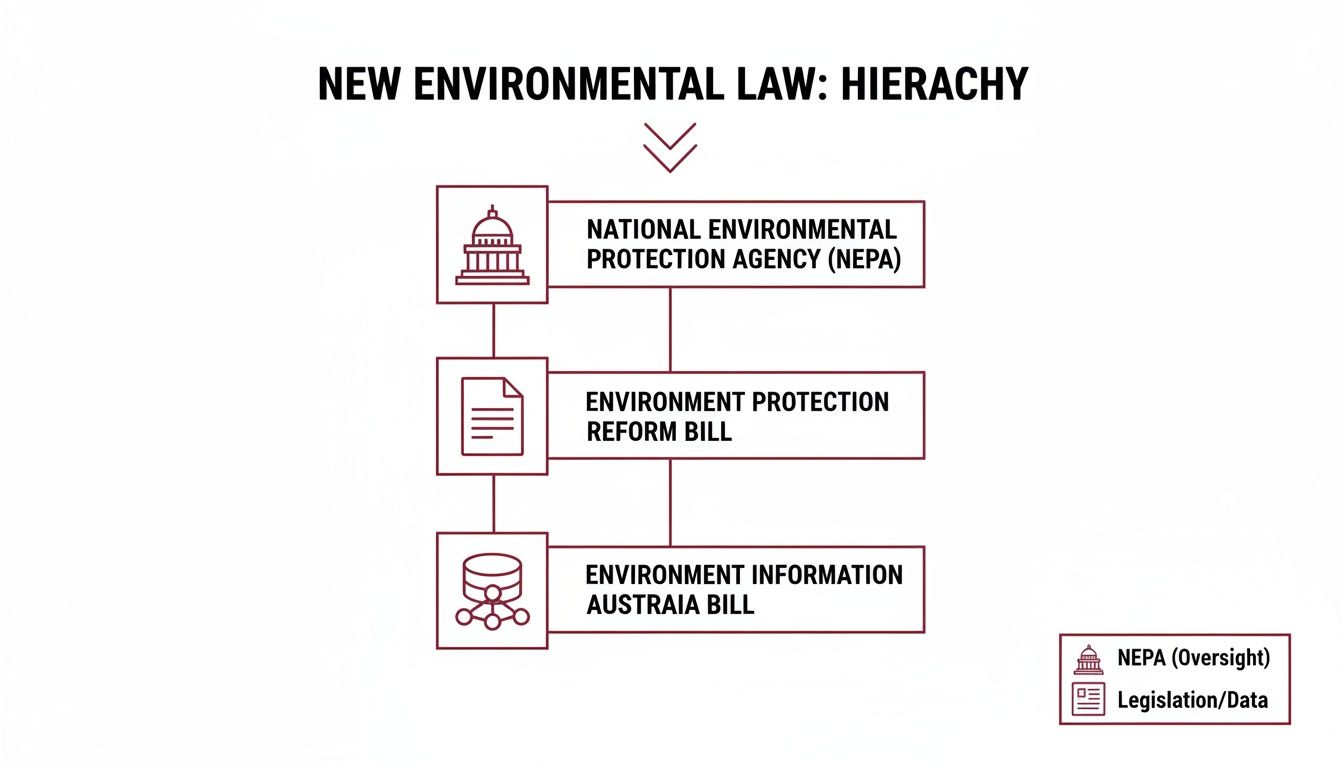
As you can see, authority is now far more centralised under the new National Environmental Protection Agency (NEPA), which is tasked with enforcing the rigorous standards set by major reforms like the Environment Protection Reform Bill.
Expanded Liability Casts a Wider Financial Net
One of the most profound financial shifts is the introduction of expanded liability. Under the old rules, responsibility for contamination often stopped with the current property owner. The new legislation casts a much wider net, creating a chain of accountability that can reach back decades.
This is often called "cradle-to-grave" liability, and it’s a game-changer. It means that previous owners, operators, and anyone who contributed to the contamination can now be held financially responsible for the cleanup. For companies, this creates a whole new layer of financial risk, even for sites they sold off years ago. Suddenly, your historical operations are a very real, present-day financial problem.
A property's entire history is now a direct line item in the current owner's financial risk profile. Due diligence during property deals just became exponentially more important, because when you acquire a site, you’re also acquiring its past environmental sins—and the bill that comes with them.
We can see parallels in other regulated industries. For example, the recent CAA fee increase leading to costly setbacks for drone operators shows just how directly regulatory changes can hit a business’s bottom line.
The Hidden Costs of Constant Reporting and Monitoring
On top of the physical cleanup, the new laws introduce a mountain of administrative overhead through mandatory monitoring and reporting. Compliance is no longer a one-and-done event; it’s about proving and documenting that you’re staying compliant over the long haul.
This forces businesses to budget for ongoing activities that were previously an afterthought. These new obligations include:
- Continuous Site Monitoring: This means regular soil and water sampling to prove contamination levels are staying below the new, stricter thresholds. Think ongoing lab analysis fees and consultant costs.
- Detailed Reporting Protocols: You’ll be submitting comprehensive data to the new Environment Information Australia agency and NEPA. This requires dedicated staff time to manage data collection and ensure every report is accurate.
- Public Disclosure Requirements: Some of the new rules mandate making contamination data public, adding another layer of administrative complexity and the need for reputation management.
This endless cycle of monitoring and reporting adds a significant, recurring expense to your budget. A one-off remediation project now becomes a long-term management commitment with a very long financial tail.
The table below breaks down how these new mechanisms translate into real-world cost increases across different sectors.
Cost Impact of Key Legislative Changes
| Legislative Mechanism | Description | Primary Affected Industries | Estimated Cost Increase |
|---|---|---|---|
| Tighter Remediation Standards | Requires more advanced, thorough, and expensive cleanup technologies to meet new benchmarks for "clean." | Manufacturing, Mining, Chemicals | 15-25% |
| Expanded "Cradle-to-Grave" Liability | Holds previous owners and operators financially responsible, increasing due diligence and insurance costs. | Real Estate, Construction, Aerospace | 10-20% (plus potential historical claims) |
| Mandatory Reporting & Monitoring | Creates ongoing administrative and operational costs for data collection, analysis, and submission to new agencies. | All industrial site owners, particularly Food & Beverage, Pharmaceuticals | 5-10% (recurring annually) |
These administrative burdens are a critical piece of the puzzle. They quietly inflate the total cost of ownership for any industrial property and must be factored into any forward-looking financial planning.
The Financial Fallout of New PFAS Regulations
Of all the recent legislative changes, the one set to have the most significant financial bite is the crackdown on a specific group of contaminants: per- and poly-fluoroalkyl substances, or PFAS. These man-made chemicals are now at the centre of a massive regulatory overhaul, and it's going to directly change the maths on property decontamination costs for a lot of Australian businesses.
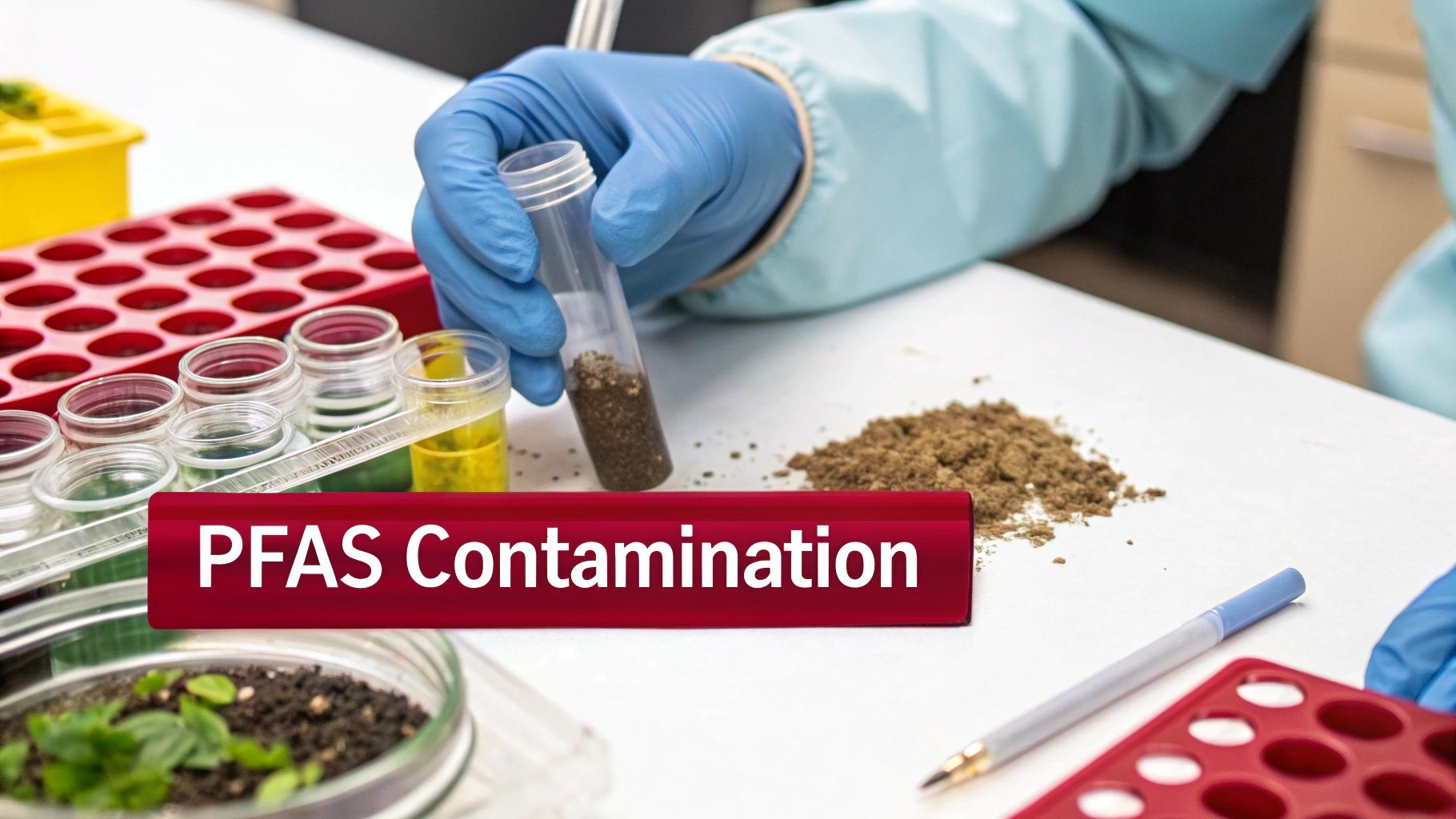
Often dubbed "forever chemicals," PFAS are a family of synthetic compounds famous for one thing: they just don't break down. For decades, their unique resistance made them invaluable in countless industrial and commercial products.
Understanding Why PFAS Are Such a Big Deal Now
The problem is that these chemicals were used in everything from non-stick pans and rain jackets to, most importantly for industrial sites, high-performance firefighting foams. Any industry that used these materials heavily is now sitting on a serious contamination legacy.
We're seeing a few key sectors land squarely in the regulatory spotlight:
- Aerospace and Defence: Think about all the fire training and suppression drills at airfields using aqueous film-forming foam (AFFF) over the years.
- Manufacturing: Any facility that produced or worked with special coatings, textiles, or electronics likely has a PFAS history.
- Oil, Gas, and Mining: Firefighting foams were a safety staple at refineries, processing plants, and transport hubs.
- Waste Management: Landfills that took in industrial or even consumer waste containing PFAS products are now considered high-risk sites.
Because these chemicals stick around for so long, they can build up in the soil, leach into groundwater, and pose a threat for generations. That persistence is exactly why regulators are finally bringing the hammer down.
Getting to Grips with the NEMP 3.0 Framework
The main engine driving up these new costs is the PFAS National Environmental Management Plan (NEMP) 3.0. Don't mistake this for a simple set of guidelines; it's a national framework that lays down strict, legally binding rules for how PFAS-contaminated sites must be managed.
NEMP 3.0 essentially sets a new, non-negotiable standard of care. It firmly places the responsibility on property owners to find, manage, and clean up PFAS contamination. This creates a new and often unexpected liability that can sink a site's value and blow out its operational budget.
The plan rolls out several critical requirements that directly inflate cleanup costs. For starters, it dramatically lowers the safety thresholds for PFAS levels in soil and water. This means land previously considered "low-risk" might now need immediate and expensive work. On top of that, NEMP 3.0 requires specific—and often more costly—investigation techniques and remediation technologies to make sure these stubborn chemicals are properly dealt with.
The Real-World Cost Implications
The financial shockwaves from NEMP 3.0 are already being felt. Endorsed by environment ministers in late 2024 and officially released in March 2025, the plan is redrawing the map for property decontamination across Australia. This is especially true for Anitech's clients in oil, gas, mining, and aerospace, who are facing a steep climb in PFAS cleanup bills as we head into 2026.
Industry experts are warning that these new rules could push remediation costs up by 15-25% for affected properties. Businesses now have no choice but to monitor, disclose, and remediate contamination under a much tougher national standard. You can discover more insights on navigating PFAS compliance moving into 2026 here.
These costs pop up in a few different ways. During due diligence for a property sale, even the potential for PFAS contamination now triggers expensive, specialised testing. If it's found, the property's value can nosedive, and the cleanup bill can become a massive roadblock in negotiations, sometimes killing deals altogether. For current site owners, compliance is no longer a choice; it's a mandatory operational expense that has to be baked into long-term financial planning. This legislative impact report makes one thing clear: looking the other way on PFAS is no longer a viable strategy.
Don't Underestimate the States: Where Fines and Penalties Really Bite
While the new federal laws get the headlines, it’s the state environmental protection agencies (EPAs) that are really on the ground, enforcing the rules and handing out the fines. Think of the federal framework as the new national rulebook, but the state EPAs are the local referees with the power to penalise you on the spot.
For businesses, this two-tiered system can be a minefield. Ignoring the specific regulations in your state isn’t just a compliance oversight; it can quickly become a multi-million-dollar blunder. This is a crucial piece of the puzzle because states aren't just copying and pasting federal rules—many are using them as a launchpad for their own tougher, more targeted enforcement campaigns.
The Heavy Hitters: Western Australia and New South Wales
If you want to see this in action, just look at industrial powerhouses like Western Australia and New South Wales. Both states have a long-standing reputation for having some of the most robust contaminated land laws in Australia, and they are perfect examples of how these new bills are driving up property decontamination costs.
The game has changed. These states are no longer just offering guidance; they are actively hunting down non-compliant sites with renewed energy. This makes proactive compliance less about ticking a legal box and more about sound financial management.
A recent 2024 guide from Baker McKenzie really drives this home. In NSW, the EPA has the authority to declare land as "significantly contaminated." This isn't just a label; it triggers legally binding cleanup orders. If a company ignores these orders, they’re looking at corporate penalties of up to AUD 1 million, or AUD 250,000 for individuals. And if that doesn't get their attention, the state can perform the cleanup itself and send the company a bill for the entire cost—which can easily climb into the millions. You can read more on how these targeted state laws are impacting heavy industry.
WA is just as aggressive, especially with its mining and oil sites. Fines there can hit AUD 500,000, with significant daily penalties added for every day the non-compliance continues. It’s a simple calculation: the cost of ignoring the problem is now far greater than the cost of fixing it properly.
Disclosure Rules: The Hidden Cost That Tanks Asset Values
The pain doesn't stop with direct fines. State regulations also pack a punch through mandatory disclosure requirements during property sales. If you're selling an industrial site in a state like NSW or WA, you are legally required to declare any known contamination.
This has a swift, and often brutal, effect on the property's value. A site with a history of contamination will immediately see its market price drop, even if a management plan is in place. Potential buyers aren't naive; they will bake the estimated cleanup costs and future liabilities directly into their offers, which means a big financial hit for the seller.
In this new environment, a clean environmental record is no longer just a bonus; it's a core component of a property's financial value. Failure to address contamination proactively doesn't just risk fines—it actively erodes the worth of your most significant assets.
Getting your head around these state-specific details is non-negotiable. Our guide on understanding state-specific meth testing legislation provides more insight into how different jurisdictions operate. With aggressive state enforcement backing up new federal standards, there's really nowhere left to hide.
Proactive Strategies to Control Decontamination Costs
When new, stricter regulations come into play, it’s easy to fall into the trap of waiting to see what happens. But in this new environment, a "wait-and-see" approach is hands down the riskiest financial move you can make. The real key to getting a handle on decontamination expenses is to get out in front of them. It's about shifting from reacting to problems to actively preventing them, turning a costly compliance burden into a real strategic advantage.

Think of this as a proactive playbook for navigating the changed legislative landscape without blowing your budget. The goal is to make smart, informed decisions right now to sidestep expensive, regulator-enforced cleanups down the track.
Establish Your Environmental Baseline Immediately
The single most important thing you can do right now is a comprehensive environmental site audit. This isn't just a quick check for obvious problems. It’s about establishing a clear, documented baseline of your property's condition before the new laws are in full swing.
Think of it like getting a building inspection before you start a major renovation. You have to know where the structural supports and hidden issues are before you start knocking down walls. An audit gives you that same clarity, flagging potential liabilities under the tougher new standards.
This puts you back in the driver's seat. You can budget accurately and tackle any issues on your own schedule, which is almost always cheaper than being forced into an emergency cleanup on the EPA's timeline.
Implement a Robust Environmental Management System
Once you know where you stand, the next step is to build a solid framework to keep you compliant. The best tool for the job is a structured Environmental Management System (EMS). An EMS is just a formalised way for your business to systematically manage its environmental responsibilities.
A well-designed EMS will help you:
- Track Compliance: It gives you a clear system for keeping on top of your legal duties under both federal and state laws.
- Identify Risks: It helps you spot potential contamination issues before they spiral into major problems that demand costly remediation.
- Improve Efficiency: When you weave environmental management into your day-to-day operations, you often find clever ways to cut down on waste and operational costs.
- Demonstrate Due Diligence: Having a documented EMS is powerful proof for regulators that you're taking your responsibilities seriously.
This system becomes your operational blueprint for managing risk and staying ahead of the regulatory game.
Adopting a formal EMS transforms environmental compliance from a series of disjointed, reactive tasks into a coherent, proactive strategy. It’s the difference between firefighting and fire prevention, and the cost savings are substantial.
The financial fallout from non-compliance in other areas shows why this is so critical. For example, the way a late tax return penalty in Australia is structured offers a direct parallel to the major financial risks of ignoring new decontamination laws. The principle is identical: proactive compliance helps you avoid expensive penalties.
Engage Expertise Early in the Process
In this complicated new landscape, going it alone is a false economy. Bringing in qualified environmental consultants and occupational hygienists from the beginning isn’t an expense—it's an investment in cost control.
Getting experts involved early gives you a huge advantage. They can run accurate preliminary site investigations (PSIs) to assess historical risks, especially for tricky contaminants like PFAS. They can also develop targeted and cost-effective remediation action plans (RAPs) that are tailored to the new standards, making sure you don't waste money on unnecessary work.
On top of that, these experts can act as your go-between with regulatory bodies, navigating the complex web of submissions and approvals far more efficiently than you could on your own. Bringing in a team like Anitech during the planning phase lets you build a strategy based on hard data and deep experience, ensuring every dollar you spend on compliance is a dollar well spent.
Got Questions? We've Got Answers
If you’re a business owner or site manager, you probably have a few pressing questions about these new laws and what they mean for your bottom line. Let's get straight to the point and tackle the big ones so you can figure out your next move.
When Do These New Environmental Laws Actually Kick In?
The rollout is a bit staggered. Some of the new rules, especially around PFAS, will start to come online during 2025. But the main event—the major federal reforms and the launch of the new National Environmental Protection Agency (NEPA)—is slated for mid-2026.
But don't make the mistake of waiting until the last minute. Some parts are being pushed through faster to stop everyone from scrambling at once. The smartest play is to start your compliance planning and site assessments now. Getting ahead of the curve means you’ll understand your liabilities before the stricter enforcement regime begins, which could save you a fortune in costs and penalties down the track.
How Can I Tell if My Property Is on the Hook for the New PFAS Rules?
Good question. If your property has ever been used for activities involving firefighting foams, certain manufacturing processes, or specific kinds of waste disposal, you should be on high alert. This is particularly true for sites in aerospace, defence, oil and gas, and chemical manufacturing. The new PFAS National Environmental Management Plan (NEMP 3.0) puts the responsibility squarely on property owners to prove their site is clean.
The best first step is to get a qualified consultant to do a preliminary site investigation (PSI). They'll dig through historical records to see if there’s a risk, which will determine if you need to move on to soil and water sampling. Finding out for yourself is always better than having a regulator find it for you.
"Waiting for a regulator to identify a PFAS issue on your site is a recipe for financial disaster. Early detection and voluntary management are exponentially cheaper and less disruptive than a mandated cleanup."
I Run a Small Business – Do I Get a Pass on This?
Unfortunately, no. There aren't any broad exemptions for small or medium-sized businesses (SMEs). The rules are triggered by the type of contamination and the industrial activity that happened on the site, not by the size of the company that owns it.
Of course, the financial hit will vary. A small workshop might have a manageable cost to clean up a minor spill. In contrast, a large industrial plant could be looking at a multi-million dollar liability. But regardless of your business's size, the same compliance and reporting standards apply to everyone.
What’s the Single Best Thing I Can Do to Keep Decontamination Costs Down?
Without a doubt, the most powerful step you can take is to get a proactive, in-depth environmental audit of your properties. Critically, this audit needs to be benchmarked against the new laws coming in, not just the ones we have today. This gives you a crystal-clear picture of your contamination risks and what you might be up for financially.
An early audit helps you:
- Create a game plan: You get to deal with any issues on your own schedule, not in a mad, expensive rush because a regulator is knocking on your door.
- Budget properly: No one likes nasty financial surprises. An audit helps you understand the full scope of potential costs from the get-go.
- Get a leg up: A clean environmental report can seriously boost your property's value and make any future sales or deals go much more smoothly.
Basically, it gives you the hard data you need to make smart financial and operational decisions in this new era.
How Will This Affect Buying or Selling Property?
These laws have seriously upped the ante for property deals. The expanded "cradle-to-grave" liability means that both buyers and sellers need to be far more thorough with their environmental due diligence.
If you're selling, failing to disclose known contamination could land you in legal hot water and facing hefty financial penalties long after the sale is done. If you're buying, taking on a site without a proper investigation means you could be inheriting a massive, and expensive, cleanup job. Environmental assessments are no longer just a box to tick—they’re a non-negotiable part of managing risk for any industrial property transaction.
Making sense of these complex new rules is a challenge, and it pays to have an expert in your corner. The team at Anitech offers comprehensive occupational hygiene and environmental consulting to help you pinpoint your liabilities and build cost-effective strategies to stay compliant. Protect your assets and keep your workplace safe by working with the leaders in the field. Find out how we can support your business by visiting the Anitech occupational hygiene experts.


