
Quick Summary: Laboratory analysis provides precise, legally defensible quantitative data on methamphetamine contamination levels, making it essential for legal compliance and post-remediation clearance. Instant swab kits offer a fast, qualitative "yes/no" indication for preliminary screening but are not accurate enough for official use and can produce false results.
When deciding between professional lab analysis and DIY instant swab kits for meth testing, the core difference is stark: laboratory analysis offers quantitative proof, while instant swab kits provide a qualitative indication. One method tells you exactly how much methamphetamine residue is present, delivering legally defensible data crucial for property transactions and health standards. The other simply flags whether a substance is detected, often without the accuracy needed for critical decisions. Understanding this distinction is vital for property owners, managers, and potential buyers navigating the risks of meth contamination.
Understanding the Two Main Testing Approaches
When you’re assessing a property for methamphetamine residue, choosing the right testing method is critical. Your decision directly impacts the accuracy of your risk assessment, your ability to meet Australian safety guidelines, and the health of future occupants. The choice between a detailed lab analysis and a quick instant swab test isn't just about speed or cost; it’s about aligning the tool with the high stakes of property safety.
Laboratory analysis is, without a doubt, the gold standard for accuracy and reliability in meth testing. It involves an accredited technician carefully collecting samples according to a specific methodology, which are then sent to a NATA-accredited facility for highly sophisticated instrumental analysis. This process yields precise, quantitative results (e.g., micrograms per 100cm²) that are legally defensible and required for property clearance.
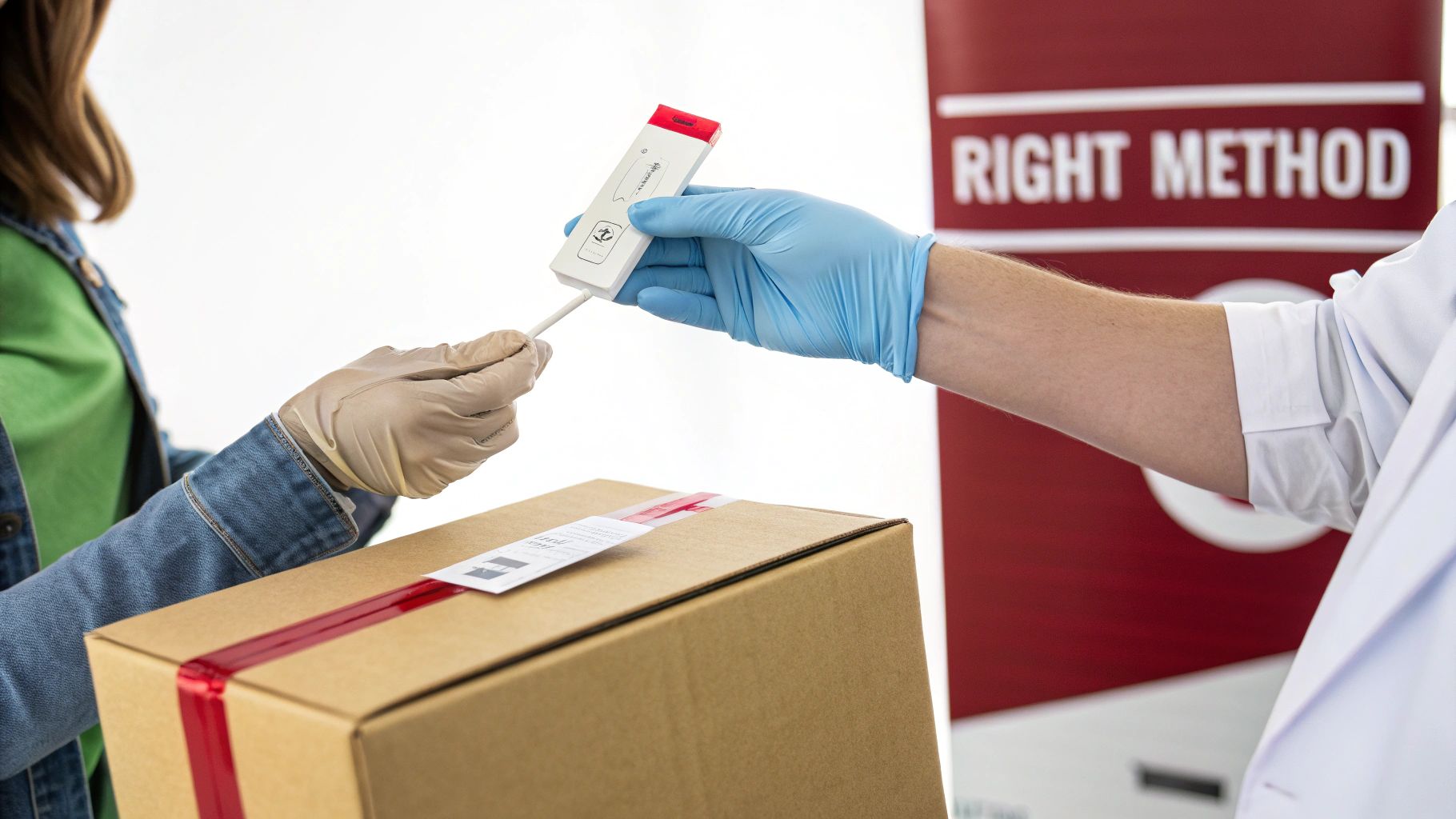
On the flip side, instant swab kits are designed for speed and on-the-spot screening. They typically use colorimetric or immunochemical reactions to detect if methamphetamine is present above a certain threshold. While convenient for a preliminary check, they cannot measure the exact concentration of contamination and are susceptible to interferences and user error, which can compromise their reliability.
Key Operational Distinctions
For property managers, homeowners, and real estate agents, this choice has massive implications. Take the scenario of a former rental property suspected of being used as a meth lab. A professional lab analysis is the only way to accurately determine if contamination levels exceed the Australian Clandestine Drug Laboratory Remediation Guidelines (0.5 µg/100 cm²). A 2022 Safe Work Australia report, while focused on workplace hazards, underscores the principle that only lab-based monitoring can properly demonstrate compliance with safety standards due to its required precision. Instant kits lack the rigour to provide the definitive data needed for a property clearance certificate. You can dive deeper into the official findings on measuring respirable crystalline silica from Safe Work Australia which highlights the need for precision.
The core decision hinges on purpose: use laboratory analysis for compliance, risk management, and property clearance, and use instant swabs for initial, non-critical screening only.
To make the differences even clearer, let's break them down in a simple table.
High-Level Comparison: Lab Analysis vs Instant Swab Kits for Meth Testing
This table provides a quick snapshot of the core differences between the two methods across the most important criteria for property assessment.
| Criterion | Laboratory Analysis | Instant Swab Kits |
|---|---|---|
| Result Type | Quantitative (specific concentration) | Qualitative (presence/absence) |
| Accuracy | High; considered the gold standard | Variable; prone to false results |
| Time to Result | 24-72 hours or more | 5-15 minutes |
| Regulatory Use | Legally defensible; used for official property clearance | Not accepted for official clearance |
| Best For | Confirming safety, post-remediation testing, and demonstrating legal compliance for property transactions. | Quick screening, identifying potential hotspots for further testing, and preliminary checks. |
Ultimately, understanding these differences is non-negotiable for anyone responsible for ensuring a property is safe and free from hazardous methamphetamine residue.
The Science Behind Testing Accuracy
When we pit lab analysis against instant swab kits, we’re not just comparing two methods—we’re looking at two entirely different scientific philosophies. The massive gap in their performance isn't by chance; it's a direct result of the technology driving them. One relies on highly sophisticated, controlled instrumentation, while the other uses basic chemical reactions in the field. This difference is what leads to such vastly different outcomes.
At the core of any serious testing are three key principles: sensitivity, specificity, and the limit of detection (LOD). Think of it like this: sensitivity is a test's ability to find a substance when it's actually there. Specificity is its power to correctly give a negative result when the substance is absent. A truly reliable test nails both, which means you get fewer false negatives and false positives. In short, you get a result you can actually trust.
Then there's the LOD, which defines the absolute smallest amount of a substance a test can reliably pick up. For professional lab equipment, this limit is incredibly low. We're talking about detecting minute, trace-level contaminants that a less sensitive method would completely miss. This level of precision isn't just nice to have; it's essential for meeting Australia's strict remediation guidelines.

The Gold Standard of Laboratory Analysis
The incredible accuracy of lab-based testing comes down to its tightly controlled environment and powerful analytical gear. Techniques like Gas Chromatography-Mass Spectrometry (GC/MS) or Liquid Chromatography-Mass Spectrometry (LC/MS) are considered the gold standard for a reason. This technology meticulously separates complex chemical mixtures and then identifies each individual component by its unique molecular fingerprint. The result? Hard, quantitative data that’s virtually irrefutable.
This process guarantees that what’s being measured is exactly the target substance, not some other chemical that just happens to look similar. This level of certainty is absolutely non-negotiable when the results could have legal or financial consequences, such as in a property sale. On top of that, the entire workflow is governed by stringent protocols.
A NATA (National Association of Testing Authorities) accreditation is your assurance that a laboratory meets the highest benchmarks for technical competence and quality management. This includes rigorous sample handling and a documented chain of custody, which meticulously tracks a sample from the moment it's collected to its final disposal, ensuring its integrity is never compromised.
How Instant Swab Kits Work
Instant swab kits work on a much simpler, more direct principle. They’re designed for speed and convenience, not deep analysis. Most rely on one of two common mechanisms to give you a quick reading:
- Colorimetric reactions: These kits are coated with chemical reagents that change colour when they encounter the target substance (or a related family of chemicals). The presence or intensity of the colour change signals a positive result.
- Immunochemical assays: These function a lot like at-home medical tests. They use specific antibodies engineered to bind to a particular substance. If that substance is on the swab, it triggers a reaction that shows up as a coloured line on the test strip.
While they’re undeniably fast, these mechanisms are inherently qualitative. They’re built to answer a simple "yes/no" question: is the substance present above a certain rough threshold? What they can't do is tell you how much is present—a critical detail needed for any meaningful risk assessment. Digging into the science behind test accuracy often involves exploring the medical device product development process, which uses rigorous controls and validation to ensure diagnostic tools are both accurate and reliable.
The Inherent Flaws of Rapid Kits
That very simplicity is also what makes instant swabs so vulnerable to problems that can throw off their reliability. Unlike the sterile, controlled environment of a NATA-accredited lab, on-site testing is a wild west of variables that can easily lead to wrong results.
Here are just a few of their weak spots:
- Cross-Contamination: It's incredibly easy for contaminants from another surface, the user's hands, or even the air to get onto the swab and trigger a false positive. Common cleaning agents can also cause false positives.
- Environmental Interference: Things like temperature, humidity, and even strong lighting can interfere with the delicate chemical reactions in the kit, skewing the outcome.
- User Error: From collecting the sample incorrectly to misreading a faint colour change, human error is a major factor that can completely invalidate a test.
- Limited Specificity: The reagents in some kits aren't picky enough. They can react with other substances that have a similar chemical structure—a problem known as cross-reactivity—leading to a false positive.
Because of these issues, you should always treat a result from an instant swab kit as presumptive, not definitive. It's a useful screening tool for flagging potential problem areas, but it simply doesn't have the scientific rigour needed for final sign-offs or compliance reporting.
A Head-to-Head Methodological Comparison
When you move beyond the science, the practical differences between lab analysis and instant swab kits become crystal clear. This isn't just about choosing a testing method; your decision impacts project timelines, budgets, and even your legal standing. A simple pros-and-cons list just doesn't do justice to the real-world trade-offs you have to weigh up.
So, let's break down the key operational distinctions that every property manager, real estate agent, and homeowner needs to consider. We’ll look at how things like turnaround time, cost, user skill, and regulatory acceptance create completely different outcomes.
Time to Result
The most glaring difference is how quickly you get an answer. Instant swab kits are built for speed, giving you a qualitative "yes" or "no" result in as little as 5 to 15 minutes. This is their biggest selling point, making them incredibly useful for quick, on-the-spot checks to find potential contamination hotspots without waiting around.
Laboratory analysis, however, is a much more deliberate process. Once a sample is collected, it needs to be securely packed and sent to a NATA-accredited facility. There, it's logged, prepared, and run through sophisticated analytical instruments by trained technicians. This entire chain of custody means the turnaround time is naturally longer, typically anywhere from 24 to 72 hours, and sometimes more if the lab is busy or the analysis is complex.
While that immediate feedback from a swab kit is tempting, the speed comes at the expense of detail and certainty. A lab report takes longer, but it provides the comprehensive, quantitative data you need for a truly definitive risk assessment.
Cost Implications
On the surface, instant swab kits look like the clear winner on price. Their low cost per unit is appealing for businesses that need to conduct frequent or widespread screening. But this initial saving can be a false economy, as it often ignores the hidden costs of an inaccurate result.
Think about it: a false positive from a cheap swab kit could trigger an expensive, unnecessary deep clean or even a full-scale lab investigation you didn't need. On the flip side, a false negative is far more dangerous, potentially leaving future occupants exposed to harmful residues and creating significant legal liability.
Laboratory analysis certainly requires a higher upfront investment for each sample. But that cost buys you a legally defensible, highly accurate result that prevents costly failures and delivers long-term value. It’s an investment in certainty. For a good analogy, you can see similar trade-offs by looking at the differences between at-home and clinic blood tests.
Required User Expertise
Another crucial point of difference is the skill needed to use each method properly. Instant swab kits are marketed on their simplicity, designed so that individuals with minimal training can perform a test. But this ease of use can be a double-edged sword.
Without a solid grasp of proper sampling protocols, the risk of user error is significant. Simple mistakes like swabbing the wrong way or accidentally touching the swab tip can completely invalidate the result, often without the user ever knowing they did something wrong.
Common User Errors with Swab Kits:
- Poor Swabbing Technique: Not applying consistent pressure or failing to cover the specified surface area.
- Cross-Contamination: Accidentally touching the swab tip to a glove or another surface.
- Mishandling Reagents: Using expired kits or storing them in a hot vehicle, which can degrade the chemicals.
- Misinterpreting Results: Struggling to read a faint colour change or an ambiguous line.
Laboratory analysis, in contrast, requires a trained technician to collect the samples. These professionals follow strict, standardised procedures to ensure the integrity of every sample, which is vital for getting reliable data. The analysis itself is then handled back at the lab by qualified scientists, taking all the guesswork out of the equation.
To give you a clearer picture of these distinctions, let's lay them out side-by-side.
Feature-by-Feature Breakdown: Lab Analysis vs. Instant Swabs
This table offers a direct comparison of each testing method against the key parameters that matter most in a property assessment setting. It highlights the fundamental trade-offs you'll be making when choosing one over the other.
| Parameter | Laboratory Analysis (Quantitative) | Instant Swab Kits (Qualitative) |
|---|---|---|
| Result Type | Quantitative (e.g., 0.8 µg/100cm²). Provides precise concentration levels. | Qualitative (e.g., Yes/No, Present/Absent). No concentration data. |
| Accuracy | Very High. Validated methods with known sensitivity and specificity. | Variable. Prone to false positives and false negatives; influenced by user error. |
| Time-to-Result | 24-72+ hours. Includes transit time and lab processing. | 5-15 minutes. Provides immediate on-site feedback. |
| User Expertise | High. Requires a trained technician for sample collection. | Low. Designed for use by non-specialist personnel with basic training. |
| Cost Per Sample | Higher. Reflects instrumentation, labour, and accreditation overheads. | Lower. Mass-produced and designed for low-cost screening. |
| Regulatory Standing | Legally Defensible. NATA accreditation is the gold standard for compliance and clearance. | Not Legally Defensible. Cannot be used for official property clearance. |
| Best Use-Case | Compliance verification, post-remediation testing, property sale clearance, and legal evidence. | Rapid screening, pre-purchase caution, and preliminary checks. |
As you can see, the choice isn't just about speed or cost—it's about fitness for purpose. Each method has its place, but they are not interchangeable.
Regulatory Compliance and Defensibility
When it comes to proving a property is safe according to Australian guidelines, there’s simply no debate. Regulatory bodies and industry standards demand quantitative data from accredited labs to confirm that contaminant levels are below the accepted remediation threshold (0.5 µg/100 cm²).
Instant swab kits, with their simple "yes/no" answer, do not provide this data and are not considered legally defensible. You cannot use their results for an official property clearance certificate, a real estate transaction, or in any legal dispute.
The importance of this distinction is thrown into sharp relief when considering remediation. A professional cleanup company will rely exclusively on lab-based testing to first map the extent of contamination and then to verify that their remediation work has been successful. This data-driven approach is the bedrock of ensuring a property is genuinely safe for habitation.
Picking the Right Tool for Your Situation
Choosing between lab analysis and an instant swab kit isn’t about which is "better"—it's about which is fit for purpose. The right choice hinges entirely on your specific scenario, the risk you’re managing, and what the regulations demand. What works for a quick, cautionary check is completely inappropriate for certifying a property as safe.
Let's break down how these methods stack up in the real world across a few key property-related scenarios. You'll see that in some cases, instant swabs have a smart, limited role to play. In others, relying on anything less than accredited lab analysis is simply not an option.
Property Management and Real Estate Scenarios
In the world of real estate and property management, where liability and duty of care are paramount, these two methods serve very different functions. Think of them as complementary tools, not competitors.
Instant swab kits can be useful for routine, low-stakes checks. A property manager might use one during a quarterly inspection if they have a vague suspicion, simply to decide whether to escalate the issue. It's a quick, low-cost way to get a preliminary signal.
But that’s where their utility ends. These swabs are absolutely not up to the task of providing the evidence needed for a bond claim, eviction, or property sale.
When it comes to formal post-remediation validation, providing a clearance certificate for a sale, or gathering evidence for legal action, NATA-accredited laboratory analysis is mandatory. It provides the hard, quantitative data needed to prove that contamination levels are below the specified, safe limits—a must-have for legal and financial peace of mind.
Pre-Purchase Due Diligence
For potential homebuyers, the stakes are incredibly high. Discovering meth contamination after a purchase can lead to devastating financial costs and health risks.
Here, an instant swab kit could be used as an initial, inexpensive screening tool during an inspection period. A positive result would be a major red flag, prompting the buyer to invest in comprehensive laboratory testing before proceeding with the sale. However, a negative result from a DIY kit should not be considered a definitive "all clear" due to the risk of false negatives.
For ultimate certainty, pre-purchase lab-based composite testing is the only truly reliable method. A professional technician will take multiple swabs throughout the property, which are then combined and analysed by a lab. This provides a highly accurate, cost-effective assessment of the entire property's status.
Post-Remediation Clearance
After a property has been professionally decontaminated, the final and most critical step is clearance testing. This is a non-negotiable stage to ensure the cleanup was successful and the property is safe for re-occupancy.
Given the need for absolute certainty, instant swab kits are never suitable for this purpose. Their lack of precision and susceptibility to error mean they could easily miss remaining hotspots, putting future occupants at risk.
This is where accredited laboratory analysis becomes the gold standard. It provides the independent, verifiable, and quantitative proof required by authorities and remediation guidelines to certify that a property meets the safety standard. The reliability of this process is backed by the stringent data requirements of occupational hygiene, where it's common for professionals to collect multiple samples to ensure data is robust enough for accurate risk modelling. You can learn more about how occupational hygiene data is used to protect businesses.
A Situational Use-Case Table
To make the decision a bit clearer, here’s a table that outlines specific scenarios for each testing method. It’s all about matching the tool to the task at hand.
| Scenario | Recommended Method | Rationale |
|---|---|---|
| Routine Rental Inspection | ||
| Quick check based on suspicion | Instant Swab Kit | Provides a rapid, low-cost indicator to decide if further action is needed. |
| Gathering evidence for legal action | Laboratory Analysis | Delivers quantitative data required for legal proceedings and bond claims. |
| Pre-Purchase Due Diligence | ||
| Initial, low-cost screening | Instant Swab Kit | Can be used as a preliminary tool to identify red flags. |
| Definitive property assessment | Laboratory Analysis | The only legally accepted method for confirming a property is safe before purchase. |
| Post-Remediation | ||
| Verifying decontamination effectiveness | Laboratory Analysis | Provides legally defensible proof that the property meets safety standards for re-occupancy. |
Ultimately, it comes down to what you need to achieve. If you’re after a quick, informal check, a swab kit might do the trick. But for anything that involves legal compliance, property transactions, or ensuring the health of occupants, accredited laboratory analysis is the only responsible and defensible choice.
How to Choose the Right Testing Method
Deciding between laboratory analysis and instant swab kits isn't just a technical exercise—it's a critical decision that directly impacts safety, compliance, and your legal standing. To cut through the noise, I always walk clients through three straightforward questions. Your honest answers will point you to the most appropriate and defensible testing strategy.
Ultimately, this process will tell you whether you need the undeniable certainty of quantitative lab data or if a simple qualitative check is enough for the job at hand. For almost any scenario involving Australian property safety guidelines, the right path becomes clear very quickly.
What's the Real Purpose of This Test?
First things first, you need to define your "why." Are you trying to satisfy a legal requirement, clear a property for sale, or just doing a quick spot-check out of curiosity?
- For Compliance and Clearance: If you need to provide a clearance certificate to meet Australian remediation guidelines or for a property transaction, the choice is already made for you. Accredited laboratory analysis is non-negotiable.
- For Preliminary Screening: If you're just doing an initial sweep to identify potential hotspots or as a simple precautionary check, an instant swab kit can be a handy, low-cost tool.
I often tell people to think of it this way: a lab test is your proof of safety, while a swab kit is a tool for flagging potential risks.
What Are the Consequences if a Result Is Wrong?
Next, you have to think about the real-world fallout of getting it wrong. A bad result isn't a small error; it can trigger serious financial and legal headaches. What happens if a false negative leaves a family exposed to a dangerous substance? Or if a false positive forces a costly and completely unnecessary decontamination?
The guiding principle here is simple: the higher the stakes, the greater the need for the gold-standard accuracy you only get from laboratory analysis. In high-risk situations like property sales, relying on a less precise method is a liability most people simply can't afford.
This flowchart gives a good visual breakdown of how different industries should approach their testing based on their specific risk profiles.

You can see how it clearly separates industries where quick screening has its place from those where only rigorous, quantitative data from a lab will do. Property assessment falls squarely into the latter category when legal or financial decisions are on the line.
What Do the Regulations Actually Require?
Finally, you must be absolutely clear on the legal and regulatory guidelines for meth contamination in property. Claiming ignorance of the standards simply isn't a defence. The Australian Clandestine Drug Laboratory Remediation Guidelines mandate hard, quantitative data.
Ask yourself these questions:
- Does the Australian government have a published exposure limit for this substance (0.5 µg/100 cm²)?
- Is a formal clearance report required before this property can be sold or re-occupied?
- Would this test result need to hold up under scrutiny in a legal or insurance dispute?
If you answered "yes" to any of these, then instant swab kits are immediately off the table for that task. They just can't produce the kind of data needed to meet your legal obligations.
My Final Recommendation
When you pull together the answers to these questions, the conclusion is almost always the same. For any situation that demands legally defensible, quantitative data to protect occupants and meet Australian remediation guidelines, accredited laboratory analysis is the only real choice. Its unmatched accuracy and reliability make it the foundation of any serious property safety assessment.
Instant swab kits should be treated strictly as secondary screening tools. Their best use is for preliminary, non-critical checks where a simple "yes/no" indication is enough to guide your next steps. They’re a useful part of the toolkit, but they can never replace the certainty and legal authority of professional laboratory testing. To protect your family, your investment, and your legal standing, investing in accredited analysis from a trusted provider like Anitech is the only responsible way forward.
Frequently Asked Questions
When it comes to methamphetamine testing for properties, a few key questions always come up around compliance, accuracy, and what to do next. Let’s clear up the confusion between using lab analysis versus instant swab kits.
Can Instant Swab Kits Be Used for an Official Property Clearance Certificate?
In short, no. Instant swab kits are not accepted for issuing an official property clearance certificate or for proving a property meets Australian remediation guidelines. These kits are for screening only; they give you a simple "yes" or "no" result.
For any clearance that needs to stand up legally for a property sale, rental agreement, or post-remediation sign-off, Australian guidelines demand accredited laboratory analysis. This is the only way to get the precise quantitative data needed to prove contaminant levels are safely below the legal limits.
Think of an instant swab kit result as an early warning, not the final word. It doesn’t have the legal or scientific weight needed for official property safety sign-offs in Australia.
What to Do After a Positive Instant Swab Kit Result?
If you get a positive from a DIY swab kit, you should treat it as a strong indicator of potential contamination, not a definitive diagnosis. It simply suggests that methamphetamine may be present at or above the kit's detection threshold.
That initial result must always be followed up with professional laboratory analysis. A lab test is the only way to determine the exact concentration of the contamination, which is crucial for assessing the actual risk to health and planning an appropriate remediation strategy. Only with that hard data can you make informed decisions.
Why Is a Chain of Custody Important for Lab Testing?
A chain of custody is the formal paper trail that proves a sample hasn't been tampered with, from the moment it's collected to the second it’s analysed. It’s a detailed log showing every person who handled the sample, exactly when they handled it, and how it was stored.
This process is what gives laboratory analysis its legal power. It eliminates any doubt about sample mix-ups, contamination, or tampering. An unbroken chain of custody turns a lab report into a legally defensible document, ensuring the result is undeniably tied to the original sample from the specific property. This is what makes it hold up in court or during a property dispute, and it's a level of accountability you simply don't get with instant kits.
When you need legally defensible, quantitative data to ensure a property is safe and compliant with Australian guidelines, accredited laboratory analysis is your only real choice. Anitech provides expert meth testing and occupational hygiene services to give you certainty and peace of mind. You can learn more about our comprehensive testing solutions at https://occhygiene.com.au.


