
Quick Summary: Interpreting parts per million (PPM) in a lab report for methamphetamine residue is crucial for safety. This guide explains how to read decontamination data, understand PPM versus surface measurements (µg/100 cm²), and compare results to Australia's safety threshold of 0.5 µg/100 cm². Learn what action to take if results exceed this limit.
Staring at a lab report full of scientific jargon and acronyms can be daunting, especially when dealing with potential methamphetamine contamination. Understanding what "PPM" or "µg/100 cm²" means isn't just an academic exercise—it's essential for ensuring a property is genuinely safe. This guide is here to cut through the confusion, show you how to read these reports with confidence, and explain what those numbers mean for health, safety, and your next steps in understanding quantitative decontamination data.
Unlocking The Language Of Lab Reports: Interpreting Parts Per Million (PPM)
Before we dive deep, let's get a handle on what PPM really represents. It’s a way to express a tiny concentration of one substance within a much larger sample.
Think of it this way: one drop of ink in a 50-litre barrel of water is about 1 PPM. It sounds minuscule, but when we're talking about hazardous materials like meth residue, even these trace amounts can be a major red flag.
This is precisely why PPM has become a global standard. It gives us a clear, standardised value for contamination, allowing us to see just how much of a problem we're facing.
Why This Measurement Is Critical
Getting your head around PPM and related units is fundamental to your duty of care. How you interpret that number on the report directly influences your decisions.
- Health and Safety: It’s the metric that tells you if a property is safe for people to live or work in. Even low-level exposure to meth residue can lead to serious health problems over time.
- Regulatory Compliance: Australian guidelines have very specific action levels based on these measurements. A misread report could leave you non-compliant and open to legal issues.
- Financial Decisions: The contamination reading dictates the scope of decontamination needed. Understanding it helps you budget accurately—avoiding both over-the-top remediation costs and, more importantly, cutting corners that leave people at risk.
By the end of this guide, you’ll be able to look at a lab analysis and know exactly what the numbers mean for your property and the people in it. The goal is to turn confusing data into a clear action plan.
While we're zeroing in on meth residue here, these principles apply much more broadly. For a wider view on how contaminants are measured, it's worth looking into general indoor air quality testing reports. The skills are transferable, giving you the confidence to navigate any lab report that comes your way.
What PPM Actually Means for Meth Residue
So, you’ve got a lab report in front of you with numbers related to "parts per million," or PPM. To make sense of it, it helps to think of PPM as more than just a scientific term. It's essentially a high-resolution microscope for measuring contamination, letting us see tiny, invisible amounts of a substance spread across a much larger area. This level of detail is exactly what we need when dealing with potent chemicals like methamphetamine residue.
A good starting point is to compare it to something we all know: percentages. A percentage is just parts per hundred. If you have a 1% solution, you have one part of a substance for every 99 parts of another, making 100 parts total.
Here’s where you can see the power of the PPM scale. That same 1% concentration is equivalent to a massive 10,000 PPM. This really drives home why we use PPM for trace contaminants. The health risks from meth residue kick in at levels so small that expressing them as a percentage would involve awkward, tiny decimal points.
Getting Your Head Around the Scale of One Part Per Million
Numbers on a page can feel a bit abstract. Let's make it more concrete. Visualising just how incredibly small one part per million is helps explain why it’s the perfect unit of measurement for this kind of work.
Imagine:
- Time: One PPM is like a single second in a span of nearly 12 days.
- Distance: Think of it as one centimetre in 10 kilometres.
- Money: It's the equivalent of a single dollar in a million-dollar fortune.
These examples show the kind of precision PPM gives us. When it comes to meth residue, this isn't just an academic exercise—it's absolutely critical for health and safety. The potential for harm exists at these microscopic levels, so being able to detect it accurately is everything.
When a lab report shows a PPM level for meth residue, it’s quantifying an amount completely invisible to the naked eye but still potent enough to pose a health risk. That’s the crux of why understanding the PPM scale is so vital.
Why This Level of Detail Matters So Much
The danger with meth contamination isn’t always what you can see. The drug itself, along with the toxic chemicals used to cook it, can settle on surfaces and stay there long after any obvious signs have been cleaned away. This invisible residue can be absorbed through the skin, inhaled, or accidentally swallowed, leading to a whole host of health problems.
This is where being able to interpret quantitative decontamination data becomes a non-negotiable skill for property owners and safety professionals. The Australian safety guidelines for meth contamination are set at incredibly low thresholds, and these limits are backed by scientific evidence about when exposure becomes a genuine risk.
Here’s why it’s so important:
- The Invisible Threat: Meth residue often has no smell and is completely invisible. Without a precise measurement like PPM, you’d just be guessing about whether a property is truly safe.
- Chronic Exposure Risks: Even at low concentrations, long-term exposure can cause serious health issues. Children are especially vulnerable because of their smaller body size and their natural tendency to touch everything and then put their hands in their mouths.
- Legal and Financial Stakes: A lab report with clear quantitative values gives you the objective data needed to decide if remediation is necessary. Acting on accurate readings protects you from potential liability and ensures you’re not cutting corners on safety or, conversely, overspending on unnecessary decontamination.
At the end of the day, that value on a lab report is far more than just a number. It's a direct measure of risk. Once you understand what these small numbers really mean, you can turn an abstract scientific report into a clear, confident action plan for protecting the health of anyone who sets foot on the property.
How to Navigate a Meth Contamination Lab Report
Opening a methamphetamine contamination lab report for the first time can feel like trying to read a foreign language. It's often a dense document, packed with client details, sample IDs, technical jargon, and—most importantly—the numbers that will dictate your next move. Let's walk through a typical report, breaking it down so you know exactly what to look for and how to make sense of the quantitative decontamination data.
The goal here is to shift from being a passive reader to an informed stakeholder who can confidently find the crucial figures. The first things you'll see are the administrative details: the client's name, the site address, when the samples were taken, and the report date. Always give this a quick check to make sure the results belong to the right property and testing event.
Deconstructing the Core Components
Beyond the basics, the report is structured to show a clear chain of custody from sampling to analysis. You'll find sections detailing where and how samples were collected, the lab's methods, and finally, the results table. Understanding each part is essential to get the full picture of the contamination status.
This visual guide shows the simple conversion from a percentage to the more granular PPM measurement used in lab reports.
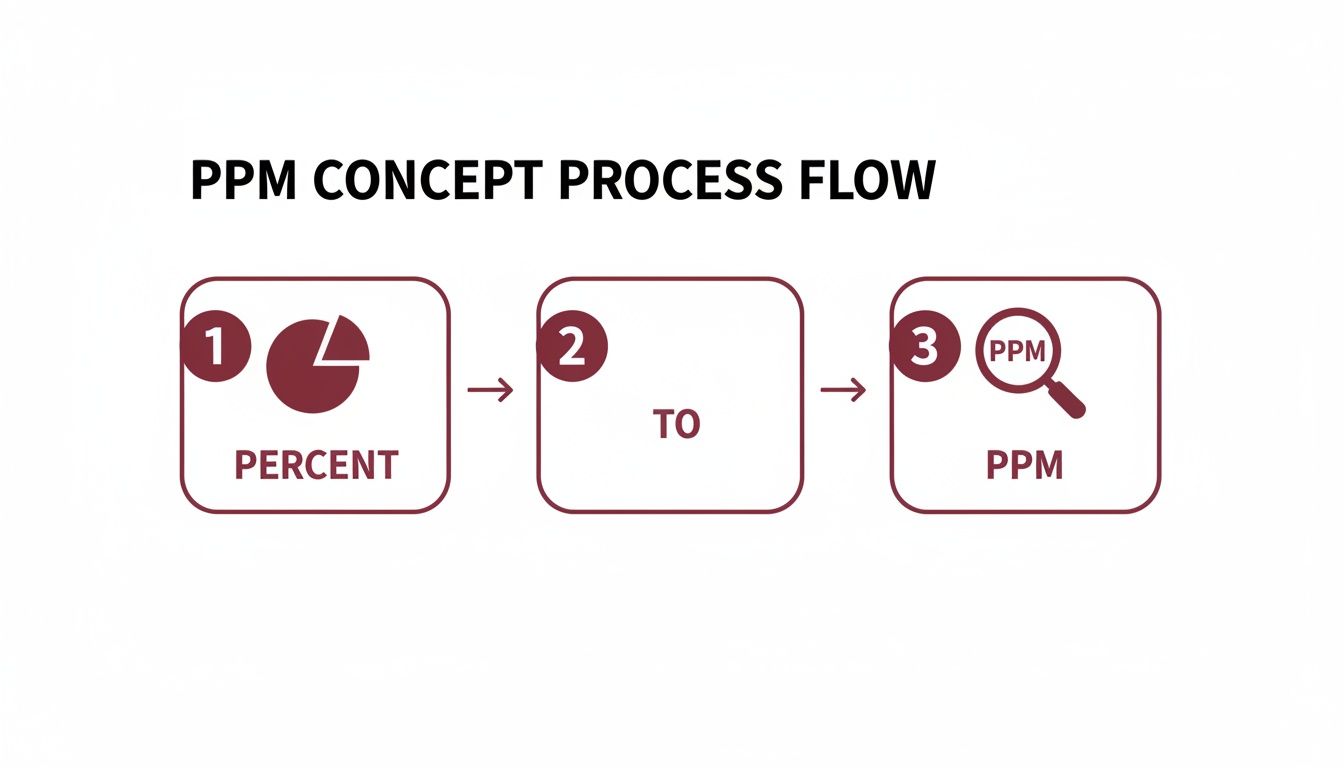
This process highlights why PPM is so important for detecting the tiny, trace amounts of residue that can still pose a health risk.
Most NATA-accredited lab reports will contain the following key sections:
- Sample Identification: Every sample gets a unique ID number that links it to a specific spot (e.g., "Living Room Wall," "Kitchen Benchtop"). This is critical for mapping out contamination hotspots.
- Analysis Method: This part specifies the scientific technique used, like Gas Chromatography-Mass Spectrometry (GC/MS). It's your confirmation that the lab is using a reliable, industry-recognised procedure.
- Date of Analysis: This simply notes when the testing was done, which is important for your records and for ensuring a timely assessment.
- Results Table: This is the heart of the report. It's where you'll find the quantitative data, listing each sample ID next to the measured concentration of methamphetamine.
Understanding Key Laboratory Jargon
The results table is often peppered with technical abbreviations that are vital for correctly interpreting parts per million (ppm) and other measurements. Two of the most important terms you'll come across are LOD and LOQ.
Limit of Detection (LOD): This is the smallest amount of a substance that the lab's equipment can reliably tell apart from zero. If a result comes back below the LOD, it doesn't mean there is zero contamination—just that it's below the threshold the instrument can "see".
Limit of Quantitation (LOQ): This is the smallest concentration of a substance that the lab can measure with a specified degree of accuracy. Any result below the LOQ is detectable but can't be reliably quantified.
For all practical purposes, any result reported as "<LOQ" or "<LOD" can be treated as a non-detection. It means no residue was found at a level of concern, according to the test's sensitivity. The final quantitative value is the number you'll be comparing against Australian safety guidelines.
This need for precision isn't just for property decontamination. In the Australian mining sector, for example, interpreting parts per million (ppm) in lab reports is crucial for managing exposure to things like respirable crystalline silica (RCS). Data from Safe Work Australia shows that in 2021-22, mining accounted for 12% of all serious workers' compensation claims, with airborne contaminants being a huge factor. Safety managers have to translate dust measurements into ppm equivalents to ensure they are below the Workplace Exposure Standard, showing how a solid understanding of lab reports directly protects worker health in high-risk industries.
Finding the Final Value and Its Context
The last piece of the puzzle is locating the definitive contamination level and understanding the context provided by how the samples were taken. For surface contamination, lab reports often present results in micrograms per 100 square centimetres (µg/100 cm²). While this isn't a direct PPM value, it's the standard unit for surface residue guidelines in Australia and serves the same purpose by quantifying the concentration over a set area.
Look for a column in the results table labelled "Result," "Concentration," or something similar. This is where you'll find the number for each sample. This is the figure you will compare to the action and clearance levels set by health authorities to decide if remediation is needed.
Finally, take a look at the sampling details. The report should state whether samples were individual "wipe samples" from specific areas or "composite samples," where multiple wipes are combined into one for analysis. A composite sample gives an average reading, which can sometimes dilute a hotspot, so knowing the sampling strategy is crucial for an accurate assessment. By methodically working through these sections, you can turn a complex document into a clear and actionable tool.
Understanding Australian Safety Thresholds And Action Levels
A number on a lab report, whether it’s in µg/100 cm² or PPM, is just data. It’s meaningless without a benchmark to compare it against. To make sense of the quantitative decontamination data from a methamphetamine lab analysis, you need to hold them up against established safety guidelines.
In Australia, these guidelines give us clear lines in the sand. They help us distinguish between an environment that’s safe and one that needs professional intervention. These safety limits aren't just pulled out of thin air; they're grounded in scientific assessments of the health risks tied to meth residue exposure. This is the crucial step that transforms your lab report from a piece of paper into a decision-making tool.
Action Levels Versus Clearance Levels
When you're wading through reports and guidelines, you'll constantly run into two key terms: action levels and clearance levels. They might sound similar, but they play very different roles in the contamination and clean-up process.
- Action Level: Think of this as the trigger. If initial testing shows contamination hits or surpasses this number, it’s a red flag. The property is considered unsafe, and it’s time to call in the professionals for decontamination.
- Clearance Level: This is your target, the goal you need to reach. After a property has been professionally cleaned, follow-up testing must prove that residue levels are safely below this threshold. This is what certifies the clean-up was a success and the property is safe to live in again.
For meth residue in Australia, things are kept pretty straightforward. The action level and the post-remediation clearance level are often the same, giving us a single, unambiguous standard for what's considered safe.
The National Guideline For Meth Residue
The go-to reference for methamphetamine contamination in Australia is the national Clandestine Drug Laboratory Remediation Guidelines. This document lays out a science-backed threshold for surface residue that has become the industry standard.
The Australian national guideline sets an action and clearance level of 0.5 micrograms (µg) of methamphetamine per 100 square centimetres (100 cm²) for residential properties. This is the most widely accepted standard across the country for deciding if a property needs to be remediated.
This number was carefully chosen to protect people from the health risks of long-term exposure, especially vulnerable individuals like young children. So, if your lab report comes back with a result higher than 0.5 µg/100 cm² in a liveable area, you've officially crossed the safety line.
How Different Scenarios Affect The Guidelines
While 0.5 µg/100 cm² is the gold standard for homes, context is everything. The guidelines recognise that not all situations are the same, and different areas can have very different risk profiles.
For example, a small, poorly ventilated cupboard where residue can build up might be looked at differently than a large, open-plan living room with good airflow. Even more seriously, properties where meth was actively manufactured, not just used, demand a far more rigorous assessment. This is because of the potential for a nasty cocktail of other toxic chemical precursors left behind.
The table below gives you a quick summary of the key Australian guideline levels. It’s a handy reference for comparing your lab results against the official safety standards.
Australian Methamphetamine Residue Guideline Levels
Here is a comparison of the action and remediation levels for methamphetamine surface residue as recommended by key Australian health authorities.
| Scenario | Guideline Authority | Surface Limit (μg/100 cm²) | Approximate PPM Equivalent Context* | Recommended Action |
|---|---|---|---|---|
| Residential Property (Post-Use) | National Guidelines | 0.5 µg/100 cm² | N/A (Surface measure) | Remediation required if exceeded. |
| Post-Decontamination Verification | National Guidelines | <0.5 µg/100 cm² | N/A (Surface measure) | Confirms successful cleanup and safety for re-occupancy. |
| Known Manufacturing Site | National Guidelines | 0.5 µg/100 cm² (plus screening for precursors) | Varies for different materials | Requires a more comprehensive assessment and remediation plan. |
| Unrestricted Land Use (Soil) | Varies by state (e.g., WA DOH) | 10 mg/kg | Directly equivalent to 10 PPM | Triggers soil investigation and potential remediation. |
*Note: It’s crucial to remember that surface wipe results in µg/100 cm² are not directly convertible to PPM. However, results for soil and other bulk samples are often reported in mg/kg, which is a direct 1:1 equivalent to PPM. This distinction is critical when interpreting your results.
This table highlights the importance of not just looking at the number, but understanding the context of the sample and the specific guideline that applies.
State-Specific Variations And Considerations
While the national guideline provides a solid foundation, some states and territories have their own specific rules or public health advice that build on the federal recommendations. The Western Australia Department of Health, for instance, has published its own detailed guidance that aligns with the national standard but offers extra context for different contamination scenarios.
It’s always best practice to know the specific requirements for the state or territory the property is in. An experienced occupational hygienist will be across both national and local standards, making sure your assessment—and any clean-up work that follows—is fully compliant. By using these official thresholds, you can confidently turn a lab result into a clear, defensible action plan.
Common Mistakes to Avoid When Reading Lab Reports
Trying to make sense of a quantitative lab report for methamphetamine contamination can feel like walking through a minefield. The numbers look simple enough, but a few common slip-ups can lead to huge errors in judgement. You might end up declaring a property safe when it’s not, or worse, paying a fortune for remediation you didn't even need.
Getting to grips with these potential pitfalls is just as vital as knowing the safety limits themselves. By understanding where things can go wrong, you can look at the data with a critical eye, ask the right questions of your testing provider, and be confident your interpretation is sound. Let's break down the most common mistakes people make when reading these critical reports.
Misunderstanding How Samples Were Taken
Not all samples are created equal. How a sample was collected dramatically affects the final number you see on the report, and overlooking this detail is one of the biggest mistakes you can make. The method that causes the most confusion is composite sampling.
A composite sample is where a technician takes several wipe samples from different spots—say, three different walls in a single room—and then combines them into one container for the lab to test.
- Why it's done: It’s a cheaper way to get a general feel for contamination across a larger area.
- Where the danger lies: It gives you an average reading. This means a single, heavily contaminated "hotspot" can be completely diluted by the cleaner areas mixed in with it.
Imagine a composite sample comes back with a reading of 0.4 µg/100 cm². That seems fine, right? It's safely under the 0.5 µg/100 cm² action level. But what if one of those individual wipes was actually 1.0 µg/100 cm², and the others were much cleaner? The average masks a serious problem. You should always ask if composite sampling was used, because it could be hiding a risk in plain sight.
Confusing 'Non-Detect' With Zero
It's easy to scan a report, see "ND" (Non-Detect) or "<LOD" (Less than Limit of Detection), and breathe a sigh of relief, thinking it means zero contamination. That's a critical mistake.
A "Non-Detect" result doesn't mean the substance isn't there. It just means the amount was too low for the lab's equipment to reliably measure.
Think of it like trying to weigh a single grain of sand on a set of bathroom scales. The scales will read zero, but not because the sand has no weight—it's just too light for that particular tool to register. It's the same with lab tests. Trace amounts of methamphetamine residue could still be present, just not enough to show up on that specific test.
Ignoring the Margin of Error
Another frequent oversight is treating the number on the report as an absolute, perfect figure. In reality, every scientific measurement has a degree of uncertainty, often called a margin of error or "measurement uncertainty" on the report itself.
This figure tells you about the potential variability in the lab's testing process. For example, a result of 0.6 µg/100 cm² might have an uncertainty of ±0.1 µg/100 cm². This means the true value could be anywhere between 0.5 µg/100 cm² and 0.7 µg/100 cm².
So why is this so important? When your result is hovering right on the edge of an action level, this margin of error becomes everything. A number that looks like it’s just over the limit could, within the bounds of uncertainty, actually be compliant. On the flip side, a result that seems just under the line might actually be over. Asking your hygienist about the measurement uncertainty gives you that extra layer of context needed to make a sensible decision, rather than having a knee-jerk reaction to a borderline result.
What to Do Once You Have Your Results
You've got the lab report back. Now what? The numbers on that page aren't just data; they're your roadmap for what comes next. Essentially, your path forward will branch in one of two directions, and it all hinges on how those results compare to Australia's established safety guidelines. This is where we move from simply reading quantitative decontamination data to creating a concrete, safety-first action plan.
Let's break down the two scenarios to remove any guesswork, ensuring every move you make is compliant, defensible, and puts people's health front and centre.
Scenario 1: Your Results Are Below the Action Level
This is the news you were hoping for. If the report shows all your sample results came in safely below the 0.5 µg/100 cm² action level, you can breathe a sigh of relief. The property is considered clear of hazardous contamination. But your job isn’t quite finished.
Good record-keeping is crucial for demonstrating due diligence. Here’s what you should do next:
- File the Report Securely: Keep both a digital and a hard copy of the complete lab report, making sure to include all chain of custody documents.
- Create a Simple Summary: For easy future reference, jot down the testing date, who did the sampling, and which lab ran the analysis. This gives you a quick-glance record of compliance.
- Share the Good News: Let all key stakeholders know the outcome. This could be property managers, tenants, or workplace safety committees who need to be kept in the loop.
Scenario 2: Your Results Exceed the Action Level
Seeing a result at or above 0.5 µg/100 cm² is an immediate red flag. It means the property is not safe for people to be in and you need to bring in the professionals. Whatever you do, don't try to clean it up yourself. Everyday cleaning products won't work and can actually make things worse by spreading the contamination around.
When a result comes back over the Australian action level, it triggers a legal and ethical duty to act. Your number one priority is to stop anyone else from being exposed and kick off a formal decontamination process.
Your action plan now becomes a structured, non-negotiable process:
- Call in a Certified Professional: Get in touch with a qualified occupational hygienist or a specialist decontamination company immediately. You need their expertise to map out a remediation strategy that is both safe and effective. Their role is to provide critical insights that go far beyond just the lab report, much like how experts help interpret a Consumer Confidence Report for drinking water quality.
- Develop a Remediation Plan: The specialist will work with you to create a detailed plan. This will cover the specific cleaning methods, safety protocols for the clean-up crew, and proper waste disposal procedures.
- Verify the Clean-up with More Testing: After the decontamination work is done, you’re not finished until you can prove it worked. A new round of "clearance testing" is essential. This final step must confirm that all the areas that were previously contaminated are now well below the 0.5 µg/100 cm² limit, giving you the official all-clear for the property to be reoccupied.
Your PPM Questions, Answered
Getting a lab report back can often spark more questions than it answers. Let's tackle some of the most common queries we hear from clients about PPM, meth residue, and what those numbers actually mean for you.
What’s the Difference Between Surface PPM and Air PPM?
This is a really common point of confusion, and it’s a great question. When we test for meth residue, the lab report will almost always show the results as micrograms per 100cm² (µg/100cm²). Think of this as a measure of density—how much physical residue is sitting on a specific patch of a surface.
Airborne PPM, on the other hand, measures the concentration of a substance floating in a given volume of air, like a single drop of ink in a swimming pool. They’re both measures of contamination, but one tells you about the risk from touching surfaces, while the other is all about inhalation risk. The units on your report simply reflect what was sampled.
The Quantitative Levels Are Low. Can I Just Clean It Myself?
Even if a reading seems minor, trying to clean up meth residue yourself is a bad idea. We can't stress this enough. Off-the-shelf cleaning products won't neutralise the contamination; in fact, they often just smear the invisible residue around, making the problem worse and increasing your exposure.
The bigger issue is that you’re not just dealing with meth. You’re often dealing with a toxic cocktail of chemical precursors left over from the cooking process. Professional decontaminators have the right training, specialised chemicals, and protective gear to handle these hazardous materials safely. It’s a job that absolutely has to be left to the pros.
How Long Does It Take to Get Lab Results?
Generally, you can expect to see your lab results within three to five business days from when the samples arrive at the lab. Keep in mind this can sometimes vary. A high caseload at the lab, the need for a more complex analysis, or if re-testing is required can occasionally extend that timeline.
Figuring out what to do next after getting your lab results can feel overwhelming. If you need professional occupational hygiene services or just clear, practical advice on how to interpret your report, you can trust the experts. Find out more about our nationwide services at https://occhygiene.com.au.


