
Quick Summary: Securing insurance coverage for meth decontamination and other drug-related property damage requires a proactive approach. A thorough insurance policy audit is crucial to identify and close coverage gaps before a claim is needed. This guide explains how to navigate the claims process with scientific evidence, professional testing, and meticulous documentation, ensuring you can recover financially from the significant risks posed by clandestine drug labs in rental properties.
When you discover your property has been turned into a clandestine drug lab, you’re facing more than just a security breach—you're up against a serious financial threat. To get through it, you’ll need to navigate the maze of insurance policy audits for drug-related property damage. It's a tricky process, but a strategic approach built on solid evidence and a crystal-clear understanding of your policy, especially concerning meth decontamination expenses, can make all the difference.
The damage left behind by a drug lab isn't just cosmetic. It's often invisible, toxic, and deeply embedded in the property itself. Successfully proving your case to an insurer requires meticulous documentation, professional contamination testing, and a firm grasp of your policy's fine print, especially around clauses for 'illegal acts' or 'chemical contamination'. A well-managed claim can be the one thing that stands between you and a massive financial loss.
Understanding the Scope of the Financial Threat from Drug-Related Property Damage
The chemical residue from illegal drug manufacturing doesn’t just sit on the surface; it seeps into drywall, carpets, and even the HVAC system. These contaminants are a toxic legacy, making a property unsafe and unsellable without a specialised, and very expensive, remediation effort. Successfully navigating an insurance claim for this kind of damage is a key part of real estate and financial risk management.
Unfortunately, many standard property insurance policies are not up to the task. They often have specific exclusions for damage caused by criminal acts or pollution, which can leave unsuspecting owners holding the bag for cleanup bills that easily run into the tens of thousands.
This isn't some rare, fringe problem. Here in Australia, the number of clandestine drug labs found in rental properties has been climbing since 2015, with authorities uncovering nearly one lab every single day. What's truly alarming is the estimate that for every lab found, nine go undetected. It's a hidden epidemic of contamination that directly hammers property values. In fact, meth contamination alone can reduce a property's value by around 10%. For a deeper dive, it's worth exploring the latest Australian insurance claims trends to see the bigger picture.
The Real-World Financial and Legal Risks
The initial cleanup bill is just the beginning. Property owners often get hit with a whole cascade of other financial and legal headaches. This is precisely why proactively understanding your insurance policy isn't just good practice—it's essential risk management.
When you're dealing with a drug-related damage claim, you're up against some unique and significant hurdles. Insurers are naturally wary of claims tied to illegal activities, and the burden of proof falls squarely on your shoulders.
Here’s a look at some of the key challenges you’ll face:
Key Challenges in Drug-Related Damage Claims
| Challenge | Description | Financial Impact |
|---|---|---|
| Ambiguous Policy Language | Clauses excluding "criminal acts" or "pollutants" are often broadly interpreted by insurers to deny claims. | Potential for full claim denial, leaving you with all remediation costs. |
| Proof of Unforeseen Damage | You must prove you had no knowledge of the illegal activity and took reasonable steps as a landlord. | Failure to prove this can lead to immediate claim rejection. |
| High Remediation Costs | Specialised testing, cleanup, and disposal are expensive and not covered by standard repair quotes. | Costs can range from $20,000 to over $100,000, depending on the extent of contamination. |
| Property Stigmatisation | A property's history of contamination can permanently lower its market value, even after full remediation. | Long-term devaluation and difficulty attracting tenants or buyers. |
These obstacles highlight why you can't afford to be passive. Every piece of evidence, every report, and every communication with your insurer has to be precise and purposeful.
The core challenge lies in proving that the damage was both unforeseen and falls within the specific definitions of your policy. Insurers will scrutinise claims related to illegal activities, making detailed, scientifically-backed evidence your most powerful tool.
Successfully getting through this process demands a clear roadmap. It all starts with understanding the true scale of the problem and the specific limitations of your insurance cover, which sets the stage for protecting your asset through diligent preparation and bulletproof documentation.
Auditing Your Policy Before You Have to File a Claim
The absolute worst time to find out your insurance doesn't cover something is right after that something has happened. When it comes to the messy and expensive reality of drug-related property damage, a proactive insurance policy audit is your best line of defence. It’s about turning that thick, jargon-filled document into a clear plan of action before you ever need it.
Think of it this way: you’re not just glancing at the summary page. You need to get into the weeds of the policy language. This is where you’ll find the specific clauses that can either save you from financial ruin or leave you holding the bag for a massive meth decontamination bill. It’s a sad fact, but many property owners are completely blindsided when they learn their standard policy offers zero protection for these situations.
Pinpointing Critical Clauses and Exclusions
Let's be honest, insurance policies can be a nightmare to read. But when you’re looking for drug contamination risks, you have to push through the jargon and hunt for specific terms and exclusions. Skipping this step is a recipe for a fast and frustrating claim denial.
Your first port of call should be the 'Illegal Acts' or 'Criminal Acts' exclusions. Insurers love to point to these clauses to deny claims related to a clandestine drug lab. Their argument is simple: the damage came from a criminal activity, so they're not on the hook for the cleanup.
But the devil is in the details. You have to read the exact wording. Does the exclusion only kick in if you, the policyholder, were part of the crime? Or is it a blanket clause that covers anyone's actions on your property? That one tiny distinction can be the pivot point that determines if your claim gets paid.
Key Policy Language to Scrutinise
To do this right, make yourself a checklist. A structured approach means you won’t miss a tiny detail that could end up costing you a fortune. Here’s what I always look for:
- Sudden and Accidental Pollution: A lot of policies will only cover pollution damage if it's "sudden and accidental." The problem is, an insurer might argue that a drug lab operating for six months isn't sudden at all. They'll call it a gradual event, and just like that, your coverage is gone.
- Malicious Damage or Vandalism: This is an interesting one. Sometimes, you can frame the damage from a drug lab as malicious damage. The argument is that your tenants intentionally or recklessly damaged your property through their actions, which is often a covered event.
- Specific Drug Lab or Contamination Riders: Newer, more comprehensive policies sometimes have specific add-ons (riders or endorsements) for drug lab contamination. If you have one, fantastic—but read its limits and conditions. If you don't, you've just found a major gap that you need to talk to your broker about, ASAP.
The whole point of a proactive policy audit is to get rid of surprises. When you know the exact terms, limits, and exclusions in your contract, you can have a proper, informed chat with your insurer to plug any holes before disaster strikes.
A Real-World Scenario Uncovering Gaps
Let me give you a classic example. A client of mine, Sarah, leased out an industrial warehouse. After she had to evict the tenants, she discovered they’d been running a meth lab. The place was a toxic mess. Predictably, her standard property policy had a very broad criminal acts exclusion.
The insurer’s first response was a flat-out denial, pointing straight to that clause.
But here’s the kicker: Sarah had sat down with her broker a year earlier and gone through her policy. They spotted that exact gap and added a specific rider for "malicious damage by tenants," which explicitly included coverage for chemical contamination from those acts.
That one small, proactive change made all the difference. The claim was still a headache, but that rider gave her the contractual leverage she needed. In the end, it led to a successful claim that covered most of the $85,000 decontamination bill. Without that audit, Sarah would have been paying that entire amount herself.
Getting a handle on these basics is crucial. For more general advice on getting your policy right, checking out some essential insurance tips can provide a great foundation. Taking the time to do an audit now truly empowers you to close coverage gaps and prevent a financially devastating outcome later.
How to Build an Ironclad Claim with Scientific Proof
When your insurer starts digging into a claim for drug-related property damage, what you think happened doesn't matter much. They deal in facts, not feelings. An ironclad claim isn't built on guesswork; it's built on cold, hard data that’s nearly impossible for them to argue with.
This is exactly why bringing in an occupational hygienist and getting professional contamination testing done is so crucial. These experts turn a vague problem like "the property feels contaminated" into an objective, measurable reality that insurers and lawyers understand. Without this proof, you're basically just asking them to trust you—and that rarely works out in your favour.
The Role of Professional Contamination Testing
First things first, you need to figure out exactly what you're dealing with. This isn't a job for a DIY kit you bought online. You need certified professionals who know how to take samples that will actually hold up under the intense scrutiny of an insurance company.
The whole thing usually kicks off with initial swab tests. A hygienist will take targeted samples from different surfaces around the property to check for specific chemical residues, usually methamphetamine. Think of it as the diagnostic phase—these tests confirm there's a problem and identify the nasty stuff you're up against.
If those first tests come back positive, it’s time for a much deeper dive. A comprehensive site assessment isn't just about taking more swabs; it's about mapping out the full extent of the contamination. The hygienist will investigate how far the chemicals have spread, checking not just the obvious spots but also hidden areas like inside wall cavities, through the ventilation system, and deep into the insulation.
Meeting the Australian Benchmark for Contamination
In Australia, it all comes down to the numbers. The national guideline for cleaning up methamphetamine contamination is 0.5 micrograms per 100cm². This isn't just some random number; it's the official benchmark that says whether a property is safe for people to be in.
Your entire claim revolves around this benchmark. The goal is to present scientific reports showing the contamination levels were well above this limit before the cleanup, which justifies the need for professional remediation. Then, you'll need another set of reports to prove the levels are safely below it after the work is done, proving the cleanup was a success and the costs were necessary.
An insurer is far more likely to sign off on a $60,000 decontamination bill when you hand them a lab report showing initial meth levels were at 15 micrograms per 100cm²—a staggering 30 times the safe limit. The data just removes all the ambiguity.
The money involved can be huge, and insurers are feeling the pressure. In fact, public liability insurance claims in Australia for property damage from hazardous substances have seen costs jump by 48%. This trend has made environmental claims a massive headache for insurers, so you can bet they'll be looking at your case very closely. You can see a full breakdown of these trends in a detailed analysis from the Australian Prudential Regulation Authority.
Why Certified Experts Are Non-Negotiable
Let’s be clear: hiring a certified and experienced occupational hygienist isn't just a suggestion, it's a non-negotiable part of your strategy. The very first thing an insurance adjuster will do is check the credentials of the person who did the testing. A report from an uncertified tester is an easy excuse for them to question—or even deny—your entire claim.
A true expert brings a few critical things to the table:
- Credibility: Their qualifications mean their findings carry real weight.
- Correct Methodology: They use sampling and testing methods that are scientifically and legally recognised.
- Expert Reporting: They produce clear, detailed reports that explain the findings, compare them to Australian guidelines, and lay out a solid case for the remediation work.
Maintaining a Strict Chain of Custody
The evidence you collect is only powerful if its integrity is airtight. This is where the chain of custody comes in. It’s a formal, documented paper trail that tracks every single sample from the moment it’s collected to the moment it's analysed and disposed of. It’s your proof that nothing was tampered with.
If that chain is broken, your scientific proof can be thrown out. Make sure your hygienist follows strict protocols, where every sample is sealed, labelled, and tracked with signed documents every step of the way. This meticulous record-keeping is your best defence against an insurer trying to poke holes in your data. Get the testing, standards, and documentation right, and you'll have a case that's not only scientifically sound but legally bulletproof.
Managing the Claims and Remediation Process
Finding your property has been used for drug-related activities is incredibly stressful. What you do in the first 48 hours can genuinely make or break your insurance claim. This is where the rubber meets the road—you need to act fast, stay organised, and manage the entire remediation process from start to finish.
Your first priority is to secure the site. No one goes in or out. This isn't just about preserving evidence; it's about preventing further contamination and keeping people safe. Once that's done, pick up the phone and notify your insurance provider. This "notice of loss" is the official starting gun for your claim.
Engaging With Claims Adjusters and Insurers
After you lodge the claim, the insurer will assign a claims adjuster to your case. This person is now your main point of contact, and it's in your best interest to build a professional, open relationship with them. Just remember, their job is to look at your claim through the lens of your policy, so they’re going to be thorough.
Expect a deep dive. The adjuster will want to see every piece of paper you have, from your first panicked notes to the official scientific reports. I tell all my clients to keep a single, meticulously organised file—digital or physical—for everything.
Make sure it includes:
- A detailed timeline of events from the moment of discovery.
- Copies of every email and notes from every phone call (date, time, who you spoke with, and what was said).
- All reports from your occupational hygienist—the initial swab tests and the full site assessment.
- Quotes and invoices from certified remediation specialists.
Clear and consistent communication is your most powerful asset here. Get back to them quickly when they ask for information. If you're not sure what they're asking for, ask for clarification in writing. That paper trail protects everyone.
The entire claims process hinges on solid, scientific proof. It’s about taking the situation from a subjective "I think there's a problem" to an objective, evidence-backed conclusion.
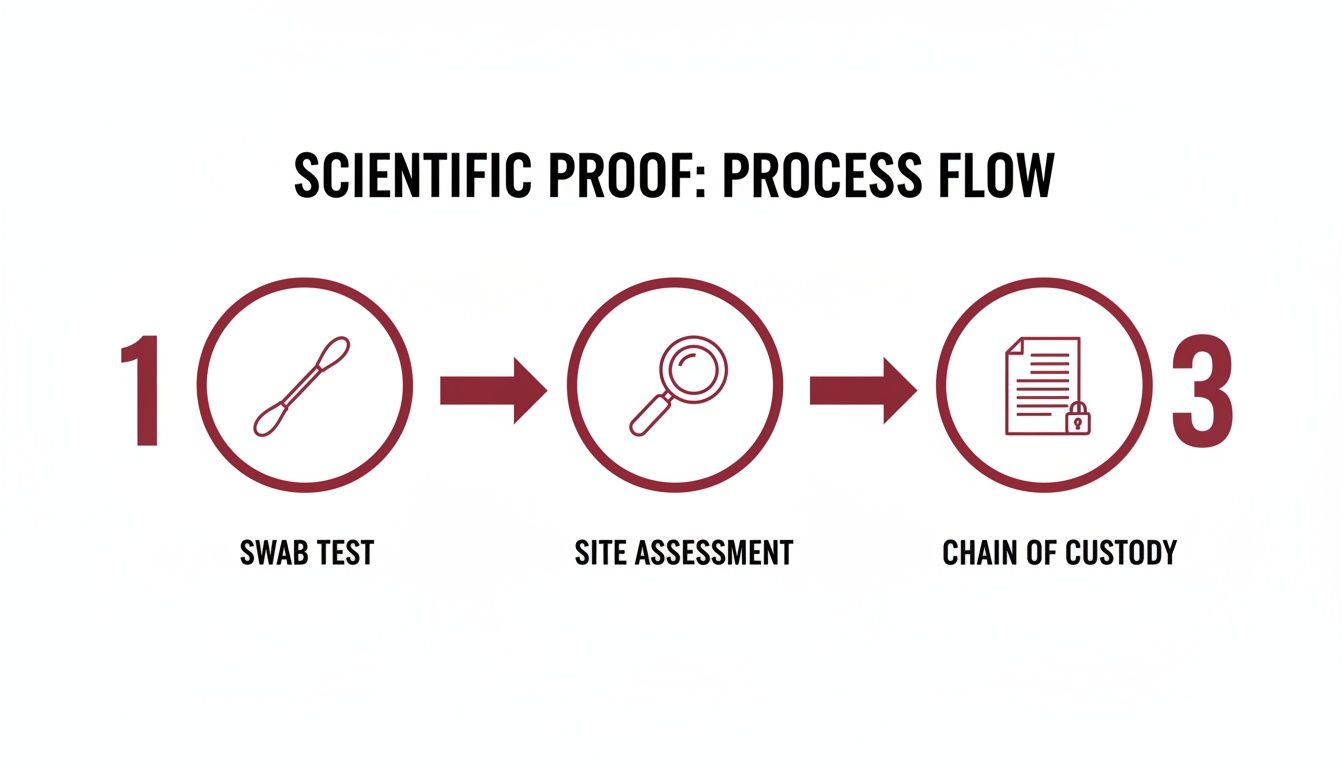
This structured approach gives the insurer the undeniable data they need to sign off on a claim.
To help you stay on track, I've put together a simple checklist that breaks down the key stages and what you need to focus on.
Claims Process Checklist
| Phase | Action Item | Key Consideration |
|---|---|---|
| Initial Discovery | Secure the property and notify your insurer immediately. | Your policy may have specific notification timeframes. Don't delay. |
| Evidence Gathering | Engage a qualified occupational hygienist for testing. | Ensure they follow strict chain-of-custody protocols for all samples. |
| Documentation | Create a central file for all communications, reports, and quotes. | Record every interaction—phone calls, emails, and meetings. |
| Contractor Selection | Obtain multiple detailed quotes from certified remediation contractors. | Verify their credentials, insurance, and specific experience with drug-related decontamination. |
| Remediation | Oversee the approved cleanup work. | Keep the claims adjuster updated on progress and any unexpected issues. |
| Final Validation | Have your hygienist perform post-remediation clearance testing. | This final report is non-negotiable; it proves the property is safe and the job is complete. |
Following these steps methodically will significantly reduce friction and help you navigate the process with confidence.
Choosing a Qualified Decontamination Contractor
Your insurance company might suggest a few "preferred vendors," but you're rarely locked into using them. It's vital to choose a contractor who is properly certified and has hands-on experience with clandestine drug lab decontamination. Don't be shy—ask for their credentials, proof of insurance, and references from similar jobs.
Always get at least two or three detailed quotes. A legitimate quote will clearly define the scope of work, the methods they'll use, and a full cost breakdown. Steer clear of anyone offering a vague estimate or suggesting shortcuts; that’s a red flag that could jeopardise both the cleanup and your claim.
While things like storm damage still dominate landlord insurance claims in Australia, the complexities of drug-related contamination are becoming a major focus. Insurers are now scrutinising these claims intensely, demanding everything from tenant eviction records to swab test results showing contamination above the 0.5μg/100cm² threshold. With cleanup costs ranging from $20,000 to $100,000, they want to see irrefutable proof.
The Final Step: Post-Remediation Validation
The job isn’t done just because the cleaning crew has packed up. The single most important step to finalising your claim is post-remediation validation testing. You need to bring back the same occupational hygienist who did the initial assessment to take new samples and prove the property is clean.
Crucial Insight: This final report is your golden ticket. It's the official proof that the property is safe, habitable, and meets Australian national guidelines. It shows the insurer their money was spent effectively and gives them the final piece of evidence they need to close out the claim and release the final payment.
Without this validation, an insurer could argue the job wasn't finished to standard and refuse to cover the final invoice. This clearance certificate is absolutely non-negotiable. Knowing your property manager's responsibilities can also be a huge help here, ensuring everyone involved is on the same page. Presenting this final piece of evidence closes the loop on your insurance policy audit, proving the work was necessary and securing your reimbursement.
Turning a Painful Lesson Into a Stronger Defence
Getting through an insurance claim for drug-related property damage is a massive relief, but let's be honest—the real win is ensuring it never happens again. This entire ordeal, as draining as it is, hands you a golden opportunity to seriously bulletproof your business. It's time to take what you’ve learned and build a proactive strategy that actually works.
The whole claims process forces you to take a hard look at your own operations. Where did things go wrong? Was your tenant screening process too lax? Did your property managers miss the signs during inspections? Facing these questions head-on is the only way to build a more resilient business.
It All Starts with Who You Let In the Door
If you've been through a claim, you've probably pinpointed the moment the wrong tenant got the keys. It’s a wake-up call to get serious about vetting, moving beyond a simple credit check. This is your first and most important line of defence, especially with commercial and industrial properties where a bad tenant can cause hundreds of thousands of dollars in damage.
It's time to level up your screening process. Think about adding:
- Deeper Business Vetting: For any commercial tenant, dig into their business registration details, check their trading history, and scan public records. Is this a legitimate, stable business or a pop-up front?
- Checks on the People in Charge: Run comprehensive background checks on the company directors and key principals. Any past legal troubles or shady business histories are massive red flags you can't afford to ignore.
- Real Reference Checks: Don’t just tick a box. Actually call the references they provide, but also do your own digging. Ask targeted questions about how they maintained their previous properties and whether they stuck to their lease terms.
You need to stop thinking of tenant screening as a box-ticking exercise and start treating it like proper due diligence. The extra time and money you spend vetting someone thoroughly is nothing compared to the six-figure decontamination bill and the insurance policy audit that follows.
Proactive Management is Non-Negotiable
Once you’ve got a tenant, the work isn't over. You have to stay vigilant. Regular, well-documented property inspections are the only way to catch problems before they spiral out of control. This isn't about being nosy; it’s about protecting your asset.
Your property management team—whether they're on your payroll or a third-party contractor—needs to know exactly what to look for. The tell-tale signs of a clandestine lab are often subtle, but they’re almost always there if you know where to look.
What to Look For: Early Warning Signs of a Clandestine Lab
Train your staff and property managers to spot and, crucially, document anything that seems out of the ordinary. These notes can become invaluable evidence if you ever find yourself filing another claim.
- Strange Smells: Persistent, strong chemical odours are a dead giveaway. People often describe them as smelling like cat urine, ammonia, or solvents.
- Weird Rubbish: Look for an unusual amount of waste, especially things like empty pseudoephedrine blister packs, chemical containers, stained coffee filters, or discarded lab-style glassware.
- Blacked-out Windows and Extra Security: If tenants have covered windows with blankets or foil and installed their own cameras or extra locks, they’re probably hiding something.
- Odd Comings and Goings: Lots of visitors who don't stay long, particularly at odd hours of the night, should set off alarm bells.
- Spikes in Utility Bills: A sudden, unexplained jump in electricity or water usage can point to the high-energy processes involved in drug manufacturing.
By taking the hard lessons from a contamination claim and turning them into practical, everyday actions, you’re not just hoping for the best—you're building a fortress around your assets. This isn't just about lowering your risk profile; it's about strengthening your entire operation. You protect your property's value, your reputation, and your bottom line from the catastrophic fallout of drug-related damage. That's what smart risk management looks like.
A Few Common Questions We Hear
When you're dealing with the fallout of drug-related property damage, the insurance process can feel like a maze. It’s natural to have a lot of questions. Over the years, we've helped countless property owners navigate this, and a few key concerns always come up.
How Long Does a Claim for Meth Contamination Usually Take?
Honestly, there's no set timeline. It really depends. I've seen straightforward claims wrap up in a few months, but that's the exception, not the rule. It’s smarter to brace yourself for a much longer process.
If your case is complex—think widespread contamination, arguments over what your policy actually covers, or a deep-dive audit from the insurer—you could easily be looking at a year or even more.
The main things that drag out the timeline are:
- The Insurer's Audit: How rigorously they scrutinise your claim, your evidence, and the fine print in your policy.
- The Scale of the Damage: The worse the contamination, the longer it takes to assess, get quotes, and complete the remediation work properly.
- Back-and-Forth Negotiations: Any disagreement, whether about the cost of cleanup or whether you're covered at all, will add significant delays.
Is My Insurance Premium Going to Skyrocket After This?
That's a fair question, and the short answer is: maybe. A major claim like this can definitely make an insurer see your property as a higher risk, which often translates to higher premiums. But it's not a given.
Insurers look at the big picture. Is this your first claim, or have there been others? More importantly, they want to see what you're doing to stop it from happening again. If you can show them you've tightened up your tenant screening, are conducting more frequent inspections, and have a solid plan in place, it can make a real difference. Sometimes, it can even prevent a steep hike.
The best leverage you have over future premiums is proving you’ve learned from this and put a robust risk management plan in place. It shows you're serious about preventing a repeat incident.
What Are the Top Reasons Insurers Deny These Claims?
Denials for drug-related damage happen more often than you'd think, and they usually boil down to specific policy exclusions or a lack of solid proof. Knowing these common pitfalls from the start is your best defence, and a thorough insurance policy audit is the first step.
Here are the main hurdles we see clients face:
- The 'Illegal Acts' Clause: This is the big one. The insurer will argue that because the damage came from a criminal act, it's not covered. The exact wording in your policy here is absolutely critical.
- Failing to Prove the Damage was 'Sudden and Accidental': Many policies are designed to cover unforeseen events. An insurer might contend that a drug lab operating over several months isn't "sudden," which could give them an out.
- Not Enough Scientific Proof: If you can't back up your claim with professional, lab-certified reports detailing the contamination, the insurer can argue there's no objective evidence. The same goes for not having post-remediation testing to prove the property is truly clean.
- Damage Happened Outside the Policy Period: It's on you to demonstrate the contamination occurred while the policy was active. If the timeline is blurry, they might use that ambiguity to deny the claim.
Getting through this process takes more than just paperwork; it demands a scientific, evidence-based strategy. Anitech provides the professional occupational hygiene services you need—from initial contamination testing to final validation—to build an undeniable case for your insurance claim. Secure your property and your financial recovery by partnering with our experts. Find out more at the Anitech website.


