
An industrial noise survey is a specialised health and safety assessment. It involves measuring sound levels across your workplace to find high-risk areas and, most importantly, to protect your employees from permanent hearing damage.
Think of it as creating a detailed "sound map" of your facility. This map not only helps you comply with Australian Work Health and Safety (WHS) standards but also prevents serious, long-term health problems for your team.
Why a Noise Survey Is a Non-Negotiable Health Check
It’s tempting to shrug off workplace noise as just part of the job—an unavoidable annoyance. But that perspective misses a crucial, and dangerous, point.
Imagine a chemical spill in your facility that you can't see or smell. Day after day, it silently causes irreversible harm to everyone exposed. Unchecked industrial noise works in exactly the same way: it's gradual, persistent, and incredibly damaging over time.
An industrial noise survey is the only way to detect and manage this invisible threat. It isn't about ticking a box for compliance; it's a fundamental health check for your entire operation. By systematically measuring sound levels, you can identify precisely where the hazards are and which workers are most at risk. This is what proactive safety looks like.
Protecting Your Most Valuable Asset
Your people are the heart of your business, and their well-being should be the top priority. A proper noise survey gives you the hard data needed to protect their hearing and overall health.
Without it, you’re just guessing about safety. You’re leaving your team exposed to preventable conditions like permanent hearing loss and tinnitus. Taking this step shows you genuinely care, which goes a long way toward boosting morale and keeping your best people.
Ensuring Legal and Regulatory Compliance
Here in Australia, the WHS regulations are strict and legally binding. Failing to manage excessive noise isn't just a safety oversight—it's a breach of your duties as an employer.
An industrial noise survey provides the documented, scientific evidence that you are meeting your obligations. This formal report becomes your first line of defence against potential fines, sanctions, and expensive workers' compensation claims.
A proactive industrial noise survey shifts your approach from reactive damage control to strategic risk prevention, shielding your business from legal complications and fostering a culture of safety.
This entire process fits into a much larger safety framework. To get a better sense of the bigger picture, it's worth understanding what is occupational hygiene and how it provides a structured way to tackle all workplace hazards.
This guide will walk you through everything, from the hidden dangers of noise to implementing practical solutions that actually work. You'll end up with a clear roadmap for making your facility a safer, more productive, and fully compliant workplace.
The Hidden Dangers of Workplace Noise Exposure
It’s easy to dismiss the constant drone of a factory or the sudden roar of a construction site as just "part of the job." But that background noise is far more than an inconvenience. It’s a silent threat with serious, and often permanent, consequences for your team's health. The damage creeps in slowly, but once it's done, there's no going back.
Beyond the obvious risk of hearing loss, exposure to dangerously loud noise sets off a chain reaction of other health problems. These issues go far beyond a person's ears, impacting their entire well-being and turning the workplace into a source of chronic stress.
It's More Than Just Hearing Loss
One of the most common and frustrating side effects is tinnitus—that persistent ringing, buzzing, or hissing in your ears that doesn’t go away when you clock off. This condition can make it incredibly difficult to concentrate, ruin a good night's sleep, and create a huge amount of mental strain.
What’s more, our bodies are hardwired to interpret loud noise as a threat. This constant state of alert puts a heavy load on the cardiovascular system, increasing the risk of high blood pressure and other heart-related conditions over time. The psychological impact is just as real, with studies linking noisy workplaces to higher rates of anxiety, irritability, and chronic fatigue.
This infographic paints a clear picture of when noise crosses the line from annoying to actively harmful.
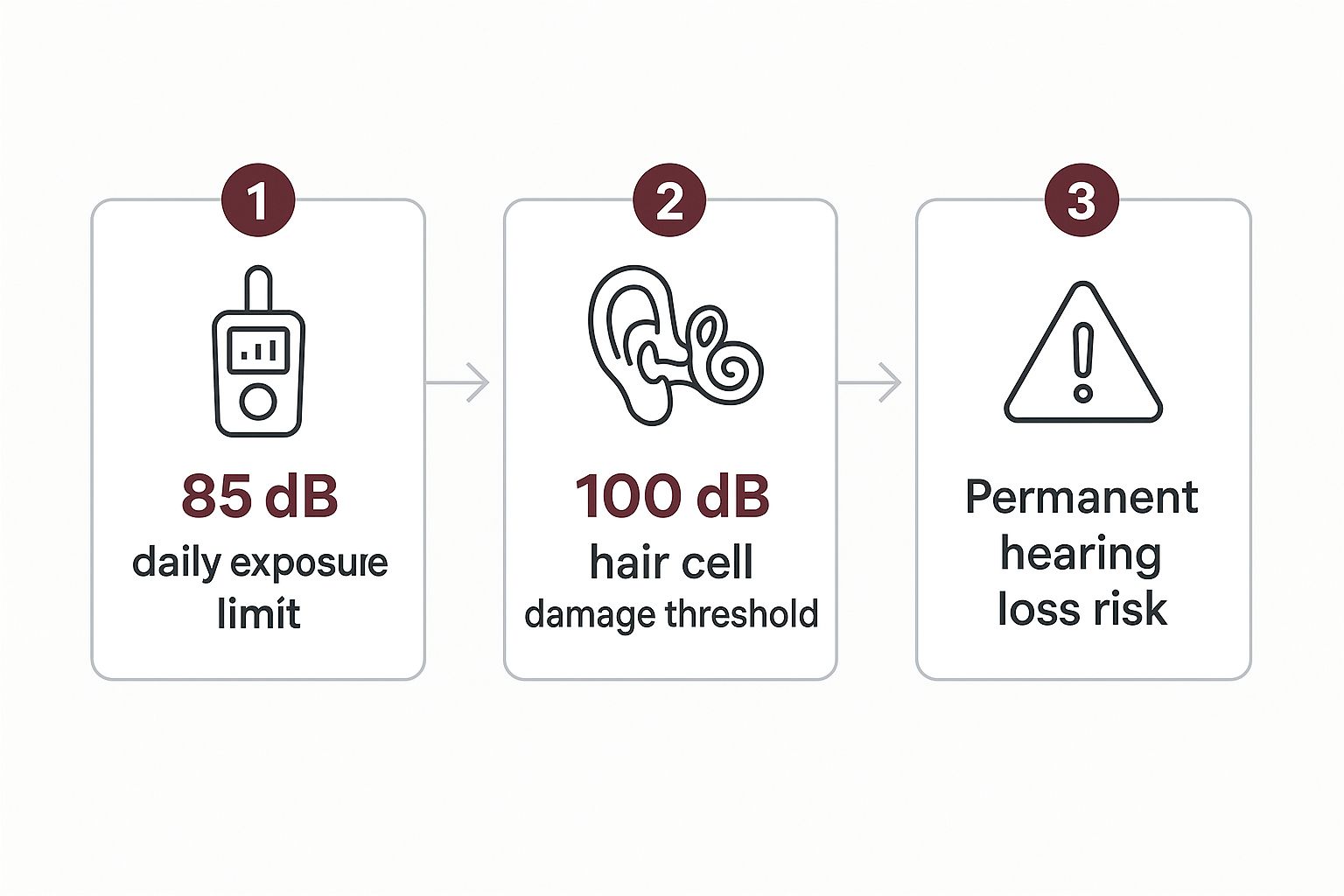
As you can see, once the daily noise exposure limit of 85 decibels (dB) is breached, a worker gets dangerously close to the 100 dB threshold. At this point, the risk of permanent damage to the delicate hair cells inside the ear becomes incredibly high.
The Science Behind the Damage
So, what’s actually happening inside the ear? Think of the tiny hair cells in your inner ear as blades of grass on a lawn. A gentle sound is like a soft breeze, making them sway without causing any harm.
Now, imagine a powerful storm—or a sudden, loud noise. It flattens the grass. After a brief downpour, the blades might spring back up. But if that storm rages on for hours, the grass becomes permanently bent and broken. In the same way, intense or prolonged sound waves damage those fragile hair cells, which are responsible for sending sound signals to your brain. Once they’re destroyed, they don’t grow back. The hearing loss is irreversible.
Noise-induced hearing loss is a silent epidemic in many industries. It's not a sudden injury but a gradual erosion of a critical sense, which is why a proactive industrial noise survey is so essential for prevention.
This isn't a minor issue in Australia. A staggering 28% of all Australian workers are exposed to hazardous noise levels on the job. This is particularly rampant in industries like manufacturing and construction, where loud machinery is a daily reality. For a full statistical breakdown, check out the official Safe Work Australia report.
Recognising Real-World Scenarios
These dangers aren't just theoretical; they are playing out in workplaces every single day. Just think about these common situations:
- The Factory Floor: In a metal fabrication shop, the high-pitched shriek of grinders and the concussive slam of stamping presses combine to create an environment that consistently exceeds safe limits.
- The Construction Site: A worker using a jackhammer is hit with intense bursts of noise that can cause immediate harm, while everyone else nearby is exposed to the nonstop rumble of heavy vehicles and power tools.
- The Processing Plant: The hum from conveyor belts, bottling machines, and cooling units in a food processing facility might not seem too bad, but over an eight-hour shift, it can easily surpass the 85 dB threshold.
Each of these examples shows a different kind of noise hazard, from a constant drone to a sudden impact. Recognising these obvious risks is a great first step, but there are many other, less obvious factors at play. To get the full picture, you can explore the ten overlooked causes of occupational hearing loss in our detailed guide. Understanding these hidden dangers makes it clear why proactive noise management is a non-negotiable part of any serious workplace safety program.
Mapping the Soundscape: A Step-by-Step Survey Process
Running a proper industrial noise survey isn’t just about walking around with a sound meter. It's a methodical process, almost like acoustic detective work, where you carefully map out your workplace's sound environment to build a clear, actionable picture of the risks. If you break it down into logical stages, it stops being this huge, overwhelming task and becomes a completely manageable project.
The real work actually starts long before you take a single measurement. Solid planning is the bedrock of any accurate survey; it ensures you’re collecting the right data, in the right places, with the right gear.

This systematic approach is your guarantee that the findings will be reliable, defensible, and can be translated directly into a noise management plan that actually works.
Stage 1: Initial Planning and Preparation
Before you even touch a piece of equipment, the very first step is to sit down and define the scope of your survey. This means pinpointing potential high-noise areas based on what you already know about your operations. A great starting point is to chat with supervisors and the workers on the floor—they almost always have a gut feeling for where the loudest spots are.
Next, you need to be crystal clear on your purpose. Are you setting a baseline for a brand-new facility? Investigating specific employee complaints? Or is this just a routine compliance check? Your "why" will shape the entire process.
Finally, coordination is key. You'll need to let all the relevant staff know what's happening and when. This ensures you can measure noise levels during typical working conditions, avoiding the mistake of surveying during a quiet maintenance shutdown, which would give you useless data.
Stage 2: Selecting the Right Equipment
Choosing the right tools for the job is absolutely critical for getting accurate data. For any serious industrial noise survey, there are two main pieces of equipment you simply can't do without, and each plays a very different role.
The goal isn't just to measure sound; it's to understand exposure. The right equipment allows you to differentiate between the general noise of an area and the specific dose of noise an individual worker receives throughout their shift.
Let's look at the essential tools and where they shine.
Noise Survey Equipment and Their Primary Uses
Here's a quick breakdown of the core equipment needed for a thorough noise survey, outlining what each tool does best.
| Equipment | Primary Function | Best Used For |
|---|---|---|
| Sound Level Meter (SLM) | Measures sound pressure levels at a specific moment and location. | Taking spot measurements of stationary machinery, identifying general high-noise zones, and creating a facility-wide noise map. |
| Noise Dosimeter | Worn by an employee to measure their personal cumulative noise exposure over an entire work shift. | Assessing the noise dose for mobile workers who move between different areas or operate multiple pieces of equipment. |
Understanding your toolkit is crucial. While SLMs and dosimeters are the foundation, specialised surveys are constantly evolving. For example, some high-tech approaches now involve things like a heavy-lift drone carrying a RIEGL LiDAR scanner to capture incredibly detailed spatial data, showing just how far the technology has come.
Stage 3: Conducting On-Site Measurements
With a solid plan in place and the right equipment in hand, it's time to get out on the floor. This is where you systematically gather the data that will underpin your entire analysis. The best approach involves using two key strategies at the same time.
Area Sampling with a Sound Level Meter
This technique is all about creating a visual representation of the sound levels across your facility, which we often call a "noise map." It's surprisingly straightforward.
- Create a Grid: Start with a floor plan of your workplace and draw a simple grid pattern over it.
- Take Systematic Measurements: Walk to the centre of each grid square and take a sound level reading with your SLM, holding it at about ear height.
- Map the Data: Jot down the decibel reading for each square right on your map. A great tip is to colour-code the results—maybe green for safe, yellow for caution, and red for high risk—to make the problem areas jump off the page.
This map gives you a brilliant, at-a-glance snapshot of where your noisy machinery is and helps you zero in on areas that need immediate attention.
Personal Sampling with a Noise Dosimeter
A noise map is perfect for static noise, but it doesn't tell the whole story for a worker who’s always on the move. Think about a forklift driver, a maintenance technician, or an operator who moves between different machines. Their exposure changes constantly.
This is where the noise dosimeter becomes essential. It's a small, lightweight device that clips onto the worker's clothing, usually on their shoulder. It quietly records their total noise exposure throughout the day, calculating a time-weighted average that gives a far more realistic picture of their personal risk. This individual data is vital for meeting compliance standards and for designing controls that are tailored to what people actually do all day.
Getting to Know the Usual Suspects: Common Noise Sources in Your Industry
When we talk about noise hazards, we're not just dealing with abstract numbers on a report. We're talking about the real, tangible machinery and processes your team works with every single day. A proper industrial noise survey is designed to pinpoint these sources, but it helps to know what you’re listening for in the first place. Once you connect decibel levels to familiar equipment, you start to see your own workplace through a much sharper, more critical lens.
It's a common mistake to think only the loudest noises are the most dangerous. A sudden, sharp blast from a stamping press is an obvious risk, no doubt. But the relentless, moderate hum of a processing plant can be just as damaging over a full eight-hour shift. This is precisely why a thorough survey is so critical—it uncovers every potential risk, from the deafeningly loud to the deceptively constant.
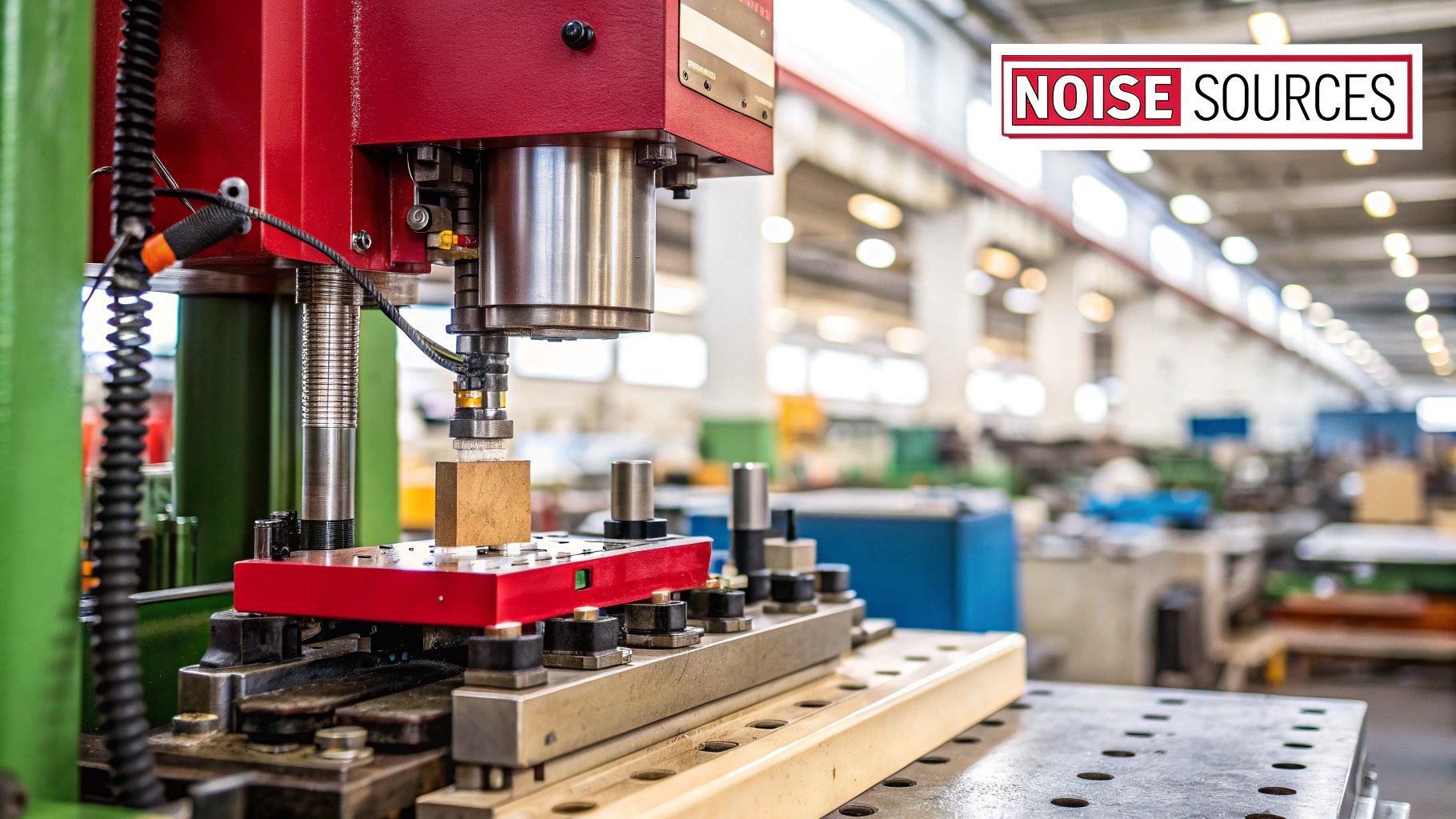
Hotspots in Manufacturing and Fabrication
The manufacturing floor is often a symphony of powerful machinery, much of which operates well above the 85 dB exposure limit. The combination of metal hitting metal, high-speed motors, and compressed air creates a complex soundscape riddled with hazards.
Keep an ear out for these key sources:
- Stamping Presses and Forges: These machines unleash intense, impact noise that can easily spike above 120 dB, creating a risk of immediate, permanent hearing damage.
- Grinders and Sanders: That classic high-pitched whine from abrasive tools is a prime source of high-frequency noise, which is particularly destructive to the delicate structures of the inner ear.
- Compressed Air Nozzles: These are often overlooked but are serious offenders. The sharp hiss from an air gun used for cleaning can blast out noise levels well over 100 dB.
Dangers on Construction and Demolition Sites
Construction sites are chaotic by nature, with noise levels that can swing wildly from one moment to the next. The mix of heavy vehicles, power tools, and demolition work makes this one of the highest-risk industries for noise-induced hearing loss.
The most common culprits here include:
- Jackhammers and Concrete Breakers: These tools generate extreme vibration and impact noise, often hammering an operator's ears with levels of 115 dB or more.
- Heavy Earthmoving Equipment: The constant, low-frequency rumble of excavators, bulldozers, and loaders contributes massively to the background noise, putting everyone on site at risk.
- Power Saws and Drills: Handheld power tools produce a concentrated blast of noise that puts the operator directly in the firing line for hearing damage.
Recent Australian research paints a stark picture of where these risks are concentrated. Powered tools and equipment are responsible for a massive 59.3% of all occupational noise exposure. Vehicles follow at 10.6%, with mining and plant equipment adding another 5.1%. You can dig deeper into these findings on workplace noise exposure to see just how widespread the issue is.
Risks in Mining and Resource Processing
In the mining and resources sector, the sheer scale of the equipment makes noise an unavoidable, ever-present factor. From the extraction process deep underground to the crushing and processing on the surface, workers are surrounded by incredibly loud, powerful machinery.
Identifying noise sources in mining isn't just about finding the single loudest machine. It's about understanding the cumulative effect of multiple sources running at once in an enclosed or reverberant space, which can dramatically amplify the overall risk.
Key areas of concern are:
- Drilling and Blasting Operations: These activities are sources of extreme impulse noise, demanding strict controls and carefully managed exclusion zones.
- Crushers and Grinding Mills: The machinery that breaks down raw materials generates a continuous, high-intensity roar that can saturate an entire processing plant.
- Ventilation Systems: Especially in underground mines, large-scale fans produce a constant, low-frequency drone that is a major contributor to a worker's total daily noise dose.
Recognising these common sources in your industry is the essential first step. The next is to quantify their precise impact with a professional industrial noise survey. That’s how you get the objective data needed to roll out effective controls and truly protect your team.
From Data to Action: Implementing Noise Controls
A noise survey report isn't just a document to file away—it’s your roadmap to a safer workplace. It’s packed with data, but let’s be honest, technical terms and strings of numbers can feel a bit overwhelming at first. The real goal is to turn that information into a practical plan that genuinely reduces noise exposure for your team.
When you get your report, you’ll immediately see two key metrics: LAeq and LCpeak.
Think of LAeq as the average noise dose a worker gets over their whole shift. In Australia, the standard sets a hard limit for this at 85 decibels (dBA) averaged over eight hours. It’s the slow-burn, cumulative exposure that this number tracks.
Then you have LCpeak, which measures the highest, most intense noise a worker is exposed to, even for a split second. This is vital for catching those sudden, sharp sounds—like a forge hammer striking or a stamping press cycling—that can cause instant hearing damage. The peak limit here is 140 decibels (dBC). Getting your head around these two figures is the first, most crucial step in knowing where to focus your efforts.
The Hierarchy of Controls: Your Framework for Action
Once the survey has pinpointed your high-risk areas, it’s time to implement controls. The best way to tackle this is with the Hierarchy of Controls, a framework that prioritises solutions from most to least effective. This isn't just a suggestion; it's a structured way of thinking that pushes you to find robust, permanent solutions before falling back on simpler fixes.
The hierarchy gives you a clear order of operations:
- Elimination: Can you get rid of the noise source altogether?
- Substitution: Can you swap the noisy process for a quieter one?
- Engineering Controls: Can you physically block or contain the noise?
- Administrative Controls: Can you change how and when people work?
- Personal Protective Equipment (PPE): Can you protect the worker directly?
Let's break down what this actually looks like on the factory floor.
Level 1 and 2: Elimination and Substitution
This is the top tier—the gold standard of noise control. Eliminating a noisy process completely is the ultimate fix, though it's not always practical. Substitution is the next best thing, where you swap out a loud piece of equipment for a quieter alternative.
For example, could you replace those screaming pneumatic tools with modern, much quieter electric models? Or instead of a deafening impact wrench, maybe a hydraulic torque wrench could do the same job. These changes attack the problem right at the source.
Level 3: Engineering Controls
When you can't get rid of the noise, you need to contain it. Engineering controls are physical changes to the workplace that either reduce noise at the source or block its path before it reaches your team.
These are some of the most powerful and reliable solutions you can roll out:
- Acoustic Enclosures: Literally building a soundproof box around a noisy generator or compressor can slash the amount of noise bleeding into the rest of the workplace.
- Sound-Absorbing Materials: In a big, echoey space like a bottling plant, installing acoustic panels on walls and ceilings can soak up sound waves, lowering the overall background hum.
- Vibration Dampening: Placing heavy machinery on anti-vibration mounts stops noise from travelling through the floor and shaking the whole building.
An investment in engineering controls is an investment in permanent risk reduction. Unlike other methods that rely on human behaviour, a well-designed enclosure works 24/7 without needing constant supervision.
Level 4 and 5: Administrative Controls and PPE
Administrative controls are all about changing work practices to limit how long people are exposed to noise. This is where you manage the when and how long. Good examples include rotating staff between noisy and quiet zones to keep any single person from going over their daily limit. You could also schedule loud maintenance jobs for after hours when fewer people are around. A well-structured noise management plan is the key to organising these strategies so they actually work.
Finally, we have Personal Protective Equipment (PPE), like earplugs and earmuffs. While absolutely essential, PPE is always the last line of defence. Why? Because it depends entirely on people—choosing the right gear, fitting it correctly, and wearing it consistently. It leaves too much room for human error. PPE should only be the primary solution when higher-level controls aren’t feasible, or as a temporary fix while you’re installing a more permanent one.
By using this hierarchy to turn your survey data into a multi-layered action plan, you're not just ticking a box—you're creating real, lasting safety improvements.
The True Cost of Ignoring Workplace Noise
Thinking an industrial noise survey is just another line item on the budget is a fundamental miscalculation. The real cost isn't the survey; it's what happens when you don't do one. Kicking this can down the road isn’t saving money—it’s a high-stakes gamble with serious financial, legal, and human consequences that build up silently, just like the hearing damage itself.
The financial fallout is much bigger than you might think. Yes, regulatory fines are a big stick, but the real damage to your bottom line often comes from the ripple effects of doing nothing. These are the hidden costs that can slowly but surely destabilise a perfectly healthy business.
Direct Financial and Legal Penalties
The most obvious hits to your wallet come from non-compliance and workplace injuries. Regulators across Australia won’t hesitate to issue hefty fines to businesses that drop the ball on their duty of care for noise management.
On top of fines, the workers' compensation claims for noise-induced hearing loss (NIHL) can be astronomical. The economic impact of industrial noise here in Australia is massive. To give you some perspective, industrial deafness has historically made up around 36% of all occupational claims in New South Wales alone. You can dig deeper into these noise-related claim statistics on safeenvironments.com.au.
Neglecting a professional noise survey isn't just a safety oversight; it's a direct financial liability. The cost of a single compensation claim can easily dwarf the expense of a thorough survey and putting the right controls in place.
The Hidden Costs Draining Your Business
The costs that really bleed a business dry are the ones that never show up neatly on a spreadsheet. These are the indirect expenses that quietly chew away at your productivity and team morale, day in and day out.
- Decreased Productivity: Think about trying to focus with a racket going on around you. Constant loud noise kills concentration and leads to mental burnout. This means more mistakes, slower work, and a real drop in your team's output.
- Higher Employee Turnover: A loud, stressful workplace is not a happy one. Companies with a reputation for noise problems find it incredibly hard to keep good people, trapping them in a costly cycle of recruitment and training.
- Increased Absenteeism: Noise-related stress and health issues are a recipe for more sick days. This disrupts project timelines and piles the pressure on the rest of the team.
Ultimately, you need to reframe how you think about an industrial noise survey. It’s not an expense to be cut. It’s a strategic investment in the health of your people, the legal integrity of your company, and the long-term stability and profitability of your entire operation.
Answering Your Questions About Industrial Noise Surveys
Even when you understand the basics, the practical side of planning an industrial noise survey often brings up specific questions. Let's tackle some of the most common queries we hear from managers and safety officers to give you confidence in handling your responsibilities.
How Often Do We Actually Need a Noise Survey?
There's no single, rigid timeline that fits every business. The simple answer is that you absolutely need a survey the moment you suspect a noise problem.
After that initial assessment, a new survey is triggered by any significant change in your workplace. Think of it this way: if something changes how sound travels or is produced, you need to re-evaluate.
This could mean:
- Bringing in new, louder machinery.
- Reconfiguring the factory floor layout.
- Adjusting work processes or the duration of shifts.
As a rule of thumb, it’s also smart to review your noise levels every five years, even if nothing major has changed. This ensures your data isn't stale and that your existing safety measures are still doing their job effectively.
What Happens If We’re Over the Limit?
Finding out you’ve exceeded the legal exposure standards—an average of 85 dBA over eight hours or a peak noise of 140 dBC—is your cue to take immediate action. The survey report is your roadmap, pinpointing exactly where the problems are and why you’re non-compliant.
Your responsibility is to apply what’s known as the Hierarchy of Controls. This isn't just about handing out earplugs. It’s a framework that forces you to look at more permanent, effective solutions first, like installing acoustic enclosures or swapping out a noisy machine for a quieter one. Administrative changes and personal protective equipment (PPE) are the last lines of defence.
A survey result that goes over the standard isn't a failure—it's a critical diagnostic tool. It gives you the hard data you need to justify spending on proper noise control and, most importantly, to protect your workers from permanent hearing damage.
Ignoring these findings is a huge risk. It can lead to improvement notices from regulators, hefty fines, and expensive workers’ compensation claims down the line.
Protecting your team from the hidden dangers of workplace noise starts with accurate data. We provide comprehensive industrial noise surveys that give you the clarity and confidence to create a safer, compliant, and more productive environment. Learn how our expert occupational hygienists can support your business and help you get ahead of noise-related risks.


