
When we talk about indoor air quality, we're often looking for things we can't see, smell, or taste. That's exactly where VOC testing comes in. It's the process of measuring airborne chemicals, known as Volatile Organic Compounds (VOCs), that are silently released from everyday items like paint, furniture, and even cleaning products. The whole point is to identify these invisible pollutants to assess potential health risks and, ultimately, create a safer, healthier space.
Unmasking the Invisible Threats in Your Air
Think of the air inside your office like a clear body of water. Now, imagine countless tiny, invisible droplets of chemicals constantly trickling into it from all directions. That’s a pretty good picture of what happens with Volatile Organic Compounds, or VOCs. These are carbon-based chemicals that have a nasty habit of turning into gas at room temperature, effortlessly mixing into the air we breathe.
The real challenge isn't just a single chemical. It's the sheer number and variety of them that have become part of modern life. Many products we use daily release these compounds through a process called off-gassing. Over time, these individual sources combine, creating an invisible chemical fog that builds up indoors.
A fact that catches many people by surprise is that indoor air can be far more polluted than the air outside. We’re quick to worry about traffic fumes, but modern, well-sealed buildings are brilliant at trapping VOCs, allowing them to accumulate to levels that would be a serious concern outdoors.
Where Do These VOCs Come From?
Figuring out where these compounds originate is the first real step towards getting them under control. The sources are usually things we use and are surrounded by every single day, which is why professional indoor air quality VOC testing is so vital for pinpointing exactly where the problems lie.
Here are some of the most common culprits:
- Building Materials and Furnishings: Fresh paint, new carpet, vinyl flooring, and engineered wood products (like MDF) are notorious for releasing VOCs, especially formaldehyde.
- Office and Cleaning Products: That “clean” smell? It might be from disinfectants, air fresheners, and other cleaning supplies. Even office equipment like printers and copiers can contribute to the chemical mix.
- Personal Care Items: Deodorants, hairsprays, cosmetics, and perfumes all release VOCs directly into your personal breathing zone.
- Hobbies and Crafts: Glues, solvents, permanent markers, and other craft supplies are often potent sources of these compounds.
This constant, low-level emission from so many different products creates a complex chemical soup. The goal isn't to find one single "bad" item, but to get a clear picture of the total chemical load in the environment. Testing gives you the hard data you need to move beyond guesswork and start making targeted improvements for the air you and your colleagues breathe every day.
The Hidden Health Risks of Poor Indoor Air

It’s one thing to know where VOCs come from, but it’s another to truly grasp why they matter. These airborne chemicals aren't just a line item on a building report; they pose a real threat to the health of anyone breathing the air, whether you’re at home with your family or working in a modern office.
Think about those nagging symptoms we often brush off as just stress or feeling a bit "off". That recurring headache, the scratchy throat that never seems to clear up, or eyes that feel constantly dry and irritated. These could be your body’s alarm bells, signalling a problem with the air you're breathing every day.
These symptoms can be frustratingly vague, making it tough to pinpoint a cause. Yet, they often flare up when you spend time in a particular building—especially newer, energy-efficient ones designed to be airtight, which unfortunately also makes them excellent at trapping pollutants.
The Immediate Symptoms You Might Notice
When VOC levels are high, or if you're particularly sensitive, your body can react almost immediately. This is the first clear sign that you might need an indoor air quality VOC testing assessment.
Look out for these common short-term effects:
- Respiratory Irritation: A stuffy nose, sore throat, and a persistent cough are classic indicators.
- Headaches and Dizziness: Feeling lightheaded or getting unexplained headaches is a direct response to inhaling certain chemicals.
- Eye and Skin Irritation: Itchy, watery eyes and even skin rashes can be triggered by airborne irritants.
- Nausea: Some VOCs are notorious for causing a general feeling of sickness or unease.
For anyone with existing conditions like asthma, the impact is often far more severe. Poor air quality can easily trigger an attack or worsen their daily symptoms, making a clean indoor environment absolutely critical for managing their health.
The Long-Term Health Consequences
While the immediate symptoms are disruptive, the real danger lies in chronic, long-term exposure. This is where a seemingly minor air quality issue can evolve into a significant health hazard.
Proactive testing isn't a luxury; it's a fundamental step in protecting your health. It takes an invisible risk and makes it something you can see and manage, giving you the control to create a truly safe environment.
Take two of the most infamous VOCs: formaldehyde and benzene. Both are classified as known human carcinogens. Their continuous presence, even at what seems like a low level, can increase the risk of developing serious conditions over time, including damage to the liver, kidneys, and central nervous system.
Research right here in Australia backs this up. Studies consistently find that VOC levels are often significantly higher indoors compared to outside. A major review covering 25 years of data revealed that formaldehyde was the most common culprit, found in 81% of investigations into Australian homes. Crucially, the highest concentrations were found in new homes, a clear pointer to the problem of off-gassing from fresh paints, flooring, and furniture. You can dive into the specifics by reading the full report on VOCs in Australian indoor environments on nespurban.edu.au.
This evidence paints a clear picture. Understanding these risks isn't about scaremongering; it’s about being informed. It makes indoor air quality VOC testing an essential, practical step towards safeguarding your family and creating a healthy space you can feel truly confident in.
Choosing the Right VOC Testing Method
Deciding to test your indoor air for VOCs is a fantastic first step. But then comes the big question: how do you actually do it? There's no single, one-size-fits-all answer in the world of indoor air quality VOC testing. The best method really boils down to what you're trying to achieve, your budget, and how much detail you need.
It helps to think of it like choosing a camera. You could grab a point-and-shoot for a quick snapshot, use a high-end DSLR for a crystal-clear, detailed image, or set up a video camera to record everything that happens over time. Each tool has its place. The same goes for VOC testing, where we generally rely on three main approaches: active sampling, passive sampling, and real-time monitoring.
Each technique gives you a different window into your air quality. One provides a super-precise measurement at a single moment, while another offers a broad average over several days. Getting this choice right is the key to getting actionable data, not just a page of confusing numbers.
Active Sampling: Precision and Power
When you need definitive, scientifically robust results, active sampling is the gold standard. It’s the most rigorous method out there.
So, how does it work? An industrial hygienist uses a calibrated pump to pull a very specific volume of air through a special collection tube over a set time. This isn't just a casual sample; it's a meticulously measured process. That tube is then sealed and sent off to an accredited laboratory for a deep-dive analysis.
Because the lab knows the exact volume of air that was pulled through the tube, they can report back with highly accurate concentrations of specific VOCs. The results are typically measured in parts per billion (ppb) or micrograms per cubic metre (µg/m³).
This is the go-to method for a few key reasons:
- Pinpoint Accuracy: It delivers quantifiable, lab-verified data on specific chemical compounds.
- Detailed Identification: It doesn’t just give you a total number; it can identify a huge range of individual VOCs by name.
- Legal & Compliance Use: The precision of active sampling makes it the only real choice for official occupational health assessments, legal disputes, or checking that a clean-up job was done properly.
Given the specialised equipment and lab analysis involved, active sampling is a job for the pros. If you need results you can count on, you'll need to engage an expert. To get a better handle on the process, it’s worth learning more about what a professional VOC testing company can do for your specific situation.
Passive Sampling: The Long-Term View
If active sampling is that high-resolution photograph, then passive sampling is more like a time-lapse. This approach uses a small badge or diffusion tube containing a material that absorbs chemicals from the air.
You simply place the badge in the room you’re concerned about and leave it there for an extended period—usually from several days up to a few weeks. It quietly soaks up any VOCs in the air through a natural process called diffusion. When the time is up, you seal the badge and mail it to a lab for analysis.
The real magic of passive sampling is its ability to provide a time-weighted average. This is incredibly useful for understanding what your typical, day-to-day exposure looks like, smoothing out the random peaks and troughs that happen throughout the week.
This method is perfect for getting a baseline reading of the general air quality in a home or office over time, rather than trying to capture a specific event. While it’s not as precise as active sampling for pinpointing sudden spikes, it provides an excellent and cost-effective overview of chronic exposure.
Real-Time Monitoring: Instantaneous Insights
Real-time monitors are exactly what they sound like: electronic devices with sensors that give you immediate feedback on your air quality. Most of these devices measure Total VOCs (TVOCs), which is a combined measurement of all the different volatile organic compounds the sensor detects at that moment.
These gadgets are fantastic for playing detective and identifying trends. You can literally watch the TVOC reading spike the moment you use a certain cleaning product or turn on a new printer, giving you instant clues about potential problem sources.
That said, it's important to know their limits. Most consumer-grade monitors can't tell you which specific VOCs are present, and their overall accuracy isn't on the same level as a proper lab analysis.
When to Use Real-Time Monitors:
- Identifying Sources: Perfect for "sniffing out" which activities or products are causing VOC levels to rise.
- Tracking Changes: A great way to see if opening windows or running an air purifier is actually making a difference.
- General Awareness: Provides ongoing peace of mind and can alert you to sudden, unexpected changes in your air quality.
To help you decide, here’s a quick breakdown of how the three methods stack up against each other.
Comparison of VOC Testing Methodologies
This table compares the key features of active, passive, and real-time VOC testing methods to help you choose the right approach for your needs.
| Testing Method | How It Works | Best For | Typical Cost | Pros | Cons |
|---|---|---|---|---|---|
| Active Sampling | A calibrated pump actively draws a precise volume of air through a sorbent tube for lab analysis. | Definitive proof for compliance, legal cases, and post-remediation verification. | $$$ (High) | Highly accurate, identifies specific VOCs, legally defensible. | Requires professional equipment and expertise, higher cost, provides only a snapshot in time. |
| Passive Sampling | A badge with sorbent material passively absorbs VOCs from the air over several days or weeks. | Assessing long-term average exposure in homes and offices; establishing a baseline. | $$ (Medium) | Cost-effective, easy to deploy, provides a time-weighted average. | Less precise than active sampling, cannot capture short-term spikes, delayed results from lab. |
| Real-Time Monitoring | An electronic sensor provides continuous, immediate readings of Total VOC (TVOC) levels. | Identifying sources in real-time, tracking trends, and checking the effectiveness of ventilation. | $ (Low to Medium) | Instantaneous feedback, helps pinpoint problem activities, relatively inexpensive. | Generally less accurate, does not identify specific VOCs, requires regular calibration for accuracy. |
Ultimately, choosing the right method is about balancing detail, cost, and your end goal. For a quick "what-if" check, a real-time monitor is a great tool. For a solid baseline of your long-term air quality, passive sampling is a smart, affordable choice. But when you need definitive, accurate, and indisputable data, active sampling is the professional standard.
How to Make Sense of Your VOC Test Results
Getting a lab report back from an indoor air quality VOC testing service can feel a bit like trying to decipher a secret code. You’re faced with a page full of chemical names, acronyms, and numbers, but what does it all mean for the air you're breathing? Let's break down how to turn that complex data into clear, actionable insights.
Think of the report as a detailed health check-up for your building's air. Just like a doctor uses specific measurements to check on your health, an air quality report uses its own units to measure the concentration of different chemicals. Getting your head around these units is the first step.
Demystifying the Numbers and Units
You'll almost certainly come across two common units: micrograms per cubic metre (µg/m³) and parts per billion (ppb). They might look intimidating, but the idea behind them is simple.
A microgram is an incredibly small unit of weight. So, µg/m³ just tells you the weight of a specific chemical found floating in a one-cubic-metre box of air.
Similarly, ppb tells you how many "parts" of a chemical are present for every billion parts of air. Both are just different ways of expressing concentration—how much of a substance is mixed into the air in a given space.
TVOC vs. Individual VOCs: What Really Matters?
One of the first things you’ll probably spot is the Total Volatile Organic Compound (TVOC) reading. This number is the combined total of all the different VOCs the test picked up. It's useful for getting a quick, big-picture snapshot of the overall chemical load in your air.
But relying only on the TVOC figure is a bit like hearing a smoke alarm. You know there's a problem, but you don't know where the fire is. That’s why digging into the individual compounds is so important. A relatively low TVOC reading could be masking a dangerously high concentration of a single, highly toxic chemical, like formaldehyde or benzene.
The real value in professional indoor air quality VOC testing lies in its ability to separate the signal from the noise. Pinpointing specific chemicals like formaldehyde is far more important for assessing health risks than just looking at a single, combined TVOC number.
For a deeper dive into the different testing options and what they can uncover, exploring professional air quality tests can help you figure out what's best for your situation.
This decision tree infographic helps visualise which testing method aligns with different goals, from a quick check to a detailed professional analysis.
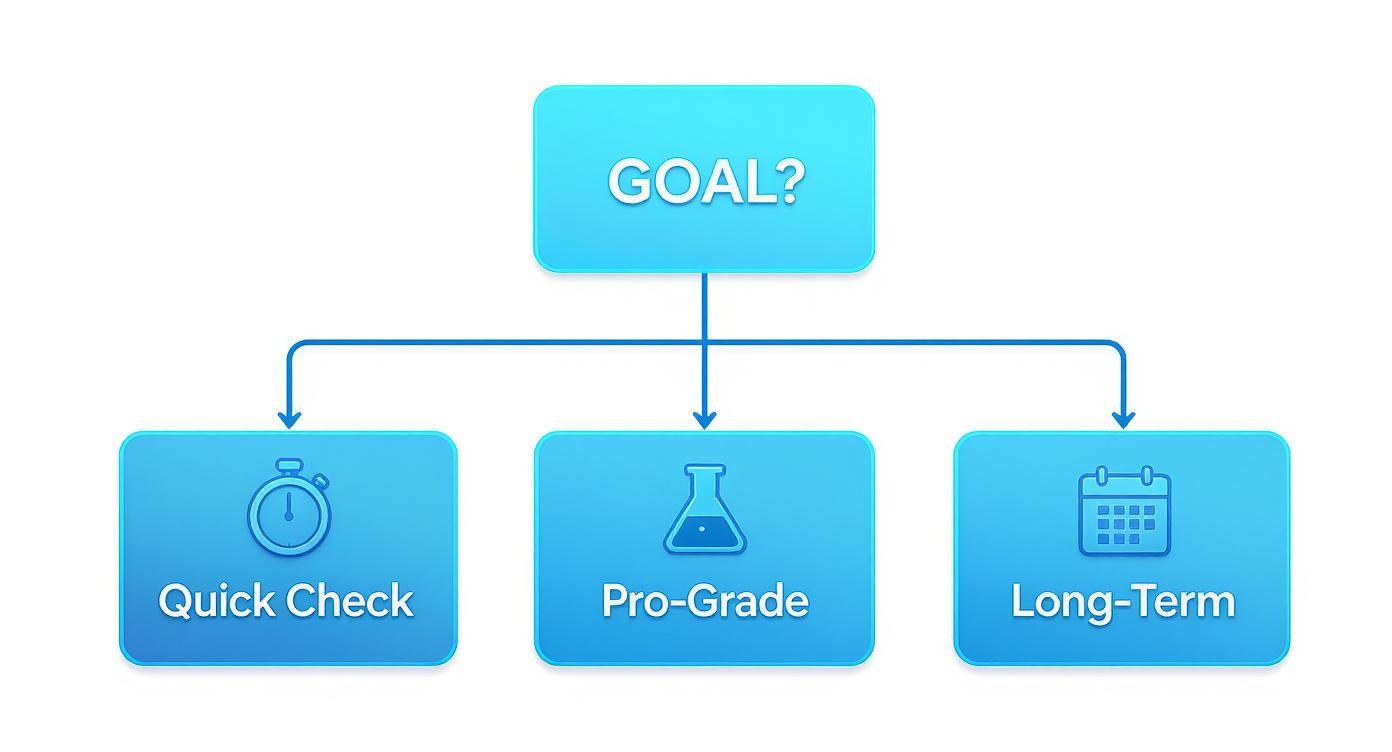
The key takeaway here is that your objective—whether you need a fast answer, a long-term average, or scientifically precise data—is what should guide your choice of testing method.
Putting Your Results into Context
Okay, so you have your numbers. Let's say the report shows 50 µg/m³ of formaldehyde. What do you do with that information? On its own, a number is just a number. It only becomes meaningful when you compare it against established health and safety guidelines.
Here in Australia, organisations like the National Health and Medical Research Council (NHMRC), and global bodies like the World Health Organization (WHO), have published recommended exposure limits for common VOCs. Any good lab report should reference these standards, giving you crucial benchmarks to judge your results against.
For instance, if your results are well below the recommended guideline, you can feel confident that the air is generally safe. But if a number exceeds that guideline, it’s a clear red flag. It’s a signal to start investigating the source of the chemical and take steps to improve your indoor air quality. This simple comparison is what turns raw data into a clear plan for creating a healthier workplace.
Actionable Steps to Lower VOCs and Breathe Easier
So, you’ve got your indoor air quality VOC testing results. Now you have a clear picture of what’s floating around in your air. The next step is turning that knowledge into real, tangible action. The good news is that lowering VOC levels isn’t rocket science; it’s all about making smart, targeted changes.
The best way to tackle this is to break the solutions into two categories: the quick wins that can make a difference right away, and the long-term strategies that stop VOCs from becoming a problem in the first place. Combine both, and you’ve got a solid plan for healthier, cleaner air.
Immediate Fixes for Cleaner Air Now
When your test results show high VOCs, you need to act fast. There are a few powerful steps you can take to quickly bring those concentrations down and make the air you breathe safer. These actions are all about getting the existing pollutants out of your indoor environment.
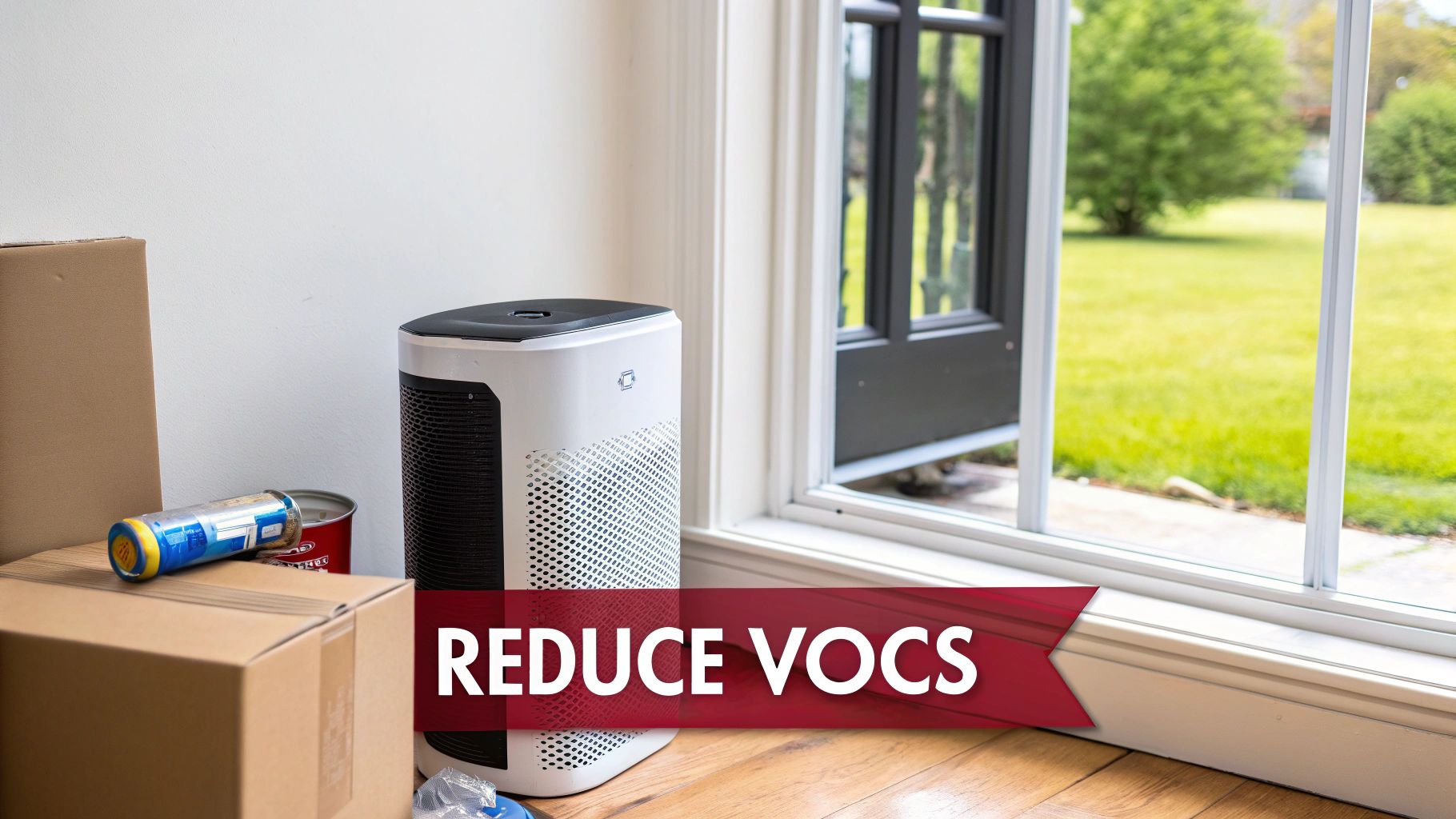
One of the easiest and most effective methods is strategic ventilation. Don't just crack a window and hope for the best. Try opening windows on opposite sides of the building to create a cross-breeze. This actively flushes out the stale, contaminated air and pulls in fresh air from outside. It’s especially critical to do this after bringing in new furniture or finishing a renovation.
For a more consistent solution, look into high-quality air purifiers. Here’s the key: you need a model with a substantial activated carbon filter. Your standard HEPA filter is fantastic for particles like dust and pollen, but it does absolutely nothing for gaseous VOCs. Activated carbon, on the other hand, acts like a sponge for chemicals, adsorbing the molecules and trapping them. Place these units in rooms with known VOC sources or just poor airflow.
Finally, do a quick audit and remove any high-off-gassing products. That new plug-in air freshener, a recently unboxed piece of flat-pack furniture, or even certain craft supplies could be the main offender. If you can, move them to a well-ventilated space like a garage to "air out" before bringing them back inside, or simply swap them for low-VOC alternatives.
Long-Term Strategies for Lasting Improvement
While quick fixes are great for immediate relief, the most powerful long-term strategy is source control. It’s a simple concept: be deliberate about what you bring into your building in the first place.
When you're painting, renovating, or furnishing a space, actively search for products with "low-VOC" or "zero-VOC" labels. This applies to a huge range of items:
- Paints, primers, and varnishes
- Flooring materials like carpet and vinyl
- Adhesives and sealants
- Furniture made from solid wood instead of composite materials like MDF
Choosing sustainable construction materials during building or renovation projects is a fundamental part of this. These choices slash the chemical load of your building right from the start.
Modern mechanical ventilation systems, like Heat Recovery Ventilators (HRVs), are also a game-changer, particularly in newer, energy-efficient buildings. These systems constantly swap stale indoor air for fresh outdoor air while conserving energy, giving you a steady supply of clean air without racking up your heating or cooling bills.
The power of ventilation cannot be overstated. By ensuring a consistent exchange of air, you actively prevent VOCs from building up to harmful levels, maintaining a healthier baseline for your indoor environment day in and day out.
Recent Australian research really drives this point home. A study on low-energy homes found that doubling the ventilation rate from 0.5 to 1.0 air changes per hour almost halved the Total Volatile Organic Compound (TVOC) concentrations in some cases. The study confirmed that better airflow consistently lowered levels of common VOCs from building materials and human activity, highlighting the crucial balance between energy efficiency and healthy air. You can explore the full findings to understand more about how ventilation rates impact VOCs on tandfonline.com.
By putting these strategies into practice, you can systematically get your VOC levels under control. Think of your test results as the starting point on a journey toward a much safer, healthier indoor space.
The Future of Australian Indoor Air Quality Standards
The conversation around the air we breathe indoors is finally getting the attention it deserves here in Australia. For a long time, all the focus was on outdoor pollution, but that’s starting to change. We're waking up to the very real health impacts of the air inside our homes, schools, and offices.
This shift isn't just happening on its own; it's backed by a growing pile of Australian research. Study after study is showing us that we need a much more organised approach to indoor air quality. It's no longer just a personal worry—it's becoming a major public health priority, and you can bet the regulations will soon follow suit.
A National Push for Cleaner Indoor Air
A huge turning point was Australia's first-ever national report on indoor air quality. Released in 2025, the study looked at over 2,500 buildings and laid bare the serious health and economic risks tied to indoor pollutants, particularly VOCs.
Even with that many buildings, it was just a drop in the ocean—less than 0.03% of Australia’s total building stock. What it really did was highlight how little we actually knew on a national scale. The report found huge variations in pollutant levels from homes to offices, confirming that we were flying blind without a complete picture of VOC concentrations. These findings have sparked urgent calls for a unified strategy, pushing routine indoor air quality VOC testing into the spotlight. You can dive into the full details of this milestone report and see how it is shaping national indoor air quality awareness on phys.org.
What to Expect on the Horizon
So, what does all this mean for the future? We’re heading towards an era where clean indoor air isn't just a nice-to-have, but a non-negotiable standard. The changes will likely be practical and affect everything from how we build to how we manage our spaces day-to-day.
Here’s a glimpse of what’s likely coming down the pipeline:
- Tougher Building Codes: Expect new rules that require low-VOC or even zero-VOC materials—think paints, floors, glues, and furniture—especially for new builds and major renovations.
- Better Ventilation Standards: We'll probably see stricter requirements for ventilation systems in all buildings, both commercial and residential, to make sure there's enough fresh air circulating.
- More Routine Testing: Don't be surprised if regular VOC testing becomes a standard part of getting building certifications, occupancy permits, or even as a tick-box for workplace health and safety compliance.
It’s important to see the bigger picture here. Your concern for healthy indoor air is part of a much larger national movement. We're all working towards creating safer, healthier buildings, and the demand for clean air is fundamentally reshaping the standards from the ground up.
Got Questions About VOC Testing? We Have Answers.
It’s completely normal to have questions when you’re diving into the world of indoor air quality and VOC testing. Getting the right answers is the first step toward making smart decisions for your home or workplace.
Let's walk through a few of the most common questions we hear.
How Often Should My Air Be Tested for VOCs?
There’s no strict calendar for this, but a good rule of thumb is to test whenever your indoor environment changes significantly. These events are big red flags that a test is in order.
Think about testing when:
- You’ve moved into a brand-new home or office. Fresh building materials are notorious for off-gassing, and levels will be at their highest.
- You’ve just finished a major renovation. New paints, carpets, and cabinetry all release VOCs into the air.
- You’ve brought in a lot of new furniture, especially pieces made from particleboard or MDF.
- People in the building are experiencing unexplained symptoms—headaches, dizziness, or irritated eyes—that seem to vanish when they go outside.
For ongoing monitoring, testing every few years is a great idea to catch any slow-building issues. But testing after a specific event is absolutely crucial.
Are Those DIY Test Kits Any Good Compared to a Professional Service?
This is a great question, and the answer really depends on what you’re trying to achieve. DIY kits, which typically use a method called passive sampling, are an affordable way to get a rough idea of your air quality. They’re good for getting a basic snapshot and can certainly alert you to a potential issue.
But when you need accuracy and detail, there's no substitute for a professional.
A professional hygienist doesn't just take a sample; they use active sampling methods to get lab-verified data that pinpoints which VOCs are present and at what precise concentrations. This detailed insight is vital for tracking down the source and creating an effective clean-up plan—something a simple DIY kit just can't do.
So, for a quick, general check-in, a DIY kit can be a useful tool. For a definitive diagnosis, especially for workplace health and safety, a professional service is the only way to go.
Can an Air Purifier Actually Remove VOCs?
Yes, but it has to be the right type of air purifier. This is where a lot of people get tripped up. Your standard HEPA filter is a powerhouse when it comes to trapping physical particles like dust, pollen, and pet dander. But VOCs are gases, and they’ll sail right through a HEPA filter.
To tackle VOCs, you need an air purifier that includes a hefty activated carbon filter. The carbon acts like a sponge for chemicals, using a process called adsorption to trap and hold onto VOC molecules. Without that carbon layer, your purifier is just pushing those harmful gases right back into the room.
At Anitech, our expertise lies in occupational hygiene, ensuring your workplace is both safe and fully compliant. If you require professional, reliable indoor air quality VOC testing to safeguard your team, we have the scientific know-how to provide the clear, actionable results you need.
Discover more about our comprehensive hygiene solutions and book a consultation at https://occhygiene.com.au.


