
Understanding how meth testing works is crucial for property managers, business owners, and anyone responsible for ensuring a safe environment. In short, it’s a methodical process designed to detect and measure methamphetamine residue on surfaces, in the air, or absorbed into building materials. The entire procedure involves three key stages: collecting a sample on-site, analysing it in a certified laboratory, and then interpreting the results against established Australian safety standards.
Key Facts: How Meth Testing Works
- Meth testing involves collecting surface swabs with specialised media that captures chemical residue from walls, floors and surfaces.
- Samples are sent to a NATA-accredited laboratory for analysis — typically using LC-MS/MS or GC-MS methodology.
- The Australian safety threshold is 0.5 micrograms per 100cm² (µg/100cm²) of surface area.
- A standard home test requires 8–10 swabs across key surfaces including walls, floors, benchtops and ventilation areas.
- On-site collection takes 15–30 minutes; laboratory results are returned within 24–72 hours.
- Results are expressed in µg/100cm² and compared directly against the 0.5 µg/100cm² national threshold.
The Meth Testing Process at a Glance
For any business owner or property manager, ensuring a safe environment is the top priority. When dealing with potential meth contamination—whether in a rental property, a commercial building, or a former clandestine lab site—understanding the testing process is critical. This isn't just about confirming a suspicion; it's about obtaining scientific data to properly assess health risks and meet Workplace Health and Safety (WHS) obligations. A positive test result provides a clear path forward, dictating remediation plans and determining when it's safe for people to re-enter the property.
The Three Pillars of Meth Testing
A reliable, legally defensible meth test is a structured sequence where each step builds upon the last to provide an accurate assessment of the contamination.
-
Sample Collection: A trained occupational hygienist visits the property to gather physical samples. This may involve taking surface wipes from walls and benchtops, collecting air samples, or taking small, discreet pieces of materials like plasterboard.
-
Laboratory Analysis: The samples are securely packaged and sent to a NATA-accredited laboratory. Here, specialized equipment is used to detect and precisely measure the amount of methamphetamine present.
-
Reporting and Interpretation: The lab provides a detailed report. An expert then translates this technical data into clear, understandable language, explaining what the results mean and confirming whether the property is safe or requires professional decontamination.
This infographic outlines the straightforward, three-step journey from start to finish.

As you can see, it’s a systematic flow from the initial site visit right through to the final, actionable report that gives you clarity.
To provide a clearer picture, here's a quick summary of the main testing methods you'll encounter.
Overview of Methamphetamine Testing Methods
| Testing Method | What It Detects | Common Use Case |
|---|---|---|
| Surface Wipe Sampling | Methamphetamine residue on non-porous surfaces (walls, floors, benchtops). | The most common method for initial screening and post-remediation clearance testing. |
| Bulk Material Sampling | Methamphetamine that has absorbed into porous materials (e.g., plasterboard, carpet, wood). | Used when surface contamination is high, to determine the depth of the problem. |
| Air Sampling | Airborne methamphetamine particles, which can pose an inhalation risk. | Important for assessing risk to occupants in a currently contaminated environment. |
These methods are often used in combination to build a comprehensive risk profile for a property.
Why This Process Matters for Your Business
Adhering to this structured process is essential. It ensures every decision is backed by scientific evidence, not guesswork. This is particularly important for businesses responsible for employee or public health. To explore this further, see our guide on https://occhygiene.com.au/why-test-properties-for-methamphetamine/.
Proactive testing is a core part of any solid safety management plan. It fits into a much wider strategy of ensuring a hazard-free environment. These general workplace health and safety tips show the bigger picture, where identifying chemical hazards like meth contamination is just one piece of the puzzle. Ultimately, it’s about managing your legal risks and protecting your most important asset: your people.
The Three Methods of Meth Contamination Sampling
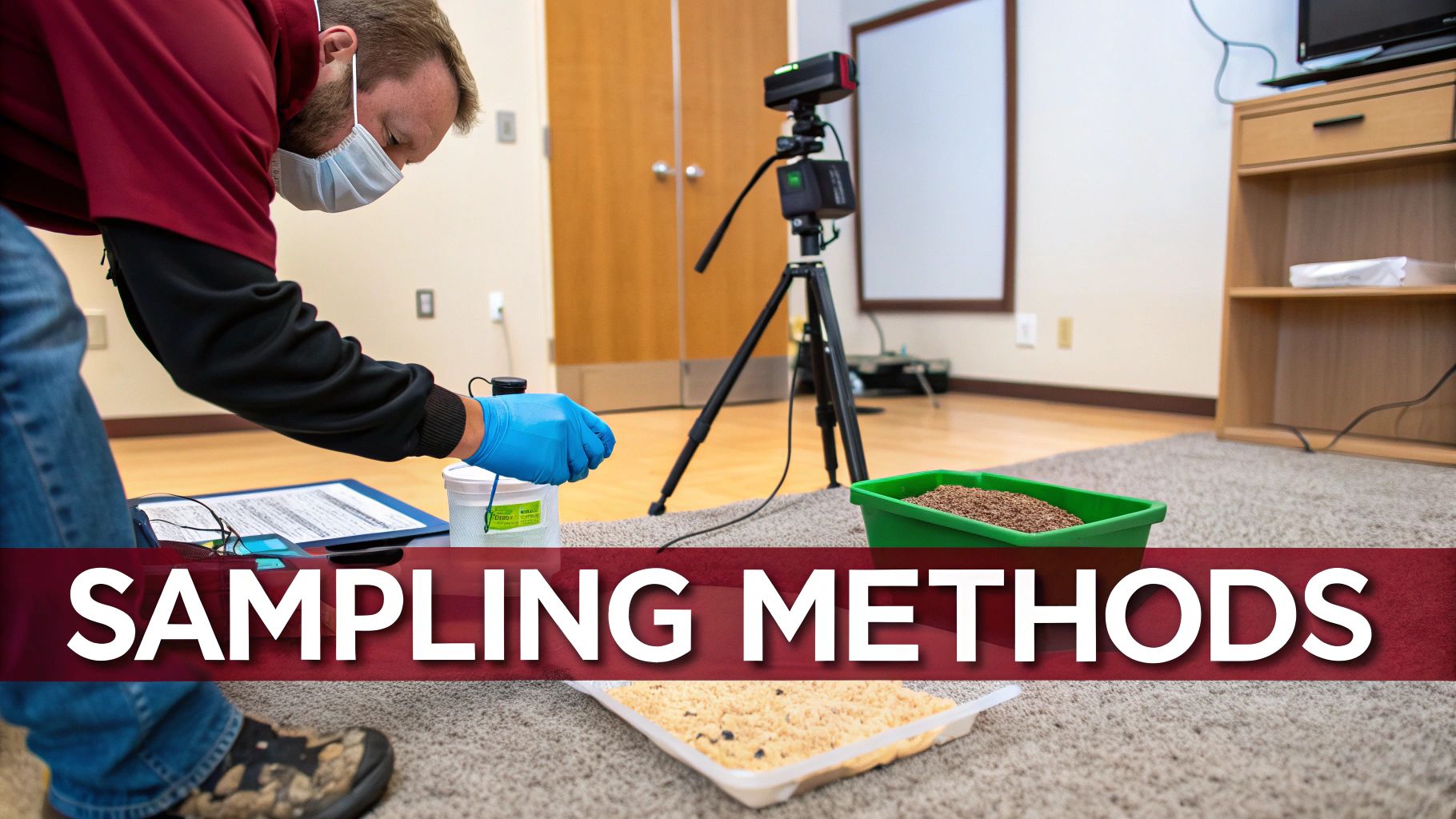
Before analysing for meth contamination, a sample must be collected. While it sounds simple, the method of gathering evidence of contamination is a precise science. An occupational hygienist acts like a forensic detective, using specific tools and methods to find clues invisible to the naked eye.
An occupational hygienist relies on three primary sampling methods to build a complete picture of a property's contamination status. Each method is designed to answer a different question about the potential risk, ensuring the final analysis is both thorough and reliable.
Surface Wipe Sampling for Direct Contact Risk
The most common and fundamental technique is surface wipe sampling. This method directly targets the invisible residue left behind from meth production or use, which settles on surfaces like benchtops, walls, and floors. It is the primary approach for determining the risk from direct contact—such as a child touching a contaminated surface and then putting their hands in their mouth.
The process itself is straightforward but requires meticulous attention to detail.
- A sterile gauze pad is moistened with a specific solvent, usually methanol or isopropanol.
- The hygienist carefully wipes a pre-measured area, almost always 100 square centimetres (10cm x 10cm), following a strict pattern to cover the entire surface.
- This sample is then immediately sealed in a vial, labelled, and documented on a Chain of Custody form to track it from the site to the lab.
This method is the cornerstone of meth testing in Australia because national guidelines are based on this exact measurement (micrograms per 100cm²). In fact, a 2021 survey found that 44% of Australian testing companies use methanol-soaked gauze wipes as their primary way to collect surface residues.
Air Sampling for Inhalation Hazards
While surface residue poses a contact threat, airborne particles present a different risk. Air sampling is used to determine if methamphetamine particles are present in the air, where they can be inhaled. This becomes especially important in enclosed or poorly ventilated spaces where contaminants can accumulate to dangerous levels.
During air sampling, a calibrated pump draws a known volume of air through a special filter cassette for a set amount of time. Any airborne particles, including meth residue, are trapped on this filter. The lab then analyses the filter to calculate the concentration of methamphetamine in the air. This is an essential step in a full risk assessment, and you can learn more about the specifics of professional air monitoring to see how it protects people's health.
No matter which sampling technique is used, maintaining a controlled environment is key to getting a reliable result. This idea is similar to how specialized swab booths for sample collection are used in medical testing to stop cross-contamination and ensure the samples are pure.
Bulk Sampling for Deep Contamination
Sometimes, contamination isn't just on the surface; it has soaked deep into porous materials like plasterboard or carpet. This is where bulk sampling is used. If surface wipe tests return extremely high readings, an experienced hygienist will suspect the problem goes far beyond a simple surface clean.
In this case, a small, physical piece of the material itself is carefully collected.
- Examples Include: A core sample of plasterboard, a square of carpet and underlay, a splinter from a wooden stud, or a piece of ceiling insulation.
These physical samples are sent to the lab to determine how deeply the meth has been absorbed into the material. The results are critical for guiding the remediation effort. A surface-level clean is ineffective if the drywall is saturated; that material will need to be completely removed and replaced. This method provides the hard data needed to make the right call between cleaning and disposal, saving time and money on the cleanup.
From Sample to Result: The Laboratory Analysis Process
Once a trained hygienist has carefully collected samples, those sealed vials begin the most critical part of their journey. They are sent under a strict Chain of Custody to a laboratory, where science takes over. This is where understanding how meth testing works shifts from the field into a highly controlled, clinical environment.
To guarantee accuracy and eliminate errors, accredited labs use a proven, two-step approach. It begins with a broad screening to identify potential positives, followed by a highly specific method to confirm and measure the results.

Step One: The Initial Screening
The first stage is the initial screening test. This acts as a preliminary filter—designed to be fast, sensitive, and cost-effective. The most common method used is an immunoassay.
An immunoassay functions similarly to a home pregnancy test, using an antigen-antibody reaction. The test is designed to react if methamphetamine or related compounds are present, providing a "presumptive positive" or "negative" result.
- Negative Result: If the sample is negative, the process stops. The lab can confidently report that no detectable level of methamphetamine was found.
- Presumptive Positive Result: A positive flag does not automatically confirm contamination. It simply indicates that something triggered a reaction, necessitating further investigation.
This screening step is effective for quickly clearing a large batch of samples, but it is not infallible. It can sometimes react to other substances, leading to a false positive. That is why a presumptive positive result always requires verification.
Step Two: Gold-Standard Confirmation
Any sample that returns a presumptive positive moves to the second, more rigorous stage: confirmatory testing. This is where precision is paramount, and labs use what is considered the ‘gold standard’ in analytical chemistry.
The main methods used for confirmation are:
- Gas Chromatography-Mass Spectrometry (GC-MS)
- Liquid Chromatography-Mass Spectrometry (LC-MS)
These sophisticated instruments perform two functions with incredible accuracy. First, they separate all the different chemical compounds in the sample. Then, they identify each one based on its unique molecular fingerprint. This process can not only find a needle in a haystack but also identify the exact type of metal it's made from.
This confirmatory step is non-negotiable. It definitively confirms the presence of methamphetamine, filters out any false positives from the initial screen, and provides a precise quantitative measurement of the contamination level in micrograms (µg).
The Importance of NATA Accreditation
For the results of any meth test to be reliable and legally defensible in Australia, the laboratory performing the analysis must be NATA-accredited. NATA, the National Association of Testing Authorities, is Australia's national accreditation body.
NATA accreditation signifies that a laboratory has been independently assessed and proven to meet strict international standards for technical competence, quality management, and impartiality. Using a NATA-accredited lab ensures:
- Accuracy: The lab uses validated methods and properly calibrated equipment.
- Reliability: The results are consistent, repeatable, and scientifically sound.
- Legal Defensibility: The findings will hold up in legal or regulatory situations, such as property disputes or WHS compliance audits.
Without this accreditation, any results are essentially meaningless from a legal and safety standpoint. It is the only way to be certain that the final report you receive is based on proven science, giving you the confidence to make critical decisions about a property's safety and any necessary remediation.
How to Make Sense of Meth Test Results and What They Mean in Australia
Receiving a lab report filled with technical jargon and numbers can be overwhelming. However, this is the crucial part where the laboratory science translates into a clear action plan for your property.
The most important figure on the report is the contamination level, usually expressed as micrograms per 100 square centimetres (µg/100 cm²). This measurement directly relates to the samples taken at the property. When a hygienist swabs a 10cm by 10cm square, this value tells you exactly how much residue was found in that specific area.
What’s the Magic Number in Australia?
In Australia, the nationally accepted benchmark for methamphetamine residue is 0.5 µg/100 cm². This is a health-based guideline designed to protect people from the risks of long-term exposure. It serves as the legal and safety threshold.
It is crucial to understand the difference between a 'positive' result and an 'exceedance'.
- A Positive Result: This simply means that some level of methamphetamine was detected. For instance, a reading of 0.1 µg/100 cm² is technically positive but is well below the safety guideline.
- An Exceedance: This is what truly matters. It means the level found is higher than the 0.5 µg/100 cm² guideline. A result like 0.8 µg/100 cm² or 15.0 µg/100 cm² indicates that the area is considered contaminated and unsafe for occupancy.
Understanding this distinction is vital. A low positive might not require any action, but an exceedance is a red flag that legally and ethically demands professional cleanup.
The Paper Trail That Guarantees Accuracy: The Chain of Custody
Along with your results, you will receive a document called a Chain of Custody (CoC). This form acts as the sample's passport, meticulously tracking its entire journey from the moment of collection to its analysis at the lab. It is the formal record that proves the integrity of the entire process.
The CoC will detail elements such as:
- The unique ID for every single sample.
- The exact location where each swab was taken.
- The date and time of collection and every transfer.
- Signatures from every person who handled the samples.
The Chain of Custody is your absolute guarantee that the results you're looking at belong to the samples from your property, with no room for mix-ups or tampering. For any legal or compliance matters, this document is just as critical as the lab report itself.
So, What Do the Numbers Mean in the Real World?
Let's place Australia's standard in a global context. Different regions have varying standards for what is considered 'safe,' which is helpful to understand.
Australian vs International Meth Contamination Guidelines
Here's a quick comparison of the recommended safe levels for methamphetamine surface residue in a few different jurisdictions.
| Jurisdiction/Guideline | Recommended Safe Level (µg/100 cm²) | Context |
|---|---|---|
| Australia (National) | 0.5 | The primary health-based standard used for post-remediation clearance. |
| New Zealand | 1.5 | A higher threshold, often applied to high-use areas. |
| California, USA | 1.5 | Aligns with New Zealand's standard. |
| Colorado, USA | 0.5 | Same as the Australian guideline, reflecting a more cautious approach. |
As you can see, Australia’s 0.5 µg/100 cm² guideline is one of the more protective standards in the world. Any result exceeding this number is a clear signal that the property poses a health risk and requires professional decontamination before it is considered safe again.
For a deeper dive into what comes next, you can explore the official methamphetamine decontamination guidelines. Armed with this knowledge, you can confidently read any report and make the right, safety-focused decisions for your property.
When Your Business Needs to Call in the Meth Testers
Knowing the science of meth testing is useful, but the real skill is knowing when to apply it. For any business in Australia, certain situations should trigger an immediate call to professionals. This is a crucial part of risk management and fulfilling obligations under Workplace Health and Safety (WHS) law.
Ignoring these red flags is not an option. It can expose staff to serious health risks and leave a business vulnerable to legal issues, particularly in sensitive industries like manufacturing, aerospace, or food production. Professional testing should be viewed not just as a method for finding contamination, but as a definitive way to confirm a space is safe.
Before You Sign on the Dotted Line
One of the most critical times for a meth test is before purchasing or leasing a commercial property. It is a non-negotiable part of due diligence, protecting both your financial investment and the future occupants.
Imagine acquiring a new warehouse for your logistics business, only to discover months later that it was a former clandestine lab. A simple pre-purchase meth test would have identified this issue, whereas a standard building inspection would likely have missed it. This knowledge provides leverage to negotiate cleanup costs or the foresight to walk away from a deal that could cost tens of thousands in remediation.
The Post-Tenancy Check-Up for Commercial Properties
For landlords and property managers, meth testing after a tenant vacates a commercial site is becoming standard practice. It is especially vital for properties with less day-to-day oversight, such as self-storage units, workshops, or industrial parks where suspicious activity can go unnoticed.
A post-tenancy screen accomplishes two key objectives:
- Protects the next tenant: It is your duty of care to ensure you are handing over a safe, clean property.
- Assigns responsibility: If contamination is found, the lab report serves as concrete proof to hold the previous tenant liable for remediation costs.
This straightforward step protects your asset's value and prevents a contamination issue from spreading.
Getting the All-Clear After a Security Incident
If a vacant building has been occupied by squatters or a remote facility has been broken into, a meth test is warranted. Any security breach involving unauthorised access is a solid reason for testing, as you cannot know what activities occurred during that time.
In these situations, professional testing provides a definitive safety clearance. It confirms that no hazardous drug residues were left behind, allowing you to confidently send employees back into the area. It is a vital component of any post-incident response plan, ensuring the site is secured before resuming business as usual.
When you can't be sure about a property's history or recent use, you need a professional assessment. It comes down to a simple principle of modern WHS compliance: you must verify a safe workspace, not just assume you have one.
When On-Site Risks and Employee Drug Policies Collide
The need for property testing can also be directly linked to your company’s drug and alcohol policy. Methamphetamine use is a significant issue for Australian businesses. According to reports, amphetamine-type substances (including meth) were responsible for a staggering 53.2% of all positive workplace drug tests in the third quarter of 2023. You can read more on these workplace drug trends to understand the broader context. For industries where impairment could be catastrophic, this poses a serious threat.
If there is reasonable suspicion of drug activity on your premises, or if a workplace incident suggests impairment, testing the physical environment is as important as testing the individual. It helps determine if the site itself has become a source of third-hand exposure, protecting the rest of your team and ensuring a holistic approach to safety.
Your Meth Testing Questions Answered
When it comes to the safety of your property and people, you need clear, direct answers. Let's address some of the most common questions our clients ask about the practical aspects of meth testing.
How Long Will This Whole Process Take?
It’s a fair question, especially when you might have to limit access to parts of your site. The good news is that the on-site part of the job is surprisingly quick.
For most commercial or industrial properties, our hygienist can usually collect all the necessary samples in just a few hours. We work hard to minimise any disruption to your day-to-day operations.
The real waiting game is the lab work. A NATA-accredited laboratory typically turns around detailed results in 3 to 5 business days. If you're in a tight spot, though, most labs can fast-track the analysis for an extra fee, getting you answers in as little as 24 to 48 hours.
All up, from the moment you call us to the time you're holding the final report, you're usually looking at a timeframe of a few days to just over a week. It really just depends on how busy the lab is and whether you opt for an express service.
Are Those DIY Meth Test Kits Any Good for a Workplace?
You've probably seen them online or in stores, but for any professional setting, DIY meth testing kits are a definite no-go. Think of them as a simple screening tool, not a diagnostic one.
They're what we call "presumptive" tests, meaning they can only give you a rough yes/no hint that meth might be present. But for a business, they fall short in critical ways:
- They cry wolf: These kits are notorious for false positives, often reacting to common household cleaners and other substances. This can cause a whole lot of unnecessary stress and cost.
- They can't measure the risk: A simple "yes" doesn't tell you how much contamination you're dealing with. You need a precise number to compare against the Australian safety guideline of 0.5 µg/100 cm².
- They won't stand up in court: The results from a DIY kit are not legally defensible. They won’t be accepted for any WHS compliance, insurance claims, or legal matters.
When there are legal or financial stakes, the only path forward is professional testing by a qualified hygienist using a NATA-accredited lab. It’s the only way to get results you can truly rely on.
What if a Test Comes Back Positive?
Receiving results above the Australian guideline of 0.5 µg/100 cm² can feel daunting, but it simply means the area is considered unsafe and it’s time to take action. This kicks off a very structured, science-led process to make things right.
The first step is for an occupational hygienist to create a formal Remediation Action Plan (RAP). This isn't just a list of suggestions; it's a detailed blueprint that outlines exactly what needs to be done to decontaminate the space safely and effectively.
This isn’t a task for your regular cleaning crew. The RAP will require you to bring in a specialised remediation company. Once they've finished their work, the hygienist comes back to conduct clearance testing. This final check verifies that the contamination has been brought back down to safe levels.
Only when we get a clear result from this final round of testing can a clearance certificate be issued, giving everyone the official all-clear to re-enter the property.
Can You Test for Meth Without Actually Going Inside?
In short, no. Proper, scientifically sound meth testing requires physical access to the property, no two ways about it.
All of the established methods—surface wipes, air sampling, and collecting bulk material—depend on a trained technician being on-site. The entire process is built on precision: swabbing an exact 100cm² area, carefully calibrating an air pump, and maintaining a strict chain of custody for the samples.
There's simply no remote technology that can reliably detect and measure meth residue from outside a building. Any service claiming otherwise isn't following Australian standards, and their results would be scientifically invalid and useless for any serious occupational health and safety purpose.
Navigating the complexities of methamphetamine testing is crucial for ensuring a safe workplace and meeting your legal obligations. Expert occupational hygienists can provide scientifically-backed testing and clear, actionable advice to businesses across Australia. If you suspect contamination or need to perform due diligence on a property, contact us for a confidential consultation.


