
Expert health & safety consulting offers more than just ticking boxes on a compliance sheet. It is a strategic partnership where a specialist helps your business identify workplace hazards, manage occupational risks, and ensure you are meeting all your obligations under Australian Work Health and Safety (WHS) laws. This vital collaboration elevates safety from a simple checklist to a proactive system that genuinely protects your employees while also boosting your business's overall performance.
Moving Beyond Rules To Build a Resilient Safety Culture
For many businesses in Australia, workplace health and safety (WHS) is often viewed through the narrow lens of legal compliance—a bunch of rules you have to follow to avoid a hefty fine. While staying compliant is absolutely critical, this mindset misses the forest for the trees.
Real, effective safety isn't just about following rules. It’s about cultivating a deep-seated culture of safety where every single person on your team feels protected, heard, and empowered to speak up. This is precisely where expert health & safety consulting makes a difference.
Think of a consultant less like an inspector looking for problems and more like a seasoned coach for your business. Their job is to help you build a solid safety framework that doesn't just sit on a shelf but actually weaves into the fabric of your day-to-day operations. They bring the specialised expertise and fresh perspective needed to turn safety from a grudging obligation into a real competitive edge.
What Does a Safety Partnership Involve?
A consultant essentially becomes a temporary, specialised member of your team, bringing a wealth of experience that would be difficult to replicate in-house. They’ll take a deep dive into your operations, getting to know your unique processes and the specific challenges you face.
This kind of partnership helps you:
- Identify Hidden Risks: Your internal team can become accustomed to certain risks, but a consultant's trained eye can spot hazards that have become "invisible" over time.
- Navigate Complex Regulations: They take the dense legal jargon from bodies like Safe Work Australia and translate it into practical, easy-to-implement steps for your workplace.
- Boost Employee Morale: When your team sees a real investment in their safety, it sends a powerful message that you care. This can do wonders for morale and staff retention.
- Enhance Productivity: A safer workplace is a more efficient one. You'll experience fewer disruptions, less downtime from injuries, and smoother operations all around.
By getting on the front foot with workplace hazards, you’re doing more than just preventing accidents. You're making a direct investment in the long-term health and success of your entire organisation. A strong safety culture is always a sign of strong leadership.
From Compliance Chore To Business Advantage
At the end of the day, quality health and safety consulting aims to shift your company's entire mindset. You move from putting out fires after an incident to proactively managing risk so the fire never starts.
This preventative strategy protects your most important asset—your people—while delivering real, measurable results to your bottom line. A crucial part of this is understanding specialised fields; for instance, you can learn more about how an occupational hygiene consulting service focuses on identifying and controlling specific health hazards in the workplace.
By bringing in expert guidance, Australian businesses can not only minimise risks but also build a more positive, resilient workplace culture that strengthens their business from the inside out.
Core Services of Health & Safety Consulting
When you bring a health and safety consultant on board, you’re not just getting someone to tick boxes. You’re tapping into a deep well of specialised skills, all aimed at making your workplace genuinely safer and more compliant. These services are the nuts and bolts of a strong safety system, each one solving a different piece of the puzzle.
Let’s get past the jargon and look at what these core services mean for your business on a practical level.
Occupational Hygiene: Protecting Your People From Hidden Dangers
Think of occupational hygiene as the science of keeping your workers healthy. It’s all about spotting and controlling the unseen hazards that can cause serious illness down the track. This isn't just about avoiding slips and trips; it’s about protecting your team from the invisible threats lurking in the work environment.
An occupational hygienist is trained to identify, measure, and manage exposure to things like:
- Chemical Hazards: We’re talking about the solvents, fumes, or fine dusts (like deadly silica) that people can breathe in or absorb through their skin.
- Physical Hazards: This covers everything from damagingly loud noise and constant vibration to extreme heat or cold.
- Biological Hazards: In some workplaces, things like mould, bacteria, or viruses can be a very real risk.
A good consultant won’t just hand you a report with a bunch of numbers. They'll work with you to find practical, realistic ways to control these exposures, protecting your team from both immediate harm and long-term health issues that can take years to develop.
Comprehensive Risk Assessments: Finding Trouble Before It Finds You
If occupational hygiene is the science, then risk assessments are your strategic battle plan. A proper risk assessment is a methodical way of looking at your operations, identifying what could hurt someone, and figuring out how serious the consequences might be. It’s about creating a clear, prioritised map of your workplace risks.
This isn’t about creating a library of paperwork that no one ever reads. A quality risk assessment is a living document, a practical tool that guides your safety efforts. The process usually looks like this:
- Spotting the Hazards: Walking the floor and talking to your team to find anything with the potential to cause harm.
- Analysing the Risk: Working out who could be hurt and how, and then weighing up the chances of it happening.
- Controlling the Risk: Putting solid measures in place to either eliminate the hazard completely or reduce the risk to a manageable level.
This proactive approach means you can spend your time, money, and energy where they’ll have the biggest impact, starting with the most serious threats first. It’s the absolute foundation of any effective safety program.
WHS Audits: A Health Check for Your Safety Systems
You can think of a Work Health and Safety (WHS) audit as a check-up for your safety management system. It’s a completely independent look under the hood to see if what you believe is happening with safety is what’s actually happening on the ground.
A consultant will systematically go through your policies, procedures, and daily practices, measuring them against legal standards and industry best practices. They'll look at your paperwork, watch people work, and chat with employees to get the full story.
An audit isn’t about pointing fingers. It’s about finding opportunities. It gives you an honest, unbiased snapshot of how you’re tracking and where you can get better.
The result is a clear, detailed report that shows you what you’re doing well and pinpoints areas needing attention. This lets you make smart decisions to improve and provides solid proof that you’re taking your safety duties seriously.
Customised Safety Training: Giving Your Team the Right Skills
Having top-notch safety procedures is pointless if your team doesn't understand them or, worse, doesn't follow them. Off-the-shelf, generic training often falls flat because it doesn't speak to the real-world challenges your employees face every day.
This is where a consultant can make a huge difference. They create and deliver training that actually sticks because it's:
- Role-Specific: It’s designed for the specific tasks and risks your people deal with, whether they’re on the factory floor or in the front office.
- Relevant and Engaging: It uses real examples and scenarios from your workplace, not some generic textbook.
- Practical: It focuses on the ‘why’ behind the rules, empowering people to make safer choices for themselves.
Of course, training is only part of the solution. The workplace itself needs to constantly reinforce safe practices. That’s why a core part of any safety strategy is implementing effective health and safety signage to clearly communicate risks and expectations. Great training turns your people into your biggest safety asset, creating a culture where everyone looks out for each other.
Navigating Australia's Complex WHS Regulations
Trying to keep up with Australia’s Work Health and Safety (WHS) laws can feel like piecing together a puzzle where the pieces keep changing shape. For any business owner, the first step to building a compliant and safe workplace is figuring out who sets the rules and how they actually apply to your day-to-day operations. This is precisely where health & safety consulting becomes invaluable—think of a consultant as your expert navigator through this tricky legal landscape.
At the top, we have Safe Work Australia. They're the national body that develops the model Work Health and Safety (WHS) laws, which act as a kind of template for the entire country. But this is where it gets interesting.
While the model laws are designed to create some consistency, each state and territory has its own regulator that implements and enforces the legislation. This means the core safety principles are generally the same everywhere, but the specific rules, codes of practice, and what the inspectors are looking for can differ quite a bit depending on your business's location.
Understanding the Key Players in Australian WHS
Knowing who’s who in the WHS world is crucial. These are the organisations that define your legal duties and provide guidance on how to meet them.
- Safe Work Australia: This is the national policymaker. They write the model WHS Act, Regulations, and Codes of Practice, but they don't actually enforce them.
- State and Territory Regulators: These are the boots on the ground. Bodies like SafeWork NSW, WorkSafe Victoria, and Workplace Health and Safety Queensland (WHSQ) are the ones who conduct inspections, investigate incidents, and hand out penalties in their jurisdictions.
Because of this two-tiered system, a company with offices in both Sydney and Melbourne has to navigate slightly different rules, even though both states base their laws on the same national model. It’s this local nuance that makes having an expert consultant so important, especially for businesses operating across state lines.
This diagram shows the fundamental services a consultant uses to cut through the complexity and build a solid safety system.
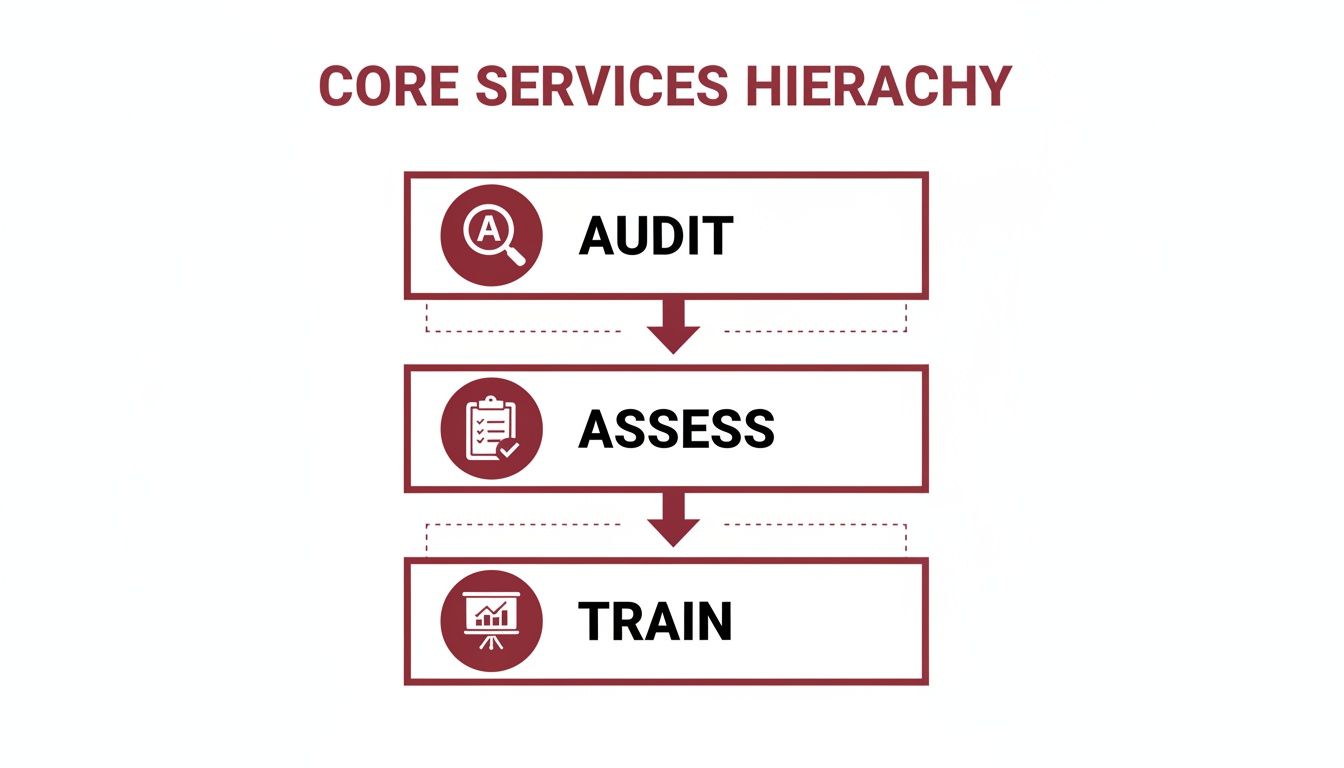
This logical flow—auditing what you have, assessing the risks, and training your team—is the bedrock of an effective WHS program.
Your Duties and Due Diligence Simplified
The WHS Act imposes a primary duty of care on a Person Conducting a Business or Undertaking (PCBU)—which is just the legal term for the business itself. This core duty means you must ensure the health and safety of your workers and anyone else affected by your operations, so far as is reasonably practicable.
It doesn’t stop there. Company officers, like directors, have a personal duty of due diligence. This isn't a passive role; it means you have to be proactive in making sure the business is meeting its safety obligations. You can't just assume safety is being managed; you must take tangible steps to verify it.
Due diligence is about active leadership, not passive oversight. It involves understanding your specific operational hazards and ensuring that you have adequate resources and processes in place to manage them effectively. Failure to do so can result in significant personal liability for company officers.
This is where a consultant helps you turn broad legal obligations into practical, everyday actions. They work with you to develop the systems, procedures, and documentation to prove you're actively managing safety and meeting your legal duties. To get a better sense of the technical details, you can read more about the Australian workplace safety standards that inform these laws.
The table below gives you a snapshot of how regulatory priorities can vary from state to state.
State-by-State WHS Regulatory Focus Areas
While the foundation of WHS law is national, the application and enforcement have a distinctly local flavour. Each state and territory regulator sets its own priorities based on local industries, incident data, and specific risk profiles. This table highlights some of these key differences.
| State/Territory | Primary Regulator | Key Regulatory Focus (Examples) | Notable Codes of Practice |
|---|---|---|---|
| NSW | SafeWork NSW | Mental health at work, silica dust exposure, falls from heights, forklift safety | Managing psychosocial hazards, Formwork, Hazardous manual tasks |
| VIC | WorkSafe Victoria | Psychological health, dangerous machines, high-risk construction work, agriculture safety | Work-related gendered violence, Confined spaces, Demolition |
| QLD | WHS Queensland (WHSQ) | Electrical safety, quad bike safety in rural areas, musculoskeletal disorders, asbestos management | Electrical safety, Rural plant, Abrasive blasting |
| SA | SafeWork SA | Bullying & harassment, plant and machinery safety, hazardous chemicals | Managing the risk of falls, Construction work, Welding |
| WA | WorkSafe WA | Mining safety (DMIRS), psychosocial hazards, violence and aggression in the workplace | Psychosocial hazards in the workplace, Concrete and masonry |
| ACT | WorkSafe ACT | Construction safety, public sector safety, electrical safety | Stevedoring, Spray painting and powder coating |
As you can see, a one-size-fits-all approach to WHS compliance simply doesn't work in Australia. Having an expert who understands these jurisdictional differences is essential to keeping your business protected and your people safe, no matter where you operate.
Why High-Risk Industries Need Specialised Safety Strategies
You wouldn't use a notepad to draft an architectural blueprint, so why apply a low-risk office safety plan to a high-stakes construction site or a bustling factory floor? Trying to fit a generic, one-size-fits-all safety approach to a high-risk industry isn't just ineffective—it's downright dangerous. These sectors operate under unique pressures and face hazards that demand a far more specialised strategy.
This is where the real value of an experienced health & safety consultant comes into play. Someone with deep, hands-on experience in your specific industry understands the nuances that a generic checklist will always miss. They can bridge the gap between theoretical safety rules and the practical realities of getting the job done, ensuring safety measures are both tough enough to protect and practical enough for your team to follow.
The Unique Dangers Lurking in High-Risk Sectors
While every workplace has some level of risk, the hazards in fields like manufacturing, construction, and mining are in a completely different league. The consequences of a single misstep can be catastrophic, which makes tailored safety protocols a non-negotiable part of the operation.
The latest national data paints a pretty sobering picture. The transport, postal and warehousing; agriculture, forestry and fishing; and construction industries were responsible for a staggering 72% of all worker fatalities. These numbers scream for focused, expert safety interventions where they're needed most.
Manufacturing: The Complex Dance of People and Machines
A manufacturing floor is a carefully choreographed dance between human workers and powerful machinery. It’s at this intersection where things can go wrong fast, and where a split-second mistake can lead to life-altering injuries.
- Machinery Entanglement: Loose clothing, hair, or limbs can easily be caught in moving parts like rollers, gears, and conveyor belts if machines aren't properly guarded.
- Chemical Exposure: Many processes use hazardous substances, from industrial solvents to cleaning chemicals, creating risks of lung or skin damage from inhalation or direct contact.
- Repetitive Strain: Day in, day out, assembly line work can cause serious musculoskeletal issues if workstations aren't designed with sound ergonomic principles in mind.
A specialist consultant can step in here by performing detailed machinery risk assessments, setting up foolproof lockout/tagout procedures, and helping redesign workflows to cut down on hazardous manual tasks.
Construction: Where the Risks Change by the Hour
No two days on a construction site are ever the same. The work environment is constantly evolving as the project moves forward, meaning the risks are always shifting, too. A safety plan that made sense last week could be dangerously out of date today.
A construction site is a living, breathing worksite. Safety strategies must be equally dynamic, anticipating the next phase of the project and its associated hazards, rather than just reacting to the current state.
Certain hazards demand constant, sharp-eyed vigilance:
- Falls from Heights: It’s one of the oldest risks in the book, but working on scaffolding, roofs, and ladders is still one of the leading causes of serious injury and death in the industry.
- Moving Plant and Vehicles: Sites are often crammed with heavy equipment, creating a high-risk environment for collisions and crush injuries.
- Trench Collapses: Digging and excavation work comes with the inherent danger of unstable ground, which can give way without warning if not shored up correctly.
This is where a consultant with a background in construction becomes essential. They are crucial for developing a robust Safe Work Method Statement (SWMS) for high-risk jobs, keeping you compliant and your workers safe. For a deeper dive, check out our guide on how to create a Safe Work Method Statement. It's a critical tool for managing the specific hazards you'll encounter on site.
Mining and Logistics: Taming Extreme Environments
The mining and logistics industries might seem different, but they share a common challenge: managing immense physical forces in often harsh conditions. In mining, workers are up against the sheer power of the earth itself. In logistics, they’re dealing with the incredible weight and momentum of vehicles and goods.
- Mining Hazards: The risks are vast, covering everything from underground collapses and explosions to exposure to toxic gases and insidious mineral dust like silica.
- Logistics and Warehousing Risks: Key dangers revolve around forklift accidents, workers being struck by falling objects from high shelves, and manual handling injuries from lifting awkward or heavy loads.
In these fields, health & safety consulting is about imposing control and order on inherently powerful and unpredictable environments. This means creating rigorous traffic management plans, implementing strict atmospheric monitoring for confined spaces, and engineering smarter ergonomic solutions for handling materials. By getting to grips with these industry-specific challenges, you can build a safety strategy that genuinely protects your people where they work every single day.
Calculating the Real ROI of Health and Safety Consulting
For many businesses, workplace safety sits on the "cost" side of the ledger. It's often viewed as a non-negotiable expense, something you have to do to stay compliant. But what if we flipped that script? What if safety wasn't a cost centre, but a profit centre?
This is exactly the shift in perspective that expert health & safety consulting brings. It moves the conversation from "How much do we have to spend?" to "How much value can we create?" The financial returns are real, measurable, and show up right on your balance sheet, not just in avoiding trouble but in actively building a stronger business.
The Direct Financial Wins
Let's start with the most obvious wins: the money you don't have to spend. These are the immediate, hard-and-fast savings that make the case for proactive safety management crystal clear.
- Slashing Workers' Compensation Costs: Every workplace injury comes with a hefty price tag. Fewer incidents mean fewer workers' comp claims. Over time, this track record leads to significantly lower insurance premiums—a direct saving you’ll see year after year.
- Dodging Crippling Fines: Breaching Australia's WHS laws isn't cheap. Fines can run into the six figures for companies, and directors can be held personally liable. A good consultant is your shield, ensuring you're fully compliant and steering you clear of these massive penalties.
- Minimising Operational Downtime: When an incident happens, it's not just about the person involved. Work often grinds to a halt for investigations, clean-up, and paperwork. Preventing these incidents means keeping the production line moving and the entire operation running without costly interruptions.
The Indirect Returns That Fuel Growth
The direct savings are compelling, but the long-term, indirect benefits are where a strong safety culture truly pays off. These are the returns that don't just save money but actively drive growth and build a more resilient, profitable organisation.
Investing in safety sends a powerful message to your team: "We care about you." This simple act builds a foundation of trust that unlocks loyalty, higher productivity, and a better workplace for everyone.
Think about the ripple effects of a genuinely safe workplace:
- Improved Staff Retention: Great employees don't stick around where they feel unsafe or undervalued. A stellar safety record makes you an employer of choice, helping you attract and—more importantly—keep top talent. This dramatically cuts down on the constant, expensive cycle of recruitment and training.
- A Boost in Productivity and Morale: When people feel secure, they can focus completely on their work. A positive safety culture gets rid of that background anxiety, boosting morale and leading to a more engaged, efficient, and motivated team.
- A Stronger Brand Reputation: In today's market, your safety record is part of your brand. Being known as a safe and responsible company makes you a far more attractive partner for big clients, reliable suppliers, and the best people in the industry. It opens doors.
Ultimately, effective health & safety consulting isn't an expense. It's a strategic investment that turns your safety program into an engine for growth, proving that looking after your people is one of the smartest financial decisions you can make.
How to Choose the Right Health and Safety Consultant
Picking the right health and safety consultant is one of the most critical decisions you'll make for your business. This isn't just about ticking a compliance box; it's about finding a genuine partner who can embed themselves in your team and drive real, lasting safety improvements. The wrong choice can lead to generic advice, wasted money, and a safety plan that looks good on paper but does nothing on the floor.
But get it right, and you'll have a partnership that protects your people and strengthens your bottom line.
Your Non-Negotiable Checklist
Before you even start looking, you need to set your baseline criteria. Think of this as the absolute minimum standard for any health & safety consulting firm you'd consider. Without these fundamentals in place, you’re gambling with your investment and, more importantly, your team's wellbeing.
Here are the essentials every consultant must have:
- Relevant Qualifications and Certifications: Check for formal qualifications in Occupational Health and Safety (OHS). Look for certifications from respected bodies like the Australian Institute of Health & Safety (AIHS), which show a real commitment to professional standards.
- Proven Industry-Specific Experience: A consultant who’s spent years in your world—whether that’s construction, manufacturing, or food production—is worth their weight in gold. They get the unique pressures, the specific machinery, and the real-world hazards of your workplace, offering practical solutions, not just theory.
- Verifiable Client Testimonials and Case Studies: Don't just rely on their sales pitch. A solid consultant will have a portfolio of success stories and be more than happy to connect you with businesses similar to yours. Ask them to show you how they've solved actual problems for other companies.
- Comprehensive Insurance Coverage: Make sure they carry proper professional indemnity and public liability insurance. This is your safety net, protecting your business from liability if their advice ever leads to an issue.
Asking the Right Questions to Find Your Ideal Partner
Once you've got a shortlist of candidates who tick the basic boxes, it's time to dig deeper. You need to get a feel for their approach, their process, and what success actually looks like to them.
Their answers will tell you everything you need to know about whether they'll fit your company's culture and operational reality. It’s also a good idea to ask about their process for understanding Australian Standards compliance when hiring a professional, because their grasp of the regulatory landscape is crucial.
A great consultant doesn't just point out problems; they give your team the tools and confidence to own the solutions. Their job should be to build your internal capability, not create a permanent dependency on their services.
Here are a few questions to steer the conversation:
- How do you measure the success of a project? You’re listening for answers that go beyond just compliance. Do they talk about reducing incident rates, getting better feedback from employees, or even seeing a boost in productivity?
- What does your typical engagement process look like from start to finish? A good consultant can walk you through their entire process with clarity—from the initial site walkthrough and gap analysis to implementing changes and the final review.
- How will you tailor your approach to our specific business operations and culture? This is a great question to filter out consultants who just use a cookie-cutter template for every client. You need a partner who listens first, then advises.
- How do you ensure your recommendations are practical for our team to implement and sustain? The best safety plans are the ones that actually get used. Their strategies must be realistic and work within your budget, your workforce's skills, and your daily operational flow.
Common Questions About Health and Safety Consulting
Thinking about bringing in a health and safety consultant is a big move, and it's completely normal to have a few questions before you jump in. We've put together some straightforward answers to the queries we hear most often from business owners, so you can feel confident you're making the right call.
How Much Does Health and Safety Consulting Cost in Australia?
There's no single price tag, as the cost really depends on what you need. A one-off risk assessment for a small mechanic's workshop is going to be a different investment than a complete overhaul of a WHS management system for a major food processing plant.
To give you an idea, consultants usually structure their pricing in a few ways:
- Project-Based Fees: You get a fixed price for a specific job, like a full WHS audit. This is great for budgeting as there are no surprises.
- Hourly Rates: Perfect if you need help with a smaller task or just want some expert advice on a specific issue.
- Retainers: This involves a monthly fee for ongoing support. It's like having a safety expert on speed dial whenever you need them.
The key is to think of this cost not as an expense, but as an investment. It's a proactive step that helps you avoid the much heavier costs of fines, workplace incidents, and the lost productivity that comes with them. Always ask for a detailed proposal upfront so you know exactly what’s included.
Is Consulting Worth It for a Small Business?
Without a doubt. In many ways, small businesses stand to gain the most from health & safety consulting. Without an in-house WHS manager, it’s easy to become exposed to risks you might not even be aware of, leaving you vulnerable to non-compliance.
A consultant gives you access to top-tier expertise without the cost of a full-time salary. You get the guidance you need to meet your legal duties and build a solid safety foundation from the ground up, protecting both your team and your business as it grows.
For a small business, a consultant isn't just another cost. They're a strategic partner who puts you on a level playing field, giving you access to the same calibre of safety knowledge that bigger companies have in their own teams.
It’s about being smart and proactive, securing your business right from the start.
At Anitech, we specialise in clear, practical, and expert health & safety consulting that’s built around the real-world challenges of your industry. Our mission is simple: make your workplace safer and your business more resilient. Get in touch with us to start building a safety culture that protects your people and your profits.
Find out how we can help by visiting us at https://occhygiene.com.au.


