
It's easy to fall into a false sense of security just by handing out hearing protection. But the reality is, fit testing hearing protection is the only way to know for sure that the device is actually doing its job for the individual wearing it. It’s how we move from simply assuming people are safe to proving it. This process verifies that earplugs or earmuffs are giving the right level of noise reduction by measuring the real-world protection each specific worker gets.
Why Generic Hearing Protection Fails
Think of it like this: handing a worker a life jacket without checking if the buckles are fastened. When the storm hits, that jacket offers a dangerous illusion of safety, not real protection. This is the exact risk businesses take when they distribute hearing protection without verifying the fit. Assuming an earplug works just because it came out of a packet is a massive gamble with an employee's long-term hearing health.
This gap between theory and reality is where the Noise Reduction Rating (NRR) comes into play. The NRR is the number you see on the packaging—a rating achieved under perfect, sterile laboratory conditions. But the factory floor, the construction site, or the workshop is a world away from a quiet, controlled lab.
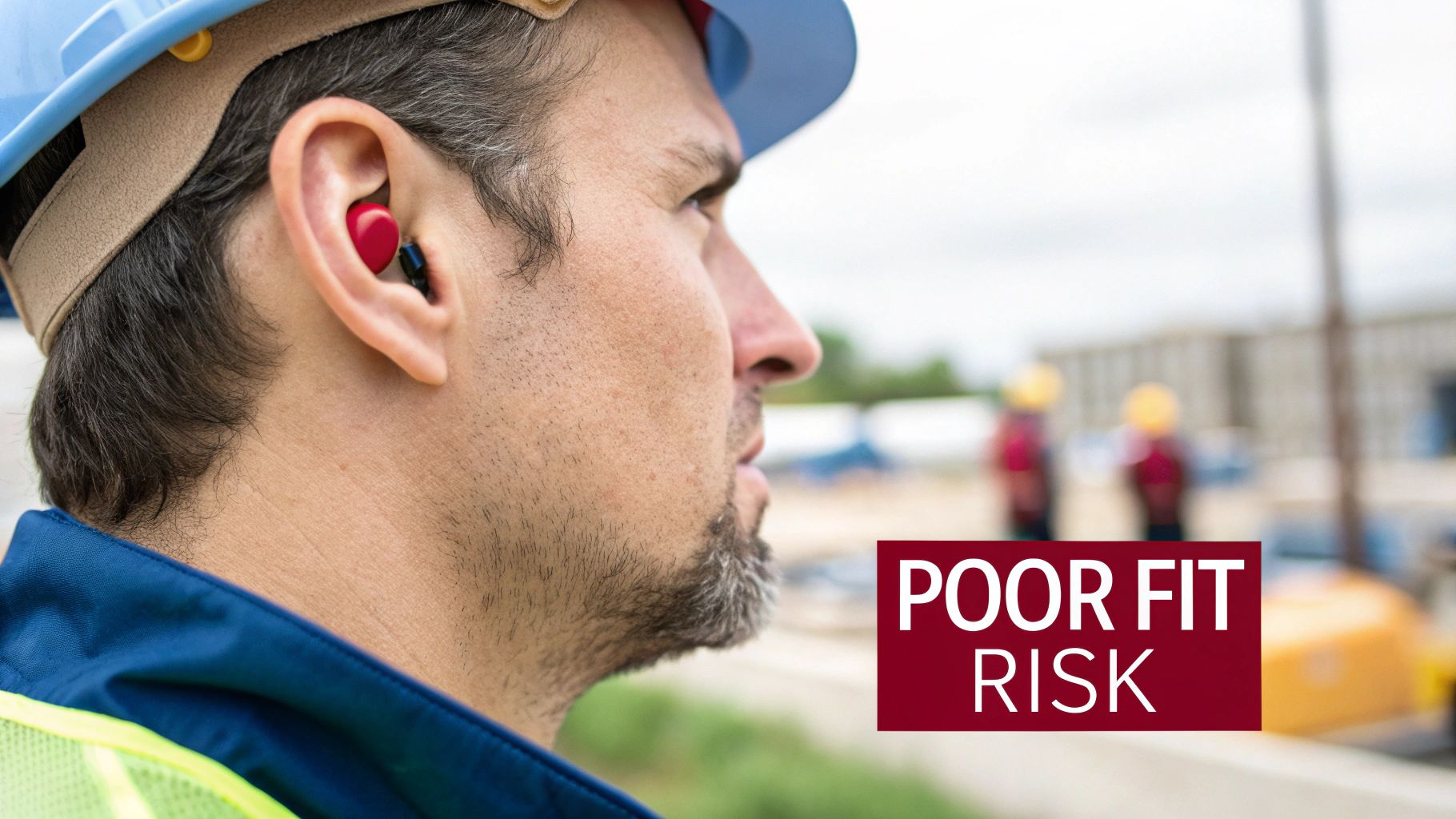
The Problem with a One-Size-Fits-All Approach
Everyone's different, and that includes their ear canals. Seemingly small things like the shape and size of an ear canal, or even facial hair interfering with earmuffs, can completely change how well a hearing protector seals out noise. This is where the whole one-size-fits-all approach falls apart.
Several key factors can lead to protection failure:
- Individual Anatomy: Ear canal sizes and shapes vary wildly. A standard earplug simply won't create an effective acoustic seal for everyone.
- Improper Insertion: So many workers have never been properly shown how to correctly insert foam earplugs or position earmuffs to get a complete seal. It's a skill.
- Device Incompatibility: Sometimes, an employee is given a device that is fundamentally wrong for their ear shape, making a proper fit impossible right from the start.
Without that perfect seal, hazardous noise just leaks straight past the protector, making it almost useless. It's why a comprehensive noise assessment is the critical first step to identify at-risk areas before you even start choosing protection. It’s the foundation of a hearing conservation program that actually works.
From Assumption to Certainty
This is where fit testing hearing protection completely changes the game. It closes the gap between the NRR on the box and the real-world attenuation an employee is actually getting on the job.
In Australia, the need for this kind of verification is stark. Around 11% of Australians live with some form of workplace-related noise-induced hearing loss (NIHL), yet it's estimated only 25% of at-risk workers regularly use hearing protection. This highlights a massive disconnect between perceived safety and actual practice—a gap that fit testing directly addresses by confirming protection is effective.
By shifting from passively providing PPE to actively verifying its performance, organisations move from a compliance mindset to one of true prevention. Fit testing provides objective data, turning a guess into a guarantee.
At the end of the day, relying on the NRR alone is like navigating a ship without a compass. Fit testing provides the precise coordinates, ensuring every single worker has a proven, effective barrier against dangerous noise. It’s the only way to be certain your team isn't just equipped, but genuinely protected.
What Is a Personal Attenuation Rating?
So, you've handed out earplugs on the factory floor. But how can you be sure they're actually protecting your team? The single most important number you need to know is the Personal Attenuation Rating, or PAR.
This isn't just another safety acronym. The PAR is a real-world, personalised measurement of how much sound a specific hearing protector is blocking for a specific person. It’s the direct result of a quantitative fit test and tells you, in decibels (dB), the exact noise reduction an employee gets when they wear their earplugs or earmuffs just as they would on any given day. It takes all the guesswork out of hearing safety.
Here’s an analogy I like to use. The Noise Reduction Rating (NRR) printed on the earplug box is like a car's official fuel economy sticker. That number was achieved in a perfect, controlled lab—think flat roads, no wind, no traffic. It's a best-case scenario that rarely matches reality.
The Personal Attenuation Rating, however, is the actual fuel economy you get driving to work every day. It accounts for all the starts, stops, and real-world conditions. It's the number that really counts for your fuel budget—or in this case, for protecting your hearing.
What a PAR Score Actually Tells You
Interpreting a PAR score is straightforward: a bigger number means better protection.
Let's say a worker is in a 95 dB environment. If their fit test shows a PAR of 25 dB, the noise level reaching their eardrum is now down to about 70 dB. This is safely below the 85 dB exposure limit required by Australian Work Health and Safety (WHS) regulations.
This individual data is where things get interesting. You can have two people standing next to each other, wearing the exact same model of earplug, and get completely different results. One might get a solid PAR of 28 dB, while the other, maybe due to a poor fitting technique or just a different ear canal shape, only scores a 10 dB. That second worker is dangerously under-protected, even though they think they're doing the right thing.
A "good" PAR is one that gets the worker's exposure to a safe level without overprotecting them. That might sound strange, but blocking too much sound can be a hazard in itself. It can stop workers from hearing critical warning signals, alarms, or even instructions from a colleague. The goal is to hit that sweet spot: enough protection to prevent hearing loss, but not so much that it introduces new safety risks. This is precisely the balance that fit testing hearing protection helps you find.
Why PAR Is the Gold Standard for Hearing Safety
Relying on the manufacturer's rating alone is a bit of a gamble. Study after study has shown a huge gap between lab-tested NRRs and the actual protection people get in the real world. Individual fit testing is the only way to close that gap.
- It proves the protection is working. The PAR confirms that the hearing protector is forming a proper acoustic seal for that individual.
- It guides better choices. If someone gets a low PAR with their current earplugs, you can immediately test a different size, shape, or model to find one that works for them.
- It empowers your people. When a worker sees their own PAR score on the screen, the abstract idea of hearing protection becomes real. It motivates them to get a good fit every single time they put their earplugs in.
Ultimately, the PAR turns hearing conservation from a passive, box-ticking exercise into an active, data-driven strategy. It gives you the confidence of knowing that every employee on your site has a proven level of protection, customised for their own ears. It’s the cornerstone of any modern hearing conservation program that is serious about stopping noise-induced hearing loss for good.
Exploring Different Fit Testing Methods
So, how do we actually figure out if a set of earplugs or earmuffs is doing its job? This is where fit testing comes in, and it's how we find that crucial Personal Attenuation Rating (PAR) for each worker.
The world of hearing protection fit testing isn't a one-size-fits-all deal. The methods are split into two main camps, and each has its own process, purpose, and level of accuracy. As a safety manager, getting your head around these two approaches—Qualitative and Quantitative—is the first step to building a truly effective hearing conservation program.
Qualitative Fit Testing: A Simple Pass or Fail
Think of Qualitative Fit Testing (QLFT) as a basic screening. It’s a straightforward, subjective check that answers one simple question: can the worker detect a specific sound while wearing their hearing protection? It's a "yes" or "no" answer, with no middle ground.
The process is pretty simple:
- The worker puts on their earplugs or earmuffs just like they would on any given day.
- A test agent—usually a specific sound—is introduced near their head.
- The worker is simply asked if they can hear the sound.
If they can’t hear it, they pass. If they can, it means there’s a leak in the seal, and they fail. This method is quick and doesn't require a lot of fancy gear, making it a fast way to spot major fitting problems. The big downside, though, is that it's all subjective. It doesn't give you any hard data—it can’t tell you how much protection someone is getting, only that a basic seal exists.
Quantitative Fit Testing: The Gold Standard for Precision
This is where we get into the real numbers. Quantitative Fit Testing (QNFT) goes way beyond a simple pass/fail to generate a precise, objective figure: the Personal Attenuation Rating (PAR). This method uses specialised equipment to measure the exact amount of noise reduction a hearing protector provides for that specific individual.
One of the most common and trusted QNFT methods is F-MIRE, which stands for Field Microphone in Real Ear. This system is clever—it uses tiny, dual-element microphones to get its readings. One microphone sits just outside the hearing protector to measure the surrounding noise level, while the other is placed inside the ear canal to measure the sound that actually gets past the seal.
The system then compares the two sound levels to calculate the exact decibel reduction the person is achieving at that very moment. This objective data is gold. It not only confirms a proper fit but also acts as a powerful training tool, showing workers in real-time how a small adjustment to their earplugs can dramatically improve their protection.
While QNFT requires a bigger investment in time and equipment, the detailed data it provides makes it the top-tier choice for truly verifying hearing safety. The principle is the same as other critical workplace checks, and you can see a parallel in the objective data needed for confirming protection in things like respirator fit mask testing.
This infographic really drives home the difference between the generic rating on the packet and a personalised, tested rating.
The real takeaway here is the move away from a broad, lab-based guess (NRR) to a specific, real-world measurement (PAR) that tells you what's actually happening for that individual.
Choosing the Right Method: A Quick Comparison
To make the decision clearer, let's break down the two approaches side-by-side.
| Feature | Qualitative Fit Testing (QLFT) | Quantitative Fit Testing (QNFT) |
|---|---|---|
| Result Type | Subjective Pass/Fail | Objective, numerical PAR |
| Data Provided | None – just a yes/no outcome | Precise decibel reduction data |
| Equipment | Minimal, low-cost | Specialised F-MIRE or similar systems |
| Time Investment | Very quick (a few minutes per person) | More time-intensive (around 10-15 mins) |
| Best Use Case | Basic awareness and initial screening | Verifying protection and training workers |
| Key Limitation | Doesn't measure how much protection | Higher initial cost and training required |
Ultimately, choosing between QLFT and QNFT comes down to what you want to achieve. A qualitative test can be a decent starting point to raise awareness, but for any organisation that is serious about preventing permanent hearing loss, the detailed, actionable data from a quantitative test is essential. It’s the only way to be certain your hearing protection plan is working for every single employee, every single day.
How Fit Testing Transforms Worker Training
Let’s be honest, traditional safety training can be a bit of a snoozefest. We've all sat through the videos or flicked through pamphlets showing the "correct" way to insert an earplug. While the intention is good, this approach is missing something huge: real-world feedback.
Fit testing hearing protection takes training off the page and into the real world. It gives your people immediate, personalised feedback that actually changes how they think about and use their gear. This isn't just another box to tick for compliance; it's one of the most effective, hands-on training tools you can have. It finally closes the gap between being told how to do something and knowing you’ve done it right.
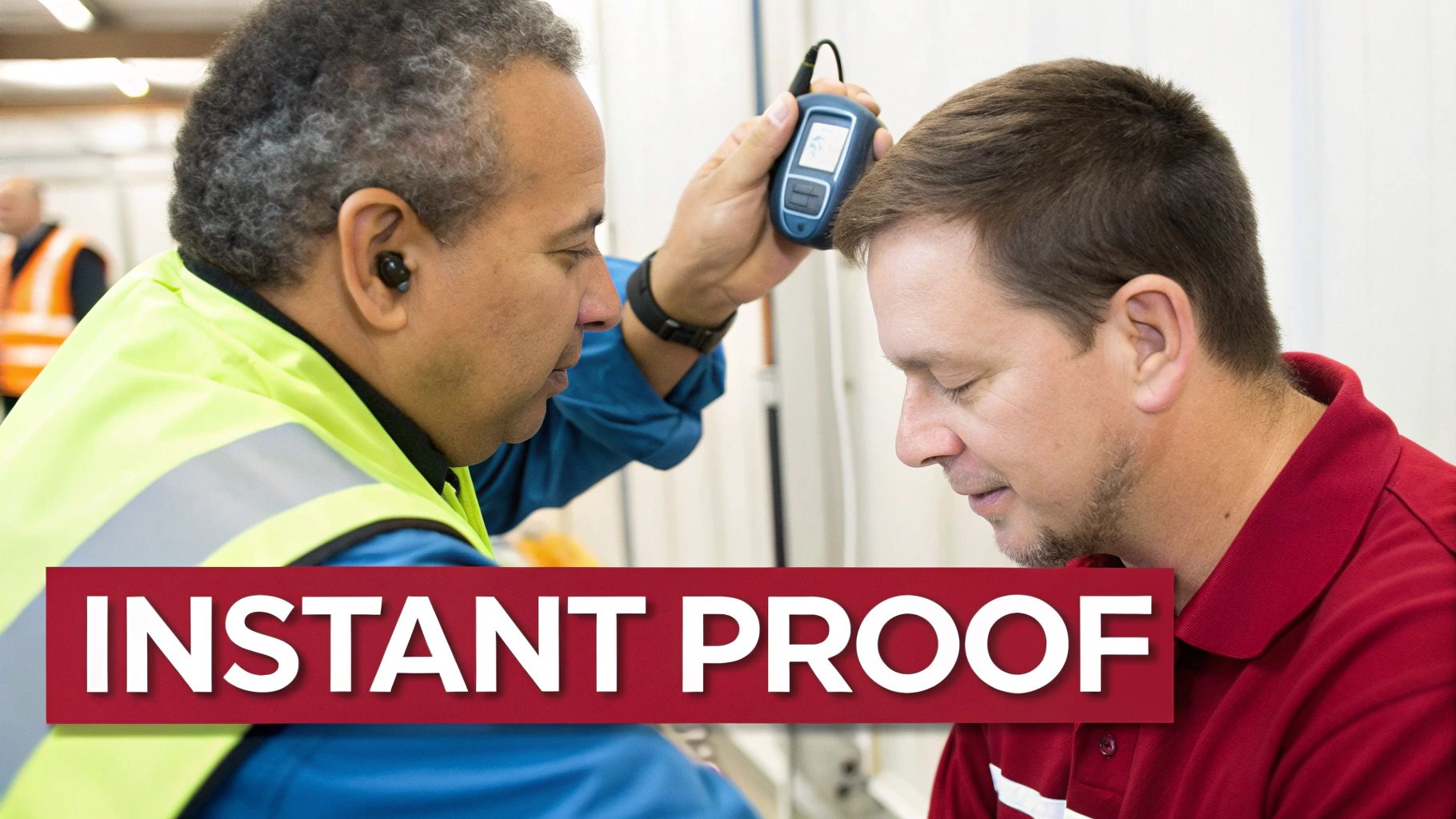
The 'Aha!' Moment of Visual Proof
The real magic of fit testing is the 'aha!' moment it creates for people. Picture a worker who's been wearing the same earplugs for years, absolutely certain they’re protected. Then, during a fit test, they see a low Personal Attenuation Rating (PAR) pop up on the screen, showing them in black and white that their protection just isn't cutting it.
The trainer then walks them through a tiny adjustment—maybe rolling the foam plug a bit tighter, or pulling their earlobe up to straighten out the ear canal before putting it in. They run the test again, and suddenly, the PAR score shoots up.
That visual proof is undeniable. The fuzzy concept of "getting a good seal" instantly becomes a concrete, measurable result they can see with their own eyes. It’s the difference between someone telling you a technique works and proving it to yourself.
This immediate feedback loop is incredibly powerful. It turns a passive safety lecture into an active, engaging experience. Your worker learns the right technique and validates it in real-time, creating a memorable moment that reinforces good habits far better than any manual ever could.
Building Personal Accountability and Ownership
When a worker sees their own PAR score, hearing protection suddenly becomes personal. It’s no longer just a company rule they have to follow; it’s their score, their hearing, and their responsibility. This is where a true sense of personal accountability starts to grow.
The hard data from a quantitative fit test shows the direct impact of getting the technique right. For instance, a study with military recruits found that after expert fit training and re-testing, the number of people with inadequate protection dropped from a worrying 34% down to just 3%. This just goes to show how combining training with verification gives people the power to get the noise reduction they need. You can explore more about these findings and what they mean for workplace training programs.
This kind of personal insight encourages people to take real ownership of their safety. They become far more conscious of getting a good fit every single time they put their hearing protection in, trying to replicate the success they had during the test.
Reinforcing Correct Habits for the Long Haul
We all know that one-off training sessions are easily forgotten, but the experience of a successful fit test sticks with people. When you build fit testing directly into your training process, you create a powerful reinforcement cycle.
Here’s how it helps build better long-term habits:
- It flags bad habits: The test immediately shows up incorrect insertion techniques that workers might have been using for years without ever realising the risk.
- It validates good habits: When someone achieves a high PAR, it confirms their technique is spot-on and gives them the confidence to keep doing it right.
- It creates muscle memory: The hands-on practice during the test helps build the muscle memory needed to get a perfect fit every single day, without even thinking about it.
This approach transforms training from a once-a-year event into a process of continuous improvement. It helps you build a proactive safety culture where every member of your team not only gets the "why" behind hearing protection but also has the proven skills to make it work for them. The result is a workforce that isn't just equipped, but truly empowered to prevent hearing loss.
Implementing a Workplace Fit Testing Program
Alright, so you understand what fit testing is and why it matters. Now, how do you actually bring it into your workplace? Moving from theory to practice takes a clear, structured plan. Setting up a successful fit testing hearing protection program is about more than just buying some new gear; it’s about building a solid process that slots right into your existing Work Health and Safety (WHS) framework.
The journey starts with getting everyone on board. The first, most critical step is getting the green light from management. You’ll need to build a strong business case that spells out the benefits loud and clear—fewer hearing loss claims, rock-solid compliance, and a healthier safety culture. Once you have that support, you can start laying the bricks.
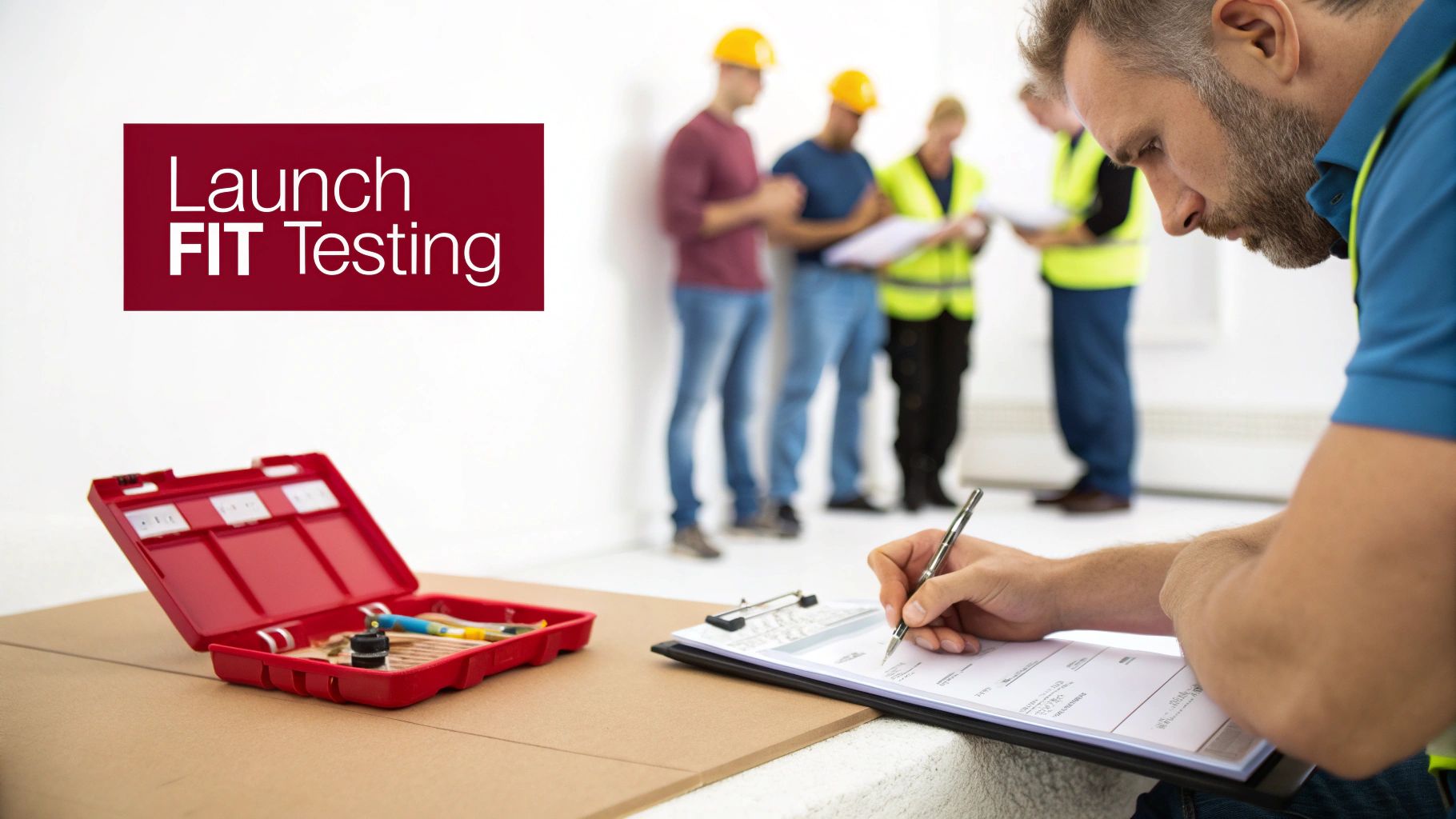
Building Your Program Step by Step
A truly effective program isn't built overnight. It involves a series of connected stages, where each step builds on the last. This methodical approach makes sure nothing gets missed and every employee gets the attention they deserve.
Here’s a practical, step-by-step guide to get you started:
- Choose Your Testing System: First things first, you need to decide if a Qualitative (QLFT) or Quantitative (QNFT) system is the right fit for you. If you’re after precise, data-driven results that prove protection and sharpen your training, a QNFT system that generates a Personal Attenuation Rating (PAR) is hands-down the better choice.
- Train Your Champions: You can’t do this alone. Designate and properly train the people who will run the tests. They need to know the equipment inside out, master the testing process, and learn how to coach employees to get a better, safer fit.
- Create a Rollout Plan: Map out how you'll get this done. Will you test department by department, or maybe shift by shift? Whatever you decide, make sure you communicate the what, why, and when to all your staff well ahead of time. It helps get everyone on side and keeps disruptions to a minimum.
- Make It Business as Usual: For your program to stick, you need to weave it into your standard safety procedures. Make fit testing a mandatory part of new hire inductions, annual safety refreshers, and for any worker who shows a standard threshold shift during their regular hearing test.
- Lock Down Your Documentation: When it comes to WHS compliance, meticulous records are non-negotiable. You must document every single test result, including the employee's name, the date, the specific hearing protector they used, and their final PAR score.
Ensuring Long-Term Success and Compliance
A fit testing program isn’t a "set and forget" task. It needs ongoing attention and regular check-ups to stay effective. Auditing your process and records from time to time is the only way to ensure you’re still meeting compliance standards and actually protecting your team.
Think about this: even your most seasoned workers often don't get the protection they think they are. Research from Australian workplaces has shown that around 30% of experienced hearing protection users fail to get enough noise reduction without a proper fit test. The same study found that 17% of users had to be completely retrained to achieve an acceptable fit. This is exactly why testing is so vital—it shines a light on these hidden safety gaps. You can read more on how fit testing identifies these crucial protection gaps from SafeWork NSW.
The ultimate goal is to create a self-sustaining cycle of testing, training, and verification. Fit testing should become as routine and expected as any other critical safety check in your workplace.
By following these steps, you’ll build a robust program that does far more than just tick a compliance box. You’ll be creating a cornerstone of your hearing conservation strategy, delivering verified, individual protection for every member of your team and building a culture where everyone takes hearing safety seriously.
The True Value of Verified Protection
Going beyond a simple box-ticking exercise, a proper fit testing program for hearing protection is one of the smartest investments you can make—both in your people and in the long-term health of your company. It’s about making a fundamental shift in how we think about safety. We move away from just handing out earplugs and start actively making sure they actually work. This proactive stance isn't just good practice; it builds a rock-solid business case.
The long-term wins are impossible to ignore. When you have objective data proving that hearing protection fits correctly, you'll see a direct and dramatic drop in noise-induced hearing loss (NIHL) claims and the workers' compensation costs that come with them. Every single claim you prevent is a direct saving, highlighting the financial sense in making sure every worker has a proven acoustic seal.
Forging a Stronger, More Resilient Safety Culture
Putting the financials aside for a moment, the real value is in the kind of safety culture you build. When your team sees a genuine commitment to their wellbeing through personalised testing, it does wonders for morale and trust. This isn't just another item on a safety checklist; it’s a clear signal that their health is a top priority.
A workplace that verifies protection is a workplace that values its people. It sends a clear message that every individual’s health matters, fostering an environment where safety is a shared responsibility, not just a management mandate.
This commitment creates a powerful positive cycle. Better morale leads to more engagement with all safety protocols, which naturally reduces incidents and makes the entire culture stronger. It's also important to remember that hazardous noise is just one piece of the puzzle. You can learn more about other unseen hazards that cause occupational hearing loss to get a more complete safety picture.
A Powerful Call to Action for Leaders
So, what's the ultimate takeaway? It’s a call for leadership to step up and drive this change. We already know how valuable objective measurement is in other fields. For a great example, check out a guide to physical performance testing to see how systematic evaluation works elsewhere. Just as an athlete uses data to get better, a workplace must use data to protect its people.
This means we have to stop being passive providers of PPE and become active guarantors of its effectiveness. Leaders need to start asking, "Did the earplugs we provided actually work for each person?" instead of just, "Did we provide earplugs?"
At the end of the day, making sure every worker is protected by a verified acoustic seal isn’t just best practice—it’s a fundamental responsibility. It's the definitive step that shields your employees from irreversible harm and cements your organisation’s reputation as a genuine leader in workplace health and safety.
Frequently Asked Questions
Even when you understand the value of fit testing, a few practical questions always pop up when it's time to actually implement a program. We get it. So, let's walk through some of the most common queries we hear from safety managers and business owners.
Think of this as your cheat sheet for building a hearing safety program that's not just compliant, but genuinely effective.
How Often Should We Be Fit Testing Our Team?
While Australian WHS law doesn't lay down a strict, mandatory schedule, industry best practice points to a clear rhythm for testing. You're not just ticking a box; you're ensuring protection that works day in, day out.
For the best results, you should fit test:
- When someone starts: Test all new employees before they ever set foot in a noisy area. This sets a baseline from day one.
- Once a year: An annual fit test is a great habit. It pairs perfectly with yearly audiometric testing and serves as a practical safety refresher.
- If a hearing test flags an issue: If an employee’s annual audiogram shows a standard threshold shift, an immediate fit test is crucial to find out why.
- When gear changes: Switching to a new brand, style, or type of hearing protection? You need to test it to make sure it's a good fit for that individual.
This approach means you’re always on the front foot, verifying protection from an employee's first day and right through their career with you.
Is Fit Testing Actually a Legal Requirement in Australia?
This is a great question, and the answer isn't a simple "yes" or "no". Right now, fit testing hearing protection isn't explicitly mandated by Safe Work Australia in the same way it is for, say, respiratory masks.
However, it all comes back to your primary duty of care.
A Person Conducting a Business or Undertaking (PCBU) has a legal obligation to ensure the health and safety of their workers, so far as is reasonably practicable. A massive part of that duty is proving that the PPE you provide is doing its job effectively.
So, while you might not find a specific clause demanding it, fit testing has become the gold standard and best practice. It's your objective proof that you’ve taken real, measurable steps to manage the risk of noise-induced hearing loss. Frankly, it's one of the strongest ways to demonstrate your due diligence.
What's the Difference Between NRR and PAR?
It’s easy to get these two mixed up, but the difference is huge. The Noise Reduction Rating (NRR) is the number you see on the packaging. It’s a laboratory rating, measured under perfect, ideal conditions that rarely exist in the real world.
The Personal Attenuation Rating (PAR), on the other hand, is what truly matters. It’s the specific, real-world measurement of noise reduction that a particular employee gets from their earplugs or earmuffs, worn the way they wear them every day. The PAR tells you exactly how protected that person is.
We help businesses move from assumption to certainty. Our occupational hygiene experts can help you build a robust hearing conservation program, including on-site fit testing, to ensure your team is genuinely protected. Visit us at https://occhygiene.com.au to see how we can safeguard your workplace.


