
Quick Summary: Living or working in a property that was once a clandestine lab can cause serious psychological distress, driven by the fear of unseen meth contamination and social stigma. This human-centric perspective explores occupant well-being, the scientific health impacts, and risk assessment, highlighting that stakeholders must pair scientific remediation with empathetic communication to address these real human fears.
A building’s history isn’t just etched into its foundations; it’s imprinted on the minds of the people who live and work there. The label “former clandestine lab” carries a heavy, unseen weight. It creates a psychological threat that a clearance certificate alone can't simply wipe away. This guide offers expert insight into the psychology of inhabiting these stigmatised spaces, looking beyond the physical data to understand the profound emotional and mental toll on occupants and their well-being.
The Invisible Weight of a Property's Past
The stigma attached to a former drug lab creates a huge psychological burden. Even after the property has been professionally remediated and declared scientifically safe, the memory of its past can linger. It often fosters a persistent sense of anxiety for residents or employees. This isn't just an irrational fear; it's a deeply human reaction to a danger that feels present, even if it’s unseen, impacting occupant well-being.
This situation really brings a critical difference into sharp focus: the gap between objective safety and subjective wellbeing. A space can pass every scientific test with flying colours and still feel psychologically unsafe to the people in it day after day. At its heart, the issue comes down to trust—trust in the clean-up, trust in the experts, and ultimately, trust in the very air you breathe.
Understanding Perceived Risk vs Actual Risk
That gap between what science proves and what a person feels is the crux of the problem. More often than not, perceived risk has a much bigger impact on our daily lives than the statistical reality of a hazard. Several powerful psychological drivers are at play here:
- The Invisibility Factor: You can see a crack in the wall, but you can't see chemical residues from focused meth contamination. This invisibility makes them a source of constant, nagging worry.
- A Lack of Control: Occupants feel powerless over their potential exposure. This only heightens their sense of vulnerability and helplessness.
- Strong Emotional Triggers: The criminal and dangerous reputation of a drug lab sparks strong negative feelings, which then become directly tied to the property itself.
It's one thing to measure risk with scientific instruments, but quite another to manage the emotional fallout it creates. The table below breaks down these two distinct, yet connected, challenges.
Psychological vs Physical Risks in Stigmatised Properties
| Aspect | Scientific Health Risk (Physical) | Psychological Impact (Mental) |
|---|---|---|
| Nature | Measurable, chemical-based contamination levels. | Subjective feelings of fear, anxiety, and unease. |
| Detection | Identified through air/surface sampling and lab analysis. | Experienced internally; identified through conversation and observation. |
| Remediation | Removed via specialised chemical cleaning and physical decontamination. | Addressed through clear communication, transparency, and validation of concerns. |
| Outcome | Property is certified as physically safe and habitable. | Occupants feel safe, secure, and confident in their environment. |
As you can see, tackling the scientific risk is only half the battle. Without addressing the psychological side, a property may be clean, but it won't truly be a home or a healthy workplace.
The greatest challenge isn't just removing contaminants from the walls; it's removing the fear from people's minds. This requires a human-centric perspective that prioritises empathy and transparent communication alongside scientific rigour.
The Role of Occupational Hygiene
Dealing with this psychological fallout is a vital, though often underestimated, part of an occupational hygienist's job. An expert's role goes far beyond taking swabs and writing reports. They become the essential bridge between cold, hard data and very real human emotion.
By clearly explaining the remediation process and genuinely listening to the concerns of occupants, a hygienist can start to dismantle the stigma. It’s this human-centric approach that helps rebuild the trust needed for true psychological safety. The financial sting of this stigma is also a major factor; you can explore this further in our guide to how former labs impact real estate value. Ultimately, this isn’t just good practice—it's essential for making a property haunted by its past truly liveable again.
How Stigma Warps Our Sense of Risk
Our brains are hardwired for survival. We’re constantly, subconsciously scanning our surroundings for danger. This is a brilliant system when you’re faced with a clear and present threat, like a snake on a bush track. But what happens when the danger is invisible?
When it comes to something like potential chemical residues in a former clandestine lab, our psychological response gets messy. The anxiety isn’t sparked by what we can see, smell, or touch, but by the nagging uncertainty of what we can’t.
This uncertainty is the perfect breeding ground for stigma. If no one provides clear, honest information about a property's history and remediation, our minds will rush to fill in the blanks—and they almost always fill them with the worst-case scenario. This isn't irrational panic; it's a deep-seated cognitive mechanism designed to protect us from unknown dangers. Suddenly, every lingering odour or unexplained headache is seen through the lens of the property’s past.
The Mental Shortcuts That Lead Us Astray
To navigate a complex world, our brains rely on mental shortcuts, what psychologists call cognitive biases. In the context of a stigmatised property, however, these shortcuts can seriously distort our perception of risk and dial up our fear. One of the most powerful biases at play here is the availability heuristic.
This is our tendency to overestimate the likelihood of events that are easier to recall. A single, dramatic news story about a family getting sick from meth contamination can feel far more real and immediate than pages of scientific data or a dozen clearance certificates. The emotional punch of that one vivid story sticks in our memory, overriding logic and colouring our judgment.
The label 'former lab' acts as a powerful trigger, activating a cascade of automatic negative associations. This leads to a state of hyper-vigilance, where occupants are constantly on alert for signs of danger, making psychological safety just as critical as physical decontamination.
It's Like Living with a Hidden Predator
Imagine you’re camping in the bush and you’ve been told there's a predator lurking nearby. You might never actually see it, but the constant threat of it changes everything. Your senses are on high alert. Your stress levels are through the roof. Every snapped twig or rustle in the leaves sounds like an imminent attack. The psychological weight of that potential danger is exhausting.
Living or working in a stigmatised former lab can feel just like that. The unseen contamination is the "predator," and your home or office is the "bush." This sustained state of high alert can lead to chronic stress, anxiety, and a seriously diminished sense of well-being, even if the actual physical risk has been reduced to zero.
The emotional toll of stigma can profoundly alter how people perceive risk. For example, concepts like rejection sensitive dysphoria and perceived stigma, which involves intense emotional pain from feeling rejected, help us understand how living in a socially stigmatised environment can feel like having an 'emotional sunburn'.
When Stigma Infects the Workplace
This psychological burden gets even heavier when it's brought into the workplace. In Australian businesses operating out of a former lab, the stigma can be toxic for mental health, particularly in industries like pharmaceuticals or food and beverage where the perception of cleanliness is everything.
Data from the Australian Bureau of Statistics already shows that people with existing mental health conditions face higher rates of discrimination (21% compared to 12% for those without). Introduce the fear of contamination into that environment, and you can create a culture of exclusion, suspicion, and mistrust. You can dig into the specifics by reading the full report from the Australian Bureau of Statistics.
The Human Cost of Environmental Stigma
When the theory of stigma meets the reality of daily life, the impact is both real and deeply personal. Living or working in a place tainted by its past as a "former lab" isn't just an abstract concern; it becomes a source of chronic, low-level stress that slowly chips away at your mental and physical health. This is where we see the true human cost.
The constant, nagging fear of being exposed to invisible contaminants can easily morph into serious psychological conditions. Occupants might develop chronic anxiety, always on high alert for some unseen threat. This can also manifest as physical ailments like persistent headaches, digestive problems, and a weakened immune system.
For some, the psychological weight is so heavy it can feel like post-traumatic stress disorder (PTSD), particularly if they feel their concerns have been brushed aside. Every unexplained cough or minor illness can send them into a spiral of worry, questioning if it’s tied to the property’s history.
The Ripple Effect on Social Connections
The stigma attached to a property rarely stays behind closed doors. It radiates outwards, souring relationships and creating a profound sense of social isolation. This social fallout can be just as damaging as the internal anxiety.
Picture this: you invite friends over for a BBQ, but you can see the hesitation in their eyes. They politely decline, their minds flashing with news reports about meth contamination. Even if it's born from their own fear, it feels like a personal rejection.
Over time, occupants can start to feel like outcasts, afraid to even mention where they live or work. The property becomes a secret, cutting them off from social support and making them feel utterly alone.
From Social Awkwardness to Workplace Toxicity
In a professional setting, this social dynamic can curdle into something far more toxic. Workplaces in stigmatised locations—which are common in sectors like oil and gas, mining, and pharmaceuticals—can become breeding grounds for bullying and exclusion. The building's history becomes a tool for whispers, jokes, or outright avoidance, destroying any sense of psychological safety.
We know that around 40% of Australian workers report being bullied at some point, and the unique stigma of a former lab can easily fuel this behaviour. This has a direct impact on organisational health. Consider Safe Work Australia's data: the return-to-work rate for psychological injuries is just 76.5%, a stark contrast to the 90.2% for physical ones. This kind of environment contributes to the fact that 61% of Australian workers experience burnout, and 40% end up quitting their jobs because of work-related stress. You can dig deeper into these figures in this report on workplace mental health statistics.
A Case Study in Stigma: Anonymised Stories
To really understand the human cost, let’s look at a couple of anonymised examples that show the real-world impact:
- The Family Home: A young family finally buys their dream home. They’re shattered to discover its past as a clandestine lab only after their children start having respiratory issues. Even after professional remediation and a clean bill of health, the mother is in a constant state of hyper-vigilance. They no longer feel they can host playdates, which isolates their children and strains their friendships.
- The Office Worker: An employee at a biotech firm, located in a remediated building, develops severe anxiety. Colleagues who know the building's history keep their distance, leaving them out of social lunches and after-work drinks. Their career stalls because they’re seen as "dramatic," and their mental health spirals downwards from the constant stress and isolation.
These stories aren't just about property; they're about people whose lives have been fundamentally turned upside down. Their emotional experiences validate what scientific data alone cannot capture: the deep, human toll of environmental stigma.
These scenarios bring a critical truth into focus. The psychological fallout from living or working in a stigmatised "former lab" isn't a fringe issue. It directly impacts well-being, family dynamics, social connections, and career security, making it a vital consideration for any property owner, employer, or occupational hygienist.
Bridging the Gap Between Scientific Data and Lived Experience
One of the toughest knots to untangle in a "former lab" situation is the gaping chasm between what science says and what people feel. An occupational hygienist can hand over a detailed report, full of reassuring lab results and technical data, declaring a property safe. But for the person living or working there, that knot of anxiety in their stomach doesn't just disappear.
This is where the real challenge lies. A clearance certificate, on its own, often isn't enough to soothe deep-seated fears. A scientific risk assessment and our own emotional responses just don't speak the same language. Science is all about objective, measurable data, while our lived experience is subjective, personal, and tangled up in emotion. To get to the heart of the issue, we have to find a way to bridge that divide.
Demystifying the Science of Safety
So, what actually goes into that safety clearance? It helps to pull back the curtain on the process. When an occupational hygienist assesses a site for something like meth contamination or other chemical hazards, they aren't just taking a wild guess. They're following a strict, methodical protocol.
They start by identifying potential exposure pathways – basically, all the ways a contaminant could possibly get into your body. This usually boils down to three main routes:
- Inhalation: Breathing in contaminated dust or vapours.
- Ingestion: Accidentally swallowing tiny amounts of a substance, often from touching a surface and then your mouth.
- Dermal Absorption: A chemical seeping through your skin after direct contact with a contaminated surface.
The hygienist will take samples from surfaces and maybe even the air, sending them off to a lab for analysis. The results are then measured against established, health-based acceptable limits. If the contaminant levels fall below these very strict safety benchmarks, the property is considered safe from a scientific point of view.
When Objective Data Meets Subjective Fear
While this process is scientifically solid, it’s where things can get lost in translation. The core of the problem is that a technical report, packed with jargon and numbers, can feel cold and dismissive to someone who is genuinely afraid. The lived experience of an occupant is shaped by anxiety, not statistics.
This is exactly why a two-pronged approach is non-negotiable. You need the rigorous scientific testing, of course, but it absolutely must be paired with empathetic, human-centred communication. It's not enough to just email a PDF report and call it a day. The findings have to be translated into understandable, reassuring information that speaks directly to a person's worries.
The role of an occupational hygienist is not just to be a technician who collects data, but a crucial communicator who can translate that data into peace of mind. They must validate the concerns of occupants, not just the safety of the building.
The Hygienist as a Translator and Trusted Advisor
This communication role is vital for rebuilding trust. A great hygienist will take the time to sit down with people, listen to their worries, and walk them through the report in plain English. They can explain why the acceptable limits are considered safe and detail the specific steps taken to make sure every exposure pathway has been checked and cleared.
When this happens, the hygienist is no longer just an assessor; they become a trusted advisor.
This approach has a massive impact on wellbeing, especially in the workplace. Take Australian workplaces that have been stigmatised as 'former labs'. Workers in these places often face a huge psychological burden. A Safe Work Australia survey found the national return to work rate for workers with psychological injuries is just 76.5%, a long way short of the 90.2% rate for physical injuries. That gap shows just how much stigma can amplify mental health struggles.
Proper occupational hygiene can help close that gap. By validating concerns through testing, hygienists can shrink the perceived risk and start rebuilding the trust that was lost. You can dig deeper into these figures by exploring the latest national return to work survey results.
Ultimately, bridging the gap between scientific data and lived experience comes down to one simple truth: feeling safe is just as important as being safe. By marrying robust science with compassionate communication, we can start to heal the invisible wounds left by a property’s past.
A Practical Framework for Rebuilding Trust
Knowing the psychological toll of a stigmatised "former lab" is one thing, but actively rebuilding trust is a completely different challenge. To move from understanding the problem to actually fixing it, you need a clear, structured plan that addresses the real-world anxieties of everyone involved. This isn't just about PR or perception management—it’s about creating an environment where people feel genuinely safe, both physically and psychologically.
Successfully navigating this fallout hinges on a coordinated effort from three key groups: employers, landlords, and occupational hygienists. Each has a distinct yet interconnected role in turning a property from a source of anxiety into a place of genuine security.
Guidance for Employers: Fostering a Supportive Culture
As an employer, the wellbeing of your team is everything. When your workplace has a history as a clandestine lab, that responsibility gets bigger—you now have to address the invisible weight of stigma. The goal here is to build a culture where people’s concerns are met with empathy, not eye-rolls.
It all starts with creating open channels for communication where staff can voice their anxieties without fear of being judged or labelled as difficult. Transparency is your greatest asset. Share the remediation reports, and make the experts available to answer questions directly. Nothing deflates fear like facts.
Consider these essential strategies:
- Offer an Employee Assistance Program (EAP): This gives employees a confidential and professional resource to discuss their anxieties with trained counsellors, completely separate from management.
- Host Expert Q&A Sessions: Arrange for the occupational hygienist who cleared the site to meet with your team. This is a game-changer. It allows employees to ask their toughest questions and hear the science straight from a trusted, independent source.
- Lead with Empathy: Acknowledge that their fears are valid. A simple statement like, "We understand this history is concerning, and our top priority is making sure you feel completely safe here," can make a world of difference.
Guidance for Landlords: Prioritising Transparency
For landlords and property managers, the temptation to downplay or even hide a property's history can be strong. The fear is that it will spook tenants or buyers. But that approach almost always backfires, destroying trust and creating much bigger problems down the line.
The only sustainable path forward is one of radical transparency and decisive action.
Investing in thorough, reputable remediation isn't just an expense; it’s a long-term investment in the property's value and your own reputation. Full disclosure, backed by comprehensive documentation from certified professionals, is the only way to build lasting confidence. Part of this involves ensuring all historical materials are dealt with properly, which includes using safe and compliant lab equipment recycling services to responsibly clear the site's legacy.
Your duty is not just to provide a building, but to provide peace of mind. Transparent disclosure, supported by verifiable scientific evidence, is the foundation upon which that peace of mind is built.
Guidance for Occupational Hygienists: Communicating with Clarity
As an occupational hygienist, you are the critical bridge between hard science and raw human emotion. Your role extends far beyond taking samples and writing reports. You are the chief translator, the person tasked with rebuilding trust on a technical level. How you communicate your findings is just as important as the findings themselves.
Ditch the overly technical jargon. Your job is to make the complex simple and the scary understandable. Remember, you’re often speaking to people’s deepest fears about their family's health and safety.
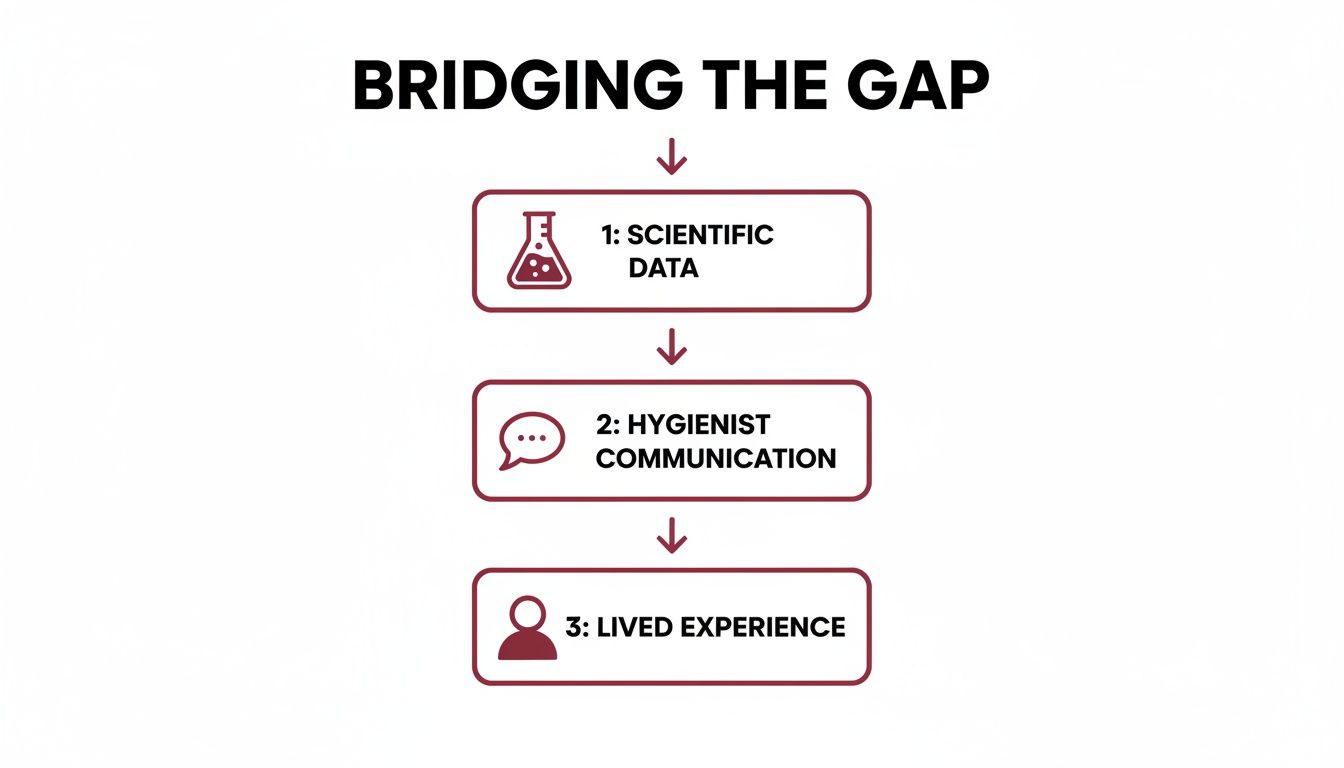
This model shows how effective communication acts as the essential filter between raw scientific data and an occupant’s lived experience. It makes dense information digestible and, ultimately, reassuring.
A few key communication techniques will get you there:
- Listen First: Before you present your data, actively listen to the occupants' specific concerns. This allows you to tailor your explanation to address what truly matters to them, rather than just reciting a standard script.
- Explain the 'Why': Don’t just state that a site is safe. Explain how you know. Talk about the process, the safety margins built into the guidelines, and why they can have confidence in the results.
- Be Patient and Available: Answer every single question, no matter how repetitive or seemingly basic. Your patience and willingness to engage are powerful signals that you take their concerns seriously.
To bring this all together, here is a practical framework that outlines how each stakeholder can contribute to a successful outcome.
Actionable Framework for Stakeholders
This table provides a clear, at-a-glance checklist for employers, landlords, and hygienists to manage property stigma effectively and support the wellbeing of occupants.
| Stakeholder | Key Responsibility | Actionable Strategy | Desired Outcome |
|---|---|---|---|
| Employers | Employee Wellbeing & Psychological Safety | Implement an EAP, host expert Q&As, and lead with empathy. | A supported workforce that feels heard, valued, and safe. |
| Landlords | Property Safety & Value Preservation | Invest in certified remediation, practise full disclosure, and provide all documentation. | Restored trust, protected asset value, and long-term tenant confidence. |
| Hygienists | Scientific Validation & Risk Communication | Use clear language, explain the "why" behind the data, and practise active listening. | Empowered occupants who understand the science and feel reassured. |
By working together within this framework, all parties can move beyond the stigma, transforming a place of fear into a safe and trusted environment for everyone.
Your Questions, Answered
When you're dealing with a property that used to be a lab, a lot of questions and uncertainties can pop up. It's completely normal. This section tackles some of the most common concerns we hear, giving you straightforward answers to help you navigate everything from the science of safety to the human side of things.
How Can I Be Sure a Property Is Actually Safe After It's Been Cleaned?
You need two things: solid scientific proof and clear, honest communication.
First, always get your hands on the detailed clearance report from a certified occupational hygienist. This isn't just a tick-a-box exercise; the report should clearly outline what was tested for (like focused meth contamination), the methods used, and confirmation that any detected levels are well below Australia's safety standards.
But a piece of paper can only do so much. A good hygienist won't just email you a PDF and disappear. They should be willing to sit down with you and explain what it all means in plain English, answering your specific questions. That conversation is what truly turns technical data into genuine peace of mind.
What Are My Rights as a Tenant if I Find Out My Home Was a Lab?
In Australia, the law is on your side when it comes to having a safe place to live. Landlords and real estate agents have a duty to disclose a property's history, although the specific rules can differ a bit from state to state.
If you discover your home’s past wasn't revealed before you signed the lease, you might have the right to break the agreement or even seek compensation. The best first step is to get proper legal advice and give your local tenancy authority a call. They can walk you through the laws and protections that apply where you live.
I'm an Employer. How Can I Help My Staff if They're Worried?
The most important thing you can do is listen and be transparent. Start by acknowledging their fears are valid—never brush them off. Make all the official clearance and risk assessment reports easily available for anyone who wants to see them.
A great next step is to organise a Q&A session with the occupational hygienist who did the testing. This gives your team a chance to ask questions directly to an independent expert. Beyond that, actively promote your mental health support, like an Employee Assistance Program (EAP), and make it clear that it's okay for people to voice their concerns. This shows you're committed not just to their physical safety, but to their psychological wellbeing too.
At OCCHEALTH, we're experts in occupational hygiene, but we also understand the human element. We bridge the gap between scientific fact and feeling safe. Our team provides comprehensive assessments and, just as importantly, clear communication to ensure your property is safe and its occupants feel secure.
Find out more about how we can help at our Occupational Hygiene Services page.


