
Environmental vibration testing is the process of measuring and analysing ground vibrations to prevent them from damaging buildings or disturbing people nearby. It’s most common during construction or heavy industrial work. Think of it as a health check-up for the ground, making sure the 'ripples' from heavy machinery don't cause any negative side effects. It's a proactive risk management tool that's absolutely vital for modern projects, ensuring that progress on a new site doesn't come at the expense of existing structures and community well-being. This meticulous process safeguards investments, maintains public relations, and upholds regulatory compliance from start to finish.
Understanding the Foundations of Vibration Testing
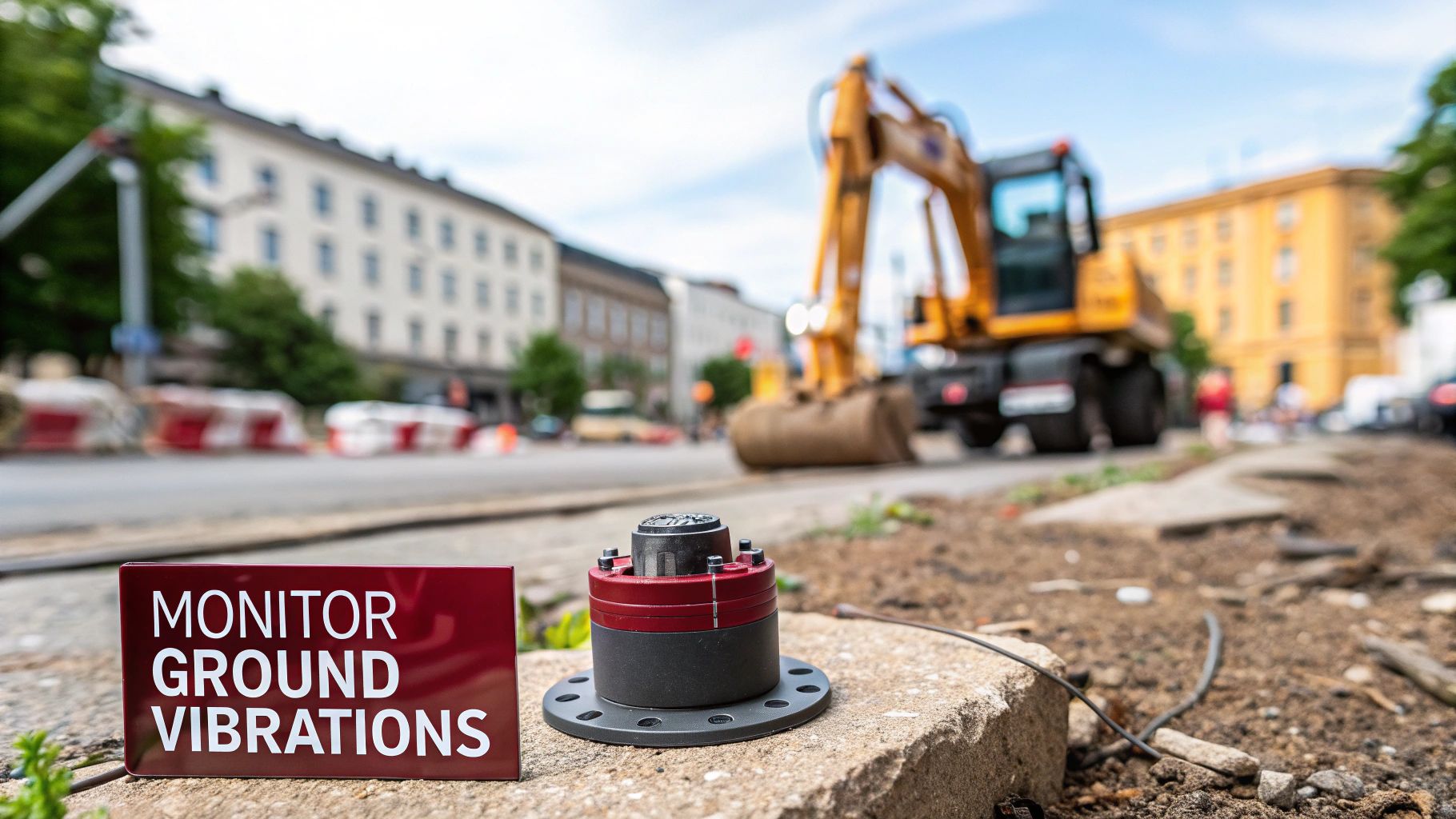
Picture dropping a heavy stone into a still pond. The ripples spreading outwards are a great analogy for ground vibrations. They're invisible waves of energy travelling from a source, like a pile driver or heavy excavation, through the ground to whatever is nearby—buildings, infrastructure, and people. Environmental vibration testing is simply the science of measuring and managing these 'ripples' before they can do any harm. This is not merely a procedural step but a fundamental aspect of responsible project management in today's increasingly dense urban landscapes.
This isn't just a box-ticking exercise for compliance. It’s a crucial risk management strategy that protects the integrity of buildings, keeps the peace with neighbours, and ultimately safeguards a project's reputation and budget. Without proper monitoring, projects can cause anything from minor cosmetic cracks in a nearby home to serious structural damage, leading to costly repairs, legal disputes, and significant delays. The investment in thorough testing upfront can save exponentially more in potential remediation costs down the line.
To really get why this matters, you need to appreciate some fundamental structural engineering principles that keep buildings standing. Every structure is designed to handle certain forces, but unexpected or excessive vibrations can easily push it beyond its design limits, compromising its stability and longevity.
Why Is This Measurement So Important?
Vibrations can have a huge range of effects, some you can see and some you can’t. By putting a number on these movements, project managers get the hard data they need to deal with risks before they turn into expensive problems. At its core, testing answers critical questions about project safety and community relations, providing an objective basis for decision-making.
The key goals of vibration monitoring are to:
- Protect Structures: This means preventing everything from cracked plaster to more serious structural problems in nearby buildings, particularly older or heritage-listed properties which are often far more susceptible to damage.
- Ensure Human Comfort: People can feel vibrations at levels well below what it takes to damage a building. If left unmanaged, these vibrations lead to complaints, disputes, and costly project delays that can derail timelines.
- Validate Construction Methods: The data helps confirm that the equipment and techniques being used are right for the site and its surroundings, allowing for adjustments before significant issues arise.
- Maintain Regulatory Compliance: It provides proof of adherence to local council requirements and Australian Standards, which are there to protect both property and people, creating an auditable trail of due diligence.
The Two Sides of Vibration
It helps to think about vibration impact in two separate categories, as each has different acceptable limits and needs a different approach. Getting this distinction right is the first step in creating a solid management plan. You can dive deeper into the specifics with professional environmental vibration monitoring, which looks at both aspects comprehensively.
The core challenge is balancing operational necessity with environmental responsibility. A vibration that is perfectly acceptable for a building's structure might be completely unacceptable to the people living or working inside it.
This dual focus—on both structural safety and human perception—is what makes environmental vibration testing so essential. It delivers the objective data needed to protect physical assets while also managing the human side of things, helping projects run smoothly and responsibly in our increasingly crowded urban environments. It bridges the gap between engineering requirements and community expectations, fostering a more collaborative and less adversarial project environment.
Making Sense of Australian Vibration Standards
In Australia, the rules around vibration are a mix of local guidelines and globally recognised standards. If you're running a construction or demolition project, getting your head around this framework is non-negotiable. It's what keeps you compliant, protects neighbouring properties, and avoids the kind of costly delays and community complaints that can stop a project in its tracks. A deep understanding of this regulatory landscape is the foundation of any successful and legally sound vibration management plan.
The starting point for most projects is AS 2436-2010, which covers noise and vibration control on construction, demolition, and maintenance sites. Think of it as the foundational playbook—it lays out the general principles and best practices for managing vibration. But, it's more of a high-level guide than a set of hard-and-fast rules with specific limits. It establishes the "why" and "how" of management in broad strokes.
That’s why, when we need to get into the nitty-gritty of protecting buildings, we almost always turn to more detailed international standards. While AS 2436 provides the local context, seasoned professionals rely on Germany’s DIN 4150-3 and the UK’s BS 7385-2 for the technical muscle. These standards give us the precise, data-driven limits needed for proper structural assessments. For a deeper dive into how these all work together on Australian sites, you can check out these insights on structural vibration.
Protecting Buildings From Damage
When our main job is to prevent cracks in walls or, worse, actual structural damage, we work with specific velocity limits. These are measured in millimetres per second (mm/s) of Peak Particle Velocity (PPV), and they are definitely not a one-size-fits-all solution. The acceptable limit changes dramatically depending on the building you’re trying to protect. This nuanced approach is critical for effective risk mitigation.
This tiered system ensures the most vulnerable structures get the care they need.
- Commercial and Industrial Buildings: These are built tough. They can typically handle vibrations up to around 25 mm/s.
- Residential Structures: Your average house or apartment block is more sensitive to things like plaster cracking. Here, we dial it back to a much stricter range, usually 5 to 10 mm/s.
- Heritage-Listed or Sensitive Structures: This is where we are most cautious. For historic buildings, hospitals, or data centres with delicate equipment, the limits can be as low as 2 to 3 mm/s.
These numbers aren’t pulled out of thin air. They’re grounded in standards like DIN 4150-3 and BS 7385-2, which provide incredibly detailed, frequency-based guidelines for assessing how different structures react to both short-term jolts and continuous vibration.
A common mistake is thinking all buildings are created equal. The reality is, your project’s vibration limits are set by your neighbours. If you're building a modern office tower next to a 19th-century church, you're working to the church's much lower tolerance, full stop.
The Human Comfort Factor
Protecting buildings is only half the battle. We also have to think about people. Humans can feel vibrations at levels far, far below what it would take to cause the tiniest cosmetic crack. Getting this right is crucial for keeping the peace with the local community and avoiding the kind of complaints that can bring a project to a grinding halt. This aspect is often underestimated but can have the most significant impact on a project's public perception.
For this, we look to AS 2670.1-2001, which deals with Evaluation of Human Exposure to Whole-Body Vibration. This standard helps us understand how people perceive vibration and sets acceptable levels for different spaces, like homes, offices, or workshops. It's a completely different ball game from structural monitoring—instead of just measuring PPV, we look at metrics that factor in how long the vibration lasts and at what frequency.
To help put this all together, here’s a quick overview of the key standards and what they do.
Key Vibration Standards and Their Applications
The table below breaks down the main standards we use in Australia to manage both structural integrity and human exposure to vibration on a typical project.
| Standard | Primary Focus | Common Application |
|---|---|---|
| AS 2436-2010 | General Guidance | Outlining best practices and management principles for construction site vibration control. |
| DIN 4150-3 / BS 7385-2 | Structural Damage Prevention | Setting specific, technical velocity limits to protect buildings from cosmetic or structural harm. |
| AS 2670.1-2001 | Human Comfort and Annoyance | Assessing the impact of vibration on people inside buildings to minimise disturbance and complaints. |
At the end of the day, a robust vibration management plan doesn’t just pick one standard and run with it; it weaves them all together. It uses the technical precision of international standards like DIN and BS to protect property, while applying the human-centric principles of AS 2670.1 to manage community perception. It’s this balanced, integrated approach that ensures your project runs smoothly, responsibly, and without unnecessary drama, addressing both the seen and unseen impacts of construction work.
The Technology Behind Vibration Monitoring
Capturing something as powerful yet invisible as ground vibration takes some seriously specialised gear. This isn't about guesswork; it's a precise science that relies on sensitive instruments to turn subtle ground movements into data we can actually use. At the heart of it all are the sensors—think of them as digital ears pressed to the ground—which are the bedrock of any solid vibration testing program. The accuracy and reliability of these devices are paramount to the entire process.
The workhorses of the industry are geophones and accelerometers. A geophone is like a highly sensitive microphone for the earth. It excels at detecting the velocity of ground movement, making it perfect for picking up the low-frequency rumbles from construction activities like excavation or heavy trucks rolling by.
Accelerometers, on the other hand, measure acceleration—how quickly the ground changes its speed. You'll often see these used for higher-frequency events or when the goal is to see how a structure itself is responding to the vibrations. Both types of sensors work by converting physical movement into an electrical signal, which is the first step in painting a clear picture of what's happening underground.
From Sensor Signal to Actionable Insight
Once a sensor captures the raw vibration, that electrical signal starts its journey. It’s fed directly into a data acquisition system (DAS), which you can think of as the central nervous system of the whole setup. This device digitises the analog signal and timestamps every piece of data, creating a precise, second-by-second record of ground activity.
The process is a bit like how a seismograph records an earthquake, just on a much smaller, more localised scale. The goal is to translate these imperceptible movements into quantifiable metrics that can be analyzed and acted upon.
Thankfully, we've moved on from the bulky, wired setups of the past. Today, many systems use compact, wireless sensors that can be installed quickly and discreetly. These sensors beam data in real-time to a cloud-based platform, which is a massive leap forward from the old way of doing things. This technological evolution has transformed the field from periodic spot-checks to continuous, dynamic oversight.
Instead of having to wait for a technician to show up at the end of the day to manually download data, site managers can now check live vibration levels on a laptop or smartphone from anywhere. This immediate access turns monitoring from a reactive chore into a proactive management tool.
This constant stream of information means teams can respond the moment vibration levels start creeping towards the agreed-upon limits, letting them get ahead of problems before they escalate into formal complaints or actual damage.
The Power of Real-Time Alerts and Cloud Analytics
Where modern vibration monitoring tech really shines is in its ability to deliver instant notifications. Cloud-based software platforms are programmed with the project's specific vibration limits, which are based on the Australian Standards we touched on earlier. If a sensor picks up a vibration that crosses a pre-set threshold, the system automatically fires off an alert.
This alert, usually an SMS or email, lands in the pocket of key personnel in seconds. This allows a site foreman to:
- Instantly Halt Work: The activity causing the spike can be stopped on the spot.
- Investigate the Cause: The team can figure out if a particular piece of machinery or a specific process is the culprit.
- Implement Controls: Adjustments can be made right away, like changing a machine’s settings or switching to a less intense construction method.
This combination of sensitive sensors, real-time data, and automated alerts creates a powerful feedback loop. The technology doesn't just measure vibration; it gives project teams the power to actively manage it. It’s a system that ties in perfectly with other crucial site assessments, like those we cover in our guide to environmental noise measurement, building a more complete picture of a project's real-world impact.
Ultimately, this technology transforms raw ground movement into the clear, actionable intelligence needed to keep a project safe, compliant, and right on schedule, mitigating risks in a way that was impossible just a decade ago.
How a Vibration Assessment Actually Works
So, what does an environmental vibration assessment actually look like on the ground? It’s not just about placing a sensor and hoping for the best. It's a methodical process that starts long before the first excavator roars to life and finishes with a clear, final report. Let's break down the practical steps professionals take to translate ground shudders into an actionable plan, ensuring every stage is handled with precision and foresight.
The whole thing kicks off with what’s known as a pre-construction assessment or, more commonly, a dilapidation survey. This is the essential first chapter of the story, setting the stage for all subsequent monitoring activities.
Establishing the Baseline Before Work Starts
Before you can measure the impact of something new, you have to know what the ‘normal’ is. A pre-construction assessment does exactly that in two ways. First, a professional will walk through nearby properties, taking detailed notes and photos of their current condition. This creates an undeniable record of every pre-existing hairline crack or cosmetic flaw, protecting both the property owner and the construction company from future disputes.
Secondly, they set up sensors to measure the baseline vibration levels. This is about capturing the everyday hum of the area – the vibrations from passing traffic, footsteps, or even a nearby train line. Without this baseline data, you have no way of knowing if a vibration spike is from your project or just the morning bus going past. It’s the scientific benchmark for everything that follows.
Think of it like a doctor taking your resting heart rate before a stress test. You need to know what 'normal' looks like to accurately measure the impact of the test itself. The baseline vibration survey serves the exact same purpose for a construction site.
Strategic Sensor Placement
Once we know the baseline, the next move is figuring out where to put the monitoring gear. This isn't a random guess; it's a strategic decision. Typically, sensors are installed at the closest point of a neighbouring structure to the work zone. Why? Because this ensures we capture the most conservative (highest) readings, leaving no room for doubt about potential impacts.
The aim is to gather the most accurate and representative data possible. For particularly sensitive projects, you might see multiple sensors on a single building to monitor different foundations or parts of the structure. The careful placement of these geophones or accelerometers is the bedrock of a good monitoring program, directly influencing the quality and relevance of the data collected.
The data gathered then goes on a simple but powerful journey from a physical shudder in the ground to a clear graph on a screen. This infographic shows you exactly how that happens.
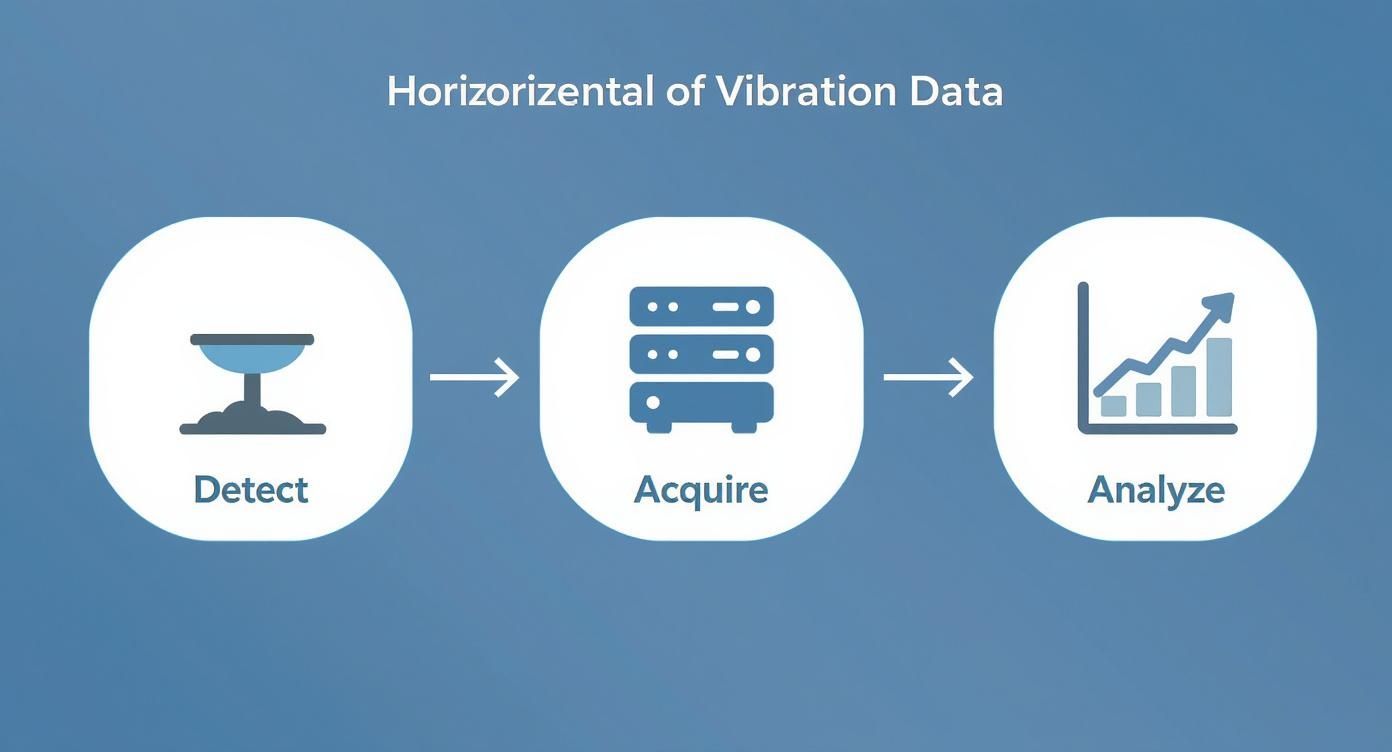
This workflow is designed to turn raw physical movements into clear data that site managers can use to make smart decisions, often in real-time, preventing minor exceedances from becoming major problems.
Choosing the Right Monitoring Approach
Not every project needs the same level of scrutiny. The monitoring strategy is always tailored to the project's scale, duration, and how close it is to sensitive neighbours. There are really two main ways to go about it:
- Continuous Monitoring: This is the go-to for long-term projects like major demolitions, tunnelling, or high-rise construction. The sensors stay on 24/7, feeding data to a cloud platform. If vibration limits are ever breached, it triggers instant alerts. It’s the best way to ensure total protection and accountability over months or even years.
- Spot-Checks (Attended Monitoring): For shorter, high-impact tasks—like a single day of rock breaking or pile driving—an expert might just come to the site. They’ll use portable equipment to measure vibrations only during that specific activity, making sure it stays within the rules. This is a cost-effective solution for brief but intense work phases.
Interpreting the Data and Reporting
All this data is useless until someone makes sense of it. This is the final, and most critical, piece of the puzzle. While the system collects a mountain of information, the key metric everyone focuses on is Peak Particle Velocity (PPV). In simple terms, this measures the maximum speed at which a particle of ground is moving. It's the industry-standard indicator for assessing the potential for structural damage.
Experts analyse the PPV data, comparing it directly against the limits set by standards like DIN 4150-3 or BS 7385-2. They’re constantly checking if any recorded vibrations have nudged past the pre-set thresholds for the specific types of buildings nearby.
Finally, all of this analysis is compiled into a comprehensive report. This document neatly summarises the findings, confirms whether the project stayed compliant, and provides a transparent record of its vibration impact. It’s the ultimate proof that the job was done responsibly, serving as a vital legal and administrative record.
When Construction Vibrations Cause Real Problems
It’s one thing to talk about technical standards and theoretical limits, but it’s another to see what happens when things go wrong on the ground. To truly grasp why proactive vibration monitoring is so vital, let's look at a real-world Australian case where unmanaged construction work led to a massive community backlash and brought a project to a screeching halt. This example serves as a powerful cautionary tale for any developer or construction manager.
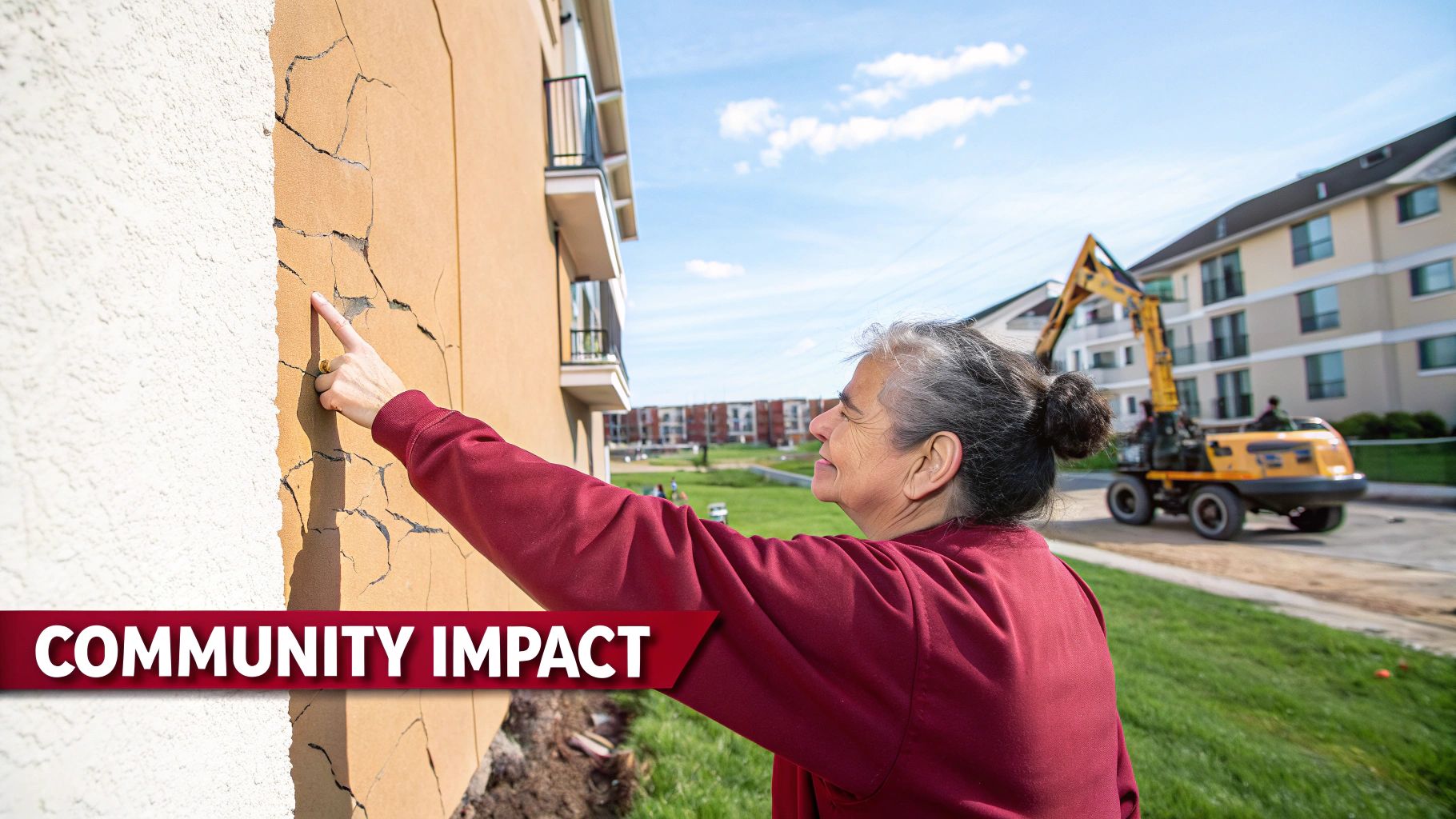
The trouble started in New South Wales during a project that used deep vibro-compaction—a ground improvement method notorious for creating intense, low-frequency vibrations. As the work got underway, the local council was suddenly inundated with complaints from residents in over 750 nearby apartments, all deeply concerned about the structural integrity of their homes.
This situation is a perfect lesson in what can happen when the potential for vibration-related issues is ignored. It shows just how quickly a standard construction job can escalate into a full-blown public relations disaster, turning a promising development into a source of widespread community anger and mistrust.
The Community Backlash and Developer Response
The residents' fears were entirely justified. They described visible shaking and audible rattling inside their homes, which understandably caused widespread anxiety about long-term property damage. It wasn't long before these concerns snowballed into formal complaints, putting the project, the developer, and the council under a microscope. The situation quickly moved from a technical issue to a highly public and emotional conflict.
The construction company was forced to respond to the mounting pressure. After residents from at least 750 apartments complained about building damage, the company had to organise detailed vibration assessments inside the homes. The investigation found that intermittent, heavy plate dropping had indeed caused cosmetic interior damage. This discovery led to a formal council intervention and a stop-work notice. You can dive deeper into this case and similar actions in the NSW EPA's vibration guide.
Of course, this reactive approach—scrambling to fix a problem after the damage was done—was far more expensive and disruptive than proactive monitoring would have ever been. The costs included not just repairs, but also legal fees, consultant reports, and the immense financial impact of project delays.
Financial, Legal, and Reputational Fallout
The fallout from this oversight was severe and hit on multiple fronts. The council's stop-work notice triggered immediate and costly project delays, throwing timelines and budgets completely out the window. On top of that, the developer was now on the hook for damage assessments, repairs to the affected apartments, and the looming threat of legal action from residents.
This case study is a compelling reminder that effective vibration management is not just an operational expense—it's a critical investment in project viability, risk mitigation, and community trust.
The reputational damage was just as bad. The negative press and loss of trust within the community created lasting problems for the developer. It’s also worth remembering that the risk of vibration damage is especially high for older, historic structures, which is why bringing in expert historic preservation architects is crucial when working in dense urban areas.
Ultimately, this incident highlights a critical point: the physical vibrations are only half the story. Human perception and the impact on people’s well-being are just as important. For a closer look at this, our guide on conducting a whole-body vibration assessment explains how these forces affect people. Ignoring the human side of environmental vibration can turn a manageable technical challenge into a major crisis.
Your Top Vibration Testing Questions, Answered
If you’re managing a project or simply living near one, you've probably got questions about environmental vibration. It’s a field filled with technical terms, but the core concepts are pretty straightforward. Let's break down some of the most common questions I get asked, providing clear answers to help you navigate this important topic.
Getting your head around these fundamentals is key to running a project that is not only compliant but also a good neighbour, fostering trust and minimising friction with the surrounding community.
What's the Difference Between Structural and Human Comfort Vibration?
This is probably the most common point of confusion, and it’s a crucial one. Think of it this way: the vibrations that might crack a wall are completely different from the ones that just annoy the people living inside that wall. They come from the same source, like a piling rig, but we measure and manage them differently because they affect entirely different things.
Structural vibration is all about the building itself. We're talking about ground movements that could potentially cause physical damage – anything from a hairline plaster crack to something more serious. This is a purely technical, engineering concern. We measure it against standards like DIN 4150-3 to make absolutely sure the building’s integrity isn't at risk.
Human comfort vibration, on the other hand, is all about perception. It’s about how people feel the vibrations. A building can be 100% structurally sound, but if the floor is constantly rattling, it can be incredibly disruptive and stressful for the occupants. This can lead to health complaints, loss of productivity in offices, and a general decline in quality of life for residents.
The fascinating thing is that the level of vibration that makes a person complain is far, far lower than the level needed to cause even the smallest crack. A vibration that poses zero risk to a building might be completely unbearable for the community, leading to complaints and stopping work on site.
That’s why we have separate standards, like AS 2670.1, to manage the human side of the equation. A good vibration management plan has to address both, acknowledging that a project's social license to operate is just as important as its building permits.
How Are Safe Vibration Limits Determined for a Project?
Safe vibration limits aren't just plucked from a textbook. Every single project gets its own specific limits, which are carefully calculated based on a unique risk profile. It's a process that involves blending three critical ingredients to create a tailored, site-specific plan.
First, we start with the Australian and international standards. These documents give us the baseline, the foundational numbers for different kinds of buildings. An old heritage-listed home will have a much lower threshold than a modern industrial warehouse, for example. This grounds everything in proven engineering practice and provides a defensible starting point.
Second, a thorough pre-construction survey is non-negotiable. This isn't just about taking photos of existing cracks. We also need to measure the existing background vibrations. What's the normal 'rumble' from traffic or nearby trains? This baseline data is essential so we can tell the difference between our project's vibrations and the everyday noise of the neighbourhood.
Finally, we look at the specifics of the site and the work itself.
- Sensitive Neighbours: Is the project next to a hospital with delicate surgical equipment, a data centre, or a historic building? If so, the limits will be set to their most conservative levels.
- Ground Conditions: Vibration travels very differently through sand than it does through solid rock. The local geology can completely change the game, requiring us to adjust the limits accordingly.
- Proposed Methods: Rock breaking and pile driving create far more intense vibrations than other, less forceful activities. The work plan directly influences the limits we set.
By combining these three elements—standards, baseline data, and site specifics—we can establish vibration limits that are realistic, protective, and, importantly, legally defensible.
What Happens When Vibration Levels Exceed the Limit?
Modern vibration monitoring is all about being proactive. The goal isn't to document damage after it’s happened; it's to prevent it from happening in the first place. When a vibration level goes over the limit, a clear and immediate chain of events kicks in, driven by real-time technology.
The moment a sensor detects a reading over the threshold, it automatically fires off an alert—usually an SMS or an email—to the site manager and other key people. This isn't a report they'll read tomorrow morning; it's a real-time alarm that demands immediate action.
On-site, the response is swift. The first step is to immediately change or stop whatever activity is causing the spike. That might mean pausing a roller for a few minutes or switching to a different, lower-impact tool. The aim is to get the vibration back under control instantly, before it can cause any harm or lead to complaints.
From there, the team investigates why the breach happened and puts a corrective plan in place. Maybe they need to use different equipment, shift that type of work to a less sensitive time of day, or even install physical damping barriers. The whole system is designed to give site managers the power to stop a small problem from becoming a big one, keeping the project compliant and the community happy.
At Anitech Ltd Pty, we live and breathe occupational hygiene. Our team provides comprehensive environmental vibration testing to ensure your project isn't just compliant, but a success. We're here to help you protect both your structures and your reputation.
To see how we can support your next project, visit us at https://occhygiene.com.au.


