
Environmental vibration monitoring is the essential practice of measuring the energy that travels through the ground from sources like construction, heavy traffic, or blasting. It serves as a crucial practice for preventing damage to nearby buildings and ensuring people aren't negatively affected. You can think of it as a sophisticated early warning system, helping to make sure that those invisible tremors don't cause expensive structural problems or disrupt sensitive operations down the line. It's a proactive step that’s absolutely essential for responsible development, especially in our busy urban and industrial areas where the margin for error is increasingly small.
The Unseen Force Protecting Our Structures
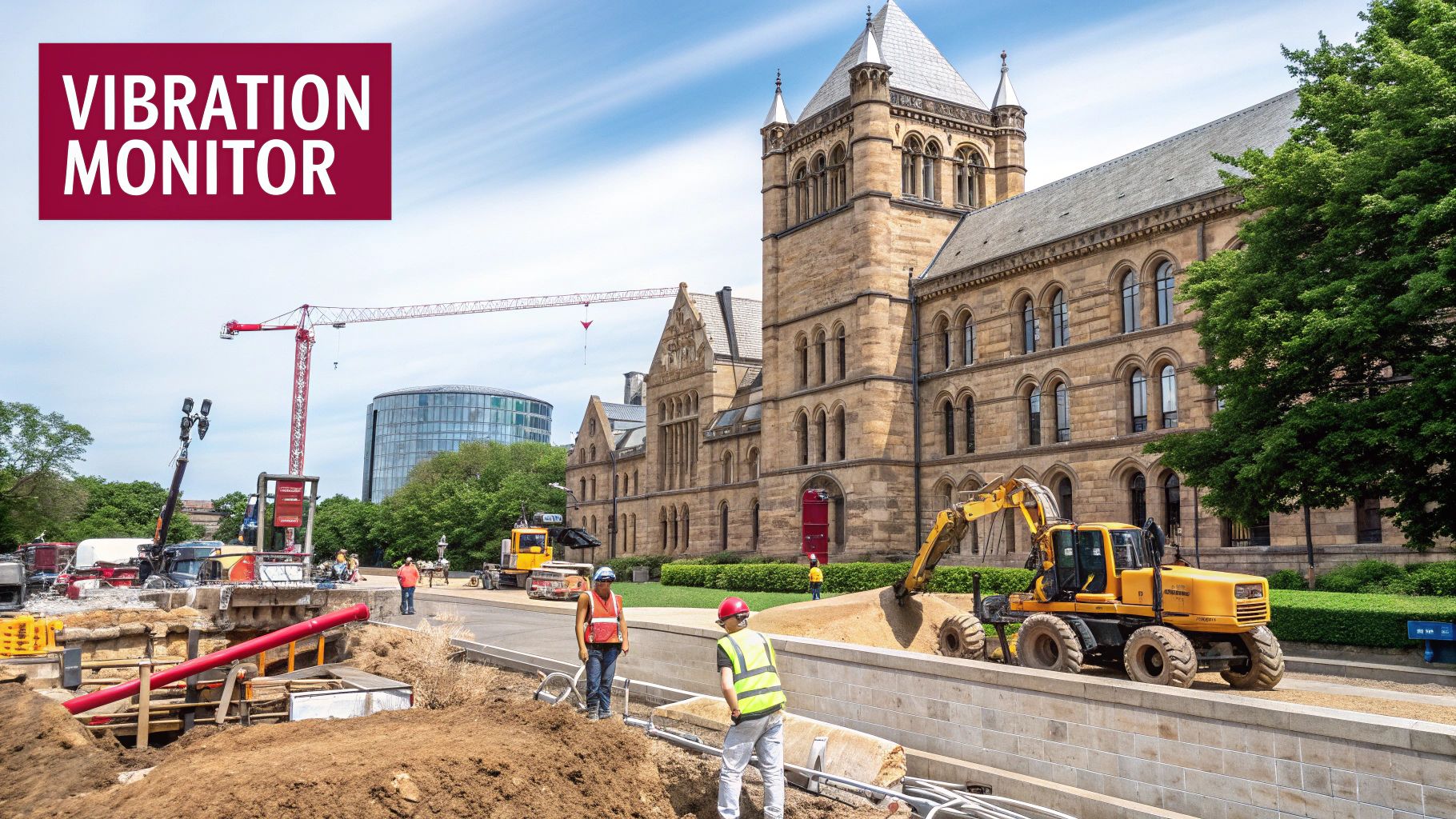
Picture this: a major construction project kicks off right next to a heritage-listed building or a high-tech hospital. The sheer energy from pile driving or heavy machinery moves through the ground in invisible waves. You might only feel a slight rumble, but the real worry is the cumulative effect these vibrations can have on structures that were never designed to handle them. This is exactly where environmental vibration monitoring becomes indispensable.
It works a bit like a specialised seismograph, constantly listening to the ground. But instead of detecting earthquakes, it picks up on the subtle, man-made tremors that could threaten a building's integrity, upset sensitive equipment, or just be a nuisance to people nearby. Without this oversight, a project could inadvertently cause thousands of dollars in damage—from small cosmetic cracks in a home to the catastrophic failure of a delicate manufacturing process. This diligent monitoring is a fundamental component of modern project management and risk mitigation.
Why Monitoring Ground Vibrations Matters
The importance of measuring these ground-borne vibrations goes well beyond just preventing a few cracks. It's a cornerstone of modern risk management and good community relations, giving teams the hard data they need to operate more safely. Ultimately, the information gathered helps protect valuable assets, ensure compliance with regulations, and maintain public trust. The data provides a clear, objective record of a project's impact, which is invaluable for demonstrating due diligence and responsible stewardship of the local environment.
Several key groups rely heavily on this data:
- Construction Managers: They use real-time alerts to adjust activities on site. This ensures they’re working within safe, allowable limits and not damaging neighbouring properties. This proactive approach can prevent costly stop-work orders and maintain project timelines.
- Engineers and Geotechnical Experts: The data is vital for them to assess how a structure is reacting to outside forces and to double-check that ground conditions are stable. It helps validate their predictive models and make informed decisions.
- Government Regulators: Authorities use monitoring reports to enforce environmental and building codes, which keeps the public safe and holds operators accountable. Comprehensive data logs are essential for demonstrating compliance.
- Community Stakeholders: For nearby residents and business owners, it provides peace of mind that a project is being managed responsibly to keep disruption to a minimum. Transparent reporting builds trust and mitigates potential complaints.
It's More Than Just Buildings
The need for environmental vibration monitoring isn't just about protecting old landmarks or residential houses. Lots of modern facilities have equipment that is incredibly sensitive to the smallest of movements. A data centre, for instance, depends on perfectly stable hard drives; too much vibration can lead to data corruption or outright hardware failure.
In a hospital, precise medical imaging equipment like MRI machines or delicate laboratory instruments can be thrown off by nearby construction vibrations, which can have a direct impact on patient care. This makes monitoring a non-negotiable part of any work carried out near such sensitive facilities.
At the end of the day, this systematic measurement is all about being proactive. It gives us the objective data we need to balance the push for progress with our responsibility to protect the built environment and the wellbeing of the people in it. By understanding and controlling these unseen forces, we can build a safer, more sustainable future across Australia.
Key Sources and Impacts of Ground Vibrations
Disruptive ground vibrations don't just appear out of thin air; they're the direct result of powerful activities that pump a huge amount of energy into the ground. Figuring out where these vibrations start is the first step to managing their impact. For instance, major structural work like basement lowering with underpinning projects is a classic source of ground shake, making careful monitoring essential to protect the building itself and any neighbouring properties.
To really get a handle on them, we can sort these sources into two main groups based on how they behave over time. This distinction is crucial because the type of vibration dictates the potential for damage and tells us how we should approach measuring it. Each type requires a different monitoring strategy and presents a unique set of risks to the surrounding environment.
Transient or Short-Lived Vibrations
Transient vibrations are sharp, sudden bursts of energy that die down almost as quickly as they appear. Think of them like the flash from a camera—incredibly intense for a split second, and then it's over. While they might be brief, their high-energy punch can often be the most destructive, as structures have little time to absorb and dissipate the energy.
You’ll typically find these coming from:
- Construction Piling: Driving massive steel or concrete piles deep into the ground creates powerful, short-lived shockwaves that ripple outwards.
- Blasting: Used everywhere from mining and quarrying to large-scale civil excavations, blasting unleashes an immense amount of energy in a fraction of a second.
- Heavy Object Drops: An accidental (or sometimes intentional) drop of heavy materials on a worksite can send a sharp, jarring jolt through the ground.
These events are measured using what's known as Peak Particle Velocity (PPV)—a key metric we use to figure out the potential for structural damage.
Continuous or Ongoing Vibrations
On the other end of the spectrum, you have continuous vibrations. These are more like a constant hum or a persistent drone. They might have a lower intensity than a big, one-off event, but their relentless nature brings a different set of problems, including structural fatigue and plain old human annoyance. Over time, this constant stress can be just as damaging as a single, large impact.
Sources of continuous vibration are often just part of the everyday environment:
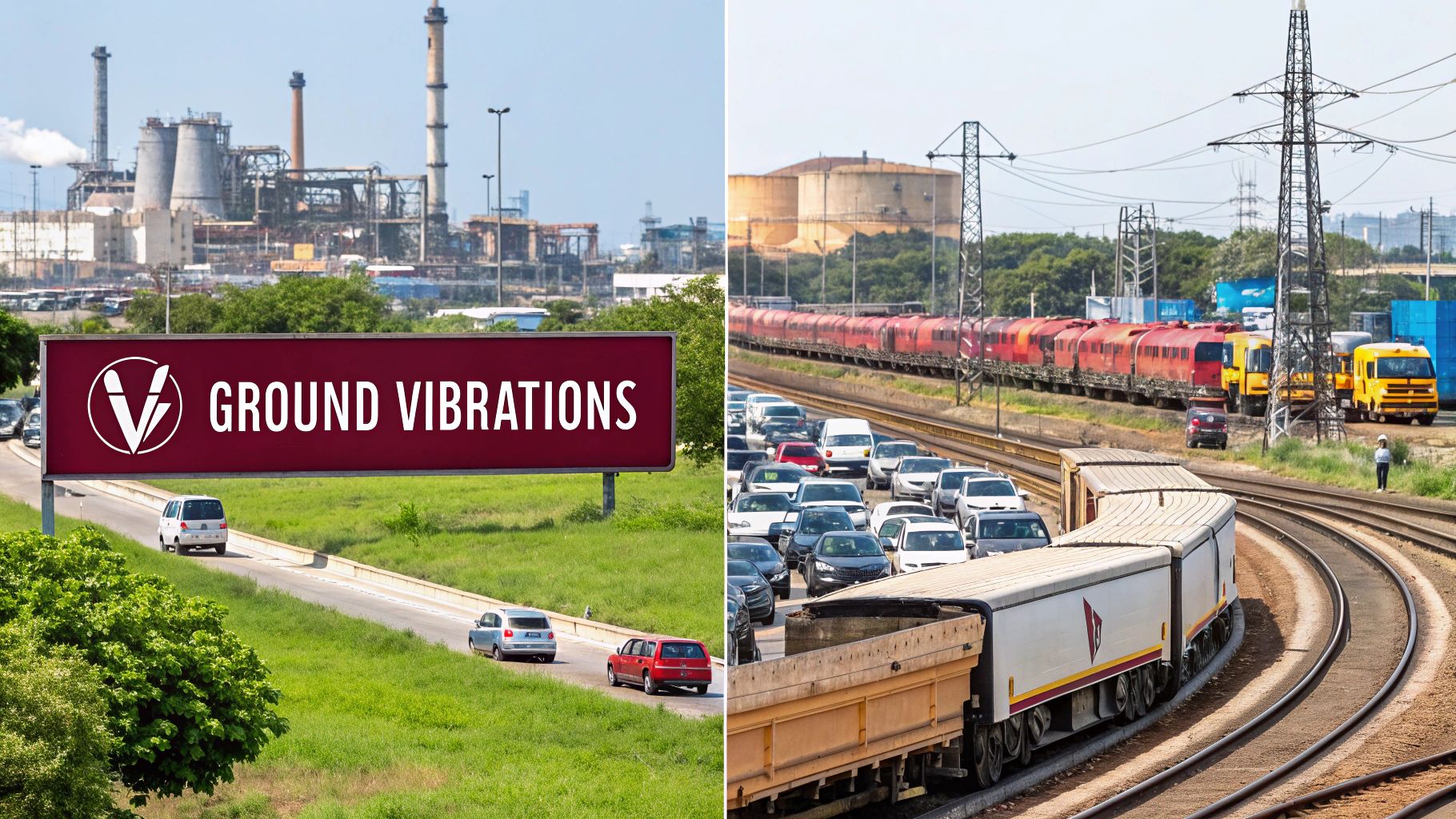
- Heavy Traffic: The endless stream of trucks and buses on busy roads creates a steady, low-level vibration.
- Railways: Trains produce rhythmic vibrations that can travel surprisingly long distances, affecting buildings near the tracks.
- Industrial Machinery: Large-scale equipment in factories—think generators, pumps, and heavy presses—can run for hours on end, transmitting a constant vibratory frequency into their foundations and the surrounding ground.
The real danger with any ground vibration isn't just a single event. It's the cumulative effect. A building might withstand one jolt, but repeated, unchecked vibrations can slowly weaken its foundation, leading to cracks, settlement, and long-term structural integrity issues.
The Real-World Consequences of Unchecked Vibrations
The fallout from ground vibrations goes far beyond a few cracked walls. The consequences can be serious and incredibly expensive, affecting everything from buildings and sensitive equipment to people's health and wellbeing. Understanding these potential impacts is key to appreciating the value of a robust monitoring program.
Structural Damage
This is the most obvious risk. Vibrations can cause cosmetic problems like cracked plaster or shattered windows. But much more seriously, they can lead to foundational shifts, compromise the integrity of load-bearing walls, and even damage underground utilities like gas and water pipes. Heritage-listed buildings, with their often delicate and irreplaceable masonry, are particularly vulnerable.
Operational Failures
Many modern facilities depend on equipment that is extremely sensitive to movement. A nearby data centre, for example, could suffer from read/write errors or even permanent hardware failure if the ground shakes too much. It's the same story for high-precision manufacturing, scientific labs, and medical imaging centres—vibrations can disrupt their operations, leading to costly downtime and unreliable results.
Human Comfort and Wellbeing
The impact on people is a huge, and often overlooked, consequence. Being exposed to constant low-level vibrations can cause serious annoyance, disrupt sleep, and create stress. In an office, it can torpedo concentration and productivity, and for residents, it can drastically reduce their quality of life. For workers, prolonged exposure is a serious health and safety issue; you can find out more about assessing these risks in our guide to whole body vibration assessment.
As Australia's cities and infrastructure continue to grow, the role of noise and vibration monitoring in environmental impact assessments (EIAs) has become more important than ever. Comprehensive monitoring is now a standard part of major projects, tracking vibration from construction, industry, and transport to minimise the impact on people and the environment. Take the Sydney Metro West project, for example—it has a detailed monitoring program in place to ensure all measurements are precise, well-documented, and that any issues can be dealt with before they cause problems. This approach isn't just about ticking a regulatory box; it's about being a good neighbour and protecting assets.
Understanding Australian Regulatory Standards
If you're managing a project in Australia, getting your head around the web of vibration regulations isn't just a good idea—it's a critical part of the job. These aren't loose guidelines; they're strict legal requirements put in place to protect buildings, sensitive equipment, and the people living and working nearby. A solid grasp of this framework is your best defence against hefty fines, project delays, and even legal action.
Australia’s approach to environmental vibration monitoring is often a blend of local council rules and widely accepted international standards. This means that even without a single, all-encompassing national code, projects are still held to a globally recognised benchmark for safety. Fail to comply, and you risk having your project shut down. This regulatory landscape demands careful planning and meticulous record-keeping to ensure full compliance at every stage of a project.
The Go-To Standard: DIN 4150-3
While Australia has its own set of standards for many aspects of construction, one of the most frequently referenced for structural vibration is the German standard, DIN 4150-3 "Structural vibration – Part 3: Effects of vibration on structures". It’s become the de-facto guide across Australia because of its practical, evidence-based approach to preventing structural damage.
DIN 4150-3 gives us clear, guideline values for vibration velocity, which is exactly what regulators and project managers need to set firm, measurable limits. It smartly categorises structures based on how sensitive they are, recognising that a one-size-fits-all approach just doesn't work.
Think of it this way: a modern, steel-reinforced warehouse can handle a lot more shaking than a 150-year-old heritage-listed sandstone church. The standard reflects this common sense by setting much tighter, more conservative limits for historically significant or delicate buildings.
This practical approach allows for realistic planning while keeping everything safe. Knowing these categories is essential because they directly dictate the vibration limits your project has to work within.
To give you a clearer picture, here's a simplified look at the kind of guideline values found in DIN 4150-3, which are commonly applied on Australian sites to prevent structural damage from short-term vibrations.
Common Vibration Velocity Limits (DIN 4150-3)
| Structure Type | Guideline PPV at Foundation (mm/s) |
|---|---|
| Industrial & Commercial Buildings | 20 – 40 |
| Dwellings & Residential Buildings | 5 – 15 |
| Structures Sensitive to Vibration | 3 – 8 |
| Heritage or Historically Significant Structures | 2 – 4 |
These values give you a starting point. The exact limits for your project will always be determined by a specific assessment, but this table shows how the standard differentiates between building types.
Key Metrics Regulators Focus On
When a regulator checks your compliance, they’re looking for hard data. The single most important metric for structural vibration is Peak Particle Velocity (PPV), measured in millimetres per second (mm/s). It's the maximum speed of a tiny particle of ground as a vibration wave passes through it—the industry standard for gauging the risk of structural damage.
Here's what they'll be looking for:
- Staying Within Limits: Is your recorded PPV consistently below the guideline values set out in DIN 4150-3 or your project-specific plan?
- A Complete Data Log: They want to see a full history from continuous monitoring, not just a few spot checks. This provides a transparent record of all site activities and their vibration impact.
- A Clear Response Plan: What happens when a limit is nearly breached or exceeded? Having a documented plan for immediate action is a non-negotiable part of any solid monitoring strategy.
Seeing Compliance in Action
The need for strict adherence to these standards is especially clear in Australia's dense urban centres. For instance, DIN 4150-3 suggests that ongoing vibrations shouldn't typically exceed 10 mm/s for industrial buildings. On a real project, the Western Harbour Tunnel Stage 3A in Sydney recorded average vibrations at a nearby home between 0.25 mm/s and 0.37 mm/s. This was well below the project’s strict 7.5 mm/s limit, as detailed in an analysis of Australian standards for structural vibration. This kind of transparent monitoring is vital for proving compliance and maintaining trust with the community.
Ultimately, these regulations are tied directly to your broader safety duties. A safe worksite means more than protecting your own team; it's about protecting the surrounding community and environment from the impacts of your work. For a deeper dive into these obligations, you can explore the basics outlined in the official Australian workplace safety standards. By building regulatory compliance into the heart of your project planning, you're not just meeting a legal requirement—you're demonstrating a genuine commitment to corporate responsibility.
Selecting the Right Monitoring Equipment
Choosing the right gear for environmental vibration monitoring is absolutely crucial for getting accurate, reliable data. Think of the equipment as your project’s nervous system—it's what feels the subtle ground movements and turns them into information you can actually use. Get this choice wrong, and you could end up with missed events, a string of false alarms, or data that just won't hold up if regulators come knocking.
Remember, the entire system is only as strong as its weakest link. Picking components that are genuinely fit-for-purpose isn't just a technical box to tick; it's a fundamental part of managing your project's risk. Your decision should always be driven by the specific needs of your site, like how long you'll be monitoring, your budget, and any unique environmental challenges you're up against. The investment in high-quality equipment pays for itself through data accuracy and long-term reliability.

Core Components of a Monitoring System
At the heart of any monitoring setup, you have the sensors doing the actual "listening." From there, a few other key pieces of hardware work together to log, process, and send the data, creating a complete solution. A typical professional system includes several integrated components designed to work seamlessly together.
- Sensors (Geophones and Accelerometers): These are the workhorses that detect ground movement. Geophones are brilliant for the low-frequency vibrations you typically get from construction, making them the most common choice for compliance monitoring. Accelerometers, on the other hand, are better for higher-frequency events and tend to be used in more specialised situations.
- Data Loggers: This is the brain of the operation. It takes the signals from the sensors, puts a timestamp on them, and stores everything for analysis. Modern loggers are smart enough to process information on the spot, giving you immediate feedback.
- 4G Modems and Connectivity: To get data from the middle of a site to your screen, you need a solid connection. 4G modems are essential for real-time alerts, allowing the system to send an SMS or email straight to the project manager the second a vibration limit is breached.
- Power Supply: For any long-term job, a continuous power source is a must. This is usually handled with solar panels hooked up to rechargeable batteries, which keeps the system running 24/7 without a hiccup, even on remote sites.
Choosing Between Geophones and Accelerometers
Deciding between a geophone and an accelerometer really comes down to what you need to measure. It's a bit like choosing between a microphone designed for deep bass notes and one built for high-pitched treble—they both pick up sound, but each one excels in a different range. Making the right choice is fundamental to collecting meaningful data.
A geophone is your go-to for most environmental vibration monitoring tasks. It's highly sensitive to the low-frequency ground vibrations (usually in the 4.5 Hz to 15 Hz range) caused by things like pile driving, excavation, and heavy trucks. Since Australian regulatory standards like DIN 4150-3 are focused on these lower frequencies, geophones give you exactly the data you need to prove compliance.
An accelerometer is designed for higher-frequency vibrations and acceleration. You’ll see them used more for things like monitoring the health of machinery or in specific scenarios like blasting, where high-frequency impacts are the main concern. For protecting buildings from typical construction work, a geophone is almost always the right tool for the job.
The key takeaway is simple: for monitoring the impact of construction or traffic on nearby buildings and ensuring compliance with Australian standards, a triaxial geophone is the industry-standard tool for the job.
Ensuring Data Reliability
Once you've picked your equipment, proper installation and calibration are completely non-negotiable. You could have the most expensive sensor in the world, but if it's not installed correctly, the data it produces will be useless. The sensor needs to be firmly coupled to the ground or the structure itself to make sure it's measuring the true vibration, not just rattling around.
Regular calibration is just as important. This process verifies that the sensor is measuring accurately against a known, traceable standard. Without those routine checks, you can't be truly confident in your data, which could put you in a very tricky position if you ever need to defend your measurements to regulators or concerned stakeholders. This attention to detail underpins the credibility of your entire monitoring effort.
How to Put Together an Effective Monitoring Plan
To get vibration monitoring right, you need a solid plan. Just plonking a sensor on the ground and hoping for the best simply won’t cut it. A methodical approach is the only way to gather reliable data that will stand up to scrutiny from regulators and keep the community onside. A well-crafted plan is your roadmap to successful and compliant project execution.
This process has to start long before the first piece of machinery rolls onto the site. Your first job is to get to know the site’s existing “vibration personality.” Every location has a unique background hum from things like distant traffic or nearby industry. Capturing this data gives you a clear baseline to measure everything against. This foundational step is critical for distinguishing project-generated vibrations from the pre-existing environment.
Get Your Bearings with a Baseline Survey
A baseline survey is the non-negotiable first step. It involves setting up your equipment for a few days before your project kicks off to record the normal, everyday vibration levels. Think of it as taking a snapshot of the site in its natural state. This data provides the essential context against which all future readings will be judged.
This pre-project data is invaluable. Without it, how can you prove that a vibration spike was caused by your work and not something else? A nearby railway line, for instance, might create regular rumbles that exceed your project’s limits. A proper baseline survey gives you the objective proof you need to distinguish your impact from what was already there.
Strategic Monitor Placement
Once you have a handle on the background noise, it’s time to decide where to place your monitoring stations. This isn’t a guessing game; it’s a strategic decision driven by risk. The aim is to get your sensors in the most sensitive spots where they’ll give you the most meaningful data. The effectiveness of your entire program hinges on placing sensors in the right locations.
Key locations to consider include:
- Nearby Homes: Placing monitors near the foundations of the closest houses is essential for good community relations and heading off nuisance claims.
- Heritage-Listed Buildings: These structures are often fragile and have an extremely low tolerance for vibration, making them a top priority.
- Sensitive Commercial Facilities: This could be anything from a data centre to a hospital with delicate imaging equipment or a lab full of precision instruments.
- Underground Utilities: Positioning sensors near critical infrastructure like gas mains or water pipes helps prevent costly and dangerous damage.
Getting professional advice on placement is often a smart move. After all, a well-placed sensor is the bedrock of a reliable monitoring plan. For more complex projects, getting an expert opinion from an occupational hygiene consulting team can make all the difference in spotting potential risks and sensitive locations.
Setting Up Smart Trigger Levels
With your sensors in place, the next step is to program them with intelligent trigger levels. These are pre-set vibration thresholds that, when crossed, automatically fire off alerts to key people on your team. It’s a good idea to set up multiple levels to create a proactive warning system. This automated system transforms monitoring from a passive activity into an active risk management tool.
A common approach is to set a lower "amber" alert at around 75% of the official limit. This acts as an early warning, giving site managers a chance to change what they’re doing before they breach compliance. A "red" alert is then set right at the regulatory limit, triggering an immediate stop-work order if necessary.
This tiered system turns your monitoring from a passive data-gathering exercise into an active risk management tool.
Managing and Reporting the Data
Finally, a strong plan needs to cover how you’ll manage and report all the data you collect. The information needs to be stored securely but remain easily accessible. Modern systems often use cloud platforms, allowing project managers to check real-time data and pull reports from anywhere. When integrating this data with other building parameters, the principles behind IoT Building Automation systems offer a useful model for creating a comprehensive overview.
Your reporting needs to be clear, concise, and tailored to the audience. A report for a regulator will be highly technical, focusing on compliance with standards like DIN 4150-3. A community update, on the other hand, should be simple and visual, clearly showing that vibrations have been kept well within safe and acceptable levels.
Common Questions About Vibration Monitoring
Even with the best-laid plans, questions always pop up during a vibration monitoring program. Getting these common queries sorted helps everyone—from site managers to the local community—feel confident in the process. Here are some of the most frequently asked questions, with straightforward, practical answers to demystify this important field.
First, let's look at the foundational three-step process for setting up a solid monitoring plan. This structured approach ensures that all key considerations are addressed from the outset, leading to a more robust and defensible monitoring program.
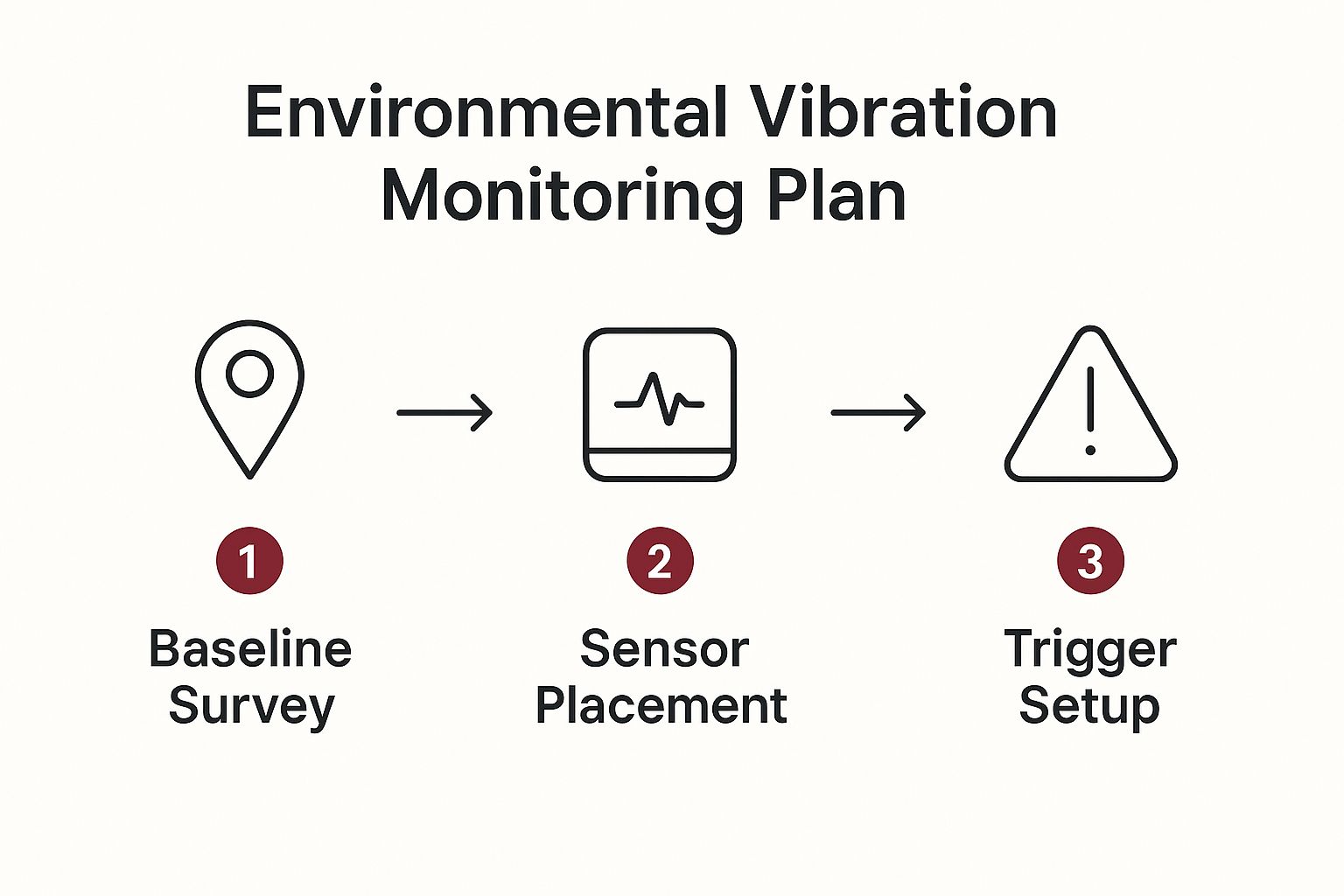
As you can see, a successful program starts with a baseline survey, moves to strategic sensor placement, and is rounded out by setting up automated trigger alerts. This systematic process is the key to effective environmental vibration management.
What Is the Difference Between Machine and Environmental Monitoring?
This is a common point of confusion. While both use similar sensor technology, what they're looking for and why they're looking for it are completely different. They are two distinct disciplines with fundamentally different goals, and it's important not to confuse them.
Think of machine vibration monitoring as a doctor checking a patient's heartbeat. It’s focused inward, listening to the high-frequency vibrations of a specific pump, engine, or piece of machinery. The whole point is predictive maintenance—catching early signs of wear and tear to prevent a catastrophic and expensive failure down the line.
Environmental vibration monitoring, on the other hand, looks outward. It’s all about measuring the low-frequency vibrations that travel from a source, through the ground, and into the surrounding neighbourhood. It’s less like a doctor and more like a neighbourhood watch, making sure that what you’re doing on your site doesn’t disturb or damage your neighbours. One protects the asset; the other protects the community.
How Are Vibration Limits for a Project Determined?
Vibration limits aren't just numbers picked at random. They are carefully worked out through a multi-step process that balances the need to get the job done with regulatory compliance and community safety. This is a critical assessment that should be conducted by qualified professionals.
Here’s how it generally breaks down:
- Regulatory Standards: The process starts with established guidelines. In Australia, the German standard DIN 4150-3 is the go-to reference, providing proven vibration values for different types of structures.
- Structural Assessment: Next, you look at the specific buildings you need to protect. A delicate, heritage-listed sandstone building will have a much lower tolerance for vibration than a modern, steel-framed office block. Its limit will be far stricter.
- Baseline Survey: This step is crucial. We measure the existing ambient vibration levels before any work starts. This tells us what’s ‘normal’ for the area, so we can clearly distinguish project-related vibrations from everyday background rumbles.
These three elements are then brought together in a project-specific Vibration Management Plan. This document sets the official trigger levels, which are almost always set conservatively below the actual damage threshold to build in a safety buffer and an early warning system.
Can Weather Affect Vibration Monitoring Results?
It's a great question, and the short answer is yes, but usually not by much. Weather can certainly have an influence, but it's typically minor compared to major sources like construction. However, understanding these potential influences is part of comprehensive data analysis.
For instance, strong winds can cause tall buildings to sway, sending subtle, low-frequency vibrations down into their foundations and the ground nearby. Heavy or extended rainfall can also change how vibration travels. When soil becomes saturated, its density changes, which can sometimes help vibration waves move more easily and over greater distances.
But it’s important to keep this in perspective. The vibrations from a windy day are a drop in the ocean compared to the energy from pile driving or rock breaking. Still, it’s best practice to log weather conditions alongside vibration data. That way, if an unusual spike pops up, the weather log is one of the first things you can check to help explain it or rule it out.
What Happens When a Vibration Limit Is Exceeded?
Breaching a vibration limit is a big deal, and it sets off an immediate, pre-planned response. Modern monitoring systems are designed to make this response as fast and effective as possible to minimise any risk. This rapid response protocol is a cornerstone of any effective vibration management plan.
The moment a trigger level is crossed, a clear chain of events kicks off:
- Automated Alerts: The system instantly fires off SMS and email notifications to key people, like the site supervisor and project manager. No delay.
- Immediate Cessation of Work: Standard procedure is to stop the activity causing the vibration right away. This prevents any further issues.
- Investigation and Verification: The team then investigates the reading to understand what happened. Was it a specific machine? A particular technique? The data is analysed to pinpoint the source.
- Corrective Action: Once the cause is found, a solution is put in place. This might mean changing an equipment setting, using a different construction method, or switching to a lower-impact tool for that part of the job.
- Documentation: The entire event, from the alert to the fix, is thoroughly documented. This report is vital for compliance and shows that the issue was handled responsibly.
This structured response ensures a one-off event doesn't become a recurring problem, keeping the project and its surroundings safe.
At Anitech Ltd Pty, we provide expert occupational hygiene services across Australia to help you manage workplace and environmental risks effectively. Our team offers specialised support in developing and implementing robust environmental vibration monitoring plans to ensure your projects are safe, compliant, and community-focused. Learn more about how we can support your health and safety goals at https://occhygiene.com.au.


