
Environmental noise measurement is the science of quantifying the sounds present in our communities. It's about much more than just determining how loud something is; it involves a detailed investigation into the character of the sound, its duration, and its origin—whether that's from bustling traffic, a nearby factory, or a new construction site. This comprehensive process is essential for understanding how these sounds impact public health, well-being, and our overall quality of life. The data gathered allows us to manage noise pollution effectively, creating more harmonious living and working environments for everyone.
Why Measuring Environmental Noise Is Like a Community Health Check
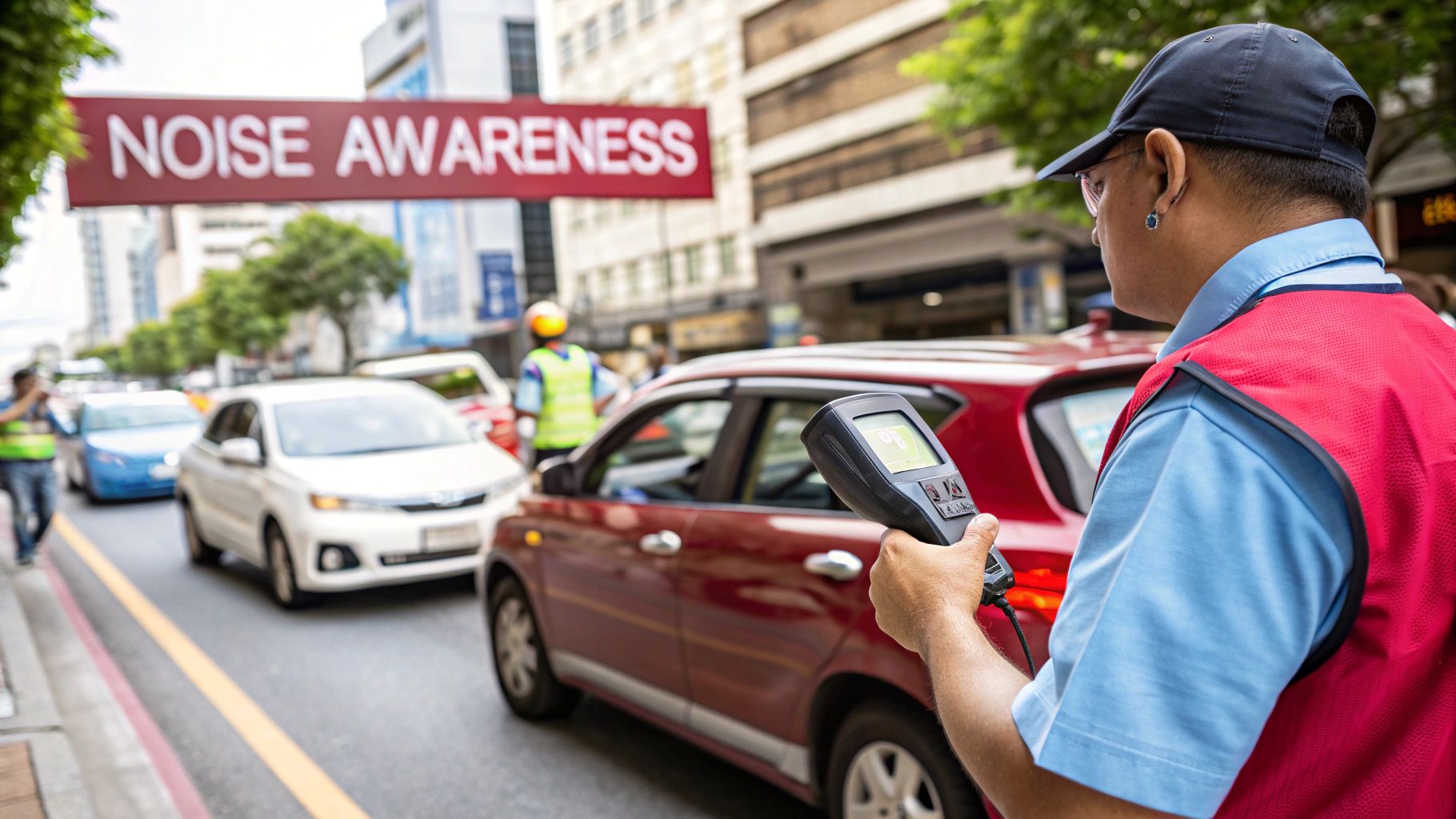
Think of an acoustic consultant as a doctor for a community's soundscape. A doctor uses a stethoscope to check your heart, while an acoustic professional uses specialised gear to diagnose the health of a local environment's sound. This 'health check' isn't about creating total silence—a dead-quiet city would feel strange and lifeless. The real goal is to pinpoint and manage noise that is genuinely harmful.
This work gives us objective data to answer really important questions. Is the continuous drone from that new factory keeping residents awake at night? Will the noise from a planned motorway ruin the peace of a quiet suburban neighbourhood? You can't answer these questions with just opinions. You need hard, defensible data that only professional environmental noise measurement can provide.
The Core Purpose of Noise Measurement
At its heart, the main goal is to protect our well-being by making sure sounds from all sorts of sources stay within acceptable limits. We know that being exposed to high noise levels over time is linked to serious health problems, from stress and poor sleep right through to cardiovascular issues.
Effective noise measurement plays a few critical roles:
- Regulatory Compliance: It’s about making sure new developments and existing industries are playing by the rules set by local councils and state EPAs, like those in New South Wales or Victoria.
- Urban Planning: The data helps planners make smarter choices, like where to place schools and hospitals so they’re not next to major noise sources, or how to design effective sound barriers along highways.
- Complaint Resolution: When a resident lodges a noise complaint, objective measurements provide the solid evidence needed to confirm the issue and find a fair solution.
- Protecting Amenity: This process helps preserve the unique acoustic feel of an area, whether that’s the quiet calm of a park or the expected ambient hum of a busy commercial street.
Establishing a Baseline for a Quieter Future
Before the first shovel hits the ground on any new project—whether it's an apartment block, a concert venue, or an industrial plant—it's vital to understand the existing acoustic environment. This initial survey is all about establishing a "baseline" noise level.
A baseline noise survey acts as a benchmark. It captures the typical sound profile of an area before any changes occur, making it possible to accurately predict and later measure the noise impact of a new development.
For example, imagine a developer wants to build apartments near a busy road. A baseline measurement will tell them exactly how loud the traffic noise is right now. That data is then used to design the building properly—with the right insulation, window glazing, and layout—to make sure the people who eventually live there have a comfortable and quiet home.
In the end, environmental noise measurement gives us the foundational data we need to build healthier, more liveable communities. It turns the subjective experience of "it's too loud!" into objective facts, allowing regulators, planners, and developers to work together to manage noise pollution. Without it, we’d just be guessing.
Understanding Key Noise Assessment Metrics
Diving into the world of environmental noise measurement can feel a bit like learning a new language, full of acronyms and technical jargon. But once you get a handle on a few key concepts, the data starts to tell a really clear story about an area's soundscape. Each metric is just a different tool, designed to measure a specific part of the noise puzzle.
Think of it like describing the weather. Just saying "it's 20 degrees" doesn't tell you if it's sunny, windy, or raining. To get the full picture of the acoustic environment, we need a set of different metrics that work together.
The Foundation: A-Weighting
Before we get into the specifics, we need to talk about A-weighting. Our ears don't hear all sound frequencies equally. We’re much more sensitive to mid-range frequencies, like human speech, than we are to very low or very high-pitched sounds.
A-weighting is simply a standard filter applied to sound level meter readings that mimics this human response. When you see a metric with an 'A' in it, like LAeq or LA90, it means the measurement has been adjusted to reflect how a person would actually perceive that sound. This makes the data far more useful for assessing things like community annoyance or potential health impacts.
Common Environmental Noise Metrics Explained
To really get to grips with a noise report, you need to understand what each of the common metrics is telling you. They each paint a different part of the picture, from the average hum to the loudest bangs and the quietest lulls.
Here's a quick breakdown of the most common metrics you'll see in Australian environmental assessments.
| Noise Metric | What It Measures | Common Application Example |
|---|---|---|
| LAeq | The average sound energy over a period. It's like a single, steady value representing a fluctuating noise source. | Assessing long-term exposure from consistent sources like a busy road, an industrial plant, or a building's air conditioning. |
| LAmax | The single highest A-weighted sound level recorded. It captures the loudest, sharpest noise events. | Identifying sleep disturbance potential from short, loud events like a train horn at night or a loud bang from construction. |
| LAmin | The quietest A-weighted sound level recorded during the measurement period. | Understanding the lulls or quietest moments in the soundscape, providing a baseline for the minimum noise level. |
| LA90 | The sound level exceeded for 90% of the time. It effectively represents the underlying background or ambient noise. | Establishing the existing background noise level of a community before a new development is approved and built. |
As you can see, you really need all of them together to build a complete and accurate picture of the noise environment.
Breaking Down The Key Metrics
LAeq: The Average Energy Level
The LAeq (A-weighted equivalent continuous sound level) is one of the most fundamental metrics you'll come across. It gives you the average acoustic energy over a set period.
Picture the sound from a distant, busy highway. Even though individual cars cause the noise to constantly fluctuate, the LAeq boils it all down to a single, steady value that represents that constant hum. It effectively smooths out all the peaks and troughs to give you a reliable overall average.
The LAeq is crucial for assessing long-term noise exposure from steady sources like industrial plants, HVAC systems, or constant traffic flow. It provides a reliable benchmark for understanding the general acoustic character of a location over time.
LAmax and LAmin: Capturing the Extremes
The average is a great starting point, but it doesn't tell the whole story. For that, we need to look at the extremes.
-
LAmax: This is the A-weighted maximum sound level. Think of the sharp, sudden sound of a car horn or a loud bang from a construction site. It’s essential for identifying and assessing those intermittent, high-impact noises that can really cause a disturbance.
-
LAmin: On the flip side, this is the A-weighted minimum sound level. It represents the quietest moments, giving you a sense of the lulls in the soundscape.
Together, these two metrics show you the dynamic range of the noise environment—the difference between the loudest events and the quietest background hum. Any comprehensive noise assessment will analyse these peaks to make sure they don’t cause a problem.
LA90: Defining the Background Noise
Finally, we have the LA90, which is arguably one of the most important metrics in environmental assessments. This is the A-weighted sound level that is exceeded for 90% of the measurement time.
What that really means is it filters out the top 10% of louder, short-term noises (like a passing car or a dog barking). The result is a stable and reliable measure of the underlying background noise—the sound that’s always there when everything else has gone quiet.
This concept is central to how regulators assess noise impact. For example, the NSW EPA's method for setting noise limits for a new development relies heavily on first establishing the existing background noise level. The LA90 is the perfect tool for this, as it helps establish a fair baseline for what is considered the 'normal' quiet level for an area, which can differ between daytime, evening, and night. If you want to dive deeper, you can explore the research on NSW noise protocols.
This infographic shows how different sources combine to create the overall environmental noise that these metrics help us understand and manage.
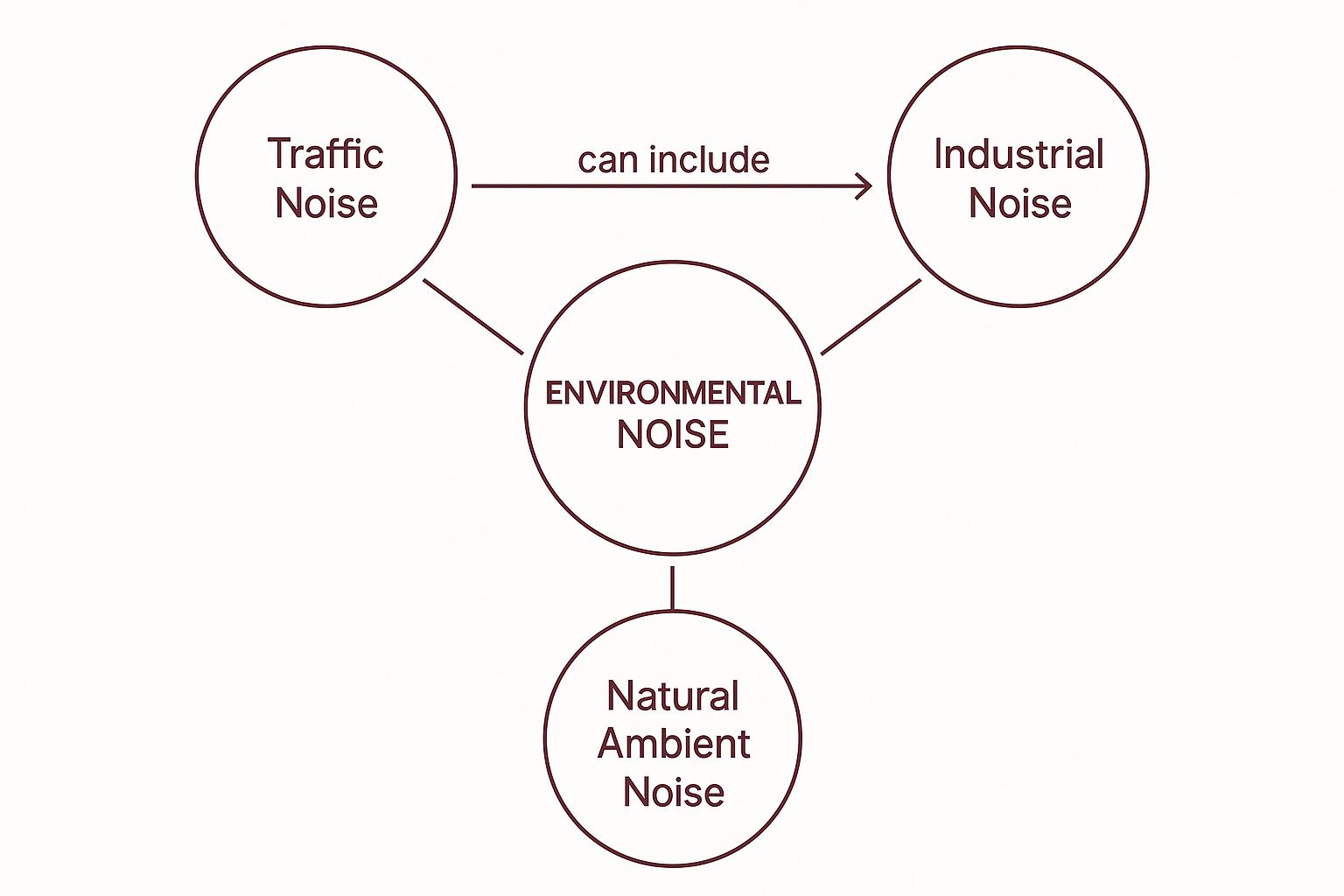
By measuring the specific characteristics of each source, we can better manage the total acoustic environment.
Once you understand these key metrics—LAeq for the average, LAmax for the peaks, and LA90 for the background—you can start to interpret any environmental noise report with confidence. Each one provides a unique piece of the puzzle, and together they create a detailed, data-driven picture of a location's soundscape.
Navigating Australian Noise Standards and Regulations
Getting a handle on the science of environmental noise measurement is one thing, but knowing how to apply it within Australia’s legal framework is another challenge entirely. There isn't a single, national rulebook for noise. Instead, you're dealing with a complex patchwork of state and territory-specific regulations, policies, and guidelines, all designed to protect communities and public health.
This regulatory maze is what gives noise data its real-world power. It means that when an acoustic consultant measures noise for a new housing estate or an industrial plant, their methods are consistent, scientifically valid, and can stand up in court. Without these standards, every noise reading would be subjective, leading to endless disputes and patchy results.
The Role of State Environmental Protection Authorities (EPAs)
In Australia, the job of managing environmental noise falls to state-based Environmental Protection Authorities (EPAs) or similar government bodies. Each state and territory has developed its own set of rules, fine-tuned for its unique mix of city life and industry. What’s acceptable for a mine in regional Western Australia will be completely different from the noise limits for a new apartment block in inner-city Sydney.
These authorities are responsible for a few key things:
- Setting the Rules: They define what noise levels are acceptable for different times of day (day, evening, and night) and for different land use zones, like residential, commercial, or industrial areas.
- Defining the Method: They specify the exact procedures acoustic professionals must follow when conducting an environmental noise measurement survey.
- Enforcing Compliance: EPAs are the ones who investigate noise complaints. They have the authority to issue fines or demand that a business take action to quieten down if they’re breaking the rules.
Because of these state-by-state differences, a noise assessment has to be grounded in the local regulations. A report that ticks all the boxes in Victoria could fall short of the requirements in Queensland.
A Key Example: The NSW Approved Methods
To see how this works in the real world, let's look at a prime example from New South Wales. The NSW EPA created the "Approved Methods for Measurement and Analysis of Environmental Noise," a landmark document that has become the gold standard for all official noise assessments in the state.
Released after extensive public consultation, this document outlines the absolute minimum requirements for measuring and analysing noise. It gets into the nitty-gritty, covering everything from the type of equipment you must use to the qualifications of the person taking the readings and the detailed records they need to keep. This ensures anyone measuring noise under the Protection of the Environment Operations Act 1997 is following the same robust, consistent process.
While the Approved Methods didn't introduce brand new laws, they provided much-needed clarity. That’s why they are now a standard condition written into environment protection licences and development approvals. You can dive into the full details on the EPA's website to see how they’ve lifted the quality of environmental noise data across the board.
The document provides a clear, legally recognised framework, ensuring consistency and reliability in all official environmental noise assessments.
Following these state-specific standards isn't optional. It's the only way to be certain that the data you collect is not only accurate but also legally sound and accepted by the authorities.
At the end of the day, these regulations dictate what happens on the ground. For any project, whether it’s a small café or a massive infrastructure build, the first step is always a deep dive into the relevant state policies. This legal context shapes every part of the survey, from choosing the right gear to writing the final report, and ensures that the entire process of professional noise testing is fair, transparent, and genuinely protects the community.
Choosing the Right Equipment for Your Survey
The quality of your environmental noise data hinges entirely on the quality of your tools. Getting the equipment right isn't just a box-ticking exercise; it's the foundation for accurate, reliable, and legally defensible results. Think of it like a surgeon selecting their instruments – the right tool for the job is non-negotiable.

For any serious survey, your go-to piece of kit will be a sound level meter. But they're not all the same. They fall into two main categories, and knowing the difference is crucial for meeting Australian standards.
Class 1 Versus Class 2 Sound Level Meters
The single biggest equipment decision you'll make is whether to use a Class 1 or a Class 2 sound level meter. While they both measure sound, their precision and what they're built for are worlds apart.
A Class 2 meter is perfectly fine for general-purpose checks. Think initial spot-checks for workplace health and safety or getting a rough idea of noise levels. It provides a decent level of accuracy for basic surveys.
But when the stakes are higher and your assessment is heading for regulatory scrutiny—like an environmental impact statement or a compliance report for the local council or EPA—a Class 1 sound level meter is the only way to go.
A Class 1 meter is a precision, laboratory-grade instrument. It has a wider frequency range and much tighter accuracy tolerances, delivering the level of precision demanded by Australian environmental noise policies. This ensures your data will hold up under legal challenge.
Trying to use a Class 2 meter for a job that requires Class 1 accuracy is a rookie mistake. It can get your entire survey thrown out by regulators, which means a massive waste of time, money, and effort. For any professional environmental noise measurement, a Class 1 meter is the standard.
The Unsung Hero: The Field Calibrator
Even the most expensive sound level meter is worthless if you can't prove its readings are accurate. This is where the humble acoustic field calibrator comes in. This small device produces a highly accurate and stable tone (usually 94 or 114 decibels), allowing you to verify your meter’s performance on the spot.
Standard practice—and a firm requirement under most Australian regulations—is to calibrate your sound level meter both before and after every measurement period. This simple two-step process confirms the instrument hasn't been knocked out of calibration during transport or use, giving you an unbroken chain of confidence in your data.
Essential Accessories for Clean Data
Beyond the meter and calibrator, a professional setup always includes a few other key items. These accessories are all about protecting your gear and, more importantly, preventing your data from being corrupted.
- Windscreens: A good quality foam or caged windscreen is non-negotiable for outdoor work. Wind blowing across a bare microphone creates a rumbling, low-frequency noise that can completely swamp the sound you're trying to measure, making your results useless.
- Tripods: You should always mount the sound level meter on a tripod. This does two things: it puts the microphone at the right height (usually 1.2 to 1.5 metres) and it keeps it away from your body, which can reflect sound and skew the reading.
- Weatherproof Kits: If you're doing long-term, unattended monitoring over several days or weeks, a weatherproof enclosure is vital. It shields the sensitive microphone and electronics from rain, dust, and wild temperature swings, ensuring you get continuous, reliable data no matter the conditions.
Putting together the right combination of a Class 1 meter, a field calibrator, and these essential accessories gives you a robust system for capturing high-quality, defensible environmental noise measurement data.
How to Conduct a Professional Noise Survey
So, we've covered the theory behind noise metrics and the gear you use. But how does this translate to the real world? An effective environmental noise measurement survey isn't just about pointing a microphone and hitting 'record'. It's a disciplined, three-phase process designed to deliver data that’s reliable, representative, and ultimately, defensible. Think of it as building a solid case: first, you plan your strategy, then you gather your evidence on-site, and finally, you verify everything back at the office.
Let's ground this in a common scenario. Imagine a local council needs to figure out the potential noise impact of a new cafe's outdoor seating area on a quiet residential street. Just showing up for an hour with a sound meter won't cut it. To make a fair decision, they need clear, objective data, and that demands a professional approach. Here’s how it’s done.
Phase 1: Meticulous Planning and Preparation
Before anyone even thinks about touching a piece of equipment, the groundwork needs to be laid. This planning stage is all about ensuring the survey captures the right information, at the right times, in the right places. Rushing this is a surefire way to end up with meaningless or flawed results.
First things first, what's the goal? You have to define the objective with absolute clarity. For our cafe example, the aim is to establish the existing background noise levels at the nearest homes. This becomes the baseline—the acoustic benchmark against which the cafe's future noise will be judged.
Next, you need to pick your measurement spots. This is a critical decision.
- Get Close to the Listener: You want to measure where people will actually hear the noise. This means setting up at locations that represent the most affected homes, like at the front facade or in the backyard.
- Dodge Reflections: The microphone should be placed well away from walls or other hard surfaces (unless you're specifically measuring at a building facade). Sound waves bounce, and these reflections can artificially inflate your readings and skew the data.
- Consider the Source: If possible, the measurement spot should have a clear line of sight to where the noise will be coming from—in this case, the cafe's outdoor area. This helps capture a true picture of the potential impact.
Finally, you have to decide how long to measure for. A proper environmental noise measurement often involves leaving a monitor unattended for several days. This is crucial because it captures the natural rhythm of the area's soundscape, including the much quieter evening and nighttime periods. These quieter times are often the most sensitive and are vital for setting appropriate noise limits.
A well-planned survey always anticipates what could go wrong. That means checking the weather forecast to avoid high winds or heavy rain (which can ruin your data) and giving nearby residents a heads-up about the equipment to make sure it isn't disturbed.
Phase 2: Precise On-Site Execution
With a solid plan in hand, it's time to head out to the site. This is where precision is everything. This phase is all about setting up the equipment correctly and gathering the raw data.
The process kicks off with a careful equipment setup. The sound level meter, always fitted with a puffy windscreen to minimise wind noise, is mounted on a tripod. It’s set to a standard height of 1.2 to 1.5 metres off the ground, which is designed to represent the ear height of a typical person.
Now for the most critical step before any measurement begins: calibration.
- A small, handheld device called an acoustic calibrator is fitted snugly over the microphone.
- It produces a pure, reference tone at a known level (often 94 dB). The consultant then adjusts the meter to ensure it reads that exact level.
- This calibration level and the time are logged meticulously. This is a non-negotiable step; without it, the data is essentially worthless.
Once the meter is calibrated and logging, the job isn't done. The consultant needs to keep a detailed field log, noting anything unusual or extraneous noise events during attended periods. This could be anything from a passing siren and a barking dog to a loud conversation nearby—anything that isn't part of the typical ambient sound you're trying to measure. These notes are vital for cleaning up the data later.
Phase 3: Post-Survey Checks and Data Validation
Once the measurement period is over, the final phase is all about ensuring the data you've collected is trustworthy. Just before packing up, the consultant performs a post-measurement calibration check. The calibrator goes back on the microphone, and the meter's reading is recorded one last time.
This final check needs to be incredibly close to the initial one, typically within +/- 0.5 dB. A bigger difference is a red flag. It could signal that the instrument's performance drifted or that there was a fault, potentially invalidating the entire set of measurements.
Back in the office, the data is downloaded for analysis. This is where those on-site notes become invaluable. The consultant will go through the timeline, cross-referencing their log to identify and filter out those extraneous noises. To get a deeper look at how this all comes together, you can find more detail on how a professional noise survey is structured from start to finish. This painstaking process ensures that the final numbers—like the Lₐ₉₀ background noise level—are a true and accurate reflection of the area's genuine acoustic character, giving you a rock-solid foundation for any noise impact assessment.
From Raw Numbers to a Clear Story: Analysing Data and Reporting Your Findings
You’ve spent days, maybe even weeks, collecting a mountain of noise data. It’s a huge milestone, but the job’s only half-done. The real magic happens now, turning those raw decibel readings into a clear, compelling story that people can actually use. This is where we transform complex data into actionable insights that guide critical decisions on everything from regulatory compliance to community wellbeing.
The first step is a bit like quality control. We need to process the data, which really means cleaning it up and filtering out all the irrelevant sounds that got captured along the way.
Sifting Out the "Noise" from Your Noise Data
During any measurement survey, especially one that runs for a long time, the microphone is going to pick up sounds that have nothing to do with the typical ambient environment. We call these extraneous events, and if you leave them in, they can seriously throw off your results.
What do these look like? Think of things like:
- A sudden, sharp sound like a nearby car horn or an ambulance siren.
- A bird chirping right next to the microphone or a dog barking its head off.
- Someone having a loud conversation as they walk past the equipment.
- Weather interference, like a gust of wind rattling the microphone or the drumming of heavy rain.
Getting rid of these is a meticulous but absolutely crucial task. This is where those detailed field notes come in handy. An acoustic professional will go through the data timeline, cross-referencing their notes to pinpoint and remove these spikes. It's the only way to ensure the final metrics, like the LA90 background noise level, give a true picture of the location’s actual soundscape. Once the data is clean, applying proven methods is key, and you can explore these data analysis best practices for more in-depth guidance.
Putting Your Data into Context: The Regulatory Check
With clean, processed data in hand, the next vital step is to see how it stacks up against the limits set by local councils or state EPAs. This is the moment of truth where your measurements meet real-world compliance. For example, you might be comparing the measured LAeq from a new industrial site against the daytime noise criteria in the local environmental plan.
This comparison is what gives the numbers meaning. We know that environmental noise, particularly from traffic, is a big issue in Australian cities. In fact, research shows that in major urban centres, between 8% and 20% of homes are exposed to road traffic noise levels over 63 dB LA10,18h. Having this kind of detailed analysis helps authorities pinpoint problem areas and protect public health.
Crafting a Professional Acoustic Report
The final piece of the puzzle is the acoustic report. This document brings everything together in a structured, easy-to-digest format. While no two reports are identical, a high-quality one will always follow a logical flow, making sure all the essential information is presented clearly.
A great acoustic report does more than just present numbers; it translates highly technical data into a clear narrative. The goal is to give regulators, developers, and the public the evidence they need to understand the situation, draw the right conclusions, and take meaningful action based on the environmental noise measurement.
Here’s what a typical report structure looks like:
- Executive Summary: A quick, top-level overview of why the survey was done, what was found, and the main takeaways.
- Introduction: Sets the scene with details about the site, the project itself, and what the assessment aimed to achieve.
- Methodology: The nitty-gritty of how it was done—what equipment was used, where it was placed, how long the survey ran, and which standards (like the NSW EPA's Approved Methods) were followed.
- Results: The core findings, usually presented in easy-to-read tables and graphs. This is also where you’ll note which extraneous events were identified and removed.
- Discussion: Here, the results are analysed, compared against the regulatory limits, and the implications are discussed.
- Conclusion and Recommendations: A final summary of the outcomes and, if needed, practical recommendations for noise mitigation or next steps.
This structured approach guarantees the report is a powerful tool for informed decision-making, not just a data dump.
Got Questions About Noise Measurement? We've Got Answers
Even when you've got a handle on the theory behind environmental noise measurement, a few practical questions always seem to pop up. It happens to everyone – developers, community members, and even regulators can find themselves scratching their heads when it comes to real-world situations. Let's tackle some of the most common questions head-on.
Think of this as the practical, on-the-ground guide to clearing up any lingering confusion about how noise assessments actually work.
How Long Does a Noise Survey Typically Take?
There's no single answer to this one; the timeline for a noise survey really hinges on what you're trying to achieve and what the regulations demand. If we're just doing a quick spot-check for a noise complaint, it might only take a couple of hours.
But for something more substantial, like an environmental noise measurement for a new development, we're usually looking at several days of unattended monitoring. This isn't just about collecting more data – it's about capturing a complete acoustic picture. We need to see how noise levels change throughout the day and, crucially, during the quieter, more sensitive nighttime periods when noise limits are much stricter. A longer survey simply gives us a more reliable and defensible set of results.
Can You Measure Noise in Bad Weather?
In short, it's a really bad idea. Bad weather can completely throw off your readings and make the data useless.
Think about it: high winds whistling over a microphone create a low, rumbling noise that can easily drown out the actual sounds you're trying to measure. Heavy rain is just as bad, creating its own noise and risking damage to the very sensitive monitoring gear.
As a rule of thumb, any professional acoustic consultant will call off a survey if the weather turns nasty. We typically won't measure in winds above 5 m/s or during steady rain. It's a non-negotiable step to ensure the data we collect is accurate and stands up to scrutiny.
What Is the Difference Between Environmental and Occupational Noise?
This is a great question, as the two are often confused. While both are about measuring sound, they operate in completely different worlds with different goals.
Environmental noise measurement is all about the sound in our communities. It’s focused on protecting public health and our general peace and quiet from external sources like traffic, industrial sites, or construction work. The rules for this are set by state EPAs and local councils.
Occupational noise, on the other hand, is purely about the workplace. The whole point is to protect workers from hearing damage caused by loud machinery and industrial processes. This is governed by workplace health and safety (WHS) laws. The exposure limits, the way we measure, and the legal responsibilities are entirely separate for each.
Navigating the world of noise assessments can be tricky. If you need expert guidance to ensure your project or workplace is compliant and that your environmental noise measurement is conducted to the highest standards, it is essential to partner with experienced professionals. Proper analysis and adherence to regulations are key to successful outcomes. You can learn more about comprehensive Occupational Hygiene services.


