
Quick Summary: Deciding between encapsulation and removal for meth remediation in 2026 is a critical choice. Encapsulation seals low-level contamination, offering a faster, more cost-effective solution. Removal physically eliminates all affected materials, providing a permanent but more expensive fix for high-level contamination. The right tactic depends on contamination levels, material type, and long-term property goals.
Deciding between encapsulation and removal for meth remediation is a critical call for property owners in 2026, and it ultimately depends on the contamination levels and the long-term strategic use of the property. Encapsulation can be a quicker, more cost-effective fix for minor contamination, where we essentially seal the residue behind a specialised coating. On the other hand, removal means physically stripping out all affected materials to eliminate the problem completely—a far more intensive approach, but one that's non-negotiable for heavily impacted sites. This strategic guide explores professional decontamination options for structural cleanup.
The High Stakes of Meth Remediation in Australia: Encapsulation vs. Removal
Dealing with methamphetamine contamination in Australian commercial and industrial properties is no longer a fringe issue; it's a major operational hurdle. As meth use remains a serious public health concern, the risk of properties becoming contaminated—either from a clandestine lab or just heavy use—is on the rise. This isn't just about cleaning; it’s a direct threat to workplace safety, business continuity, and your legal compliance. The choice between encapsulation vs. removal is central to managing this risk.
The real danger is often invisible. We're talking about third-hand exposure, where tiny meth particles settle on surfaces like plasterboard, concrete, and even inside ventilation systems. These residues can become airborne or transfer to skin with the slightest disturbance, creating serious health risks for anyone on site—employees, contractors, and visitors. We've seen cases lead to everything from respiratory problems and skin irritation to severe neurological symptoms after long-term exposure. For a business, this is a massive occupational health and safety (OH&S) liability waiting to happen.
Understanding the Core Methodologies
The choice between encapsulation and removal is the first—and most important—strategic decision you'll make. Each tactic tackles the problem from a completely different angle. Getting this right is fundamental to a safe, compliant, and cost-effective outcome.
| Decision Factor | Encapsulation (Containment) | Removal (Elimination) |
|---|---|---|
| Primary Goal | Create an impermeable barrier, locking contaminants away from the environment. | Physically strip out and eliminate all contaminated materials and residue. |
| Best Use Case | Low-level contamination on hard, non-porous or semi-porous surfaces. | High-level contamination, porous materials (like carpet, plasterboard), or sensitive sites. |
| Process Speed | Much faster. It's about surface prep and applying a specialised coating. | Slower and more methodical. Involves controlled demolition, hazardous waste disposal, and deep cleaning. |
| Cost Profile | Lower initial cost. Less labour and no significant material disposal fees. | Higher upfront investment due to intense labour, specialised gear, and certified disposal costs. |
The Financial and Legal Imperative
Get this decision wrong, and the consequences can be brutal. A botched cleanup will fail post-remediation testing, which means you're back to square one, but this time with double the cost. Worse still, lingering health issues among staff can trigger workers' compensation claims, hefty fines from bodies like Safe Work Australia, and destroy your company's reputation.
Look, the core issue isn't just about cleaning a site. It's about protecting your long-term asset value and shielding yourself from future liability. A failed remediation can leave a commercial property unusable, halting operations and turning it into a financial black hole.
Ultimately, choosing between encapsulation and removal is a risk management decision. This guide is designed to give you the strategic insight needed to pick the right tactic for your specific situation, ensuring your property is not just clean, but genuinely safe, compliant, and ready for 2026 and beyond. For a deeper dive, the Australian Government Department of Health provides official guidelines on clandestine drug laboratory remediation.
Understanding Encapsulation as a Containment Strategy
Encapsulation is a containment strategy, plain and simple. Instead of physically stripping out contaminated materials, we're isolating them. The whole idea is to apply a specialised, non-porous coating directly onto affected surfaces like plasterboard, concrete, or even structural timber. This creates a tough, impermeable barrier that literally seals—or encapsulates—the meth residue, stopping it from leaching out or becoming airborne.
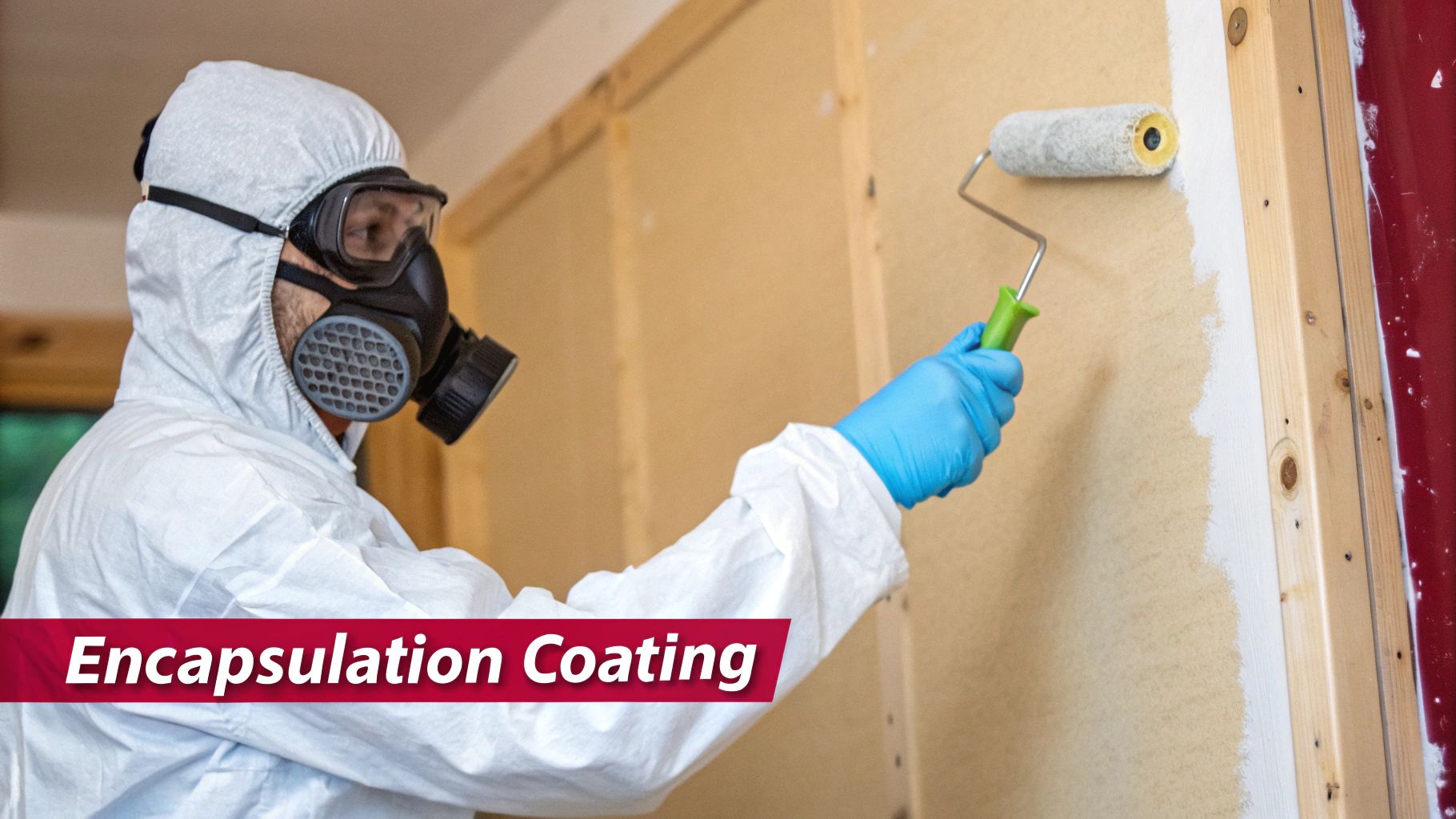
A good way to think about it is like putting a high-performance sealant over a stained wooden deck. You're not actually removing the stain itself, but you are creating a durable layer that prevents it from transferring to anything that touches it. In meth remediation, this coating locks the hazardous chemicals in place, which makes the surface safe to touch and the space safe to occupy again.
The main draw of this approach is its speed and efficiency. Encapsulation can dramatically reduce project downtime and is often a more budget-friendly option compared to full-scale removal, making it a practical choice in certain, well-controlled situations.
How Encapsulation Works
The process is methodical and starts with really intensive site preparation. Every surface has to be thoroughly cleaned of any dust and grime to make sure the encapsulant can bond properly. Sometimes we'll use specialised cleaning agents to knock down the surface-level contamination before the main coating even goes on.
Once the area is prepped, the encapsulant is applied, usually with rollers or sprayers, to create a seamless, durable membrane. And to be clear, we're not talking about your standard tin of paint. These are advanced, polymer-based coatings engineered to be chemically resistant and incredibly long-lasting. Curing times can vary, but the whole process is generally much quicker than the demolition and reconstruction that comes with a full removal job.
By forming a tough, monolithic film, the encapsulant effectively turns a contaminated substrate into an inert surface. The goal is to create a barrier so robust that the underlying contamination is no longer a factor in the building’s ongoing safety.
This method really shines when you're dealing with low-level, surface-only contamination on non-structural or semi-porous materials. However, its real-world effectiveness is a hot topic in the Australian remediation industry. A University of Queensland study found that while encapsulation cut surface wipe levels by 85-92%, airborne contaminants remained above health guidelines in a staggering 40% of cases even after a year. It's a sobering reminder of just how critical it is to choose the right tactic for the job.
Critical Limitations and Long-Term Risks
For all its benefits in the right context, encapsulation is not a silver bullet. It has some serious limitations that need to be weighed up carefully when deciding between encapsulation and removal.
- Saturation Issues: It's completely the wrong choice for materials that are saturated with contaminants. Think insulation, carpets, or plasterboard that has soaked up meth residue like a sponge. Just sealing the surface does nothing to address the chemicals trapped deep inside.
- High-Contact Surfaces: Using an encapsulant on high-traffic or high-contact surfaces is a bad idea. If the coating gets scratched, worn down, or damaged, you risk re-exposing the contamination you tried to seal away.
- Coating Failure: The long-term integrity of the coating is probably the biggest question mark. If it starts to delaminate, peel, or crack because of moisture, building movement, or a poor application, you've got a catastrophic failure of the containment barrier.
We see similar containment principles in other remediation fields, like preventing mold in basements, where controlling moisture is absolutely vital to the barrier's success. At the end of the day, encapsulation's success hinges entirely on the permanent integrity of that coating. Any compromise means the contamination problem is back, often forcing a much more expensive removal job down the track.
Going for a Full Strip-Out: The Definitive Decontamination Method
While encapsulation works as a containment strategy, full removal is the only way to completely and permanently eliminate the contamination. Think of it as the gold standard in meth remediation. It's an intensive process that involves physically stripping out and disposing of all affected materials, leaving zero doubt about the site's safety.
The logic behind removal is straightforward: if a material has soaked up meth residue, it has to go. This is especially true for porous materials that act like sponges for contaminants—things like plasterboard, insulation, carpets, and soft furnishings. Trying to clean or seal these items is often a lost cause when they're heavily saturated. The chemicals trapped deep inside can continue to release toxic vapours, creating a long-term health hazard.
In many cases, removal isn't just an option; it's the only responsible choice.
What the Removal Process Actually Looks Like
A full removal job is a tightly controlled operation. We follow strict protocols to stop cross-contamination and keep everyone safe. First, we set up a secure containment zone around the entire affected area, sealing off doors, windows, and vents to create a completely isolated environment.
Inside this "bubble," we install negative air pressure systems. These are powerful units that continuously pull air through High-Efficiency Particulate Air (HEPA) filters, trapping any airborne contaminants before pumping clean air outside. This simple step is critical—it ensures no hazardous particles can escape into other parts of the building while we work.
The hands-on removal work involves:
- Controlled Demolition: Our technicians, kitted out in full personal protective equipment (PPE), systematically dismantle and bag up all contaminated porous materials. This means carefully cutting out plasterboard, removing insulation, and ripping up flooring.
- Chemical Washing: Once the porous materials are gone, we're left with the non-porous surfaces like the building's frame, concrete slab, and metal fixtures. These get a rigorous, multi-stage chemical wash to break down and lift any surface residue.
- HEPA Vacuuming: After washing, every single surface is meticulously vacuumed with industrial-grade HEPA vacuums to suck up any microscopic particles that might be left.
Full removal isn't just about cleaning a surface. It's about hitting the reset button on the entire environment. We're eradicating the problem at its source, which eliminates future liability and protects the long-term value of the property.
Dealing with the Hazardous Waste
A huge part of a removal project is managing the hazardous waste correctly. Every single piece of contaminated material—from a scrap of plasterboard to a used cleaning wipe—is legally classified as hazardous waste.
Under Australian environmental regulations, all this waste has to be double-bagged, sealed, and properly labelled. It's then transported by a licensed carrier to a designated hazardous waste facility. We maintain meticulous records, tracking the waste from the moment it leaves the site to its final disposal. This creates a legally defensible paper trail that proves we've complied with all state and federal laws. It’s our guarantee that the problem has been solved, not just shifted somewhere else.
This is why full removal is the only acceptable option for high-stakes environments like pharmaceutical labs or food processing plants, where even the tiniest trace of contamination is a deal-breaker. It's also the go-to strategy for property owners who want to completely erase a site's history and restore its full value, no questions asked.
Comparing Encapsulation vs Removal Decision Criteria
Deciding between encapsulation and removal isn’t just about picking the cheapest option. It’s a strategic choice with serious implications for long-term safety, your operational continuity, and the future value of the asset. The only way to get it right is to methodically weigh up the critical factors to ensure your remediation tactic aligns with your business goals for 2026 and beyond.
The process flow for a structural remediation project is quite involved, from initial containment right through to the final sign-off. The flowchart below gives a good high-level overview of the major stages.
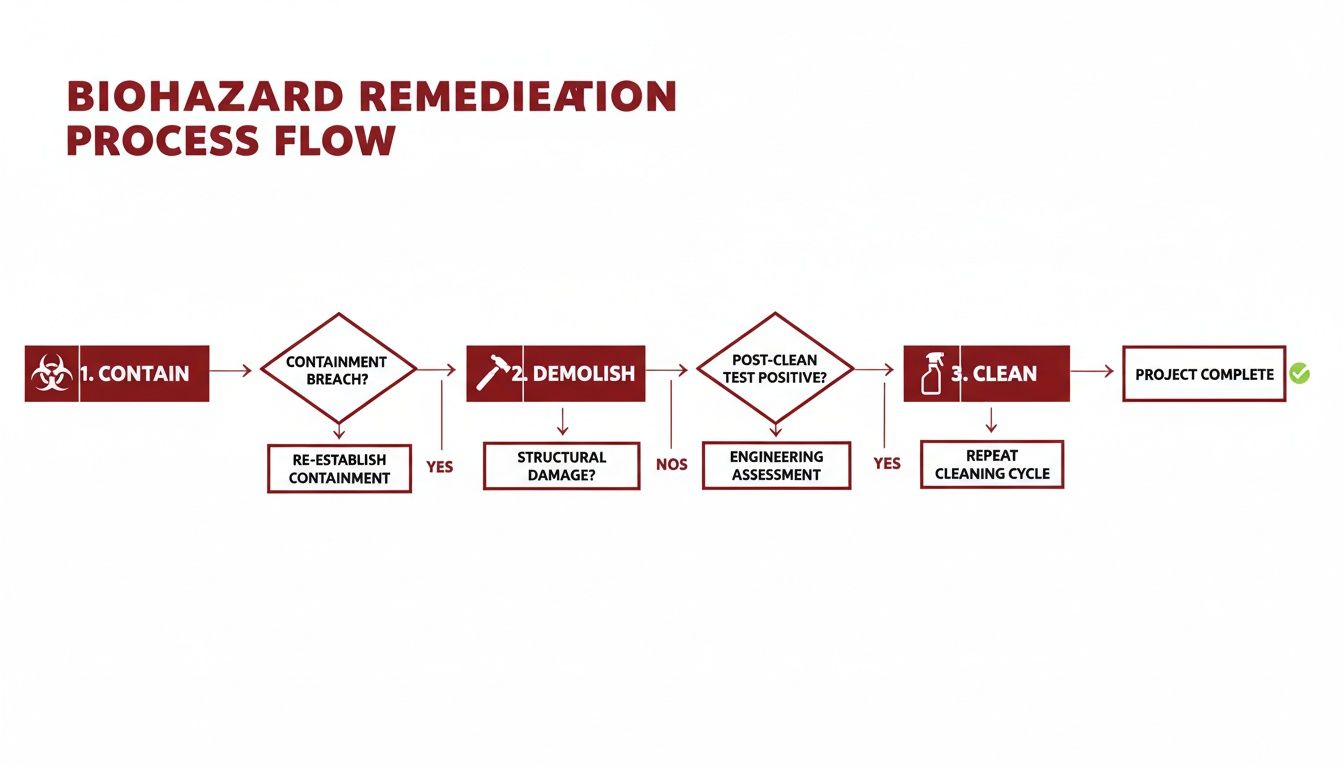
This process makes one thing clear: whether you choose to seal or demolish, the foundational steps of secure containment and meticulous cleaning are non-negotiable for a compliant project.
To help you navigate this decision, here's a direct comparison of the two approaches across the most important criteria we see in the field.
Encapsulation vs Removal A Strategic Comparison
This table offers a side-by-side look at how meth remediation tactics stack up across the critical decision-making factors for industrial and commercial properties.
| Decision Factor | Encapsulation | Removal |
|---|---|---|
| Long-Term Effectiveness | Manages the risk by creating a barrier. Leaves contamination in place, requiring ongoing monitoring. | A permanent solution. Physically eliminates the source of the hazard, leaving no residual risk. |
| Upfront Cost | Lower initial cost. Reduced labour, minimal demolition, and no hazardous waste disposal fees. | Higher initial cost. Involves demolition, hazardous waste disposal, and reconstruction expenses. |
| Total Lifecycle Investment | Lower upfront cost but may have future expenses for maintenance, re-inspection, or barrier failure. | Higher upfront cost but offers a definitive end to the problem, protecting long-term asset value. |
| Project Duration | Significantly faster. Often completed in days, minimising operational downtime. | More time-consuming. Can take weeks due to demolition, intensive cleaning, and reconstruction. |
| Property Value Impact | Can negatively impact value. Disclosure of contained contamination may deter potential buyers or tenants. | Restores the property to its full pre-contamination value, providing a clean slate. |
| Regulatory Certainty | Can achieve compliance, but may come with future monitoring requirements or caveats on the clearance certificate. | Provides absolute certainty and a straightforward, defensible clearance certificate. |
| Best-Case Scenario | Low-level, non-porous surface contamination where speed and minimal disruption are the top priorities. | High-level contamination, porous materials (like timber or plasterboard), or when maximum certainty is required for asset sale. |
As you can see, the "best" choice is entirely situational. It hinges on your specific risk profile, financial strategy, and the intended future use of the property.
Long-Term Effectiveness and Permanence
The most fundamental difference between the two is finality. Full removal offers a definitive, permanent solution. When we physically strip out all contaminated materials, the source of the hazard is gone for good. There's no residual risk left to worry about.
Encapsulation, on the other hand, is a containment strategy. It’s about managing the risk by putting a durable barrier over it, but the contamination itself remains in place. While it can be perfectly effective in certain low-risk scenarios, it creates a long-term liability. The barrier could fail from physical damage, delamination, or even just building movement over time, which would re-expose the hazard.
The core differentiator is finality. Removal closes the chapter on contamination for good. Encapsulation manages it, requiring a long-term commitment to monitoring and maintenance of the sealed surfaces.
This distinction is absolutely critical for properties in sensitive industries or those you plan to sell. Any lingering doubt about contamination can crush an asset's value and its insurability.
Upfront Costs vs Total Lifecycle Investment
Cost is always a driving factor, but comparing initial quotes can be dangerously misleading. Encapsulation almost always looks cheaper on paper due to less labour, minimal demolition, and no fees for hazardous waste disposal.
But you have to look at the total lifecycle cost. For a typical 150m² facility, encapsulation might run AUD $12,000-$18,000, while a full removal could easily top AUD $40,000. However, that removal job often comes with a 30-year warranty, whereas an encapsulation warranty is typically just 5-7 years. That's a huge difference, especially with regulators like WA Health continually tightening the standards.
With hospitalisations for meth-related issues doubling to 48 per 100,000 between 2012 and 2022 and industries potentially facing AUD $1.5 billion in remediation bills annually, the long-term certainty of removal often proves to be the smarter investment. You can find more detail on these trends in reports from the Australian Criminal Intelligence Commission.
Project Duration and Operational Downtime
For any business, downtime is a direct hit to the bottom line. This is where encapsulation really shines. These projects are much faster, often taking just days instead of weeks. The process is straightforward: prepare the surface, apply the coating, let it cure, and you can get the facility back online.
Removal is inherently more disruptive and drawn out. The process is a major undertaking:
- Setting up containment zones and negative air pressure systems.
- Controlled demolition and careful bagging of all contaminated materials.
- Intensive, multi-stage chemical cleaning of every remaining surface.
- Rebuilding demolished areas, like installing new plasterboard and finishes.
That extended timeline has to be factored into your cost-benefit analysis. For some operations, the financial pain of a prolonged shutdown can actually outweigh the long-term benefits of removal.
Regulatory Compliance and Property Value
Across Australia, the regulatory guidelines are only getting stricter. While both methods can achieve compliance when done correctly and in the right situation, removal gives you a level of certainty that is far easier to document and defend. A clearance certificate after a full removal means the site is genuinely clean.
A certificate following encapsulation confirms the barrier is working at that specific moment, but it often includes caveats about ongoing monitoring. This can have a very real impact on your property's value. Prospective buyers or tenants will naturally be wary of a property with known, albeit contained, hazardous materials, which can lower its market appeal and rental income. Removal, quite simply, restores the asset to its full, pre-contamination value.
Ultimately, the right call comes down to a balanced assessment of your risk, budget, and long-term goals. For low-level contamination on non-critical surfaces where speed is everything, encapsulation is a viable tool. But for high-level contamination, porous materials, or when you need absolute certainty, removal is the only responsible path forward.
Picking the Right Strategy for Your Industry
The academic debate over encapsulation versus removal gets real, fast, when you're standing on-site. The right approach to meth remediation isn't a textbook answer; it's a strategic call shaped by your industry's daily operations, regulatory headaches, and tolerance for risk. What works for a remote storage shed could be a complete disaster in a food processing plant.
Getting this right hinges on a solid risk assessment. You need to look at the hard numbers—the contamination levels, how the space is actually used, and the real-world chances of human exposure.
Manufacturing and Warehousing
In big, open-and-shut places like factories and warehouses, a hybrid strategy often makes the most sense. You've got huge expanses of concrete floors and steel frames—non-porous surfaces that are perfect for encapsulation, especially if contamination levels are on the lower end of the scale.
But then you have the high-traffic zones: the staff lunchroom, the site office, the control panels everyone touches. In these areas, there's no room for compromise. Full removal of contaminated porous materials like plasterboard, carpets, and furniture is the only way to go to keep your team safe.
- When to Encapsulate: Think sealing a large concrete floor or metal wall cladding in a back corner of the warehouse that hardly anyone goes into.
- When to Remove: Gutting a break room is a classic example—tearing out the plasterboard, flooring, and cabinetry where people eat and spend their downtime.
This blended approach lets you manage costs effectively across the vast, low-risk spaces while making sure you completely eliminate the hazard where it truly counts.
Pharmaceutical and Food Production
For industries like pharma or food production, where health and safety rules are iron-clad, the choice is simple. Full removal is the only defensible option. The risk of even a microscopic trace of contamination is just too high to entertain anything else.
Here, product integrity and consumer safety are everything. The idea of knowingly leaving a toxic substance sealed behind a wall, no matter how tough the sealant, flies in the face of Good Manufacturing Practice (GMP) standards and Food Standards Australia New Zealand (FSANZ) codes.
In a sensitive production environment, the tolerance for contamination is zero. Your whole remediation plan has to be built around total, verifiable removal to safeguard the product and the public. Encapsulation isn't just a bad idea; it's a permanent audit failure waiting to happen.
Any remediation project in these sectors means a complete strip-out of the affected area, followed by intensive chemical washing of every remaining surface and multiple rounds of independent testing to prove the site is sterile.
Remote Mining Camps
Out at a remote mining camp or an isolated infrastructure site, logistics are king. The cost and time it takes to get specialised crews, heavy equipment, and hazardous waste trucks out there can be astronomical.
In these situations, encapsulation can be a smart interim move. Let's say a non-critical building like a storage shed or a donga shows low-level contamination. Encapsulating it can make it safe for limited use quickly and cheaply. This buys you precious time to properly plan a full-scale removal and disposal job during the next scheduled shutdown when logistics are on your side.
This strategy contains the immediate risk and stops the problem from spreading, all without the massive upfront cost and operational chaos of a full removal in the middle of nowhere.
Commercial Real Estate
If you're a commercial property owner or manager, this decision hits you right in the asset value. Encapsulation might look tempting with its lower initial price tag, but it can create major roadblocks when you want to sell or lease down the track.
Having to disclose that the building contains encapsulated meth residue—even when it's been done by the book—is a surefire way to spook potential buyers and tenants. It often leads to a lower valuation, as the ongoing inspection requirements and the lingering risk of the barrier failing become a permanent liability.
- Short-Term Win: Encapsulation can solve a contamination problem quickly, getting a rental property back on the market and generating cash flow with less upfront capital.
- Long-Term Value: Full removal is a permanent fix. It cleans the slate, restores the property to its maximum market value, and removes any lingering legal or financial clouds for future owners.
Ultimately, removal is an investment in the building's future. It provides the clean bill of health you need to command top dollar and ensure a smooth, straightforward sale when the time comes.
Ensuring Compliance Through Professional Remediation
Ultimately, deciding between encapsulation and removal isn't a choice to be made lightly or in a vacuum. It’s a high-stakes call. Whichever meth remediation tactic you’re considering for 2026 and beyond, the only path to a legally defensible and genuinely safe outcome is through certified professionals. Kicking things off with an independent occupational hygienist is the critical first step.
Their job is to give you an unbiased, science-led assessment of the site. They’ll handle the initial testing to figure out the contamination levels, pinpoint exactly which materials are affected, and then produce a detailed risk assessment. This expert evaluation isn't just a suggestion; it’s the foundation for a remediation plan that is both tailored and compliant, taking all the guesswork out of the process.
The Role of Independent Verification
Once the remediation work is done—whether it’s encapsulation or a full strip-out—the job isn't truly finished. It needs to be independently verified. This is where post-remediation verification and clearance testing are absolutely non-negotiable.
A certified hygienist will come back to the site to conduct thorough testing. They’ll take surface and air samples to confirm, without a doubt, that contamination levels have been brought down below the Australian health-based guidelines.
This independent clearance certificate is your proof of compliance. It validates the effectiveness of the remediation method you chose and acts as your legal defence, showing that you’ve met your duty of care to protect your people, your assets, and your regulatory standing.
Protecting Your Business with Expert Guidance
Navigating the complexities of meth remediation requires specialist knowledge. For a problem this serious, you simply can't overstate the importance of getting professionals involved. It’s a bit like the debate over DIY carpet cleaning vs professional services; while one might seem cheaper upfront, only expert intervention guarantees a reliable and thorough result.
When you partner with accredited specialists, you ensure every decision is backed by practical industry experience and solid scientific principles. This isn't just about getting a clean site; it’s about protecting your business from the massive financial and reputational fallout that comes with a botched cleanup. The first step is always a professional site assessment.
Your Questions Answered: Meth Remediation FAQs
When you're dealing with meth contamination, a lot of questions come to mind. It’s a complex situation, and you need clear answers to make the right call. Here’s a rundown of the common queries we get from property owners and facility managers.
Can We Just Paint Over Meth Residue?
It’s a common thought, but the answer is a hard no. Slapping a coat of standard paint over meth residue is like putting a band-aid on a bullet wound. Regular paint just doesn't have the chemical makeup to block toxic contaminants.
Over time, meth residue will simply leach through the paint, re-contaminating your space and putting people at risk. You need a specialised polymer coating—a true encapsulant—that’s engineered to create a permanent, non-porous seal. It's a completely different product designed for a very specific, hazardous job.
What Are the Legal Requirements for Meth Remediation in Australia?
Australia-wide, the benchmark for a successful clean-up is getting contamination levels below 0.5 micrograms (µg) per 100 square centimetres (100 cm²). While the National Clandestine Drug Laboratory Remediation Guidelines set the standard, it’s the states and territories that handle enforcement.
Getting it right isn't just a matter of scrubbing down surfaces. It's a formal, documented process:
- Initial Assessment: An independent occupational hygienist must test the site to map out the contamination.
- Remediation Action Plan: Based on those findings, a detailed clean-up strategy is created.
- Professional Clean-up: The work must be done by certified remediation specialists who know what they're doing.
- Post-Remediation Verification: The hygienist returns to conduct clearance testing, providing a certificate that proves the site is safe and meets legal standards.
Cutting corners here can lead to serious legal headaches and financial penalties down the track.
How Long Does a Typical Industrial Remediation Project Take?
The timeline really hinges on the method you choose and how complex the site is. There's a significant difference between the two main approaches.
-
Encapsulation: This is your faster route. Because it involves sealing surfaces rather than ripping them out, a project can often be wrapped up in just a few days to a week, including prep, application, and curing.
-
Removal: This is the more disruptive and time-consuming option. It involves full-scale containment, demolition of affected materials, chemical washing, and safe disposal. You’re looking at several weeks, or even over a month, before you factor in any necessary reconstruction.
Facing meth contamination is a serious business. Making the right decision is crucial for the health of your people and the future value of your asset. Our team provides expert occupational hygiene services to guide you through every step, from the first test to the final clearance certificate.
Contact us for a professional site evaluation to develop a compliant and effective remediation strategy.


