
Navigating workplace safety documentation can be confusing, so let's clarify the difference between a JSA and a SWMS. A Job Safety Analysis (JSA) is a versatile, proactive safety tool for a broad range of tasks across many industries—think of it as a general safety playbook. Conversely, a Safe Work Method Statement (SWMS) is a specific, legally mandatory document in Australia, required for high-risk construction work. One focuses on best-practice safety planning for general tasks, while the other is a strict compliance document for the most hazardous jobs. Understanding this core difference is the first step toward robust risk management.
Getting the Foundations Right: JSA and SWMS
It’s easy to get tangled up in workplace safety paperwork, but knowing the difference between a JSA and a SWMS is crucial for keeping your worksite safe and on the right side of the law. While both are designed to spot and manage hazards, they have very different roles and legal implications, especially under Australia's Work Health and Safety (WHS) regulations.
A JSA is a flexible tool that’s considered best practice across many industries. The whole point is to take a job, break it down into simple steps, pinpoint what could go wrong at each stage, and then decide on control measures to stop it from happening. It’s a fantastic, practical approach to safety.
A SWMS, however, is a different beast altogether. It's a legal document required for a very specific list of 19 high-risk construction activities. It’s less of a flexible guide and more of a formal, documented plan. For any business serious about safety, knowing how to Create a High-Impact Health Safety Course is a great step toward embedding these documents into your company culture.
JSA vs SWMS Core Differences at a Glance
To make things crystal clear, this table lays out the fundamental differences between the two documents. It’s a quick reference to help you see where each one fits.
| Attribute | Job Safety Analysis (JSA) | Safe Work Method Statement (SWMS) |
|---|---|---|
| Primary Purpose | To proactively identify and control hazards for a specific task. | To legally document how high-risk construction work will be done safely. |
| Legal Status (AU) | Best practice; not typically a legal requirement for specific tasks. | Legally mandatory for 19 specific high-risk construction activities. |
| Scope of Use | Broad; used across all industries for routine or non-routine tasks. | Narrow; specific to high-risk construction work as defined by WHS law. |
| Typical Application | New tasks, non-routine jobs, or tasks with a history of incidents. | Working at heights, demolition, excavation, asbestos removal, and similar jobs. |
As you can see, the distinction is pretty sharp. A JSA often comes into play for tasks that are new, aren't performed often, or where a standard Safe Operating Procedure (SOP) doesn't exist. It's your common-sense safety check.
A SWMS is the opposite—it’s strictly for those jobs with the potential for serious injury or death, as defined by Australian WHS regulations. If you want to dig deeper into the overarching rules, it’s worth exploring the official Australian workplace safety standards.
Understanding the Job Safety Analysis (JSA)
A Job Safety Analysis, or JSA, is one of the most practical, hands-on tools in any safety professional's kit. Think of it less as paperwork and more as a structured conversation about how to get a job done safely. It's a proactive process that digs into the nuts and bolts of a task to spot risks before they can cause harm, and its use spans virtually every industry, not just high-risk ones like construction.

The whole point of a JSA is to get ahead of incidents. Instead of reacting after someone gets hurt, it systematically identifies and manages hazards from the outset. This preventative focus is a core difference between JSA and SWMS; a JSA is a flexible tool for a wide range of tasks, whereas a SWMS is a legally mandated, rigid document reserved for specific high-risk work.
The Three Core Parts of a JSA
At its core, a JSA follows a simple but highly effective three-step logic. This straightforward structure is what makes it so versatile, whether you're setting up new equipment in a factory or tackling a one-off maintenance job on a remote site.
- Break the Job Down into Steps: First, you observe the task and list every action in the order it happens. This granularity is crucial because it stops you from glossing over small but significant hazards that get lost when looking at the job as a whole.
- Pinpoint Potential Hazards for Each Step: Next, for every single step you've listed, the team brainstorms what could realistically go wrong. This isn't just about obvious safety risks; it includes health issues and environmental dangers too. A seemingly simple step like "lift a box" could have hazards like "muscular strain" from poor technique or "tripping" over nearby clutter.
- Put Clear Control Measures in Place: With the hazards identified, the final step is to decide on practical controls to either eliminate or minimise the risk. This could be anything from using a mechanical hoist instead of manual lifting to mandating specific Personal Protective Equipment (PPE) for that step.
This methodical approach turns a complex job into a series of manageable, risk-assessed actions, making sure nothing is left to chance.
A great JSA isn't just a document; it's a conversation. It gets supervisors and the people actually doing the work in the same room, sharing their unique knowledge to agree on the safest way forward.
Legal Standing and Who's Responsible
In Australia, a SWMS is a legal requirement for high-risk construction work, but a JSA typically falls under the banner of best practice. While not always explicitly mandated by law for every single task, conducting a JSA is a very clear and defensible way for a Person Conducting a Business or Undertaking (PCBU) to show they're meeting their primary duty of care under Work Health and Safety (WHS) legislation.
Creating a JSA should never be a one-person job. The most effective ones are always a team effort, usually involving:
- A supervisor or manager who oversees the work.
- The worker (or workers) who performs the task day in and day out.
- A health and safety representative, where available.
This collaborative approach ensures the final document is grounded in reality and genuinely useful on the job. When a task involves complex machinery, the JSA process is often done alongside a formal plant risk assessment to make sure all mechanical and operational risks are properly addressed.
Ultimately, a JSA is a living document. It's a fantastic tool for training new staff, guiding pre-start talks, and even serves as a reference point during an incident investigation. It helps build a proactive safety culture for any non-routine or moderate-risk task, making it an essential part of any strong safety management system.
Understanding The Safe Work Method Statement (SWMS)
While a Job Safety Analysis (JSA) is a fantastic, versatile tool for general risk management, a Safe Work Method Statement (SWMS) plays in a completely different league. Think of it less as a safety form and more as a legally mandated operational blueprint for Australia's most hazardous jobs, particularly within the construction sector.
The core difference between a JSA and a SWMS is its legal weight. For certain high-risk tasks defined by Work Health and Safety (WHS) regulations, having a compliant SWMS isn't optional—it's the law.
A SWMS is a detailed, step-by-step plan that maps out precisely how high-risk work will be controlled from start to finish. It goes far beyond simply listing hazards. Instead, it documents a systematic process to manage those risks, ensuring every person on site knows their role and the specific safety protocols they must follow. Its entire purpose is to prevent a catastrophic event in work environments where the consequences of getting it wrong could be fatal.
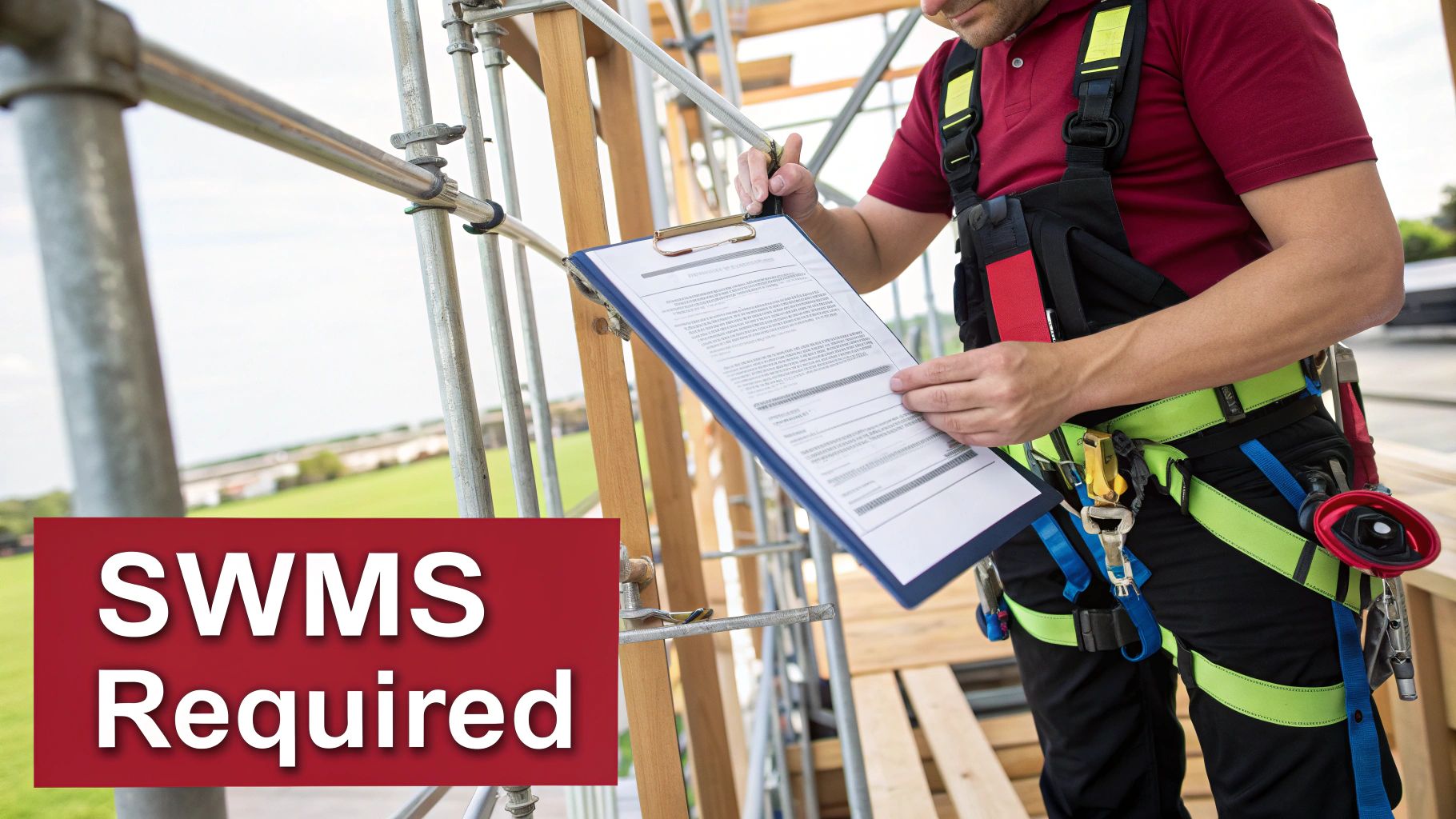
Starting high-risk construction work without a properly prepared SWMS isn't just cutting corners; it's a serious breach of the law. The penalties for a Person Conducting a Business or Undertaking (PCBU) can be significant.
What Counts as High-Risk Construction Work?
The legal trigger for a SWMS is what WHS regulations classify as "high-risk construction work". This isn't a loose term left to interpretation. It refers to a specific list of 19 prescribed activities that are statistically proven to carry a high likelihood of serious injury or death. If your job involves any of these, a SWMS is mandatory.
Here are a few of the most common examples you'll see on-site:
- Work where there’s a risk of a person falling more than 2 metres.
- Demolishing a load-bearing part of a structure or anything that affects its physical integrity.
- Working in or near a trench or shaft with an excavated depth of more than 1.5 metres.
- Any work on or near pressurised gas mains or piping.
- Handling or removing asbestos.
- Working in a confined space.
This clear-cut list eliminates any guesswork about when you need to elevate your safety planning to the level of a SWMS.
The Critical Role of Consultation
A standout feature of a compliant SWMS is the absolute requirement for consultation. A PCBU can't just draft a SWMS in an office and expect workers to follow it. The regulations are very clear: the document must be developed in consultation with the workers who will actually be doing the job (and their health and safety representatives).
This collaborative approach is non-negotiable for a few key reasons:
- Real-World Insight: The workers on the tools have invaluable, firsthand knowledge of the practical hazards and what control measures will actually work.
- Worker Buy-In: When people are involved in creating the safety plan, they have a sense of ownership and are far more likely to understand and adhere to it.
- Legal Compliance: It's a black-and-white legal requirement. A SWMS developed without genuine consultation simply isn't compliant.
A SWMS is a living document, not something you file and forget. It must be kept on-site, be easily accessible to the team doing the work, and be reviewed and updated if the work changes or a control measure proves inadequate.
SWMS Content and Compliance Requirements
Unlike the more flexible format of a JSA, a SWMS has specific content requirements it must meet to be compliant. While the layout might differ between companies, every SWMS must clearly identify the high-risk work, detail the associated health and safety hazards, and then describe the control measures that will be put in place.
Crucially, the control measures must align with the hierarchy of controls. This means you must prioritise the most effective solutions—like eliminating the hazard entirely—before resorting to less effective measures like administrative rules or just relying on personal protective equipment (PPE). This structured approach ensures you’re always aiming for the most robust safety solution possible, making the SWMS a powerful tool for proactively managing danger on a construction site.
A Detailed Comparison of JSA and SWMS
At first glance, a Job Safety Analysis (JSA) and a Safe Work Method Statement (SWMS) seem to do the same job: make work safer. But in practice, they operate in very different worlds. The real difference between JSA and SWMS comes down to their legal clout, their scope, and the sheer level of detail they demand. Getting these nuances right is crucial for keeping your team safe and staying on the right side of the law.
Think of it this way: a JSA is a versatile, best-practice tool you can use across almost any industry to get a handle on risk. A SWMS, on the other hand, is a legally binding document, specifically required in Australia for a very particular list of high-risk construction activities.
Legal Status and Regulatory Weight
This is the biggest dividing line between the two. Their standing under Australian Work Health and Safety (WHS) law dictates everything about when and how you use them.
A SWMS carries serious legal weight. It's a non-negotiable requirement for the 19 specific high-risk construction work activities outlined in the WHS regulations. If you start this kind of work without a compliant SWMS that has been properly prepared, reviewed, and is accessible on-site, you’re breaking the law. The penalties for a Person Conducting a Business or Undertaking (PCBU) can be severe.
A JSA, by contrast, is a best-practice tool. It's not usually required by law for specific tasks. However, completing a JSA is an excellent way for a PCBU to prove they are meeting their primary duty of care. It’s tangible, documented proof of proactive risk management.
The bottom line is this: a SWMS is a document of legal compliance for prescribed hazards, whereas a JSA is a tool of operational safety for general hazards. One is non-negotiable by law; the other is non-negotiable for a strong safety culture.
Scope of Application and Industry Use
The intended purpose of each document is also worlds apart. A SWMS has a narrow, legally defined job to do, while a JSA is built for broad, flexible use.
-
SWMS Scope: A SWMS is only used for those prescribed high-risk construction tasks. We’re talking about things like working at heights over two metres, demolishing a load-bearing structure, or working in a confined space. Its scope is deep but very narrow, zeroing in on jobs with the potential for life-changing injury or death.
-
JSA Scope: A JSA can be applied to just about any task in any industry you can think of—from a factory floor to a landscaping project. It’s particularly handy for non-routine jobs, tasks where the process has recently changed, or any work that has a history of incidents.
This contrast is a critical piece of the puzzle. Data from Safe Work Australia paints a sobering picture, showing 4,306 worker deaths between 2003 and 2021. While JSAs are often used for jobs with high injury rates or new equipment, SWMS are mandated for high-risk construction to directly combat these kinds of tragedies. You can explore more safety insights at Work Safety Queensland.
Required Detail and Content Structure
The two documents also differ in the level of detail and structure required. A SWMS is far more demanding and prescriptive in what it must contain.
A SWMS doesn't just list hazards; it must meticulously detail the control measures, making sure they follow the hierarchy of controls. It's an operational blueprint specifying who is responsible for each control and how you'll monitor their effectiveness. Critically, it has to be site-specific and developed in direct consultation with the people actually doing the work.
A JSA is generally more flexible. It still follows the logical process of breaking down a task, finding the hazards, and listing controls, but its format isn't set in stone. The main goal is to create a practical, easy-to-follow guide for workers, not to tick boxes on a stringent legal checklist.
Responsibility and Document Control
Finally, who is responsible for creating and managing them differs. For a SWMS, the buck stops with the PCBU. They hold the ultimate legal responsibility for ensuring a compliant SWMS is in place for any high-risk construction work. This process must involve consulting with the workers and their health and safety reps. The SWMS must be kept on-site, ready for inspection at any time.
Responsibility for a JSA is usually more operational. It’s often driven by a supervisor or team leader, working directly with the crew who knows the job inside and out. While senior management is accountable for the overall safety system, the JSA itself is more of a frontline, team-based document, with its control and storage guided by internal company policy, not specific laws.
Choosing The Right Document: Real-World Scenarios
It's one thing to understand the theory behind the difference between a JSA and a SWMS, but it’s another thing entirely to know which one to grab on a busy worksite. Moving from rules on a page to decisive action in the field can be tough, which is why walking through some real-world scenarios is the best way to get a feel for when a Job Safety Analysis is the right tool, versus when you absolutely need a Safe Work Method Statement.
This simple decision tree gets right to the heart of the matter for choosing between a JSA and a SWMS in Australia.
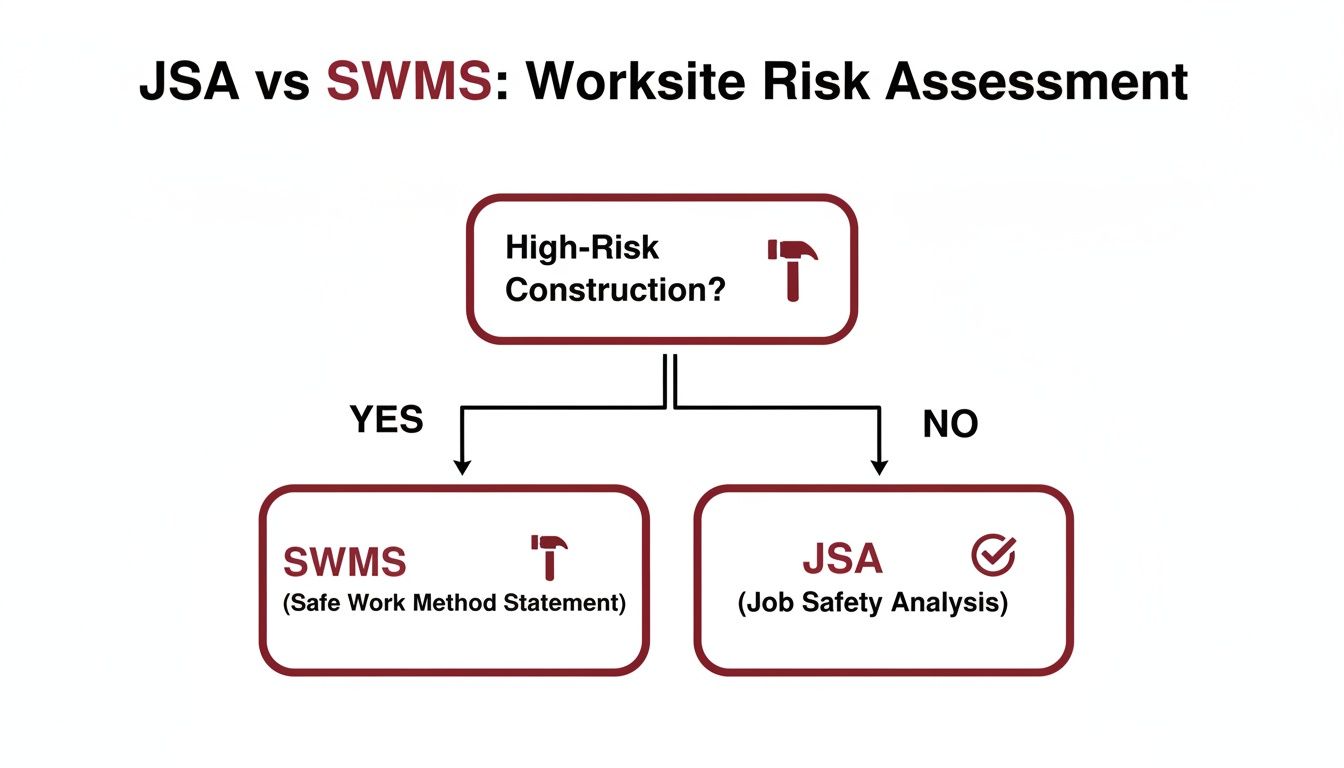
As the flowchart shows, the critical legal distinction is simple: if the job is classified as high-risk construction work under WHS law, a SWMS is a legal requirement. For everything else, a JSA is the practical choice for proactive risk management.
When To Use A Job Safety Analysis (JSA)
A JSA is your go-to document for managing the risks in countless everyday tasks that don't fall into the legally defined "high-risk construction work" category. Think of it as a flexible, collaborative tool built for proactive safety planning on the ground.
Here are a few common situations where a JSA is the perfect fit:
-
Scenario One: A One-Off Maintenance Task: Imagine a maintenance crew in a factory needs to replace a worn conveyor belt. It’s not a routine job, and it comes with hazards like nip points, manual handling, and the risk of the machine starting up unexpectedly. A JSA is ideal here. The team can break down the process, identify risks like muscular strain or entanglement, and map out controls like using lock-out/tag-out procedures and bringing in mechanical aids for lifting.
-
Scenario Two: Introducing New Equipment: A landscaping company just bought a new, more powerful wood chipper. Before anyone uses it for the first time, the supervisor should lead a JSA. Together, the team analyses every step of its operation—from start-up to feeding material and clearing jams—pinpointing specific hazards and agreeing on safe procedures. This gets everyone on the same page about the new risks before they cause a problem.
-
Scenario Three: A Minor Excavation: A team is digging a small trench, 1.2 metres deep, to lay irrigation pipes. Since it's under the 1.5-metre threshold for high-risk work, a SWMS isn't legally required. Still, there are risks of a minor collapse or someone tripping. A JSA is used to document these risks and outline simple controls, like shoring the sides or setting up a clear exclusion zone.
In every case, the JSA acts as a practical guide for managing moderate risks without the formal, legal weight of a SWMS.
The real trigger for a JSA is the presence of manageable, non-prescribed hazards. It empowers teams to think critically about any task, helping to build a culture where safety analysis is second nature, not just a box-ticking exercise driven by legislation.
When To Use A Safe Work Method Statement (SWMS)
A SWMS is non-negotiable. If a task is on the list of 19 high-risk construction work (HRCW) activities defined by Australian WHS regulations, you must have one. This document is a formal, legally binding plan.
These are the kinds of scenarios where a SWMS is mandatory:
-
Scenario One: Erecting Scaffolding: A crew is putting up scaffolding where a person could fall more than 2 metres. This is explicitly listed as HRCW. A detailed SWMS must be created before the work even begins. It needs to outline fall prevention methods (guardrails, harnesses), procedures for safe erection and dismantling, and what to do in an emergency.
-
Scenario Two: Demolition Work: A contractor is taking down an internal, load-bearing brick wall. Because this affects the building's structural integrity, it’s automatically classified as high-risk. The SWMS must detail the sequence of demolition, the control measures to prevent an unplanned collapse, dust suppression techniques, and how the area will be secured to keep everyone else safe.
-
Scenario Three: Working Near Powerlines: An electrical contractor has to operate a boom lift near live overhead powerlines. This is a classic HRCW activity. The SWMS would have to specify minimum safe approach distances, the use of an insulated boom, the need for a dedicated spotter, and the communication protocols with the electricity provider.
For bigger or more complex projects, getting these requirements right can be a real challenge. Getting expert advice from workplace health and safety consultants can provide the clarity you need to stay compliant and, most importantly, protect your team.
Common Mistakes to Avoid With Your JSA and SWMS
It's one thing to have a JSA or SWMS on file; it's another thing entirely for it to actually keep someone safe. Even with the best intentions, these documents can easily become just another piece of compliance paperwork, gathering dust in a folder instead of preventing incidents on site.
Knowing the difference between JSA and SWMS is the foundation, but truly effective safety management comes from sidestepping the common mistakes that render them useless. These aren't just minor errors; they undermine the safety culture you're trying to build and turn a vital process into a meaningless tick-and-flick exercise.
Ignoring the People on the Tools
One of the biggest mistakes is a safety document drafted in an office by someone who has never done the job. When a manager writes a JSA or SWMS without talking to the workers on the ground, it’s instantly out of touch with reality.
Your team holds the practical, hands-on knowledge of what really happens day-to-day—the real hazards and what actually works to control them. A SWMS is legally required to be developed in consultation with workers, so skipping this makes it non-compliant. For a JSA, leaving out this collaboration means you’re throwing away the most valuable insights you could possibly get.
The most effective safety documents are a conversation, not a directive. They have to capture the lived experience of your workforce to be practical and respected.
Creating Generic, Vague Documents
Another classic pitfall is the old copy-and-paste job. Using a generic template without customising it for the specific site, team, or conditions is a recipe for disaster. The risks of operating a grinder in a controlled workshop are worlds away from using that same tool on an exposed, outdoor construction site.
Your safety documents must be site-specific and task-specific. They need to reflect the unique context of the work. Vague instructions like "use PPE" or "be careful" are completely useless. You need to be explicit.
- Weak Control: "Wear appropriate PPE."
- Strong Control: "Wear Class 5 hearing protection, impact-rated safety glasses, and cut-resistant gloves at all times."
That level of detail leaves no room for guesswork. It turns a bureaucratic document into a practical guide that people can actually use to stay safe.
Failing to Review and Update
Workplaces are never static. Conditions change, new equipment comes in, and people move on. A JSA or SWMS that was perfect six months ago could be dangerously out of date today. These are not "set and forget" documents.
They must be treated as living documents that evolve with your operations. A SWMS, for instance, must be reviewed if the work changes or if a control is found to be ineffective. A JSA should be revisited after any incident or near-miss, or whenever a process is tweaked. This constant review cycle ensures your safety planning isn't just reacting to the past but is actively protecting your team from the risks they face right now.
Your JSA & SWMS Questions, Answered
When you’re trying to manage workplace safety, the paperwork can be confusing. It’s vital to get straight answers to make sure you're not just ticking boxes, but actually keeping your people safe. Here, we'll clear up some of the most common questions about the difference between a JSA and a SWMS.
Knowing when to use each tool, and why, is the foundation of a solid risk management strategy.
Can a JSA Ever Replace a SWMS for High-Risk Work?
In a word: no. This is the single most important distinction to grasp. A Job Safety Analysis (JSA) is not a substitute for a Safe Work Method Statement (SWMS) when you're dealing with any of the 19 prescribed high-risk construction work (HRCW) activities.
Under Australian Work Health and Safety (WHS) laws, a SWMS is a non-negotiable legal requirement for these specific tasks. If you start high-risk work without a compliant SWMS in place, you're breaching WHS regulations and could face serious penalties.
Who Actually Has to Prepare the SWMS?
Legally, the buck stops with the Person Conducting a Business or Undertaking (PCBU). This duty can't be passed off to someone else.
A crucial part of that responsibility, however, is consultation. The PCBU must make sure the SWMS is developed with the direct input of the workers who will be doing the job, along with their health and safety representatives. This collaboration isn't just good practice; it's a legal requirement for the SWMS to be valid.
How Often Should We Be Reviewing These Documents?
JSAs and SWMSs are living documents, not something you file away and forget. How often you review them depends on the document and what's happening on site.
- A SWMS must be reviewed immediately if the high-risk work changes, new hazards appear, or if there's any sign that the current controls aren't working as they should.
- A JSA should be reviewed regularly as part of your standard safety audits. It also needs an immediate update after any incident or near-miss, or whenever a job’s process or equipment changes.
Does a JSA Go By Other Names?
Yes, you'll definitely hear other terms used for a JSA, and they generally mean the same thing. The name might change, but the fundamental process doesn't.
You’ll often hear a Job Safety Analysis (JSA) called a Job Hazard Analysis (JHA) or a Task Risk Assessment (TRA). All three describe the same core process: breaking down a job into steps to spot hazards and put controls in place.
Getting your head around WHS regulations shouldn't feel like an uphill battle. The expert team at Anitech Ltd Pty offers specialised Occupational Hygiene services to help ensure your workplace isn't just compliant, but genuinely safe. We work with businesses across Australia to build robust safety systems, from developing practical JSAs to ensuring your SWMSs tick every legal box. Contact us today to see how we can support your commitment to workplace safety.


