
Quick Summary: After a successful decontamination, retesting is crucial for long-term safety verification. Immediate verification confirms the clean-up worked, but delayed confirmatory testing (typically 30-90 days later) ensures contaminants like mould or meth residue haven't returned. This diagnostic FAQ provides technical guidance on creating a risk-based retesting timeline for different contaminants to ensure lasting safety.
You’ve just completed a decontamination, and the initial tests come back clear. That’s a great result, but it’s not the end of the story. The real question for any occupational hygiene professional is, what happens next? Knowing when to retest is just as critical as the initial clean-up itself, especially for focused meth contamination or persistent mould.
The answer depends entirely on what you're dealing with, the environment, and the relevant regulations. While that first "all clear" confirms the cleaning process was effective on the day, a follow-up test—what we call delayed confirmatory testing—is often essential for long-term safety. This is especially true for stubborn contaminants like methamphetamine residue or biological threats like mould, which are notorious for making a comeback.
Why the First "All Clear" Isn't the Final Word in a Diagnostic Workflow

Getting that initial clearance is a huge milestone. But the question of when should you retest after a successful decontamination cycle is fundamental to any robust diagnostic workflow and property screening process. Simply ticking the box right after the cleaning crew leaves doesn’t always guarantee the space is safe for good.
Think of it like pulling weeds from a garden. You can spend hours clearing every visible weed, leaving the garden looking perfect. But you know that seeds are still lurking under the soil, just waiting for the next rain to sprout. Microscopic contaminants behave in much the same way. They can hide deep within porous materials or settle in tiny crevices, only to reappear days or even weeks later.
Verification vs. Long-Term Assurance
This is where we need to separate immediate verification from long-term assurance. The first test verifies that the decontamination process itself was performed correctly. A later follow-up test assures you that the environment has remained safe over time. This two-stage approach isn’t just best practice; it’s essential in many high-stakes industries.
You'll see this level of diligence applied in sectors like:
- Pharmaceutical Manufacturing: Where maintaining a sterile environment is non-negotiable to prevent product contamination and meet strict TGA standards.
- Property Management: When tackling issues like focused meth contamination, where chemical residues can slowly leach back out of walls and furnishings, a phenomenon known as off-gassing.
- Healthcare Facilities: Essential for stopping the spread of hardy bacteria and viruses to protect immunocompromised patients.
A proactive retesting schedule isn't about second-guessing the initial clean. It’s about managing ongoing risk and upholding a duty of care. It provides the hard, scientific evidence that a space isn’t just clean—it's certifiably safe for people long after the decontamination team has packed up.
The Importance of a Structured Plan
Without a clear retesting strategy, you’re essentially flying blind. You risk recurring contamination, potential health issues for anyone using the space, and falling foul of health and safety regulations. The goal is to shift from a reactive "clean-and-hope" mindset to a proactive, evidence-based workflow that validates safety for the long haul. It’s about providing genuine peace of mind and demonstrating a rock-solid commitment to a healthy environment.
Immediate vs. Delayed: The Two Phases of Post-Decontamination Testing
Right, you've just finished a major decontamination job. The big question is, what now? It's tempting to pack up, sign off, and declare victory, but the job isn't quite done. Deciding when to retest after a successful decontamination cycle isn't a single event—it's a crucial two-part strategy that involves both immediate checks and a later follow-up.
These two phases, immediate verification and delayed confirmatory testing, serve very different purposes. Both are absolutely vital for ensuring the space is genuinely safe for the long haul.
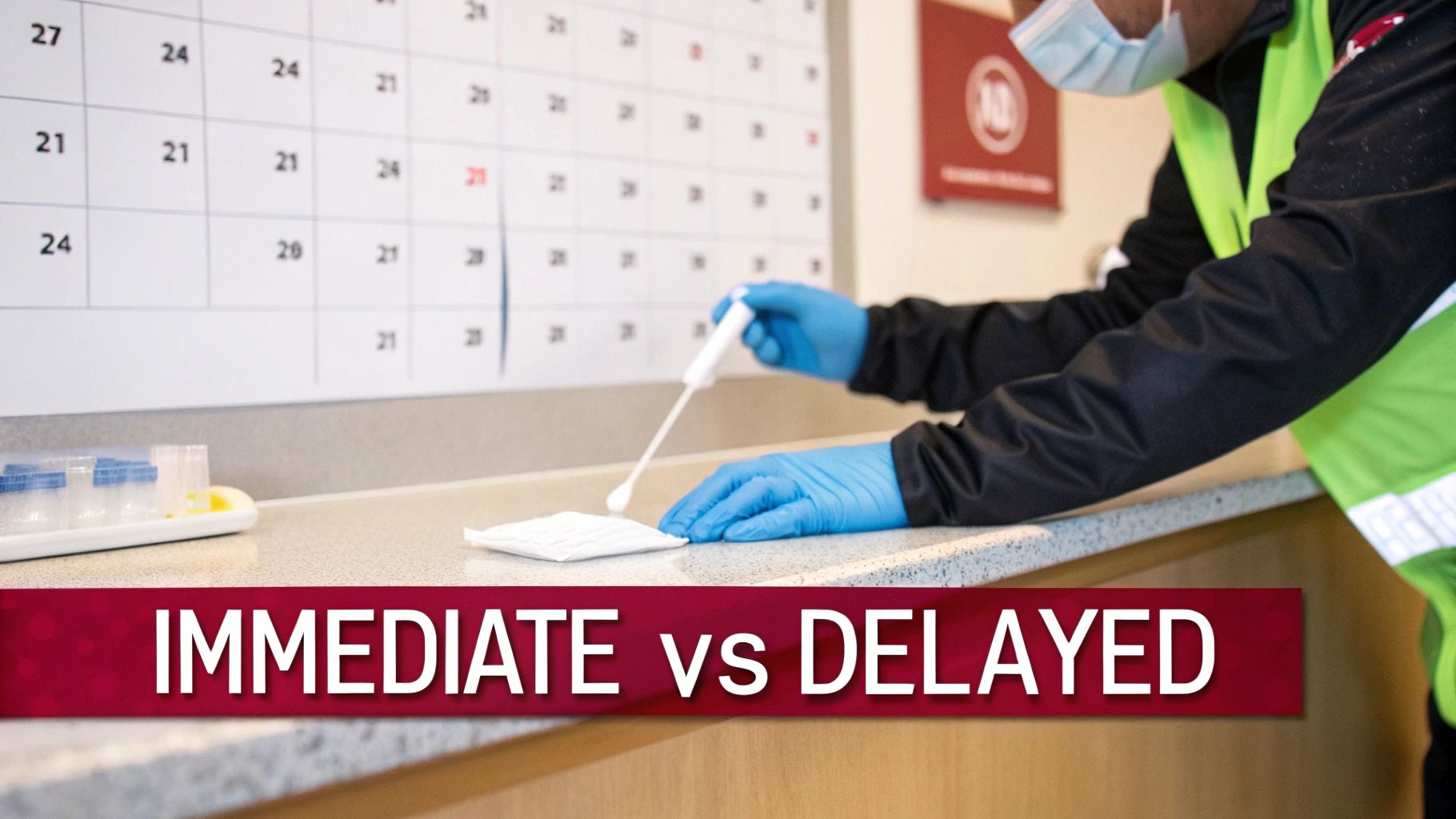
Think of it like this: immediate verification is the firefighter doing a final walkthrough to make sure the flames are out. Delayed confirmatory testing is them coming back the next day to check for hidden embers that could smoulder and reignite the fire. You can’t skip that second check if you want to be sure the building is safe.
The Role of Immediate Verification Testing
Immediate verification is exactly what it sounds like: a check-up performed as soon as the decontamination crew packs up their gear. Its main job is to confirm that the cleaning process itself was done properly and hit the required clearance levels.
This test gives you a quick, straightforward answer to one question: Did the decontamination process work as intended right now?
Common methods for this initial check include:
- Surface Swab Sampling: Taking samples from high-touch or critical surfaces to test for any leftover contaminants.
- Initial Air Sampling: Measuring airborne particles or specific agents to confirm the air is clean.
- ATP (Adenosine Triphosphate) Testing: A rapid test that measures organic material to give a quick gauge of cleaning effectiveness.
This first step is your frontline defence. It gives you that initial "all clear" needed to get operations back up and running. But remember, it's just a snapshot in time. And that’s why the second phase is so important.
Why Delayed Confirmatory Testing Is Crucial
Delayed confirmatory testing is the long-term health check for the facility. This is the testing that happens weeks, or even months, after the initial clean-up. The goal here is to be certain the contaminant hasn't made a comeback.
This follow-up isn’t about second-guessing the initial work. It’s about scientifically verifying long-term safety against stubborn threats. It's a non-negotiable part of any robust risk management strategy, especially when dealing with persistent issues like microbial growth or focused meth contamination.
Some contaminants are notorious for reappearing. For instance, tiny pockets of hidden moisture can allow mould spores to regrow long after the visible mould is gone. Similarly, chemical residues absorbed into porous materials like drywall can slowly leach back into the air—a process we call off-gassing.
Delayed testing is your insurance against this kind of rebound contamination. It provides the peace of mind that the environment will remain safe long after the incident is a distant memory. It's an absolute must in sensitive environments like pharmaceutical labs, food processing plants, and residential properties recovering from complex chemical contamination. Without it, you’re just leaving the door open for recurring problems and chronic exposure risks down the line.
To make the differences crystal clear, let's break down the two protocols.
Comparing Immediate vs Delayed Retesting Protocols
The following table highlights the key differences in purpose, timing, and methodology between the two main types of post-decontamination testing.
| Aspect | Immediate Verification Testing | Delayed Confirmatory Testing |
|---|---|---|
| Primary Goal | Confirm the decontamination process was effective immediately after completion. | Verify that the contaminant has not returned over time (rebound). |
| Timing | Right after decontamination, usually within 24 hours. | Weeks or months later (e.g., 30-90 days), depending on the risk. |
| Focus | Surface-level cleanliness and immediate airborne concentrations. | Long-term stability, checking for regrowth, off-gassing, or re-emergence. |
| Typical Scenarios | Standard post-cleaning clearance for most contamination events. | High-risk microbial issues (mould), volatile chemicals (meth labs), or porous materials. |
| Outcomes | Provides the "all clear" to reoccupy the space or resume operations. | Confirms the long-term safety and effectiveness of the remediation solution. |
As you can see, one test provides an immediate answer, while the other offers long-term assurance. A comprehensive decontamination plan needs both to be considered truly complete.
Key Factors Influencing Your Retesting Timeline
Figuring out when to retest after a decontamination job isn't as simple as picking a date on the calendar. There's no one-size-fits-all answer. Your timeline is a delicate balance of science, the specifics of the environment you're dealing with, and often, what the law demands. Taking a blanket approach is a surefire way to either waste money on pointless tests or, far worse, get a false sense of security.
To get it right, you have to think like a detective and build a testing plan based on the unique risks of the situation. You need to consider what you cleaned up, the materials it was on, and how you cleaned it. All these pieces of the puzzle help determine whether you should test again straight away or wait a while.
The Nature of the Contaminant
First things first: what are you dealing with? The contaminant itself is the biggest clue. Different nasties behave in completely different ways, and that dictates your retesting strategy.
We can break them down into three main groups:
- Microbial Contaminants (like mould and bacteria): You're dealing with living things here. You might have wiped out the current colony, but if you haven't fixed the root cause—usually a moisture problem—it's only a matter of time before it comes roaring back. Retesting isn't just about checking the clean-up; it's about confirming the environment won't support a second round.
- Chemical Contaminants (think methamphetamine residue or industrial solvents): Volatile chemicals are sneaky. They love to soak into porous materials. After you've cleaned the surface, they can slowly leach back out into the air over days or weeks. This process, known as off-gassing, is precisely why a delayed, follow-up test is non-negotiable for focused meth contamination.
- Particulate Contaminants (like asbestos or lead dust): These are physical particles. Once they're gone, they're gone—they don't "regrow" or "off-gas." For these jobs, the focus is almost always on immediate clearance testing. You need to know, right then and there, that the removal was 100% effective and no dangerous fibres or dust are left hanging in the air.
Environment and Material Porosity
Where the contamination happened is just as critical as what it was. The physical surfaces involved play a massive role in whether the problem is likely to pop up again.
Think of porous materials—things like unsealed timber, plasterboard, and carpet—as sponges. They can trap contaminants deep inside, making a complete clean-out incredibly difficult. These are the materials that are most likely to cause "rebound" contamination, where the problem reappears after you thought it was solved.
On the other hand, non-porous surfaces like stainless steel, glass, and sealed concrete are much more forgiving. Contaminants sit on top and are easier to remove, which seriously drops the risk of them coming back.
A proper risk assessment has to account for porosity. A simple surface swab might give you the all-clear on a steel bench, but that same clean-up could be completely inadequate for the plasterboard wall right next to it, which might still be hiding contaminants deep inside.
Decontamination Method and Regulatory Standards
The clean-up method you chose also feeds into the retesting timeline. Some chemical treatments are fantastic because they leave behind a residual barrier that helps stop mould from growing back. Other methods, like physically scraping something off or using a HEPA vacuum, get the job done but offer no ongoing protection. You have to know the limits of your clean-up technique.
Finally, and this is a big one, your testing schedule has to tick all the official boxes. Regulatory bodies like Safe Work Australia have clear guidelines that often specify how frequently you need to retest for certain hazards. For high-stakes jobs like licensed asbestos removal, clearance testing isn't just a good idea—it's the law. Following these standards is the only way to stay compliant and prove you've done everything by the book to keep people safe.
Retesting Timelines: A Contaminant-Specific Approach
When it comes to retesting after a decontamination job, a "one-size-fits-all" mentality just doesn't cut it. The real question—when should you retest?—has a completely different answer depending on whether you’re dealing with mould, meth, or asbestos. Each contaminant has a unique risk profile that demands its own specific retesting timeline.
Getting this right is fundamental to building a workflow that guarantees genuine, long-term safety. A timeline that works for microbial regrowth is completely useless for chemical off-gassing, and vice versa. Let's break down the practical, evidence-based guidelines for the most common scenarios we see in the field.
Microbial Contamination (e.g., Mould)
With microbial issues like mould, our primary concern is regrowth. You can eliminate the visible problem, but microscopic spores often remain dormant, just waiting for the right conditions to spring back to life. This is a huge risk after water damage, where moisture can get trapped in hidden wall cavities or under flooring.
This is precisely why a delayed confirmatory test is so important. We recommend retesting 30 to 90 days after the initial clearance. This window gives any residual spores enough time to germinate if there's still a lingering moisture problem, offering true verification that the root cause has been fixed.
Focused Meth Contamination
Meth contamination is a different beast entirely. The risk isn't regrowth; it's off-gassing. Methamphetamine residues are incredibly stubborn and easily absorb into porous materials like plasterboard, timber, and carpet. Even after a meticulous surface clean, these trapped chemicals can slowly leach back into the air over time.
An immediate verification test confirms the surfaces are clean right now, but only a delayed test can catch this off-gassing effect. Industry best practice is to retest after four to six weeks. This waiting period allows any absorbed residues to re-emerge, giving you a much more accurate picture of the property's ongoing safety. To dive deeper into this, check out our complete methamphetamine decontamination guidelines.
Retesting timelines must be based on the scientific properties of the contaminant. For chemicals, it's about detecting slow release from porous materials. For microbes, it's about allowing time for potential regrowth to become detectable.
Asbestos Abatement
Asbestos presents another unique scenario. As a particulate hazard, it doesn’t regrow or off-gas. The number one goal following asbestos abatement is immediate clearance to confirm there are no airborne fibres left behind. This is a non-negotiable step before a space can be reoccupied and is always performed as soon as the removal work is finished.
Long-term management doesn’t involve retesting the initial clean. Instead, it shifts to scheduled re-inspections as part of an ongoing asbestos management plan, which ensures any remaining materials are monitored and stay in good condition.
This principle of validating a process is common in other highly regulated fields. For example, the Australian standard AS 5369:2023 for reprocessing medical devices mandates routine monitoring based on validated procedures. This ensures safety is maintained through a structured, risk-based approach, not just arbitrary timelines.
How to Build a Risk-Based Retesting Workflow
Shifting from simply reacting to contamination events to building a proactive, defensible hygiene program isn't about guesswork. It’s about structure. When you have a solid internal workflow for retesting, every decision you make after a clean-up is logical, documented, and stands up to scrutiny.
This systematic approach turns abstract safety goals into a concrete action plan. It gives safety managers a clear, repeatable process that not only verifies long-term safety but also creates a paper trail proving due diligence—protecting your people and your organisation.
Key Steps in the Workflow
A truly robust retesting plan is built on a sequence of logical steps. Following this process ensures nothing critical gets missed, from the initial assessment right through to the final documentation.
- Initial Contamination Assessment: Start at the beginning. What was the contaminant, and where exactly was it? Getting a handle on the nature and scope of the initial problem is the foundation for everything that follows.
- Review Decontamination Report: Get the details. What methods, chemicals, and processes were used in the clean-up? This report tells you what was done, which directly informs potential long-term risks.
- Conduct Immediate Verification: Did the clean-up actually work? This is your initial clearance test. It's there to confirm the decontamination achieved its immediate goal.
- Identify Long-Term Risks: Think ahead. Could the contaminant come back? This is where you assess things like how porous the materials are, the potential for chemical off-gassing, or the chance of microbial regrowth.
- Consult Regulatory Standards: What does the law—or your industry—require? Check your obligations for the specific contaminant you're dealing with.
- Schedule Delayed Confirmatory Testing: Based on the risks you’ve just identified, put a date in the diary for a follow-up test. This isn't random; it's a calculated decision.
- Document Everything: If it isn't written down, it didn't happen. Keep a complete record of every assessment, report, test result, and decision made along the way.
The decision tree below gives you a practical look at how different contaminants—like mould, meth, and asbestos—drive very different retesting timelines within this kind of workflow.
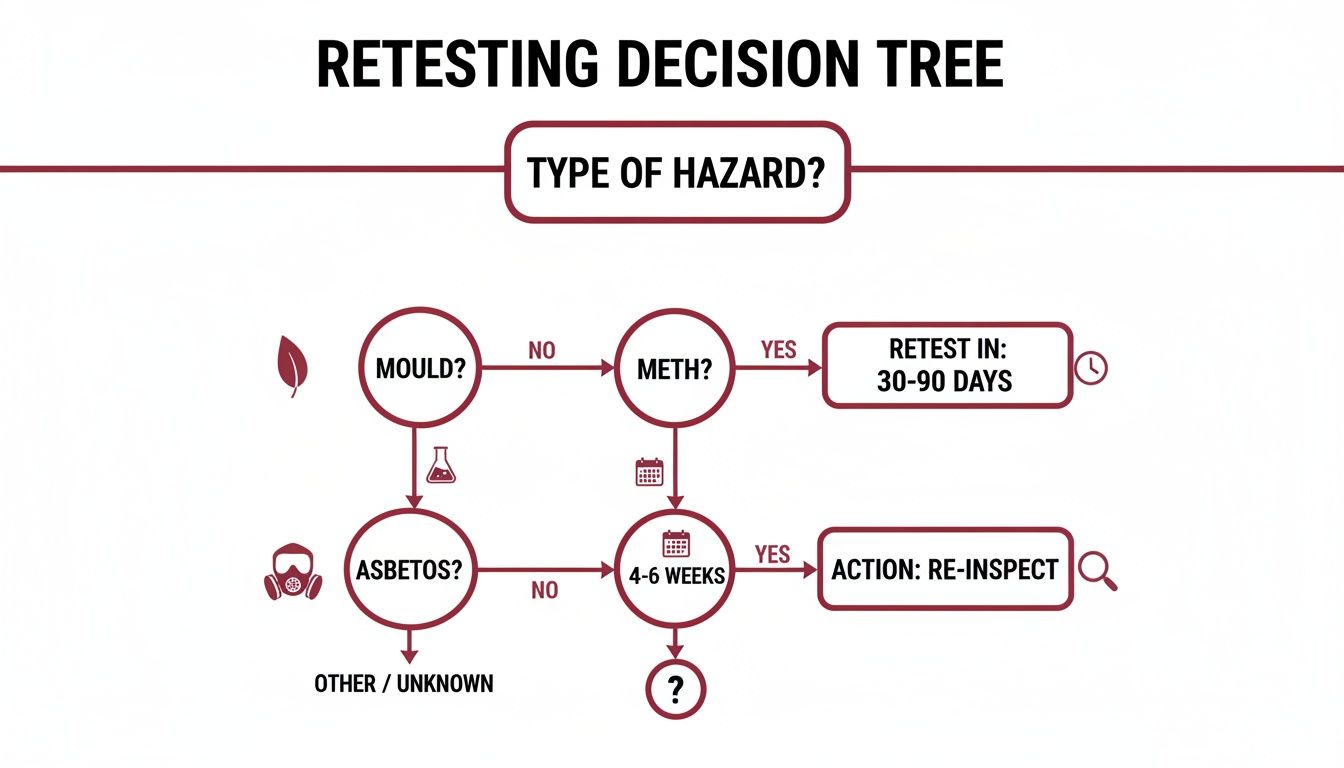
As you can see, something like mould demands a longer monitoring window (30-90 days) to watch for regrowth. In contrast, chemical off-gassing from a meth lab decontamination might need checking after 4-6 weeks, while asbestos remediation pivots to a long-term, scheduled re-inspection program.
Why Rigorous Protocols Matter
This kind of structured approach is non-negotiable in regulated industries. Think about it this way: historical Australian data on the reuse of single-use medical devices revealed that a staggering 58% of hospitals were reusing these items, often with inadequate sterilisation driven by a push to cut costs.
That situation is a stark reminder of why robust, scheduled re-verification after any decontamination is so critical. It’s the only way to be certain you’re preventing risks from quietly creeping back in. You can explore more of the findings on medical device reuse to understand the stakes.
Your Questions Answered: Post-Decontamination Testing
Once the initial decontamination work is done, you're often left with some practical questions. It’s one thing to complete the clean-up, but it's another to be certain the area is safe for good. Here, we'll tackle some of the most common queries we get from clients, giving you straightforward answers to help you lock in your retesting strategy.
Is Retesting Legally Required in Australia After Every Decontamination?
This really comes down to what you're dealing with and where the work took place. For high-risk, regulated materials like friable asbestos, the answer is a hard yes. Australian WHS Regulations mandate strict clearance testing. You simply cannot let anyone back into the space until an independent expert gives it the official all-clear.
But for other things, like mould or meth residue, the rules aren't as black and white. There isn't a specific law telling you to retest. Instead, it falls under your general 'duty of care' according to WHS legislation. While it might not be explicitly required, having a documented retesting program is the best way to prove you’ve done everything reasonably practicable to make the workplace safe.
What Happens If a Delayed Confirmatory Test Fails?
A failed test down the track is a major red flag, and it means you need to get back to investigating. It tells you one of two things is happening: either the original clean-up didn't get everything, or a hidden source is re-contaminating the area. A classic example is mould coming back because of a slow, undiscovered water leak.
The first move isn't to just clean again. It's to dig deeper and find the root cause. This diagnostic work will shape a new, smarter decontamination plan. After that second round of cleaning, you’ll need to run through the entire testing cycle again—both immediate and delayed—to finally validate the remediation was a success.
Can Our In-house Team Perform the Retesting Samples?
While it might be tempting to use your own team, especially if they handle routine monitoring, post-decontamination testing is a different beast. Verification and confirmatory testing should really be handled by an independent, third-party professional, like a qualified occupational hygienist.
Bringing in an outside expert gives you a few crucial advantages:
- Impartiality: It removes any hint of a conflict of interest.
- Expertise: It guarantees the right sampling methods are used in the right spots.
- Defensibility: The results are scientifically solid and will hold up if regulators, insurers, or lawyers get involved.
Using an independent expert provides an unbiased, scientifically sound validation of the decontamination work. This third-party verification is your strongest evidence that a property is safe for reoccupation.
How Does the Cost of Retesting Compare to the Risk of Not Retesting?
When you weigh it up, the cost of a proper retesting plan is tiny compared to the enormous costs of getting it wrong. Skipping that delayed confirmatory test might look like a saving on paper, but it leaves your organisation wide open to some serious long-term risks.
Think about what you're risking:
- Regulatory Fines: Hefty penalties for not meeting health and safety obligations.
- Legal Liability: The chance of being sued by employees or others exposed to the hazard.
- Business Interruption: The cost of shutting down the site again if contamination returns.
- Reputational Damage: Losing the trust of your customers, staff, and the public.
Worst of all, you're gambling with people's health. Think of retesting as an insurance policy—a small, smart investment to protect you from catastrophic financial and human costs. The odds aren't great, either. TGA guidelines show that even with a sample size of 10 from a batch with 10% contamination, there's only a 40% chance of detection. It's why Australian regulations now restrict repeat testing unless the first test was clearly invalid, which makes getting your testing strategy right the first time absolutely critical.
At Anitech, we provide expert occupational hygiene services to help you navigate post-decontamination workflows with confidence. Our team ensures your workplace is not just clean, but verifiably safe for the long term. Contact us today to develop a robust retesting strategy.


