
Quick Summary: When assessing health risks in a home with meth contamination, toxins enter the body through skin contact (dermal) and inhalation (respiratory). Respiratory exposure is typically the primary concern due to its direct, rapid route to the bloodstream via the lungs. Calculating the risk for both pathways involves specific formulas that consider contaminant concentration, exposure duration, and individual factors like body weight. A professional risk assessment is crucial for creating an effective remediation plan and ensuring a property is safe for residents.
When we're assessing the health risks in a home contaminated by meth, we have to look at two main ways people get exposed: through their skin (dermal) and through breathing (respiratory). Understanding the distinction between dermal vs. respiratory exposure is the cornerstone of accurately calculating residential health risks from meth contamination. While both routes are important, experience and scientific data consistently show that inhalation typically presents a more immediate and significant threat due to the body's absorption process.
The Lingering Threat of Methamphetamine Residue
When methamphetamine is produced or smoked indoors, it releases a fine, sticky aerosol that coats everything—walls, carpets, furniture, and even the inside of air-conditioning ducts. This residue doesn't simply vanish; it adheres to surfaces, posing a silent but persistent danger long after the drug-related activity has stopped.
This chemical residue isn't static. It can re-enter the air through off-gassing (releasing vapours) or by attaching to dust particles that are disturbed. This leads to the two primary exposure pathways for anyone living in the space:
- Respiratory Exposure: Inhaling airborne contaminant particles or chemical vapours.
- Dermal Exposure: Absorbing the residue through the skin after touching a contaminated surface.
A comprehensive health risk assessment must thoroughly evaluate both pathways to understand the full picture.
Why Inhalation is the Primary Concern
While dermal contact is a valid concern, the respiratory pathway almost always drives the risk assessment. The lungs are designed for incredibly efficient gas exchange, meaning they can absorb airborne chemicals and deliver them directly to the bloodstream within seconds. This rapid uptake allows for fast distribution throughout the body, leading to more immediate and systemic health effects.
In Australian residential scenarios, it’s not uncommon to see the calculated risks from inhalation dwarf those from dermal contact. For example, when assessing hazards from indoor mould, the risk quotients for mycotoxins can be 5 to 50 times higher from breathing them in compared to skin contact. This really underscores just how critical air quality is.
This is not just theoretical. Look at common household environmental issues. Research in Australia consistently shows that respiratory problems tied to indoor air quality, particularly from mould, far outnumber health issues from skin contact alone. With Australia's 11% asthma rate heavily influenced by indoor environmental factors, the focus is rightly on what people are breathing. Studies overwhelmingly point to respiratory and allergic reactions as the main health problems, a conclusion supported by findings in this Australian-focused review on PMC.
Comparing Exposure Pathways
Getting a handle on how these two exposure routes differ is the first step in calculating the risk. The table below breaks down the key distinctions.
| Attribute | Dermal Exposure (Skin Contact) | Respiratory Exposure (Inhalation) |
|---|---|---|
| Mechanism | Toxins slowly permeate through the layers of the skin. | Contaminants are inhaled directly into the lungs and absorbed by the alveoli. |
| Speed of Uptake | A much slower process, typically occurring over minutes to hours. | Extremely fast, with toxins entering the bloodstream almost instantly. |
| Bioavailability | Lower. The skin provides a natural, albeit imperfect, barrier. | High. The lungs offer a direct and highly efficient route into the body. |
| Primary Health Effects | Can cause localised skin irritation and rashes. Systemic effects build up over time. | Acute respiratory distress, systemic toxicity, and potential neurological damage. |
A Side-by-Side Look at Dermal vs Respiratory Exposure
When we are calculating residential health risks from meth contamination, it's crucial to understand how the toxins actually enter the body. The two main pathways, dermal (skin contact) and respiratory (inhalation), could not be more different. Each route presents unique challenges and potential health consequences, with the primary difference being how quickly and effectively toxins can reach the bloodstream.
Think of respiratory exposure as a direct superhighway into the circulatory system. When tiny meth residue particles become airborne and are inhaled, they travel deep into the lungs. The thin membranes there, designed for rapid gas exchange, absorb these toxins almost instantly. This efficiency means contaminants can bypass many of the body's natural defences and hit the bloodstream in seconds, leading to immediate, system-wide effects.
The Dynamics of Respiratory Exposure
Inhalation is almost always the main driver of acute health risks in contaminated properties. The process begins when microscopic meth particles, adhered to dust or fibres, are disturbed and become airborne. This can be caused by simple actions like walking on a carpet, opening a door, or the HVAC system activating.
Once inhaled, these particles penetrate deep into the respiratory tract. The body's capacity to absorb them is incredibly high—a concept known as high bioavailability. This direct route to the blood is why inhaling contaminants is so often linked to more severe health problems, like neurological symptoms and respiratory distress, as the toxins can quickly reach vital organs.
The infographic below illustrates the differences between these two exposure pathways.
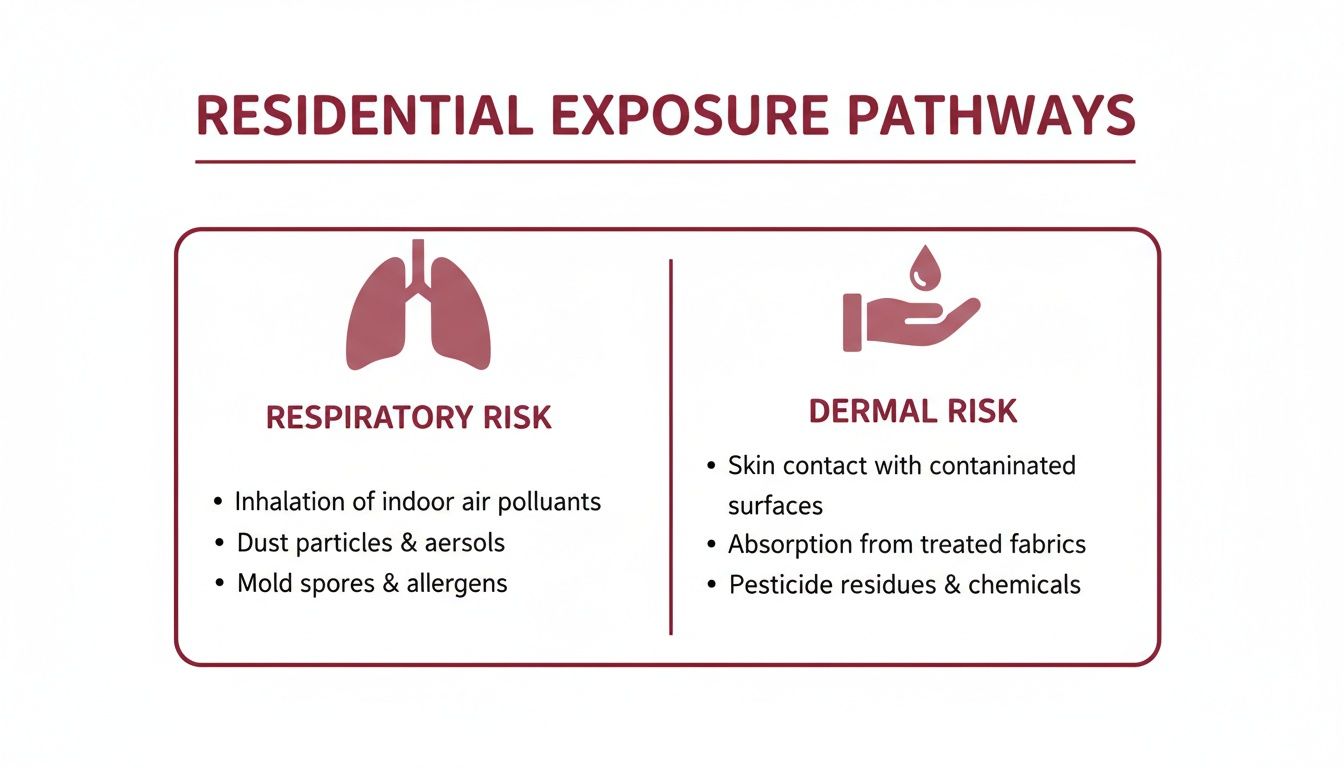
As you can see, while both skin contact and inhalation are genuine concerns, the directness of the respiratory route often makes it the more immediate and significant threat in a residential setting.
The Subtleties of Dermal Exposure
Dermal exposure, or skin contact, is a much slower and more complex process. It occurs when a person touches a contaminated surface, such as a countertop, a child's toy, or furniture. For these toxins to cause harm, they must first penetrate the skin's tough outer protective layer, the stratum corneum.
Several factors influence the rate and amount of absorption through the skin:
- Concentration of Residue: The more contamination on a surface, the higher the potential dose.
- Skin Condition: Broken, scratched, or irritated skin provides an easier entry point for chemicals.
- Contact Duration: The longer the skin remains in contact with the residue, the more can be absorbed.
While both pathways pose risks, respiratory exposure often leads to more acute, systemic effects due to its direct route to the bloodstream. Dermal contact may result in localised irritation or contribute to a long-term body burden through gradual accumulation.
This aligns with what we see with other residential contaminants in Australia. A 2022 survey, for example, found that 50% of Australians experienced mould or dampness in their homes, with 34% reporting visible mould—a major source of respiratory triggers. While dermal risks from things like dust mites are common, the health impacts from inhalation are often far more pronounced and well-documented, especially for vulnerable people. You can read more about these housing survey findings to get the broader context.
To make things clearer, let’s break down the key differences between these two exposure routes when dealing with meth residue.
Dermal vs Respiratory Exposure to Meth Contamination
This table shows the key distinctions between skin-based and inhalation-based exposure to methamphetamine residue in a residential property.
| Attribute | Dermal Exposure (Skin Contact) | Respiratory Exposure (Inhalation) |
|---|---|---|
| Absorption Rate | Slow and gradual, dependent on skin integrity and contact time. | Extremely rapid, with toxins entering the bloodstream almost instantly. |
| Bioavailability | Generally lower, as the skin acts as a partial barrier. | Very high, due to the efficient gas exchange function of the lungs. |
| Typical Health Outcomes | Localised skin irritation, rashes, or chronic effects from long-term accumulation. | Acute respiratory issues, systemic toxicity, and potential neurological damage. |
| Risk Calculation Focus | Considers surface concentration, skin surface area, and absorption factors. | Focuses on airborne concentration, inhalation rates, and exposure duration. |
At the end of the day, a proper assessment of both dermal vs. respiratory exposure is fundamental for calculating residential health risks with any real accuracy. While skin contact definitely contributes to the overall risk profile, the speed and efficiency of inhalation often make it the top priority for any mitigation and clean-up efforts.
A Step-by-Step Guide to Calculating Health Risks
To truly grasp the potential danger from meth contamination, we need to move beyond guesswork and into quantitative analysis. Calculating health risks in a residential setting involves specific formulas that we, as occupational hygienists, use to estimate the dose of a toxin a person might absorb. By walking through these calculations for both skin contact (dermal) and inhalation (respiratory) exposure, property managers and safety officers can gain a much clearer understanding of professional risk assessment reports.
The main objective is to calculate an Estimated Daily Intake of contaminants. This figure can then be compared against established health benchmarks to determine if a genuine risk exists. While the formulas might look a bit intimidating at first, the core concepts are actually quite straightforward. Let's break down the process for both pathways, highlighting the key data points we need for an accurate assessment.
Calculating Dermal Exposure Risks
When we look at dermal exposure, our primary goal is to determine the Absorbed Daily Dose (ADD). This calculation gives us a solid estimate of how much of a contaminant is likely absorbed through the skin over a 24-hour period. It’s a blend of hard data from surface testing and realistic assumptions about a resident's behaviour.
The standard formula we use looks like this:
ADD (dermal) = (CS x SA x AF x ET) / BW
It might seem complex, but each part of this equation represents a logical piece of the puzzle. Here’s what each variable means in practice:
- CS (Contaminant Concentration on Surface): This is the amount of meth residue found on a surface, measured in micrograms per square centimetre (μg/cm²). We get this number from professional laboratory analysis of the wipe samples taken on-site.
- SA (Skin Surface Area): This is an estimate of the skin area expected to touch a contaminated surface, measured in square centimetres (cm²). It's based on the resident's age and typical activities—think of a toddler crawling on the floor versus an adult simply touching a countertop.
- AF (Absorption Factor): This is a critical, unitless value. It represents the fraction of the contaminant that can actually get through the skin's protective barrier. This factor is specific to the chemical and can be influenced by things like skin condition.
- ET (Exposure Time): This simply represents how many hours per day a person is in contact with the contaminated surface.
- BW (Body Weight): The resident's body weight in kilograms (kg) helps us normalise the dose. A smaller person absorbing the same amount of a toxin will experience a greater effect, so this accounts for that difference.
To source these values accurately, hygienists rely on standardised guides. For instance, the enHealth 'Australian Exposure Factor Guide' provides default values for parameters like skin surface area and body weight for different age groups, which ensures our risk assessments are consistent and comparable across the country.
Calculating Respiratory Exposure Risks
Calculating the risk from breathing in contaminants follows a similar logic, but instead of skin, we focus on the air a person breathes. Here, the goal is to figure out the daily dose of contaminants taken into the lungs. This calculation hinges on two key factors: the concentration of airborne particles and a person’s breathing rate.
The formula for respiratory intake is generally expressed as:
ADD (respiratory) = (CA x IR x ET x EF) / BW
Let's break down these components to see what they mean in a real-world scenario:
- CA (Contaminant Concentration in Air): This is the amount of meth residue present in the air, measured in micrograms per cubic metre (μg/m³). This value is obtained using specialised air sampling equipment at the property.
- IR (Inhalation Rate): This is the volume of air a person breathes over a set period, usually measured in cubic metres per hour (m³/hour). This rate varies a lot depending on age and activity level; a resting adult breathes far less air than an active child.
- ET (Exposure Time): Just like in the dermal calculation, this is the number of hours per day someone spends in the contaminated environment.
- EF (Exposure Frequency): This factor accounts for how many days per year the exposure is happening. For a permanent home, this is often assumed to be 365 days/year.
- BW (Body Weight): Again, we use the resident's body weight in kilograms (kg) to standardise the dose relative to their size.
It's crucial to remember that these calculations provide an estimate of exposure. They rely on assumptions about behaviour and averages for biological factors. Even so, they are the scientific standard for quantifying potential harm and are absolutely essential for making informed decisions about remediation.
Using Australian-specific data, such as the inhalation rates provided in the enHealth guide, is vital for making these calculations relevant to our local population. These regionalised values improve the accuracy of the risk assessment, giving us a much more realistic picture of the potential health risks. By understanding these formulas, you'll be able to engage more effectively with occupational hygiene reports and appreciate the data that drives our recommendations for cleanup.
Real-World Scenarios for Risk Calculation
The formulas give us a solid framework, but risk assessment truly comes alive when we apply it to real-world situations. It’s how we turn theory into a practical decision-making tool. To show you just how much different behaviours and resident profiles can change the outcome, we'll walk through two very different scenarios: a toddler living in a contaminated home and an adult with long-term, low-level exposure.
These worked examples are all about the practical application of calculating health risks from meth contamination. By plugging plausible values into the equations we've covered, we can see exactly how dermal and respiratory exposure pathways contribute to the overall risk for different people. It’s a process that really drives home why a one-size-fits-all approach just doesn't work for ensuring a home is safe.
Toddler Exposure Scenario
Young children, especially toddlers, are a high-risk group in any contaminated environment. It’s their unique behaviours—crawling, constant touching, and frequent hand-to-mouth contact—that open up multiple pathways for exposure that go far beyond simple breathing or skin contact. This scenario is a combination of both dermal and incidental ingestion pathways, which seriously elevates their potential dose.
Let's picture a two-year-old child in this situation. Because they spend so much time on the floor where dust and residue settle, both skin contact and accidentally ingesting contaminants from their hands are the primary concerns.
Key behaviours and assumptions for a toddler include:
- Constant Contact with Flooring: A toddler’s hands, knees, and legs are in direct contact with carpets and other floor surfaces for hours every day.
- Hand-to-Mouth Activity: This is a classic toddler behaviour, and it creates a direct pathway for any contaminants on their hands to be ingested.
- Higher Respiration Rate: Relative to their body size, children breathe in more air than adults, which naturally increases their respiratory exposure.
A crucial takeaway here is that for young children, the risk is a composite of multiple exposure routes. Dermal absorption is significant, but it's amplified by the high likelihood of ingestion. This makes surface contamination an absolutely critical factor to get right.
When we plug realistic values for a toddler’s body weight, skin surface area, and exposure times into our risk formulas, we can quantify this heightened risk. The numbers often reveal a much higher potential dose compared to an adult in the exact same environment, which underscores why we need such stringent cleanup standards in homes where children live.
Adult Resident Scenario
Now, let's switch gears and consider an adult living in a home with moderate, but chronic, contamination. This scenario models a long-term resident who has no idea they're being exposed to low-level meth residue on surfaces and in the air. Here, the main exposure pathways are chronic inhalation of airborne particles and intermittent skin contact with household surfaces like benchtops and furniture.
Unlike the toddler scenario, we don't typically consider hand-to-mouth ingestion a major pathway for adults. The focus really shifts to the cumulative effect of being exposed over a long period.
To properly model these scenarios, we need to use different input parameters based on standard assumptions and data from trusted sources like the enHealth ‘Australian Exposure Factor Guide’.
Input Parameters for Risk Calculation Scenarios
This table outlines the typical values and data sources used in calculating health risks for different resident profiles in a meth-contaminated property.
| Parameter | Toddler Scenario Value | Adult Scenario Value | Data Source/Assumption |
|---|---|---|---|
| Body Weight (kg) | ~12 kg | ~70 kg | Age-specific averages from health guides. |
| Exposure Time (hours/day) | 12–16 hours | 10–14 hours | Assumes significant time spent at home. |
| Skin Surface Area (hands, cm²) | ~350 cm² | ~840 cm² | Standard anthropometric data. |
| Inhalation Rate (m³/hour) | ~0.4 m³/hour (active) | ~0.8 m³/hour (light activity) | Australian Exposure Factor Guide data. |
| Primary Exposure Route | Dermal, Ingestion, Respiratory | Respiratory, Dermal | Based on typical age-related behaviours. |
These parameters clearly show why we can't treat every resident the same; age and behaviour dramatically change the risk profile.
Once we run the calculations for an adult, the balance between dermal vs. respiratory exposure becomes quite clear. Even with intermittent skin contact, the dose from continuously breathing contaminated air over many years often becomes the dominant contributor to their overall health risk. An adult’s larger body weight also means the normalised dose is lower than that of a child exposed to the very same concentration of contaminants.
By comparing the final calculated risk values for both scenarios against Australian national health-based screening levels, we can put the danger into context. The toddler scenario will almost certainly exceed acceptable limits, demanding immediate remediation. The adult scenario might land in a grey area, requiring careful judgment and possibly more testing to make an informed call on the property's safety. These examples prove that calculating residential health risks demands a nuanced approach, tailored to the specific people who will be living in the home.
Making Sense of the Numbers and Dealing with Uncertainty
Once you have a risk value calculated, the real work begins: figuring out what it actually means. A number on a page is a powerful starting point, but we have to be realistic about its limitations and the context behind it. These calculations aren't a crystal ball predicting specific health problems; they're scientifically-backed estimates that help us make smart decisions about remediation and safety.
The whole process of calculating residential health risks from meth contamination hinges on a series of assumptions and measurements. Every single one of them introduces a degree of uncertainty. Think about it: contaminant levels are never perfectly even across a house. A sample from a bedroom wall could give you a completely different reading to one from the living room carpet, which means the calculated risk can shift depending on where you test.
Getting to Grips with Key Metrics and Their Limits
One of the core metrics we rely on in risk assessment is the Hazard Quotient (HQ). To get the HQ, you simply divide the estimated daily intake of a substance by its reference dose (which is the maximum acceptable oral dose). If the result is greater than 1.0, it’s a red flag suggesting a potential for adverse health effects. This is our signal to dig deeper or start planning a clean-up.
But you have to interpret this value with a bit of finesse. An HQ of 1.2 doesn’t automatically mean someone will get sick, just as an HQ of 0.8 doesn't give a 100% guarantee of safety. It's best to think of it as a screening tool that helps us put the risk into a manageable category.
Several factors will always introduce a level of uncertainty into these calculations:
- Behavioural Assumptions: We have to make educated guesses about how people live. How many hours do they really spend at home? How often does a toddler actually put their hands in their mouth? These are variables, not certainties.
- Variability in Absorption: People are different. Factors like skin condition, individual metabolism, and respiratory health mean two people in the exact same environment can absorb different amounts of a contaminant.
- Data Gaps: The science is always evolving. Toxicological data for long-term, low-level exposure to methamphetamine residue is still being developed, so the reference doses we use today might be updated as new research comes out.
Understanding uncertainty isn't a weakness in the risk assessment process; it's a core part of it. When we acknowledge these variables, we can make stronger, more defensible decisions that help manage liability and get our priorities straight.
Turning Calculations into Actionable Decisions
The real power of comparing dermal vs. respiratory exposure and putting a number on the risk is that it lets us build a practical and defensible action plan. For example, if you find a high HQ that's mostly driven by respiratory exposure, that tells you to urgently tackle airborne contaminants with specialised air scrubbing and ventilation, on top of standard surface cleaning.
On the other hand, if the main concern is dermal exposure for a toddler, the remediation plan needs to laser-focus on cleaning floors, surfaces at a child's height, and any items they might touch. The risk assessment gives you the hard evidence to justify why you're doing what you're doing, and how intensively it needs to be done.
Ultimately, these calculations are about building confidence. They give us a structured way to evaluate potential harm, taking us from a subjective "it feels risky" to a conclusion based on data. By properly understanding the results and the uncertainties that come with them, property managers and safety professionals can make informed, protective decisions that stand up to scrutiny and keep residents safe for the long haul.
Effective Mitigation and Remediation Strategies
Once you’ve finished calculating residential health risks, the job shifts from assessment to action. This is where a data-driven remediation plan becomes the crucial next step, ensuring a property is genuinely safe for people to live in again. The strategy you choose should be a direct result of the risk assessment, making the response both efficient and, most importantly, protective of human health.
When the numbers point to unacceptable levels of contamination—especially if a Hazard Quotient (HQ) exceeds 1.0—professional decontamination isn’t just a good idea; it's a legal and ethical requirement. Australian guidelines are very clear on this: this isn't a DIY project. It demands certified occupational hygienists who have a deep understanding of the complex chemistry and safety protocols needed.
Core Remediation Protocols
A professional remediation plan isn’t a single action but a multi-stage process, designed to systematically strip methamphetamine residue from a property. Just how intensive this process needs to be depends entirely on the contamination levels found during the initial testing.
Key control measures typically include:
- Specialised Cleaning: This isn't about using off-the-shelf products. It involves specific chemical solutions formulated to break down and neutralise methamphetamine residue. Standard household cleaners are simply not effective and can even spread contaminants, making the problem worse.
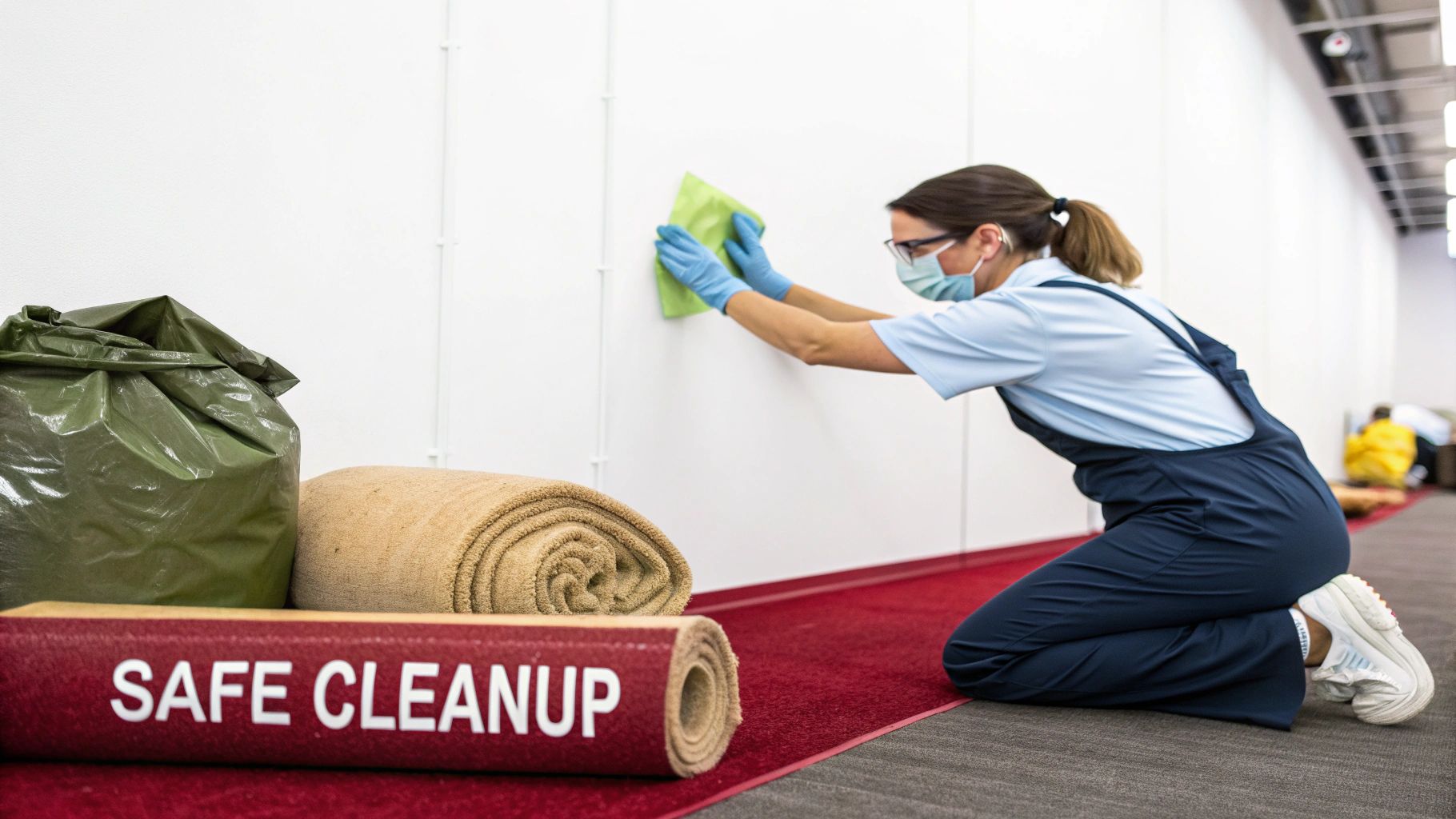
- Removal of Porous Materials: Meth residue has a nasty habit of seeping deep into porous items. Things like carpets, curtains, unsealed wood, and plasterboard often can't be saved. They must be carefully removed and disposed of as contaminated waste.
- HVAC System Decontamination: The heating, ventilation, and air-conditioning (HVAC) system is a prime culprit for circulating contaminated particles throughout a home. This makes it a primary target for a deep, thorough clean.
Beyond tackling meth contamination specifically, adopting general strategies for improving indoor air quality is also vital for reducing a wide range of respiratory exposure risks.
The ultimate goal of any remediation effort is not just to clean but to verify. Post-remediation verification testing is arguably the most important step. It provides objective, scientific proof that the cleanup has successfully reduced contaminant levels to below the nationally accepted health-based screening levels.
The Role of Post-Remediation Verification
After the cleaning crews pack up and leave, an occupational hygienist returns to the property to conduct what's known as clearance testing. This involves taking a fresh set of surface and air samples, often from the very same locations that were tested initially.
These new samples are sent back to the lab for analysis, and the results are meticulously compared against the Australian government guidelines. Only when these tests provide firm confirmation that the property is safe can a clearance certificate be issued, giving the green light for residents to return. This final verification is what closes the loop, linking the initial risk calculation to a successful outcome and ensuring that both dermal vs. respiratory exposure pathways were properly addressed. It’s this rigorous process that truly highlights why professional oversight is non-negotiable.
Frequently Asked Questions
When it comes to meth contamination, it's easy to get lost in the technical details. We get a lot of questions about the real-world signs, risks, and what it actually takes to make a property safe. Here are some straightforward answers to the most common queries we receive.
What Are the First Signs of Meth Contamination in a House?
Often, the signs are subtle and easy to miss if you don't know what you're looking for. A key indicator can be a strange, persistent chemical smell, sometimes like ammonia or vinegar.
You might also spot unusual yellow-brown stains on walls, floors, or around drains. Another red flag is finding a large amount of rubbish like empty cold medicine packets, batteries, or chemical containers left behind.
How Long Does Meth Residue Remain Dangerous on Surfaces?
Meth residue is notoriously stubborn. It doesn't break down or fade away on its own, meaning it can linger on surfaces and in materials for months, or even years, after the source is gone.
This persistence is why simply airing out a property isn't enough. Without a proper, professional decontamination process, the residue continues to pose a significant risk through both dermal and respiratory exposure.
Can I Clean Up Minor Meth Contamination Myself?
We strongly advise against any DIY cleanup attempts. It’s not just ineffective—it can be downright dangerous. Your typical household cleaners won't neutralise meth residue and can actually spread the contamination further or cause harmful chemical reactions.
Professionals use specialised chemical agents and follow very specific, controlled procedures to safely and thoroughly remove the contamination.
Because of the serious health risks involved, meth remediation isn't a DIY job. It absolutely has to be handled by certified professionals to ensure the property is brought back to Australian health and safety standards for someone to live there again.
Why Is Professional Testing Necessary After a Cleanup?
Post-remediation testing, often called "clearance" testing, is the final, crucial step. It’s the only way to scientifically prove that the cleanup worked and the property is genuinely safe.
An independent occupational hygienist will take new samples from surfaces and the air to verify contaminant levels are below the accepted national health-based guidelines. This isn't just for peace of mind—it's a critical step for legal compliance and provides the definitive all-clear.
At Anitech, our expert occupational hygienists specialise in comprehensive testing and risk assessment for hazardous contaminants. If you need to manage and mitigate residential health risks with scientific certainty, get in touch with our team.


