
Quick Summary: Methamphetamine residual toxicity refers to the significant health hazards posed by invisible chemical residues left on surfaces and in the air after drug use or production. This lingering contamination, which includes methamphetamine and often toxic precursor chemicals, exposes individuals to serious health risks through inhalation, skin contact, or accidental ingestion. Understanding the science behind this persistent hazard is crucial for effective risk management and ensuring a safe environment.
The comprehensive science of methamphetamine residual toxicity uncovers the persistent chemical dangers that linger long after methamphetamine has been used or manufactured. It’s a completely invisible threat, but one with very real and tangible health consequences. A space that appears perfectly clean can, in reality, be a source of continuous chemical exposure—a toxic footprint that doesn’t simply fade away on its own.
The Invisible Hazard of Methamphetamine Residual Toxicity
So, what exactly are we talking about? Methamphetamine residual toxicity is the scientific term for the health risks posed by the chemical compounds left behind when the drug is either smoked or manufactured. When heated, methamphetamine transforms into an aerosol—a fine mist of microscopic particles. These particles drift through the air and then settle, chemically bonding with nearly every surface they encounter.
Imagine an invisible chemical film coating walls, floors, furniture, and even penetrating deep into ventilation systems. This residue isn’t just leftover methamphetamine; it often includes a dangerous cocktail of hazardous precursor chemicals used in the manufacturing process, making the environment even more toxic.

This contamination puts anyone who enters the space directly at risk. Whether it’s your workers, maintenance crews, or future tenants, they can be exposed through three primary pathways:
- Inhalation: Breathing in contaminated dust or airborne particles.
- Dermal Absorption: Touching a contaminated surface allows the chemicals to be absorbed through the skin.
- Ingestion: Accidental hand-to-mouth contact, which is a common unconscious behaviour, transfers the residue directly into the body.
Smoking vs. Clandestine Lab Contamination
The level and type of toxicity you’re dealing with can vary hugely depending on the source. While both scenarios create risk, understanding the difference is fundamental to assessing the real danger in a residential, workplace, or industrial setting.
The core issue is that methamphetamine residue is a sympathomimetic agent, meaning it stimulates the sympathetic nervous system. Even at low levels, chronic exposure to these residual compounds can lead to a range of health issues, making professional assessment and remediation an essential public health and safety measure.
Contamination from smoking meth usually leaves behind lower, but still hazardous, concentrations of the drug on surfaces. On the other hand, a former clandestine lab is a completely different level of chemical hazard. These illegal labs are chaotic chemical environments where volatile reactions spray not just the finished drug but also highly toxic precursors and by-products throughout the property.
To help clarify the distinction, the table below outlines the different sources of contamination and the risks they pose.
Sources and Risks of Methamphetamine Contamination
This table summarises the primary sources of meth contamination and highlights the different risk profiles associated with each.
| Contamination Source | Typical Residue Levels | Primary Exposure Pathways | Key Associated Risks |
|---|---|---|---|
| Methamphetamine Smoking | Low to moderate (primarily meth) | Dermal, Inhalation, Ingestion | Chronic low-dose exposure, neurological effects, skin irritation, cardiovascular stress. |
| Clandestine Drug Lab | High to extreme (meth + precursors) | Inhalation, Dermal | Acute chemical burns, respiratory damage, corrosive exposure, explosion/fire hazards, long-term toxic effects from multiple chemicals. |
As you can see, the hazards escalate dramatically from user sites to production sites. These additional substances found in labs can be corrosive, flammable, or toxic in their own right, creating a complex chemical hazard that demands a far more sophisticated and careful remediation process.
For any facility manager or safety officer, determining which scenario you’re facing is the critical first step. It dictates the entire safety and cleanup strategy, as laid out in stringent Australian health and safety standards.
How Meth Residue Behaves in Residential Environments
The real problem with methamphetamine residue is its sheer persistence, a direct result of its chemical properties. When someone uses or manufactures meth, the drug doesn’t just stay in one place. It becomes an aerosol—a fine, invisible mist of drug particles that hangs in the air. These particles are chemically active; they seek out and cling to any surface they can find, creating a layer of contamination that’s not only unseen but incredibly difficult to remove.
This is how a seemingly clean home or workplace can quickly become a hidden reservoir of toxic chemicals. The aerosolised particles settle everywhere, from porous drywall and carpets to non-porous countertops and inside ventilation systems. Think of it less like dust and more like an invisible, sticky film that standard cleaning just can’t handle. The comprehensive science of methamphetamine residual toxicity makes it clear we’re not dealing with simple dirt; this is a bonded chemical hazard.

Why Residue Clings to Different Materials
How meth residue behaves depends entirely on what it lands on. For occupational hygienists at firms like Anitech, understanding this is crucial because a typical residential or industrial site is a complex mix of different materials, each posing a unique challenge.
- Porous Surfaces: Materials like unsealed concrete, wood, plasterboard, and fabrics are a huge headache. The tiny meth particles get absorbed deep into the material’s structure, almost like a sponge soaking up water. You can scrub the surface all you want, but the bulk of the contamination is trapped inside, ready to leach out over time.
- Non-Porous Surfaces: On the other hand, you have materials like stainless steel, glass, and sealed plastics. They don’t absorb the residue, but the drug forms a surprisingly strong molecular bond with the surface. Wiping it down with a regular cleaner might just smear the contamination around instead of actually breaking those chemical bonds to remove it.
This is why a typical home, with its porous drywall and non-porous kitchen surfaces, can become so thoroughly contaminated in such a complex way. Getting a handle on how these materials interact with the residue is the first step in any effective clean-up plan.
The Slow Process of Chemical Degradation
Unlike a lot of common household spills, meth residue doesn’t just evaporate or break down on its own. It’s a very stable chemical compound that can linger indoors for months, or even years, creating a serious long-term exposure risk. While a few environmental factors can influence how quickly it degrades, none of them work fast enough to be a real solution.
Methamphetamine acts as a sympathomimetic agent, stimulating the sympathetic nervous system. Its chemical stability means that even microscopic, residual amounts can continue to pose a health risk long after the initial contamination event, making its persistence a key focus of occupational hygiene.
Certain conditions can have a slow-and-steady effect on the residue:
- UV Light Exposure: Direct, intense sunlight is one of the few things in nature that can reliably break down the methamphetamine molecule. The catch? It only works on surfaces getting a full blast of sun, making it completely useless for indoor spaces, shaded areas, or inside equipment.
- Humidity and Airflow: High humidity can actually make things worse by encouraging the residue to “off-gas” or become airborne again, which increases the chance of someone inhaling it. And while a strong ventilation system might seem like a good idea, it often just spreads the invisible particles into previously clean areas, including the entire HVAC system.
- Temperature: Warmer temperatures can make the residue slightly more volatile, but not nearly enough to significantly reduce contamination levels in any meaningful way.
At the end of the day, you can’t just wait for nature to take its course. The slow, unpredictable breakdown of meth residue means that professional, science-based remediation is the only way to ensure a site is truly safe. This is precisely why professional testing and cleanup aren’t just recommended—they’re non-negotiable for protecting people and meeting Australian health standards.
How People Are Exposed and the Risks to Their Health
When we talk about meth residue, we’re not talking about something you can easily see or smell. It’s an invisible chemical layer, and that’s what makes it so dangerous. But how exactly does this unseen contamination get from a surface into a person’s body and cause harm? To really grasp the risk, we need to look at the ways people are exposed, often without even knowing it.
These aren’t just theories; they’re the practical, real-world ways toxic residues make their way into the human body. The deep science behind methamphetamine residual toxicity has shown us that even brief, seemingly minor contact can set off a chain reaction of harmful effects.
The Three Main Ways of Exposure
For anyone living or working in a contaminated environment, the exposure happens in ways that are subtle but incredibly effective. Each route carries its own set of risks.
- Inhalation: This is probably the most direct path. Microscopic meth residue particles can cling to dust. The moment someone walks through a room, turns on a fan, or even just disturbs the air, these contaminated dust particles become airborne. Breathing them in sends the toxins straight to the lungs, where they’re quickly absorbed into the bloodstream and circulated throughout the body.
- Dermal Absorption: Your skin might feel like a solid barrier, but it’s not. When a person touches a contaminated surface like a countertop, wall, or tool, the chemical residue can seep right through their skin. This is a particularly sneaky route because it can happen over and over again throughout the day, completely unnoticed.
- Ingestion: Accidentally eating the residue sounds unlikely, but it’s more common than you’d think. It happens through simple hand-to-mouth habits. Think about a child playing on the floor and then putting their hands in their mouth, or an adult eating lunch after touching a contaminated surface. The residue travels from hands to mouth and is then absorbed through the digestive system.
Put these three pathways together, and you can see how anyone in a contaminated space is at risk. Everyday actions are suddenly transformed into potential exposure events.
Toxicokinetics: What Happens Inside the Body
Once meth residue gets inside the body, it doesn’t just vanish. The science of how a chemical is absorbed, distributed, broken down, and eventually removed is called toxicokinetics. With methamphetamine, this internal journey is complicated and really drives home why even low-level exposure is a major public and occupational health concern.
The body, primarily the liver, gets to work trying to metabolise the drug using an enzyme known as CYP2D6. Here’s the catch: not everyone’s body is equally good at this. How fast or slow your body processes chemicals is down to your individual genetics, and this variation is a massive factor in how susceptible you are to harm.
Two people can be exposed to the exact same amount of contamination, yet one might have a severe reaction while the other has none. This is all down to individual metabolic differences, which is why we need safety standards that protect everyone, especially the most vulnerable, not just the ‘average’ person.
This genetic lottery explains why a blanket, “one-size-fits-all” approach to risk assessment just doesn’t work. Some groups are naturally more vulnerable. In fact, around 5.4% of Australians are considered ‘poor metabolisers’ of methamphetamine because of their genetics. That figure can jump even higher for people taking common medications that slow down their metabolism. This is exactly why a deep, expert understanding of methamphetamine residual toxicity is non-negotiable for building safety specialists. To dig deeper into the health impacts, you can review the technical paper on methamphetamine smokehouses.
The Dose Makes the Poison
A core principle in toxicology is the dose-response relationship. Simply put, the more you’re exposed to, the worse the harm. But with meth residue in a residential or workplace setting, the big danger isn’t usually a single, massive exposure. It’s the slow, steady drip of chronic, low-level contact day in and day out.
Picture a leaky tap dripping into a bucket. A single drop is nothing, but leave it for long enough, and the bucket will eventually overflow. It’s the same with small, daily exposures to meth residue. They can build up in the body over time, leading to serious health problems.
This long-term, cumulative damage is precisely why professional testing and remediation are so critical. Even if the residue levels seem low—not enough to cause immediate, obvious symptoms—they can still be contributing to serious chronic health issues down the track. Protecting people means finding and stopping that “drip” for good.
What Meth Residue Actually Does to the Human Body
Understanding the chemistry is one thing, but it’s what happens when people come into contact with methamphetamine residue that really brings the risks home. This isn’t just about abstract science; it’s about connecting the dots between invisible contamination and the very real, often severe, health problems that can follow. For anyone responsible for property or workplace safety, this connection is the critical ‘why’ that drives every test and clean-up procedure.
It’s a common misconception that exposure will always cause an immediate, obvious reaction. In reality, the health effects exist on a spectrum. They can range from short-term issues that are easily brushed off as something else, to chronic conditions that build up quietly over months or even years of low-level contact. This slow, insidious onset makes it incredibly difficult to pinpoint the cause without a professional assessment.
Acute or Short-Term Health Effects
When someone is first exposed to a meth-contaminated environment, the body can react pretty quickly. These initial symptoms are often the first red flag, but they’re so common that they’re frequently mistaken for allergies, a head cold, or just feeling run down.
Watch out for these common acute symptoms:
- Respiratory Irritation: A nagging cough, shortness of breath, or a burning feeling in the throat as tiny airborne particles are inhaled.
- Headaches and Dizziness: The chemical’s stimulating effect on the nervous system can trigger persistent headaches, light-headedness, or a general feeling of being off-balance.
- Skin and Eye Irritation: Rashes, redness, itching, and burning or watery eyes can all result from direct contact with contaminated surfaces.
- Nausea and Abdominal Discomfort: If residue is ingested, often through hand-to-mouth contact, it can easily upset the digestive system.
While these might seem like minor complaints, they are your body’s early warning system screaming that it’s being exposed to something toxic. Ignoring these signals can pave the way for much more serious, long-term health battles.
Chronic or Long-Term Health Consequences
The biggest threat from lingering methamphetamine residue is the risk of chronic, long-term health damage. When someone is exposed continuously, even to low doses, the toxins can accumulate in their body. This leads to systemic problems that can be debilitating or even life-threatening. The main targets are two of the body’s most critical systems: the cardiovascular and the neurological.
Think of methamphetamine as a potent sympathomimetic agent—it essentially tricks the body into a constant ‘fight or flight’ state. Chronic exposure forces the cardiovascular and nervous systems to stay on high alert, 24/7. This relentless pressure causes accelerated wear and tear, which can eventually lead to irreversible organ damage.
This constant state of stimulation puts an immense strain on the heart and blood vessels. Pathological data paints a grim picture: cardiovascular complications are a dominant feature in methamphetamine-related deaths, found in a staggering 54% of cases, with coronary artery atherosclerosis (hardening of the arteries) being a key culprit. On top of that, cerebrovascular problems like brain haemorrhages were present in 20% of cases. These numbers aren’t just statistics; they highlight a severe cardiotoxicity risk and underscore why OHS professionals must grasp these impacts when assessing a contaminated property. You can discover more about these pathological findings and what they mean for risk assessment.
Neurological and Cardiovascular Damage
The long-term assault on the body’s core systems is profound. It can directly impact a person’s quality of life and their ability to function day-to-day.
Cardiovascular System Damage:
- Hypertension: Sustained high blood pressure from being in that constant state of alert.
- Cardiomyopathy: A weakening of the heart muscle, making it harder to pump blood.
- Arrhythmias: An irregular heartbeat that seriously increases the risk of stroke and heart failure.
- Atherosclerosis: The hardening and narrowing of arteries, restricting blood flow.
Neurological System Damage:
- Cognitive Impairment: Trouble with memory, focusing, and making decisions.
- Mood Disturbances: A higher risk of developing anxiety, depression, and paranoia.
- Motor Control Issues: Uncontrollable tremors, problems with coordination, and muscle twitching.
- Permanent Nerve Damage: Over time, exposure can cause lasting damage to the body’s nerve cells.
Understanding these severe outcomes highlights the serious duty of care property owners and employers have. The ultimate goal is to protect people from preventable health crises like these, which is why implementing stringent, science-backed testing and remediation protocols—guided by experts like the team at Anitech—is non-negotiable.
Making Sense of Australia’s Remediation Standards
If you’re a property owner or organisation grappling with potential methamphetamine contamination, getting your head around the regulations is crucial. This isn’t just about ticking compliance boxes; it’s about making smart, science-driven decisions to protect people and your assets. The Australian government has laid out some clear guidelines to help, offering a logical framework for assessing risk and taking responsible action. These rules aren’t designed to create alarm but to provide a structured path forward.
At the core of this approach are the Health Investigation Levels (HILs). These aren’t just random numbers. They are carefully calculated thresholds that give occupational hygienists and property managers a tangible way to measure potential risk. Think of them as the bridge connecting the comprehensive science of methamphetamine residual toxicity to practical safety metrics we can actually use on the ground.
Decoding the Numbers
The key reference point for anyone in Australia dealing with this issue is the National Clandestine Drug Laboratory Remediation Guidelines. This document establishes the benchmark for what “clean” looks like after a professional decontamination.
The national guideline for an acceptable surface level after remediation is 0.5 micrograms (µg) per 100 square centimetres (100cm²). This is the standard used to confirm a property is safe to re-enter following its use as a meth lab or from heavy user contamination.
That figure—0.5µg/100cm²—is the finish line. It’s the scientifically backed level where a property is considered safe for people to live or work in without facing a significant long-term health risk. It’s important to remember this is a post-remediation target, not an initial trigger for panic.
Why a Risk-Based Approach is Key
Discovering levels above this guideline doesn’t automatically mean you’ve got a toxic disaster on your hands. Instead, Australian standards champion a risk-based approach. The guidelines are there to kick off a clear sequence of events: assess the situation, investigate thoroughly, and only then, if necessary, remediate.
This measured process stops property owners and businesses from overreacting to initial findings and ensures the response fits the real-world risk. It’s all about empowering decision-makers with data, not fear.
- Initial Screening: A positive test is simply a signal that a more detailed investigation by a qualified occupational hygienist is needed.
- Detailed Assessment: An expert will then carry out comprehensive sampling to map out exactly where the contamination is and how concentrated it is.
- Risk Evaluation: With that data, they can evaluate the actual health risk, taking into account things like how the space is used, its ventilation, and the types of surfaces involved.
- Remediation Plan: Only after all this is a targeted remediation plan put together to bring contamination levels safely below the 0.5µg/100cm² guideline.
Following this process ensures you use your resources wisely and keep disruption to a minimum. It shifts the conversation from “we have a problem” to “we have a plan.”
Navigating the Different Thresholds in Australia
While 0.5µg/100cm² is the nationally recognised goal for remediation, it’s not the only number you might come across. Different states have their own nuances, and you’ll sometimes see other figures pop up in reports or discussions.
This is where things can get a bit confusing, but a proper risk-based view clears it up. The table below breaks down the key Australian guidelines and what they mean in practical terms.
Australian Methamphetamine Contamination Thresholds
Here’s a breakdown of key Australian guidelines and what they signify for property and workplace assessment.
| Guideline/Threshold Level (µg/100cm²) | Regulating Body/Source | Typical Scenario | Required Action |
|---|---|---|---|
| 0.5 µg/100cm² | National Clandestine Drug Lab Remediation Guidelines | Post-Remediation Target: The legally recognised standard for declaring a property safe for reoccupation. | Verification Goal: Professional remediation must achieve this level or lower. Final testing confirms success. |
| 1.5 µg/100cm² | WA Department of Health (Investigation Level) | Investigation Trigger: Often used as a preliminary screening level in Western Australia. | Further Assessment: A reading at this level triggers a formal, detailed site investigation by a hygienist. |
| 5.0 µg/100cm² | QLD Health (Investigation Level) | High-Level Trigger: Historically used in Queensland as a signal for significant contamination. | Detailed Investigation & Risk Assessment: Indicates a higher likelihood of risk requiring expert evaluation. |
| Up to 3.8 µg/100cm² | enHealth (Risk-Based Recommendations) | Context-Dependent Assessment: Used by hygienists to evaluate risk in low-intensity use areas. | Risk-Based Management: May not require full remediation if exposure pathways are controlled and risk is low. |
As you can see, context is everything. Higher investigation levels, like the 1.5 micrograms per 100cm² used in some states, shouldn’t be seen as an immediate health danger but as a clear trigger for a more detailed assessment. You can find more information about how these standards are interpreted in practice and learn about busting some meth contamination myths.
Ultimately, making sense of these numbers requires real expertise. A professional hygienist, like the team at Anitech, can decipher the test results, explain exactly what they mean for your specific property, and guide you through the regulatory maze with clarity, ensuring both the safety of occupants and your complete compliance.
Your Guide to Professional Decontamination
Understanding the science behind meth residue is one thing, but translating that knowledge into a safe environment requires a clear, methodical action plan. This isn’t a DIY job. The path from suspected contamination to a verified clean slate depends entirely on the expertise of a professional occupational hygienist. Their job is to cut through the complex chemistry and regulations, creating a systematic process that protects people and ensures compliance.
This process eliminates guesswork by relying on hard data at every single step. It all starts with a thorough initial site assessment to get a feel for the property layout and pinpoint potential contamination hotspots. From there, the hygienist maps out a strategic sampling plan to accurately determine the extent and concentration of the residue.
The Role of an Occupational Hygienist
Think of an occupational hygienist as your expert guide through this entire process. These are trained scientists who live and breathe the world of anticipating, recognising, evaluating, and controlling environmental and workplace hazards.
In a meth contamination scenario, their responsibilities are clear-cut:
- Initial Site Assessment: They dig into the history and use of the space to identify high-risk areas where contamination is most likely.
- Strategic Sampling: Using accredited, scientific methods, they collect surface samples that are then sent off for precise laboratory analysis.
- Data Interpretation: This is where expertise really shines. They analyse the lab results against Australian health and safety standards to figure out the actual level of risk.
- Remediation Oversight: They create a detailed scope of works for specialised cleaners and oversee the entire decontamination process to ensure it’s done right.
- Verification Testing: The final, crucial step. They conduct clearance sampling to prove the area is safe for reoccupation and meets the strict 0.5µg/100cm² guideline.
The infographic below lays out the straightforward, standards-based process we follow here in Australia.
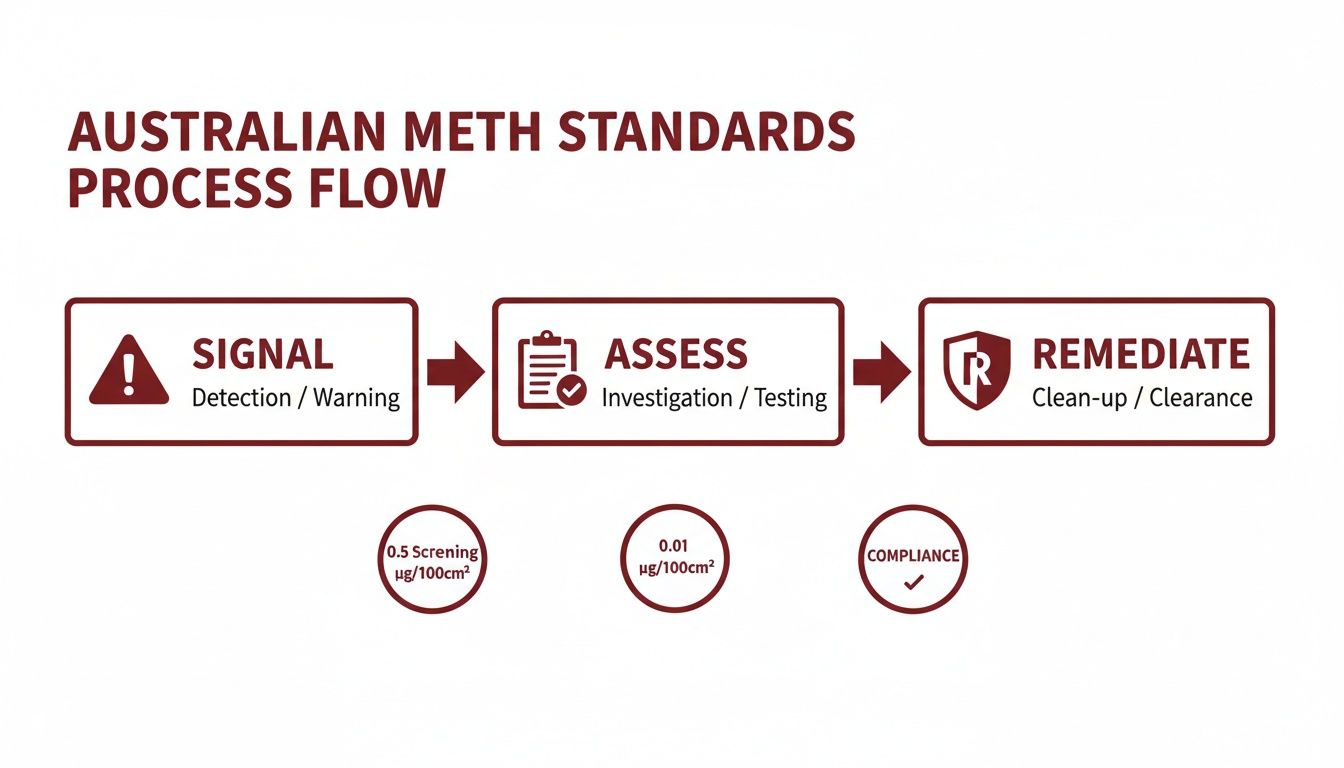
As you can see, a positive initial signal isn’t a cause for panic. It’s simply the trigger for a professional assessment, which then informs a proportionate and effective remediation strategy. When looking at the most thorough decontamination methods, it’s also worth understanding how specialised air purification systems can play a critical role in removing airborne contaminants.
At the end of the day, bringing in experts like the team at Anitech is the only way to properly manage the risks of methamphetamine residue. This approach doesn’t just protect the health and safety of occupants; it also minimises disruption and shields property owners and businesses from significant liability.
Frequently Asked-About Topics
When you’re dealing with potential methamphetamine contamination, a lot of questions come up. We get it. Here, we’ve tackled some of the most common queries we hear from property managers, homeowners, and safety officers to give you clear, science-backed answers for protecting your property and the people in it.
How Long Does Methamphetamine Residue Remain Dangerous?
Methamphetamine residue is incredibly stubborn. It doesn’t just fade away over time and can stay at dangerous levels for years if left untreated.
How long it sticks around depends on a few things: how heavy the initial contamination was, what surfaces it’s on (it clings to porous materials like wood and drywall far more than non-porous steel), and how much sunlight it gets (UV light can help break it down, but very slowly).
The key takeaway is that without professional decontamination, the residue will remain well above safe levels indefinitely. This is why you can’t just air a place out or leave it vacant; professional testing is the only way to know for sure.
Can We Just Use Our Regular Cleaners to Get Rid of It?
Absolutely not, and it’s critical to understand why. Standard cleaning methods and everyday products are completely useless against methamphetamine residue. General-purpose cleaners, bleach, and even industrial-strength janitorial supplies won’t neutralise the chemically bonded compounds.
Trying to clean meth residue with normal products is more than just ineffective—it’s actively dangerous. You’ll likely just smear the invisible contamination over a wider area, which only increases the exposure risk for your cleaning staff and anyone else who enters the space.
Proper remediation is a specialised science. It demands specific chemical agents, proven techniques, and strict, controlled procedures that can only be carried out by certified professionals.
What Are the First Steps if We Suspect Contamination?
If you have any reason to suspect contamination in your property, your first and most important job is to restrict access to the area immediately. This prevents anyone else from being exposed. Don’t try to clean it, investigate it, or handle anything yourself.
Your next step is to call a qualified occupational hygiene firm. They’ll provide a confidential consultation and map out a scientific sampling plan to figure out if contamination is present and how widespread it is. This expert assessment is the essential starting point for building a safe and effective remediation plan for your site.
Don’t leave your property’s safety to chance. Anitech provides expert, science-backed occupational hygiene services to definitively identify and manage methamphetamine residual toxicity. Protect occupants and ensure compliance by scheduling a confidential consultation with our team today.
📚 More in This Series: Health, Science & Exposure
- Why Test Your Property for Meth? Health, Safety & Law
- Meth Exposure Health Risks: Dermal vs Respiratory Routes
- Third-Hand Meth Exposure in Children and Pets: Key Signs
- Low-Level Meth Contamination: Long-Term Occupancy Safety
- Meth + Lead & Asbestos Co-Contamination Risks | White Paper
- Professional vs DIY Meth Decontamination: Health Outcomes


