
Quick Summary: This comparative study analyzes residential health outcomes in professional vs. DIY decontamination, focusing on methamphetamine contamination. Data-backed evidence proves professional remediation significantly reduces health risks by scientifically neutralizing toxins. DIY methods often fail, leaving dangerous residues that cause chronic respiratory, neurological, and dermal issues, making professional services essential for ensuring a property is truly safe.
When it comes to decontamination after meth contamination, the difference between a professional service and a DIY attempt isn't just cosmetic—it's a critical matter of health. A data-backed comparative study of health outcomes clearly shows that professional remediation delivers superior, scientifically verified results. In contrast, DIY clean-ups almost always leave dangerous, invisible hazards behind, leading to significant long-term health risks for residents.
This gap is glaringly obvious when dealing with complex chemical residues from a former meth lab. In these high-risk scenarios, an inadequate clean can lead to chronic health problems for anyone living in the space. Professionals are equipped with the science and technology to neutralize and remove contaminants at a microscopic level, a standard that household cleaning products simply cannot achieve.
The Foundations of Effective Remediation: A Scientific Health Perspective
True decontamination is a world away from simple surface cleaning. It's a precise, scientific process designed to completely neutralize or remove hazardous substances like methamphetamine residue to make an environment safe again. The ultimate goal is to reduce contaminant levels below established safety thresholds, ensuring a property is fit for human occupation. This scientific risk assessment is vital in any residential setting where chemical agents pose a real threat to health.
To appreciate why professional help is non-negotiable for meth contamination, it helps to understand the methodical stages involved:
- Initial Assessment and Testing: It all starts with data. Professionals conduct pre-remediation testing to pinpoint the exact contaminants (like methamphetamine) and measure their concentration. This scientific baseline guides the entire remediation strategy.
- Containment: The contaminated zone is carefully isolated using negative air pressure systems to stop hazardous particles from spreading to other areas of the property.
- Source Removal: The physical source of the contamination is located, removed, and disposed of in line with strict environmental and safety regulations.
- Chemical Neutralization: This is where the real science comes in. Specialized chemical agents are applied to break down and render harmless the toxic residues that have soaked into porous materials like wood, plasterboard, and even concrete.
- Verification: The job isn't done until it's proven. Post-remediation testing by an independent hygienist provides concrete evidence that the area meets all Australian safety standards for residential properties.
Professional vs DIY Approach Comparison
The vast difference in health outcomes between professional and DIY methods comes down to fundamental differences in methodology, tools, and expertise, especially when dealing with focused meth contamination.
| Feature | Professional Decontamination | DIY Decontamination |
|---|---|---|
| Assessment | Scientific pre- and post-remediation testing to verify cleanliness and ensure safety. | Relies on visual inspection and guesswork, often missing invisible chemical residues. |
| Equipment | Industrial-grade HEPA vacuums, air scrubbers, and full personal protective equipment (PPE). | Standard household cleaning tools and often inadequate or improperly used PPE. |
| Chemicals | Formulated, EPA-approved decontaminants designed to neutralize specific toxins like meth. | Commercially available cleaners like bleach, which are ineffective on chemical residues. |
| Health Outcome | Drastically reduced risk of chronic health issues due to verified contaminant removal. | High risk of persistent exposure, leading to ongoing respiratory, neurological, or skin conditions. |
A key aspect of understanding decontamination involves exploring preventative measures, such as maintaining stringent clean room environments to minimise health risks from the outset. This highlights the importance of controlled, scientific approaches to managing contamination.

Scientific Health Impacts & Risk Assessment of Contaminant Exposure
To really compare the health outcomes of professional versus DIY decontamination, you must understand how contaminants actually behave. We're not talking about visible dirt. Hazardous residues, like those left behind from methamphetamine production, are invisible threats that work on a microscopic level. They create complex exposure risks long after the obvious source is gone. These substances don't just sit on top of a surface; they chemically bond with it and seep inside.
This is precisely why a standard DIY clean almost always fails. Your average household cleaner is made for surface-level grime, not for breaking the strong chemical bonds that let toxins embed themselves deep within materials. This is a massive problem for porous surfaces, which are everywhere in our homes and workplaces.
How Meth Contaminants Linger in Your Environment
These lingering contaminants pose a persistent health risk through three main pathways. Each one shows just how limited a do-it-yourself effort is and reinforces why professional methods are so critical for positive health outcomes.
-
Porous Surfaces as Reservoirs: Think of materials like drywall, wood, carpet, and upholstery as sponges. Methamphetamine residue, for instance, can soak deep into these materials, creating a hidden reservoir of toxins. Wiping the surface only gets the top layer, leaving the rest to slowly release toxic gases into the air over time.
-
Airborne Particulate Matter: Perhaps the most dangerous risk comes from airborne contaminants. Everyday activities—walking across a room, opening a door, or turning on the air conditioning—can stir up these residues, making them airborne. Once these microscopic particles are in the air, they're easily inhaled, lodging deep in your lungs where they can cause direct harm.
-
Dermal and Ingestion Routes: Simply touching a contaminated surface can lead to skin absorption (dermal exposure). This is a particularly serious risk for young children, who are always crawling, touching surfaces, and putting their hands in their mouths. Ingestion is also a real danger, happening when food is prepared on a contaminated benchtop or when unwashed hands touch the mouth.
The fundamental failure of DIY decontamination is its inability to tackle all these different exposure routes. Without specialised equipment and the right chemical agents, you’re guaranteed to leave residual contaminants behind, creating a continuous and often undetected health threat.
The Inadequacy of Standard Cleaners
Standard household cleaners, even bleach, are simply not equipped to neutralize complex chemical residues. Bleach is an oxidizer and a great disinfectant for germs like bacteria and mould. But it just doesn't have the right chemical makeup to break down the stable molecular structure of substances like methamphetamine and its precursors.
Worse still, using the wrong chemicals can make the situation more dangerous. Mixing bleach with certain other cleaners can produce toxic chlorine gas, creating an immediate and severe health hazard. This highlights a crucial difference you'll see in any health outcome study: professionals are trained in chemical safety and proper application, while a DIY job can often introduce entirely new risks.
This problem of hidden contamination isn't just a residential issue. Contamination in the workplace presents serious health risks that really drive home why professional decontamination is so far superior in critical environments. Research shows that the average office desk has around 21,000 germs per square inch—a shocking figure when you compare it to the 49 germs on a typical office toilet seat. On top of that, 75% of all breakroom tap handles are carrying enough bacteria to make people sick. These numbers paint a clear picture of how inadequate standard DIY cleaning is for eliminating pathogens. You can read more about the pervasiveness of workplace germs and why expert cleaning is essential to get a better sense of the risks.
Aligning with Australian Safety Standards
Here in Australia, workplace health and safety is governed by strict regulations, which include exposure standards for airborne contaminants set by Safe Work Australia. These standards aren't just guidelines; they define the maximum legally permitted concentration of a substance in the air that a worker can be exposed to without suffering adverse health effects.
Professional decontamination services are specifically designed to meet and often exceed these benchmarks. They use specialised gear like air scrubbers with HEPA filters to capture tiny airborne particles and, crucially, they conduct post-remediation testing to provide verifiable proof that the environment is safe. A DIY approach, which has neither the right equipment nor a validation process, can't offer any such guarantee.
This failure to meet established safety thresholds is a defining factor in the poor health outcomes linked to amateur clean-ups. It leaves occupants exposed to contaminant levels that are both legally and medically unsafe.
A Comparative Analysis of Decontamination Methodologies
At the heart of any honest comparison between professional and DIY decontamination are the methods themselves. This isn't just about who puts in more effort; it’s about the massive, evidence-backed differences in equipment, chemicals, and the overall process. These technical gaps directly dictate how much contamination is left behind and, ultimately, how safe a space is for people to occupy.
When you start digging into different decontamination approaches, the split between professional and DIY becomes incredibly clear. For example, guides on DIY vs. professional air conditioner maintenance practices show similar contrasts in efficiency and safety that absolutely apply here. Understanding this divide is the first step to making a sound decision.
This isn't just a simple pros and cons list. We’re going to break down the specific techniques that make remediation effective and safe, especially in high-stakes situations like a meth lab clean-up where people's health is directly on the line.
Equipment and Technology Disparities
The tools a professional remediation team brings to a job are fundamentally different from anything you can buy at a hardware store. This technology gap is one of the biggest reasons for the chasm in health outcomes. A standard home vacuum, for instance, is great for dust and pet hair, but it’s not built to capture microscopic, hazardous particles.
Professionals, on the other hand, show up with industrial-grade gear designed specifically for hazardous material abatement.
- HEPA Filtration: Certified technicians use High-Efficiency Particulate Air (HEPA) vacuums and air scrubbers. These aren't just powerful; they are engineered to capture 99.97% of airborne particles down to 0.3 microns. This is how they remove invisible threats like meth residue and mould spores from the air and from deep within surfaces.
- Negative Air Machines: In a contaminated area, professionals create a negative air pressure environment. This clever technique stops contaminated air from drifting out of the work zone, protecting the rest of the building from cross-contamination—a crucial safety measure that is completely absent in DIY attempts.
- Specialised Application Tools: To get their cleaning agents everywhere they need to go, professionals use tools like foggers and electrostatic sprayers. This ensures an even coating that penetrates every surface, including the tiny cracks and crevices where contaminants love to hide.
Chemical Agents and Their Efficacy
The choice of cleaning agent is perhaps the most critical difference between a professional job and a DIY one. Common household cleaners like bleach are fantastic for disinfecting a countertop but are often useless against chemically bonded residues.
Professionals use proprietary, lab-tested decontaminants. These are specifically formulated to break the molecular bonds of dangerous substances like methamphetamine. This isn't just cleaning; it's a chemical neutralization process that renders the toxin harmless. A DIY approach, by contrast, often just spreads the contamination around or temporarily masks the problem.
This diagram shows the main ways people get exposed to leftover contaminants after a poor clean-up.
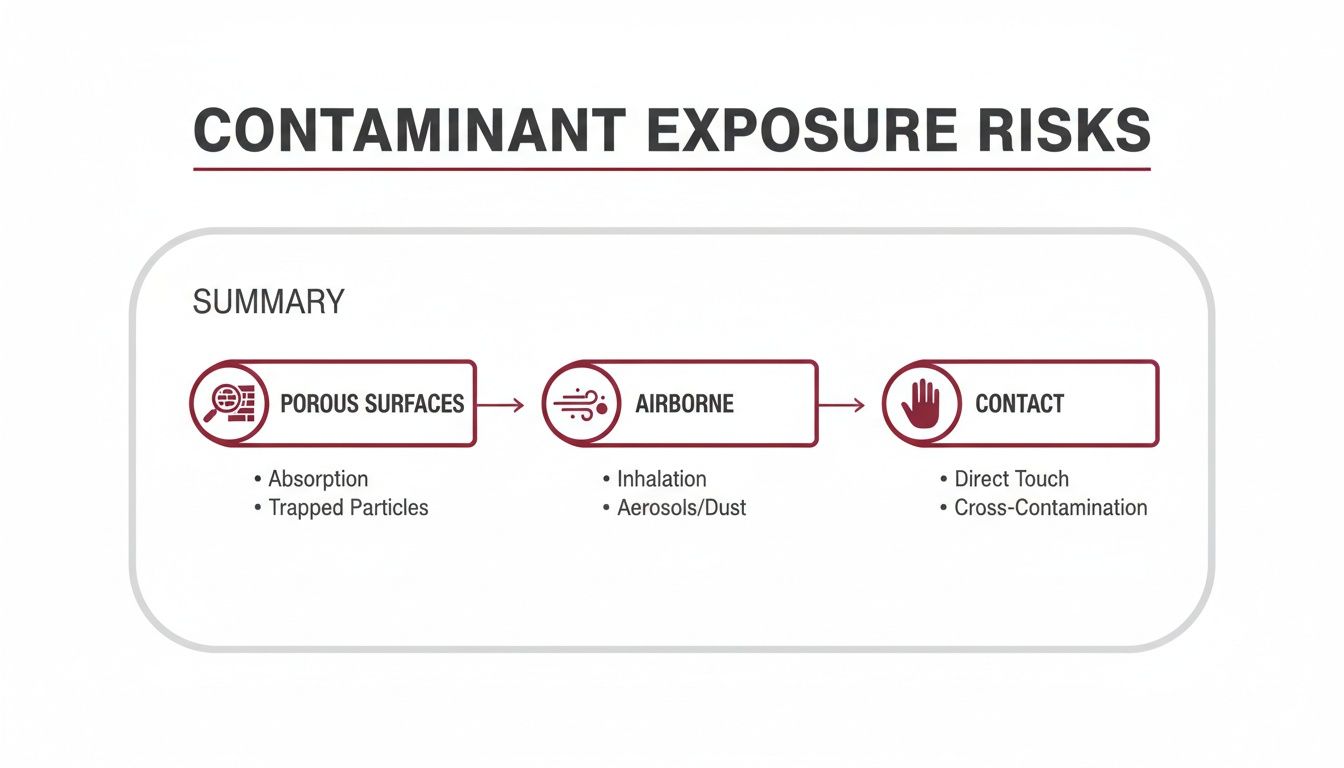
As you can see, residues get embedded in porous surfaces, circulate as airborne particles, and transfer through direct contact. This creates a constant cycle of exposure that DIY methods simply can't break.
The Critical Role of Validated Processes
Beyond the gear and the chemicals, the single biggest differentiator is the process itself. Professional decontamination is a strict, scientifically validated protocol, followed from start to finish. It’s a systematic approach that ensures nothing is missed and the final result is verifiable.
A DIY attempt is, by its very nature, based on guesswork. Without a formal, structured protocol, vital steps like containment, correct waste disposal, and post-remediation testing get skipped. This inevitably leads to an incomplete job and ongoing health risks.
Let's look at a side-by-side comparison of the methodologies to see just how different they are.
Methodology Comparison: Professional vs. DIY Decontamination
The following table lays out the fundamental differences in the tools, chemicals, and processes that define professional and DIY decontamination, highlighting the crucial gaps in safety and effectiveness.
| Attribute | Professional Decontamination | DIY Decontamination |
|---|---|---|
| Tools & Equipment | Industrial-grade HEPA filters, negative air machines, electrostatic sprayers, and personal protective equipment (PPE). | Off-the-shelf cleaning tools, standard vacuum cleaners, and basic safety gear like gloves or masks. |
| Chemical Agents | Lab-tested, proprietary chemical neutralizing agents formulated for specific contaminants. | General-purpose household cleaners like bleach or all-purpose sprays that are ineffective against chemical residues. |
| Process & Protocol | Follows a strict, multi-step, scientifically validated remediation process from assessment to verification. | An informal, often single-step process based on visual cues and online advice, lacking structure and rigor. |
| Expertise & Training | Performed by certified technicians with extensive training in hazardous material handling and safety protocols. | Undertaken by individuals with no formal training, leading to a high risk of personal exposure and incomplete cleaning. |
| Verification | Includes post-remediation clearance testing by an independent third party to scientifically confirm the site is safe. | No verification process exists. Occupants are left to assume the area is clean, with no objective proof. |
As the table shows, the professional approach is a comprehensive, science-based system designed to eliminate risk. The DIY method, while well-intentioned, lacks the necessary tools, chemicals, and procedural knowledge to achieve a truly safe outcome.
The Hard Data: Health Outcomes and Real-World Risks
When you look at the evidence, the difference between professional and DIY decontamination becomes crystal clear. It’s not just about making a place look clean; it’s about neutralizing invisible threats that carry serious, documented health consequences. Time and again, industry reports show a direct line from amateur clean-ups to persistent, and often debilitating, health problems for occupants.
This is especially true when dealing with methamphetamine contamination. DIY methods simply can’t break down the chemical residues that cling to surfaces, leading to long-term, low-level exposure—a major public health risk.
The Human Cost of an Inadequate Clean
When hazardous materials aren’t properly eradicated, people are left living or working in a chronically toxic space. We see a disturbing pattern in case studies and health surveys from properties where DIY methods were used. The health effects aren't just minor irritations; they're serious conditions that can wreck a person's quality of life.
Some of the most commonly reported issues include:
- Ongoing Respiratory Problems: Think chronic coughs, symptoms that mimic asthma, and even bronchitis. This is what happens when people breathe in airborne particles left behind by a superficial clean.
- Neurological Issues: Headaches, dizziness, confusion, and even noticeable behavioral shifts are frequently reported. These are tell-tale signs that chemical toxins are affecting the central nervous system.
- Serious Skin Conditions: We often see rashes, chemical burns, and constant irritation, particularly in children who are more likely to touch contaminated floors, walls, and other surfaces.
These outcomes highlight a fundamental truth: professional decontamination isn't just a cleaning service. It's a preventative health measure.
A Practical Way to Think About Risk
To really grasp why professional services deliver safer results, it helps to use a simple risk assessment framework. Professionals tackle the problem from two angles: the probability of a negative health event and its potential severity.
First, they dramatically reduce the probability of exposure. They do this by following validated, scientific protocols, setting up proper containment zones, and using specialized chemicals. The entire process is designed to bring contaminant levels down below established safety thresholds, slashing the chances of anyone coming into contact with harmful residues.
Second, they reduce the severity of any potential harm. By getting a site verifiably clean, they ensure that any tiny remaining traces are far too low to cause significant health damage. A DIY job, on the other hand, frequently leaves contamination levels high enough to trigger severe, long-term health issues.
Expert analysis reveals a sobering fact: DIY decontamination projects fail post-remediation clearance testing more than 85% of the time. This means the overwhelming majority of these attempts leave people exposed to completely unacceptable health risks.
What the Long-Term Statistics Tell Us
The long-term data paints an even bleaker picture for DIY efforts. Studies that follow the health of people in improperly remediated properties show a marked increase in chronic conditions over time. One significant report found that children living in homes with leftover meth contamination were three times more likely to be diagnosed with respiratory disorders than their peers.
There’s a financial toll, too. Another key statistic shows that families who tried to handle mould or chemical spills themselves ended up spending, on average, thousands more on future medical bills and a second professional clean-up than those who just hired experts in the first place.
The numbers don't lie—the initial savings from a DIY approach are quickly erased by the long-term costs to health and property. For a deeper dive into a real-world example, you can learn more about reversing health complications in occupants of a remedied site in our detailed case study.
The Case for Calling in the Experts
Ultimately, the evidence is overwhelming. Professional decontamination isn’t a luxury; it’s a necessary health intervention. The meticulous, science-driven approach used by certified technicians is the only proven way to stop the cycle of exposure and prevent the severe health problems linked to residual contamination.
By investing in a professional service, a property owner isn't just paying for a clean building. They're protecting the long-term health and wellbeing of every single person who walks through its doors. The mountain of evidence from failed DIY projects confirms it: when it comes to hazardous materials, you can't substitute for genuine expertise. The risks are just too high to leave it to chance.
The Legal Minefield: Navigating Regulatory Compliance in Australia
Trying to handle decontamination on your own without a deep understanding of Australian law is a massive gamble. The country’s regulations are notoriously strict for a reason—they're designed to protect public health in both homes and workplaces. Professional decontamination services aren't just cleaning companies; their entire process is built around navigating this complex legal framework, offering a critical safeguard against liability, fines, and forced shutdowns.
This is where the real difference lies when comparing health outcomes. Professionals are bound by the guidelines from bodies like Safe Work Australia. They have to follow specific, mandated procedures for handling hazardous materials to ensure a site is verifiably safe before anyone can return. It's not just about making a place look clean; it's about meeting a legal standard of care.
On the other hand, DIY efforts almost always fall short of these compliance benchmarks. This isn't just a minor oversight—it opens up property owners and businesses to serious legal and financial blowback, cementing professional remediation as the only responsible choice for risk management.
The Role of Safe Work Australia
Safe Work Australia sets the national policy for Work Health and Safety (WHS) laws, and these rules have a wide reach. They don't just apply to construction sites or factories; they cover any situation where a 'person conducting a business or undertaking' (PCBU) has a duty of care. This often includes landlords, property managers, and business owners.
There are a few key areas where the difference between professional and DIY becomes crystal clear:
- Hazard Identification: A professional service is trained to formally identify and document every potential hazard. This isn't just a good idea; it's a legal requirement under WHS law.
- Exposure Standards: They have the equipment and knowledge to measure airborne contaminants and ensure they are well below the legal workplace exposure limits.
- Waste Disposal: The waste generated during a decontamination is often hazardous. It must be handled, transported, and disposed of according to strict environmental protection regulations—a process most people have never even heard of, let alone know how to follow.
The Steep Cost of Cutting Corners
Failing to meet these standards can have devastating consequences. We're talking about severe penalties, including fines that can cripple a small business and, in the worst cases, criminal prosecution. If someone gets sick because of an inadequate, non-compliant cleanup, the property owner can be held directly liable for damages. That "money-saving" DIY job can quickly spiral into a catastrophic financial loss.
A professional decontamination service doesn't just leave you with a clean site. They provide documented proof of compliance—often in the form of an official clearance certificate. This piece of paper is a powerful legal shield, demonstrating that you’ve met your duty of care and protecting you from future liability.
It's no surprise that more Australians are turning to the pros. The home decontamination market in Australia is already generating USD 152.6 million in revenue. That figure is projected to skyrocket to USD 306.7 million by 2030. This growth isn't just a trend; it's a clear signal that people are waking up to the real value and security that comes with professional expertise. You can discover more insights about Australia's decontamination market growth to see just how fast the industry is expanding.
Decontamination as a Pillar of Corporate Governance
For any business, ensuring a safe workplace isn't optional; it's a fundamental part of good corporate governance. Opting for a DIY approach to decontamination is a direct failure of this duty. It exposes employees to unacceptable health risks and puts the company's reputation, and its very ability to operate, on the line.
Ultimately, you need a specialist to navigate the Australian regulatory landscape. Professional services are designed for exactly this, making sure every single step—from the first assessment to the final clearance testing—is done by the book. It’s the only reliable way to protect people's health and steer clear of immense legal and financial trouble.
The Real Cost-Benefit Analysis of Your Decontamination Choice
It’s easy to look at the upfront quote for a professional decontamination service and compare it to the price of a few cleaning supplies from the local hardware shop. But that’s a dangerously simplistic view. When you dig into the true economic impact, the DIY approach often turns out to be a costly gamble that just doesn't pay off.
A proper cost-benefit analysis almost always shows that professional remediation is the smarter financial move. The real cost of a DIY job isn't just the bleach and brushes; it's the specialised personal protective equipment (PPE), the often-useless retail-grade chemicals that need multiple applications, and the value of your own time squandered on a high-risk task. And that's before we even touch on the biggest financial pitfalls.
Unpacking the Hidden Costs of a DIY Failure
The most significant financial hits from a DIY attempt come when it, almost inevitably, falls short. What started as a money-saving exercise can quickly spiral into a major financial liability.
- Doing the Job Twice: When a DIY clean fails to meet clearance standards, you’re left with no choice but to hire professionals anyway. You've just paid for the job twice.
- Long-Term Health Bills: Lingering, low-level contamination can lead to chronic health problems for occupants, racking up medical expenses for years to come.
- Reduced Property Value: A property known to be contaminated—and not properly remediated by certified professionals—can take a massive hit on its market value, making it incredibly difficult to sell or lease.
The strongest financial case for professional services is simple: you get a guaranteed, compliant, and safe result the first time. Think of that initial investment as an insurance policy against the far greater, and often devastating, long-term costs of getting it wrong.
The Clear ROI of a Professional Service
Putting your money into a professional service provides a tangible return on investment. It completely removes the risk of expensive re-dos while safeguarding against future health costs and the devaluation of your property.
Here in Australia, the data consistently points to professional services being far more cost-effective when you look at the full picture. A standard professional deep clean for a three-bedroom house might cost between AUD 190–350. When you weigh that against the immense financial risks of an incomplete DIY job, it’s a minimal outlay. You can find a more detailed breakdown in this true cost comparison on austclean.com.au.
Ultimately, professional decontamination isn’t just another expense. It's a strategic investment in the health of your people, the safety of your site, and your long-term financial security. It delivers a guaranteed return that a DIY approach simply can't promise.
Your Decontamination Questions Answered
When you're dealing with property decontamination, a lot of questions come up. It's completely normal to wonder about the best approach, what it costs, and how to get it right. Let's tackle some of the most common queries to help you make a smart, safe decision for your property and the people in it.
Why Can’t I Just Use Bleach to Clean Up?
This is a question we hear all the time. While bleach is a household staple for killing germs, it's simply not the right tool for chemical contamination, especially something like meth residue. The problem is that these chemicals don't just sit on the surface; they seep into porous materials like plasterboard, wood, and concrete. Bleach can't penetrate these materials to get to the root of the problem.
Worse still, trying to mix your own cleaning concoctions can be genuinely dangerous, sometimes creating toxic gases. Professional decontamination isn't just a surface wipe-down. It's a scientifically validated process involving deep cleaning, specialised chemical neutralisers that break down hazardous compounds, and comprehensive rinsing to ensure nothing is left behind.
Is It Worth Paying a Professional for a Minor Problem?
It’s easy to look at a small contaminated area and think a DIY job will suffice, but it's crucial to weigh the cost against the long-term risks. What might seem 'minor' can still pose serious health risks, particularly for children or people with compromised immune systems. DIY attempts almost always leave behind hidden residues, which can lead to ongoing health issues, devalue your property, and even open you up to legal problems down the line.
Think of it this way: the true cost of a failed DIY attempt—factoring in potential medical bills and then having to hire professionals to fix the mess anyway—often skyrockets past the initial price of getting it done properly from the start. In almost every situation, professional intervention is the smarter financial move.
How Do I Find a Decontamination Company I Can Trust?
Choosing the right company is the most important step you'll take. A botched job is worse than no job at all. Here’s what you should be looking for to separate the experts from the cowboys:
- Proper Qualifications: Are they certified? Look for credentials from reputable bodies like the IICRC. This isn't just a piece of paper; it shows they're trained to meet industry standards for hazardous material remediation.
- A Clear, Transparent Process: Ask them to walk you through their entire process. They should be able to clearly explain the chemicals they use, their safety protocols, and how they conduct post-remediation testing. If they're vague or secretive, that's a major red flag.
- Proof of a Job Well Done: A reputable company won’t just say the job is done—they’ll prove it. They should provide a formal clearance certificate confirming the property meets all Australian safety standards. You'll need this document for any legal or insurance purposes.
- A Solid Track Record: Don't be afraid to ask for references or look for testimonials. Check that they have proven experience with your specific type of contamination and carry comprehensive insurance. This protects both you and them.
At Anitech, we base our occupational hygiene services on proven science to make sure your workplace is not just compliant, but genuinely safe and healthy. Our certified professionals provide clear, verifiable results that protect your team and your business. Discover how our tailored solutions can safeguard your environment.


