
Asbestos air monitoring is how we determine if asbestos fibres are present in the air we breathe. It’s an essential safety procedure performed whenever asbestos-containing materials might be disturbed, providing scientific proof that a space is safe. In Australia, this process is a critical legal and ethical requirement for ensuring public and worker health.
Understanding the Critical Need for Asbestos Air Monitoring
Imagine asbestos fibres as an invisible threat. You cannot see, smell, or feel them. However, once these microscopic needles are inhaled, they can become embedded deep within the lungs, leading to devastating diseases many years later.
This is why asbestos air monitoring is so vital. It is our only method of "seeing" this invisible danger.
The primary purpose of monitoring is to ensure human safety. It provides quantifiable data demonstrating that containment measures—such as plastic barriers and negative air pressure systems—are functioning correctly during asbestos removal. For anyone responsible for a property, from building managers to homeowners, it offers both peace of mind and essential legal documentation.
Why Is Monitoring So Important in Australia?
Australia has a long and complex history with asbestos. For decades, it was widely used in thousands of building products, leaving a dangerous legacy in our homes, schools, and workplaces. Consequently, Australia has some of the world's strictest safety regulations for managing and removing it.
A critical part of these regulations involves legal exposure limits. In Australia, the national workplace exposure standard for asbestos is 0.1 fibres per millilitre (f/mL) of air, averaged over an eight-hour day.
However, for clearance monitoring following a removal project, the standard is significantly more stringent. The action level is set at just 0.01 f/mL. Any reading above this level indicates the area is not safe, and the work is considered incomplete. These standards are non-negotiable and are rigorously enforced by law.
The Core Objectives of Air Monitoring
Air monitoring is not a one-size-fits-all task; different types of monitoring are employed to achieve specific objectives.
- Confirming Safety: This is the primary objective. The main goal is to verify that an area is safe for workers while a project is in progress, and for the public to re-enter once the work has been completed.
- Validating Controls: Monitoring serves as a real-time check on safety protocols. If fibre levels begin to rise, it acts as an immediate warning that containment has been breached and requires immediate attention.
- Providing Reassurance: Official air monitoring reports offer undeniable proof to workers, building occupants, and neighbours that a worksite is not releasing dangerous fibres into the surrounding environment.
Grasping the importance of air monitoring is fundamental, especially in complex undertakings like asbestos management in knock down and rebuild projects. Understanding the stakes involved emphasizes why this process is non-negotiable for anyone responsible for building and public safety.
Understanding the Three Main Types of Asbestos Air Monitoring
When managing asbestos, air monitoring is not a one-size-fits-all solution. The appropriate approach depends entirely on the specific information required. Think of it as a diagnostic toolkit—each type of monitoring has a very specific function.
Choosing the correct method is fundamental. It is the only way to gather accurate data, protect public health, and satisfy all legal requirements in Australia. The three primary forms are personal, background (also known as area or boundary), and clearance monitoring.
It is important to understand that the results from one type of monitoring cannot be used to answer the questions of another. For example, a background sample taken 20 metres from a work zone provides no information about the direct exposure of a worker inside that zone, and neither can be used to legally clear a site for reoccupation.
To clarify when and why each is used, the table below provides a concise overview.
Asbestos Air Monitoring Types and Their Purpose
| Monitoring Type | Primary Goal | When It's Performed |
|---|---|---|
| Personal Monitoring | To measure a specific worker's direct exposure to airborne asbestos fibres in their breathing zone. | During asbestos-related tasks to verify the effectiveness of safety controls and RPE. |
| Background Monitoring | To ensure asbestos fibres are not escaping the work area and contaminating the surrounding environment. | Before work begins (to set a baseline) and during removal to confirm containment is working. |
| Clearance Monitoring | To officially certify that an area is safe for reoccupation after asbestos removal is finished. | After the removal and cleaning is complete, but before any containment barriers are removed. |
Each of these monitoring types plays a distinct and non-negotiable role in managing asbestos risks safely and legally.
Personal Monitoring: The Worker Safety Check
This type of monitoring focuses on the individual. Personal monitoring measures the concentration of asbestos fibres directly within a worker's personal breathing zone—the small area of air immediately around their head. It is the most direct and accurate way to understand what an individual is actually inhaling while on the job.
The setup is straightforward. A small, quiet air pump is clipped to the worker’s belt, connected by a tube to a filter cassette fastened to their lapel, as close to their mouth as possible. As they work, the pump pulls air through the filter, trapping any fibres present in their immediate vicinity.
The objective is to confirm two things: that their respiratory protective equipment (RPE) is functioning correctly and that fibre levels are maintained safely below the national exposure standard of 0.1 fibres/mL. It serves as a direct assessment of individual risk and the real-world performance of safety controls.
Background Monitoring: The Site’s Safety Net
While personal monitoring focuses on an individual worker, background monitoring provides a broader view of the entire site. It acts as a safety net, checking for any stray asbestos fibres in the air before, during, and after asbestos-related work.
Monitors are placed in static locations, typically around the perimeter of the work area, just outside the sealed containment zone, or in nearby offices and public spaces. The primary purpose is to prove that the containment measures are effective and that no fibres are escaping to contaminate adjacent areas.
Background monitoring serves as proof of due diligence. It offers peace of mind to building occupants, neighbours, and the general public by providing documented evidence that the removal work is not putting anyone else at risk.
This process also establishes a baseline. By taking samples before work commences, a hygienist can measure the normal ambient fibre levels. This makes it easy to detect any spike once work begins, which could signal a breach in containment that requires immediate action.
Clearance Monitoring: The Final All-Clear
Clearance monitoring is arguably the most critical checkpoint in the entire asbestos removal process. It is the final, non-negotiable test performed after the removal work and detailed cleaning are finished, but crucially, before the containment barriers are taken down.
This is the official certification that an area is safe for people to re-enter and use without needing any protective equipment. The standard for passing is incredibly strict in Australia—airborne asbestos fibre levels must be less than 0.01 fibres/mL.
An independent, competent person (such as a licensed asbestos assessor) must conduct both the air monitoring and a meticulous visual inspection. If the air samples pass and there is no visible dust or debris remaining, a formal clearance certificate is issued. Only then can the area be returned to normal use. For any licensed asbestos removal project, this step is a legal requirement that cannot be skipped.
How Air Sampling and Analysis Works
While the technical jargon can seem complex, the process of asbestos air monitoring is quite logical. It consists of two main parts: first, capturing an air sample on-site, and second, analyzing that sample in a specialized laboratory. Understanding these two steps is key to interpreting what your occupational hygienist is doing and, more importantly, what the numbers on the final report mean for safety.
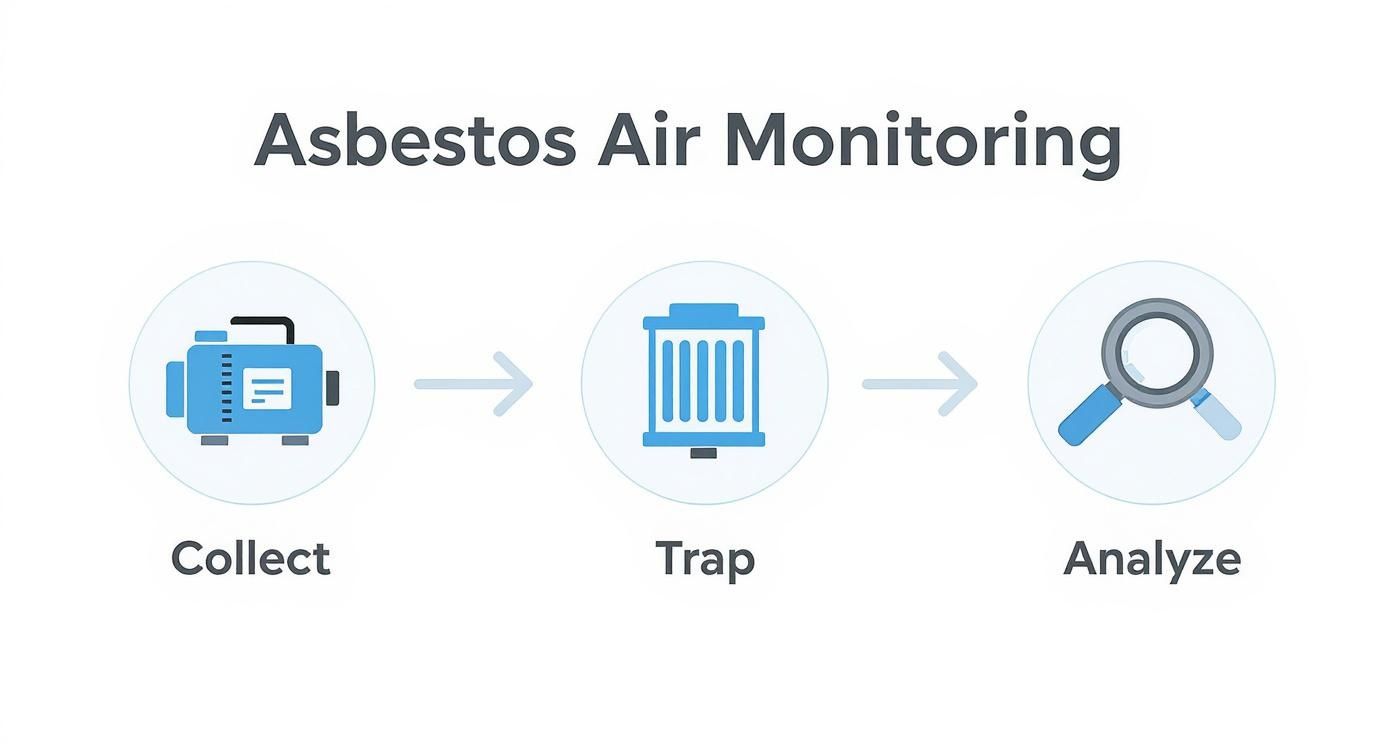
The process begins with air sampling. This involves physically capturing any microscopic asbestos fibres that may be present in the air. A calibrated air pump is set up to pull a precise volume of air through a small filter disc housed in a plastic casing called a cassette. This acts like a sophisticated, miniature vacuum cleaner, trapping airborne particles on the filter.
That small filter is crucial. As the pump operates, any fibres in the air—asbestos or otherwise—are trapped on its surface. The total volume of air that passes through is meticulously recorded. The hygienist notes the pump's flow rate and the sampling duration, allowing the laboratory to later calculate the fibre concentration in the air. This yields the final, critical number, usually expressed as fibres per millilitre of air (f/mL).
The Two Main Laboratory Analysis Methods
Once the pump is switched off, the cassette is sealed and sent to an accredited laboratory. In Australia, there are two primary methods for counting and identifying fibres. The choice between them typically involves a trade-off between speed, cost, and the level of certainty required for a particular situation.
The industry standard is Phase Contrast Microscopy (PCM). It is the go-to method for most routine air monitoring, including personal exposure checks, background monitoring, and clearance inspections after asbestos removal. Using a PCM microscope, a trained analyst examines the filter and counts every fibre that fits a specific size profile—generally longer than 5 micrometres, thinner than 3 micrometres, and with a length-to-width ratio of at least 3:1.
However, PCM has a limitation: it cannot distinguish asbestos fibres from other similar-looking fibres, such as cotton or fibreglass. It is a counting tool, not an identification tool. For this reason, the results are reported simply as fibres per millilitre, without confirming they are asbestos. For regulatory work like clearance monitoring, this is acceptable because it is assumed that in a controlled asbestos work area, the vast majority of fibres present are, in fact, asbestos.
When You Need Absolute Certainty
Sometimes, simply counting fibres is not enough. When a situation demands definitive proof, a more powerful technique is used: Transmission Electron Microscopy (TEM). While PCM uses a beam of light, TEM uses a beam of electrons. This allows for incredibly high magnification, providing a far more detailed view of the fibres themselves.
TEM analysis is the gold standard for asbestos identification. It can easily distinguish asbestos from non-asbestos fibres and can even pinpoint the specific asbestos type, such as chrysotile, amosite, or crocidolite.
This level of precision is non-negotiable in highly sensitive environments like schools or hospitals, or in legal situations where indisputable evidence of the fibre type is required. The trade-off is that TEM is significantly more expensive and time-consuming than PCM. An experienced hygienist will recommend TEM only when the stakes are high and absolute certainty is essential. For a deeper dive into how different asbestos types are pinpointed, our guide on how asbestos is identified provides a comprehensive overview.
Ultimately, knowing the difference between PCM and TEM places you in a much stronger position. It enables you to have a meaningful conversation with your occupational hygiene consultant, ensuring the analytical method chosen is appropriate for your project’s safety, compliance, and budgetary needs. It’s about obtaining the right data to make informed decisions.
Designing an Effective Air Sampling Strategy
Developing a robust asbestos air monitoring program is not a matter of guesswork. Simply scattering a few pumps around a site and hoping for the best will not yield the reliable, legally defensible data needed to ensure safety. An effective air sampling strategy is a deliberate plan, involving a series of critical decisions that determine whether your results accurately reflect on-site conditions.
An incorrect strategy can result in a waste of time and money.
The process comes down to answering a few key questions: How many samples are needed? Where should they be placed to obtain the most meaningful data? And for how long should the pumps operate? The answers to these questions form the foundation of a successful project.
The process itself is straightforward, but each step builds on the one before it. The initial strategy—the 'Collect' phase—is the bedrock for everything that follows.
Choosing Strategic Sample Locations
The placement of your air monitors is arguably the single most important decision in the entire strategy. The objective is to capture air that is truly representative of the potential exposure risk. A poorly placed monitor can provide a false sense of security or, conversely, trigger unnecessary alarm.
An experienced hygienist considers the entire picture—airflow patterns, work methodologies, and human traffic—not just a floor plan. This leads to placing monitors in strategic locations such as:
- Near the Removal Zone: Positioned just outside the sealed asbestos work area, these monitors act as an early warning system. If there is a breach in containment, they will detect it immediately.
- Adjacent Occupied Areas: If work is being conducted in one part of a building while other areas remain in use, monitors are needed in those adjacent spaces (like offices or hallways) to confirm there is no cross-contamination.
- Site Boundaries: For large outdoor projects or demolitions, boundary monitoring is essential. It is how you prove that fibres are not drifting off-site and posing a risk to neighbours or the public.
- Waste Decontamination Route: It is prudent to take samples along the path where sealed bags of asbestos waste are transported to the disposal vehicle. This ensures the entire removal and transit process is under control.
This is not just a box-ticking exercise. It is a process guided by a deep understanding of how microscopic asbestos fibres move through the air—a skill that a qualified occupational hygienist for asbestos develops over years in the field. Their expertise ensures your plan will withstand regulatory scrutiny.
Determining Sample Numbers and Timing
Determining the appropriate number of samples involves balancing the need for statistically sound data with project costs. There is no magic number. A professional will assess the size of the area, the risk level of the work, and regulatory requirements to recommend a number of samples that provides genuine confidence in the results.
Timing is equally critical. During a removal job, samples will typically run for most of the work shift to obtain a good average of the conditions. For a final clearance test, timing is about volume. The pump must run long enough to draw a sufficient volume of air to ensure detection of fibres down to the extremely low clearance level of 0.01 f/mL.
The goal of a well-designed strategy is to create a data-driven narrative of the site's air quality. Each sample location and timeframe adds a new piece to the story, building a complete picture of safety and compliance.
Static vs. Aggressive Sampling Techniques
Finally, the strategy must specify how the air will be sampled. Most background or boundary monitoring is static, meaning the air is sampled under normal, everyday conditions. This provides a baseline of the ambient fibre level during typical activity.
However, for clearance monitoring, a more demanding approach is required. This is where aggressive sampling comes into play. After the final clean-up, tools like leaf blowers are used to deliberately disturb all surfaces inside the work area while the air pumps are running. This aggressive disturbance is designed to re-suspend any stubborn fibres that may have settled on floors, walls, or ledges, ensuring they are captured by the sample.
This aggressive test is the ultimate final check. If the air passes monitoring under these worst-case conditions, you can be extremely confident that the area is truly clean and safe for people to re-enter. Historical data underscores the importance of these strict methods; analysis of past asbestos air measurements has shown how much exposure can fluctuate, highlighting the absolute need for robust and challenging testing protocols.
How to Interpret Your Monitoring Results
Receiving a lab report after asbestos air monitoring can seem intimidating at first. It is often a page of technical jargon and numbers, but understanding what they mean is absolutely critical for maintaining site safety and complying with Australia's stringent regulations.
Think of the report less as a complex scientific paper and more as a simple safety scorecard for your project.

Ultimately, it all comes down to how your results compare against two key legal benchmarks. These numbers are the bottom line—they tell you whether your site is safe or if you need to take immediate action to protect people from harm.
Understanding the Key Australian Action Levels
In Australia, workplace health and safety laws have established very clear numerical thresholds for asbestos. You do not need a science degree to understand them; you just need to know what each number signifies for your project.
The two most important figures you will find on your report are:
- The Clearance Level (less than 0.01 f/mL): This is the crucial number. It is the ultimate pass mark for an area after asbestos has been removed. A result below 0.01 fibres per millilitre of air indicates that the space is safe for people to re-enter without protective gear.
- The Exposure Standard (0.1 f/mL): This is the legal limit for a worker's exposure over an eight-hour shift, often referred to as the Time-Weighted Average (TWA). All personal monitoring samples are measured against this standard to ensure workers are not inhaling dangerous levels of fibres.
Any reputable report from a NATA-accredited laboratory will clearly show the fibre concentration found and directly compare it to these legal limits. Your task is to find that comparison and understand its implications.
What a 'Pass' Result Really Means
Achieving a 'pass' result, especially for clearance monitoring, is excellent news. When you see a reading of "<0.01 f/mL" (less than 0.01 fibres per millilitre), it is the all-clear you have been working towards. It confirms that the removal work was performed correctly, the cleanup was thorough, and the containment measures were effective.
This result is more than just a number; it is documented, legally defensible proof that you have fulfilled your duty of care. Once the clearance certificate is issued based on this result, the barriers can be removed, and the area can be returned to normal use. It is the final, crucial step in the process.
Responding to a 'Fail' Result
On the other hand, a result that exceeds the legal limits is a serious issue that demands an immediate response. A 'fail'—any clearance reading of 0.01 f/mL or higher—means the area is still contaminated, and the control plan was not successful.
A failed air monitoring test is not a point for negotiation; it is a clear stop signal. The health of workers and future occupants is at risk, and work cannot proceed until the source of the fibres is identified and eliminated.
If you receive a result above the action level, you have a legal obligation to follow a strict and immediate protocol.
Here are the essential steps you must take:
- Cease All Work Immediately: Everything stops. No one may enter the affected area unless they are wearing the correct personal and respiratory protective equipment (PPE and RPE).
- Investigate the Source: The licensed asbestos assessor and removalist must collaborate to determine why the test failed. Was the cleanup incomplete? Was a hidden patch of asbestos missed? Was there a breach in the containment seals?
- Implement Corrective Actions: Once the cause is identified, it must be rectified. This almost always involves re-cleaning the entire work area from top to bottom and re-inspecting all containment measures.
- Re-Test the Air: After the area has been re-cleaned and secured, a fresh round of aggressive air monitoring must be conducted. This cycle of cleaning and re-testing must continue until a consistent pass below the 0.01 f/mL clearance level is achieved.
Only when a new test confirms the area is safe can the clearance certificate be issued and the project move forward. Acting quickly and methodically is not just good practice—it is the only way to manage the risk and ensure compliance.
Why You Must Choose a NATA-Accredited Provider
When it comes to asbestos air monitoring, the reliability of the results depends entirely on the competence of those who collect and analyse them. Choosing the right consultant is not just a procedural step; it is a critical decision that affects the health of everyone on site and your legal standing.
In Australia, the choice is clear: you must work with a provider accredited by NATA.
NATA, the National Association of Testing Authorities, is the gold standard for accreditation in Australia. It functions as an independent regulator for laboratories and inspection bodies, ensuring that all adhere to incredibly strict rules. A NATA-accredited provider has undergone rigorous assessment and has proven it meets the highest standards for technical skill, quality control, and professional integrity.
This is not a one-time certification. Accreditation involves continuous, rigorous audits to ensure the provider consistently follows strict protocols and Australian Standards. Essentially, the NATA stamp of approval is your assurance that the results are accurate, reliable, and legally sound.
What NATA Accreditation Guarantees
Partnering with a NATA-accredited provider offers peace of mind. You are not just hiring someone with a pump and some tubing; you are investing in a comprehensive quality system that has been independently verified from start to finish.
This assurance covers the core aspects of their work:
- Technical Competence: Their team is properly trained, qualified, and regularly assessed for the specific sampling and analysis methods required for asbestos.
- Validated Methods: They use scientifically proven procedures that are in full compliance with Australian regulations. There is no guesswork involved.
- Calibrated Equipment: Every piece of equipment, from the air sampling pumps to the high-powered microscopes, is precisely calibrated and maintained to deliver accurate measurements.
- Quality Management Systems: They operate under a robust quality framework that governs everything from sample handling to the documentation and delivery of reports.
NATA accreditation serves as your protection against unreliable data and regulatory complications. It confirms that your provider is committed to the highest professional standards, ensuring your investment in safety delivers results that will withstand any scrutiny.
Vetting Your Provider: A Practical Checklist
Do not just take their word for it. Seeing a NATA logo is a good start, but you should dig a little deeper to ensure their accreditation covers your specific needs.
Before signing any contracts, perform these simple but vital checks:
- Check Their Scope of Accreditation: Visit the NATA website and search for the provider by name. Their public listing will detail the specific tests and inspections for which they are accredited. Ensure it explicitly lists services like asbestos fibre counting and air volume measurement.
- Request Sample Reports: Ask for a de-identified report from a similar project. This is an excellent way to see how they communicate their findings. Is the report clear and professional? Does it provide the level of detail you need for your records?
- Verify Technician Qualifications: Inquire about the experience and qualifications of the individuals who will be on your site. A reputable consultant will have no problem being transparent about their team’s expertise.
Making the right choice here is fundamental. For anyone managing projects in Victoria, understanding the local landscape of certified professionals is vital. You can get a more detailed look in our complete guide to asbestos testing in Melbourne, which offers more guidance on selecting the right experts for the job.
Got Questions About Asbestos Air Monitoring? We've Got Answers.
When it comes to asbestos, having numerous questions is natural. Navigating air monitoring rules and procedures can seem complex, but it doesn't have to be. Here are straightforward answers to some of the most common questions we receive from clients across Australia.
How Long Does Asbestos Air Monitoring Take?
The entire process can be broken down into two main stages: on-site work and laboratory work.
First, there is the on-site sampling. For a typical clearance inspection following asbestos removal, our hygienist will be on-site for approximately two to four hours. The exact duration depends on the volume of air that needs to be drawn through the filter to obtain a scientifically sound reading, especially when targeting the critical clearance level of <0.01 fibres/mL.
Next is the laboratory analysis. After sampling, the filter cassette is sent directly to a NATA-accredited laboratory. The standard analysis method, Phase Contrast Microscopy (PCM), is relatively quick. In most cases, you can expect to receive the results either the same day or within 24 hours.
Is Air Monitoring Mandatory for All Asbestos Removal Jobs?
It is not required for every single job, but it is absolutely essential in high-risk situations.
In Australia, air monitoring is a non-negotiable legal requirement for all licensed Class A (friable asbestos) removal work. It is also required for any Class B (non-friable) removal that occurs indoors or where there is any uncertainty about potential fibre release.
Even when not legally mandated, we always consider it best practice. This is because it provides indisputable, documented proof that the job was performed safely and that the area is free from contamination. This protects everyone involved—from the workers to the building occupants and property owners—from future health risks or liability claims.
Think of it this way: for any licensed removal project, clearance monitoring is the final, official sign-off. It’s the only way to get the legal clearance certificate required to safely reoccupy the area.
What Happens If a Clearance Test Fails?
A failed clearance test—meaning a result of 0.01 f/mL or higher—is a serious red flag. It indicates that the area is not yet safe for reoccupation, and a strict protocol is immediately enacted.
- The work area remains completely sealed off. No one can enter.
- The licensed removalist and the independent assessor must collaborate to determine the cause of the failure.
- The entire enclosure must be re-cleaned from top to bottom to capture any remaining contaminated dust.
- Once the cleaning is complete, a new round of aggressive air monitoring is performed.
This cycle of re-cleaning and re-testing continues until the air quality finally meets the strict clearance standard. Only then can we be certain that the space is completely safe for people to use again.
Ensuring your asbestos air monitoring meets the highest Australian standards is not just about compliance—it's about protecting people. Anitech Ltd Pty provides expert occupational hygiene services nationwide, delivering reliable results and complete peace of mind. For professional guidance on your next project, learn more about our asbestos air monitoring services.


