
Quick Summary: Surface porosity, the network of microscopic pores in materials like concrete, wood, and drywall, plays a critical role in trapping persistent toxins. Substances such as methamphetamine residue and industrial chemicals are absorbed deep into these materials, resisting standard cleaning and creating long-term health risks through gradual release (off-gassing).
Ever tried to clean a red wine spill? On a glass tabletop, it’s a simple wipe. But on an unsealed wooden floor, that stain seems to set in an instant, defying all your efforts. What you're fighting isn't just the wine; it's a hidden property of the wood itself: surface porosity. This guide provides a scientific investigation into why specific materials retain residue longer. The analysis of surface porosity and its role in persistent toxin trapping is central to understanding hidden environmental dangers, especially concerning focused meth contamination and its scientific health impacts.
This very same principle is at the heart of why some chemical hazards, from methamphetamine residue to industrial solvents, are so stubbornly difficult to remove from a building. The material’s intricate network of microscopic pores and crevices acts like a sponge, locking in these harmful substances and creating a long-term health risk that’s invisible to the naked eye.
Why Do Some Contaminants Stick Around? The Science of Toxin Trapping
It's not just a cleaning nuisance; it’s a major issue in occupational hygiene and public health. When toxic substances get trapped inside a material, they don't just stay put. They can slowly leach back into the air over time—a process called off-gassing—or transfer to skin and other objects on contact. This creates a persistent, low-level exposure threat that standard cleaning routines simply can't handle.
Think of a material's surface as a landscape. Non-porous materials like stainless steel or glazed ceramic are like flat, barren plains. Contaminants have nowhere to hide and are easily removed. Porous materials, on the other hand—think concrete, drywall, timber, and carpet—are like a complex terrain riddled with countless tiny caves, tunnels, and valleys.
This is where the trouble starts.
The Trapping Mechanism Explained
When a contaminant hits a porous surface, it’s not just sitting on top. It’s actively being pulled deep inside the material’s structure, creating a contamination problem that’s much more than skin-deep.
Initial Absorption: Through a force called capillary action, liquid or airborne toxins are wicked deep into the porous network. It’s the same way a paper towel instantly soaks up a spill.
Chemical Bonding: Once inside, the toxins aren't just physically trapped. They can form chemical bonds with the internal surfaces of the pores, essentially gluing themselves to the material and resisting normal cleaning methods.
Long-Term Release: These trapped contaminants can then be released slowly over weeks, months, or even years, creating a constant source of exposure long after the initial spill or contamination event.
A crucial concept in any analysis of surface porosity and its role in persistent toxin trapping is realising the sheer scale of this hidden world. The total internal surface area within a material's pores can be hundreds or even thousands of times greater than the visible, external surface. This is the vast, hidden landscape where the real danger lurks.
This dynamic is especially critical in properties with focused meth contamination. Everyday materials like plasterboard, carpets, and unsealed timber can act as reservoirs for meth residue, turning a home into a lasting health hazard that demands expert scientific assessment and remediation. The same goes for industrial sites, where chemical spills can saturate concrete floors, posing an ongoing risk to workers. Truly understanding how these surfaces work is the first step toward making any environment genuinely safe.
Understanding the Science of Porous Surfaces
To really get a handle on why some materials act like permanent sponges for hazardous chemicals, we need to zoom in and look at their microscopic structure. The science here isn't rocket science; it really comes down to a handful of key properties that decide how easily a toxin gets in and, more importantly, how stubbornly it stays put. This scientific foundation is the bedrock for any meaningful analysis of surface porosity and its role in persistent toxin trapping.
At its heart, porosity is just a way of measuring the empty spaces, or voids, inside a material. Think of it this way: picture a glass jar filled with marbles versus another one filled with fine sand. The marbles leave big, connected gaps, while the sand creates countless tiny pockets. Both are porous, but they'd trap and hold a spilled liquid in completely different ways.
Common materials like unsealed concrete, timber, and even drywall are riddled with a complex network of these microscopic pores. When toxins land on these surfaces, the voids act like a super-absorbent sponge, wicking the contaminants deep below the surface where they're incredibly hard to reach.
This diagram shows the simple but critical process of a toxin getting stuck inside a porous material.
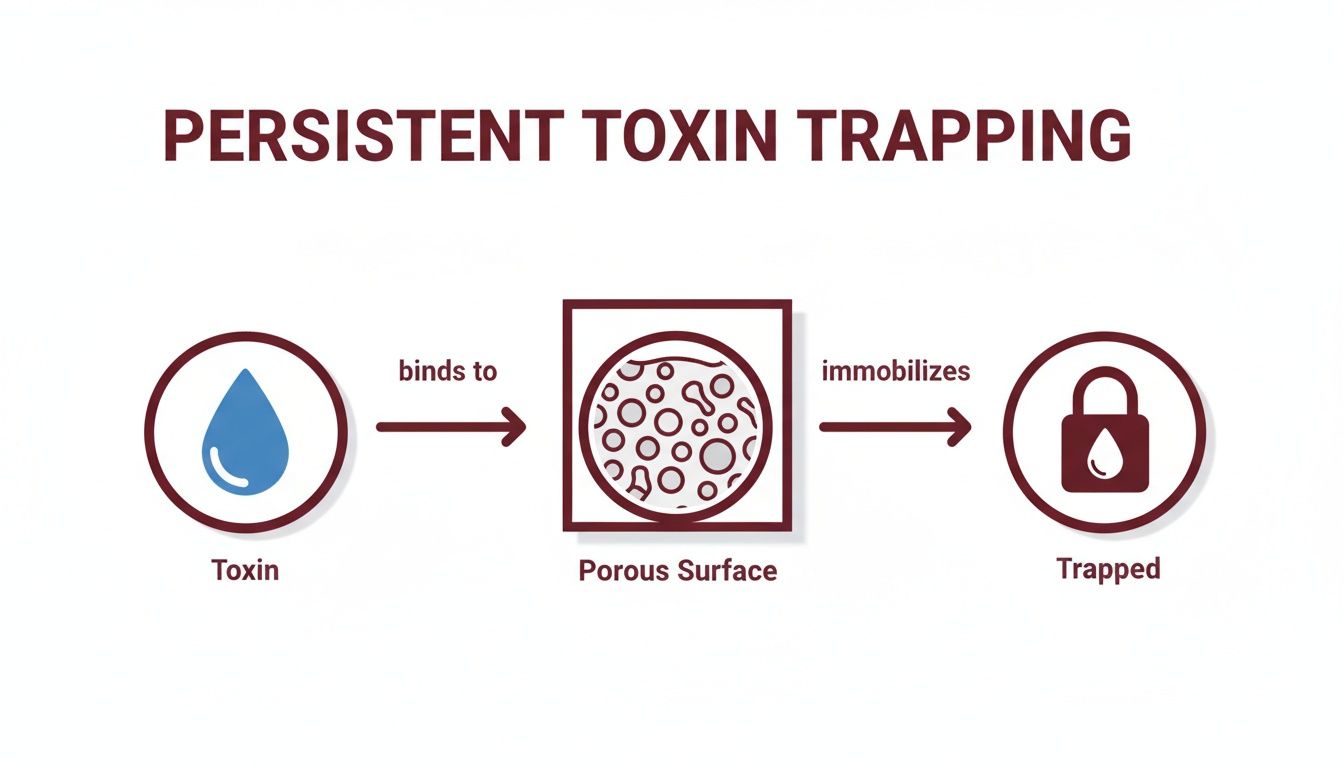
As you can see, the toxin makes contact, gets drawn into the pore network, and becomes immobilised. The material itself is an active participant in capturing and holding onto the contaminant.
Key Factors That Dictate Toxin Trapping
A material's vulnerability to trapping toxins isn't just about having pores; it's about the specific character of those pores and the surface itself. Several properties work together to create the perfect trap.
Three characteristics are the main culprits:
- Pore Size and Connectivity: The size, shape, and how well the pores connect with each other determine how deeply a substance can work its way in. Materials with tiny, well-connected pores can pull liquids deep inside through a process called capillary action, which makes them a nightmare to clean properly.
- Total Surface Area: This one often surprises people. A seemingly smooth slab of concrete can have an internal surface area thousands of times larger than what you see on the outside. This massive, hidden landscape provides a huge amount of real estate for toxins to cling to.
- Surface Chemistry: This is all about the natural attraction (or repulsion) between the material's surface and the contaminant. Some surfaces are hydrophilic (they "like" water), while others are hydrophobic (they repel water), which drastically changes how water-based or oil-based toxins behave when they meet.
A classic real-world example is focused meth contamination. During production, it's often suspended in oily substances. This allows it to absorb readily into porous materials like timber and plasterboard, which have a natural affinity for oils.
Why Standard Cleaning Fails on Porous Surfaces
The science of porosity explains exactly why a simple wipe-down just doesn't cut it for deep contamination. Cleaning solutions applied to the surface simply can't penetrate far enough to reach the toxins locked away in the complex pore network. Worse still, using the wrong cleaning agent can sometimes push the contaminants even deeper into the material, compounding the problem.
This is the fundamental reason why cleaning up meth-contaminated properties or dealing with industrial spills on concrete is a highly specialised, scientific job. The goal isn't just to clean the surface you can see, but to neutralise or extract the toxins from the vast, hidden surface you can't.
This is why in places like commercial kitchens, the choice of non-porous surface materials like stainless steel is non-negotiable. Their smooth, solid structure means contaminants stay right on the surface, where standard sanitisers can easily wipe them out. It's a world away from unsealed concrete or wood, where contaminants don't just sit on top—they become woven into the material's internal structure, creating a persistent health hazard that demands a far more advanced approach. This distinction is what separates basic cleaning from true, effective decontamination.
How We Uncover Hidden Contamination Threats
So, if these persistent toxins are invisible, how on earth do we find them? It’s a great question. Uncovering these hidden dangers takes a lot more than a simple visual inspection; it demands a deep, scientific dive into the material itself. This process is the heart of any reliable risk assessment, combining powerful lab techniques to both see the surface structure and pinpoint the chemical nasties trapped inside.
This is where the analysis of surface porosity and its role in persistent toxin trapping moves us from guesswork to data-driven certainty. When we understand exactly what we're dealing with and where it's hiding, we can build remediation strategies that actually work.

Visualising the Microscopic Landscape
Our first job is to understand the physical terrain where these toxins are hiding. Think of it like creating a detailed map of the material's porous network. To do this, occupational hygienists turn to some seriously high-powered microscopy.
Scanning Electron Microscopy (SEM) is a workhorse in our field. Instead of using light like a standard microscope, an SEM uses a focused beam of electrons to scan the surface. What we get back are incredibly detailed, three-dimensional images of all the pores, cracks, and tiny crevices that you'd never see otherwise. An SEM analysis reveals the physical architecture that makes a surface vulnerable, showing us the exact pathways contaminants have used to burrow deep inside.
Identifying the Chemical Culprits
Once we have our map of the terrain, the next critical step is to identify the trespassers—the chemical contaminants themselves. This requires sophisticated analytical methods that can sniff out and name specific toxins, even in minute quantities.
We have a few powerful techniques in our toolkit to pinpoint the exact nature of the contamination:
- Fourier-Transform Infrared Spectroscopy (FTIR): This method works by shining infrared light on a sample. Different chemical bonds absorb light at different frequencies, creating a unique "chemical fingerprint." This allows us to identify specific compounds like leftover solvents or drug residues.
- Gas Chromatography-Mass Spectrometry (GC-MS): Often considered the gold standard for chemical analysis, GC-MS is brilliant at separating complex chemical cocktails and identifying each individual ingredient. It’s absolutely vital for confirming the presence of substances like methamphetamine or other persistent organic pollutants (POPs) with an incredibly high degree of certainty.
- X-ray Fluorescence (XRF): This one is particularly handy for detecting heavy metal contamination. An XRF analyser hits a surface with X-rays, which causes the elements within to glow with their own characteristic X-rays. This reveals their identity and concentration, all without damaging the sample.
The data we gather isn't just for academic papers. It's the essential evidence for a comprehensive risk assessment, directly shaping the safety protocols needed to protect workers in sectors from aerospace to food processing.
This rigorous scientific approach is crucial in the real world. For instance, take the shipping containers arriving at Australian ports—they’re the lifeblood of supply chains for pharmaceuticals and manufacturing. The problem is, they often retain hazardous fumigants within their porous internal materials. A Safe Work Australia hazard surveillance report found that in 8% of inspected containers, residual chemical levels were above Australian Workplace Exposure Standards. Porous surfaces like internal linings and wooden pallets were effectively trapping toxins like methyl bromide and formaldehyde, which showed up in 21% of containers. It's a significant, and often overlooked, occupational health risk. You can read the full findings on residual chemicals in shipping containers from Safe Work Australia.
Bringing the Data Together for a Clear Risk Assessment
Ultimately, the whole point of these analytical methods is to build a complete picture of the contamination threat. By combining the visual data from microscopy with the chemical IDs from spectroscopy, we can finally answer the most important questions:
- What is the contaminant? Naming the specific toxin is the first step to understanding its health risks.
- How deep is the contamination? Knowing if the problem is just on the surface or has seeped deep inside dictates the entire cleanup strategy.
- What is the concentration? Quantifying the amount of toxin tells us the level of risk to anyone in that environment.
This detailed investigation transforms an invisible threat into a known, measurable problem. It’s this clarity that allows us to move from uncertainty to action, developing a targeted plan to make sure the environment is genuinely safe and compliant.
Where Theory Meets Reality: Toxin Trapping in Action
It's one thing to talk about porosity in theory, but seeing how it plays out in the real world is what truly drives the point home. Let's step out of the lab and into some common scenarios where everyday porous materials become long-term chemical reservoirs. These examples aren't just hypotheticals; they represent real challenges and health risks that property owners and businesses grapple with every day.
Each case highlights why understanding the link between a surface and the toxins it can trap is far from an academic exercise. It's a fundamental part of creating a safe environment.
Case Study 1: The Hidden Hazard in a Rental Home (Focused Meth Contamination)
The growing problem of methamphetamine contamination in residential properties is a perfect, if frightening, example of porosity at work. When a house is used as a clandestine meth lab, it can stay hazardous for years, long after the culprits are gone. This is a prime example of focused meth contamination requiring a thorough scientific investigation.
Think about the "cooking" process. It releases a fine aerosol of volatile chemicals, including methamphetamine itself, that blankets every single surface. But it doesn't just sit on top.
- Plasterboard and Drywall: These materials are everywhere, and they act like giant, rigid sponges. The chemical mist soaks deep into their gypsum core, well beyond the reach of a simple wipe-down.
- Carpets and Underlay: The thick web of fibres is a magnet for chemical residues and any liquid spills, effectively locking the contamination into the floor.
- Unsealed Timber: From structural framing to floorboards and kitchen cabinets, raw or poorly sealed wood readily absorbs the oily meth residue, making it nearly impossible to remove completely.
You could scrub the walls and steam the carpets, but the bulk of the contamination is now literally part of the building's bones. As these trapped chemicals slowly release, or "off-gas," future tenants are exposed through the air they breathe and the surfaces they touch. This is why professional meth remediation isn't just a deep clean; it often means stripping out and replacing huge sections of the property.
Case Study 2: The Spill That Never Really Left
Picture a factory floor. A chemical solvent is spilled on the unsealed concrete. The maintenance crew is called, and they mop it up. Problem solved, right? Not quite.
The moment the solvent hit the floor, it was drawn deep into the concrete's vast network of tiny pores and capillaries. Even when the surface looks clean and feels dry, a significant volume of the chemical is still locked away inside the slab. This sets the stage for a sneaky, dangerous phenomenon called vapour intrusion.
Over weeks, months, or even years, that trapped solvent will slowly evaporate. The vapours migrate back up through the porous concrete and silently enter the workspace. This creates a chronic, low-level chemical exposure for staff—an exposure that’s incredibly hard to pinpoint but can lead to serious respiratory issues and other long-term health problems.
Case Study 3: Turning the Tables on Toxins in Our Waterways
This same principle of toxin trapping extends well beyond the four walls of a building and into our environment. In cities and industrial zones, stormwater is a major headache. As it washes over roads and factory sites, it picks up a nasty cocktail of heavy metals, oils, and other pollutants.
Interestingly, this is where engineers cleverly use porosity as a solution. In Australian urban design, specialised "gross pollutant traps" are installed in stormwater systems. They are engineered with porous screens designed specifically to capture these contaminants before they poison our creeks and rivers.
A study in Melbourne’s Coburg catchment, for instance, looked at how these traps performed. During heavy rain, runoff from industrial areas sent Total Suspended Solids (TSS) soaring to 570 mg/L. The porous trap surfaces were vital, achieving a 30% removal efficiency for pollutants like total phosphorus by capturing the fine, toxin-coated sediments. You can dive deeper into how these porous systems are used in Australia's urban water management strategies.
It’s a fantastic example of how a deep understanding of surface porosity allows us not only to identify risks but to engineer systems that turn the problem on its head, using it to protect our environment.
Porosity and Contamination Risks by Industry
The specific materials and toxins of concern vary dramatically from one sector to another. The following table gives a snapshot of the unique challenges different industries face when it comes to porous surfaces trapping contaminants.
| Industry Sector | Common Porous Materials | Typical Persistent Toxins Trapped |
|---|---|---|
| Manufacturing | Unsealed concrete, cinder blocks, industrial insulation, filter media | Solvents (e.g., TCE, benzene), heavy metals, machining oils, plasticisers |
| Pharmaceuticals | Stainless steel (microporosity), HEPA filters, cleanroom garments | Active Pharmaceutical Ingredients (APIs), cytotoxic agents, sterilising chemicals |
| Oil & Gas | Concrete containment bunds, refractory bricks, soil, rock formations | Crude oil hydrocarbons, drilling fluids, hydrogen sulphide (H₂S), VOCs |
| Food & Beverage | Stainless steel, plastics (e.g., cutting boards), wood, packaging materials | Biofilms (bacterial colonies), cleaning agent residue, food allergens |
| Aerospace | Composite materials (carbon fibre), thermal insulation, ceramic coatings | Hydraulic fluids (e.g., Skydrol), de-icing agents, heavy metal dust (from machining) |
This comparison shows that no industry is immune. Recognising the specific porous materials in a given workplace is the first critical step toward managing the long-term health risks they can pose.
Scientific Health Impacts & Risk Assessment
So, we've covered the science of how tiny pores trap nasty substances. But let's get to the heart of the matter: what does this actually mean for people in those environments? The human cost of contaminants hanging around in a workplace or home is a major focus for occupational hygienists today. The real danger often isn't a single, big exposure event. It’s the slow, steady drip of low-level contact that can fly under the radar for months or even years.
Things like methamphetamine residue, industrial solvents, or fumigation chemicals don't just vanish. They seep into materials like drywall, concrete, and timber, and then they slowly leach back out. This turns a seemingly clean space into a persistent hazard, creating a toxic environment that people are exposed to day in and day out.
From a Nagging Cough to Lasting Damage
The health problems caused by these trapped toxins can be tricky. They often start small, with symptoms you might easily brush off, before developing into something much more serious.
In the short term, low-level exposure can show up as:
- Nagging headaches and dizziness
- Nausea and a general feeling of fatigue
- Unexplained skin irritation or rashes
- Respiratory issues, like a persistent cough or feeling short of breath
The bigger worry, though, is what happens over the long haul. Chemicals known as Persistent Organic Pollutants (POPs) are infamous for their staying power, and they can cause significant damage to the body. Extensive research has linked ongoing exposure to these substances with neurological disorders, reproductive issues, a compromised immune system, and even certain cancers.
Pinpointing the Invisible Threat
Protecting people from these hidden dangers isn't guesswork; it requires a systematic, evidence-based plan. This is where a formal risk assessment framework is absolutely essential. It’s a structured process that methodically peels back the layers of uncertainty to create a clear path forward.
An occupational hygienist will typically work through these critical steps:
Identify Potential Hot Spots: First, they'll pinpoint porous materials in high-risk zones. This could mean mapping out unsealed concrete floors in a factory, plasterboard walls in a former meth lab, or the timber framing in a chemical storage area.
Conduct Strategic Sampling: With the hot spots identified, the next step is to collect samples. This isn't a random swab here and there; it’s a targeted effort to build a detailed picture of which contaminants are present and in what concentrations.
Evaluate Exposure Pathways: The final piece of the puzzle is to figure out how people are actually coming into contact with these toxins. Are they breathing in vapours off-gassing from the walls? Could they absorb it through skin contact? Is contaminated dust being kicked up and inhaled?
By weaving these steps together, the analysis of surface porosity and its role in persistent toxin trapping becomes an incredibly powerful tool for protecting health. It gives professionals the hard data they need to quantify the risk and see if contamination levels breach Australian workplace exposure standards.
This level of scientific rigour is non-negotiable. Without it, companies and property owners are operating in the dark, potentially exposing employees or residents to serious, long-term health consequences. A proper risk assessment provides the definitive answers needed to take action and make a space truly safe for everyone.
Effective Remediation and Mitigation Strategies
Knowing how porous surfaces trap toxins is one thing, but creating a safe environment demands a solid, practical plan of action. When you're up against stubborn contaminants like methamphetamine residue or industrial chemicals, your standard cleaning playbook just won't cut it. Effective remediation means going deeper than a simple surface wipe-down; it's about targeting the toxins that have become physically locked inside the material's structure.
The real challenge here is that the contaminants aren't just sitting on the surface—they're embedded in it. This is precisely why a splash of bleach does next to nothing for meth residue that's soaked into plasterboard, and why a high-pressure hose won't flush solvents out of concrete. The clean-up strategy has to be scientifically matched to both the specific toxin and the unique porosity of the material it has contaminated.
Proactive Mitigation Through Material Selection
As any seasoned expert will tell you, the best strategy is always prevention. Making smart, informed choices about materials during construction or renovation can dramatically cut the future risk of dealing with persistent, trapped toxins.
Choosing non-porous or low-porosity materials in high-risk zones is a straightforward but incredibly powerful move. Think about:
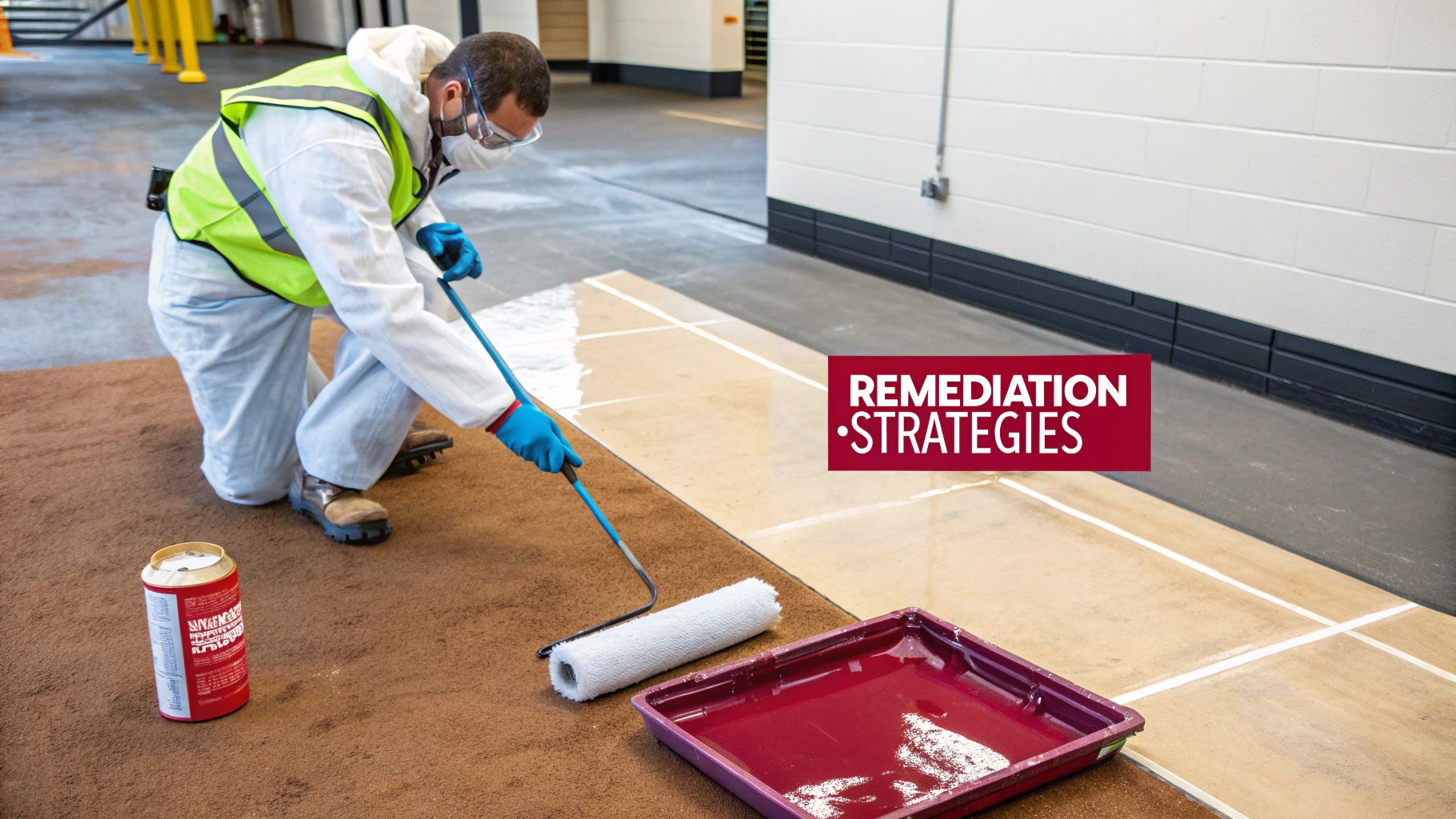
- Sealed Concrete: Applying an epoxy or polyurethane coating to a concrete floor creates an impermeable shield. Spills just sit on top instead of soaking in.
- Stainless Steel: It's the go-to for benchtops and equipment in pharmaceutical labs or food processing plants for a reason—it’s non-porous and easy to decontaminate.
- Glazed Tiles: A practical and effective choice for walls and floors in areas where chemical splashes are a daily reality.
By selecting materials with low surface porosity from the very beginning, you are effectively designing a workplace that is inherently easier to clean and make safe. This not only ensures a higher standard of occupational safety but also significantly reduces long-term liability.
Advanced Remediation for Existing Contamination
What happens when contamination is already a reality? This is where a more intensive, professional approach becomes necessary. We rely on a few proven techniques to neutralise or remove toxins that have settled deep within a material.
- Chemical Neutralisation: This involves applying specialised chemical agents designed to penetrate the porous structure. Once inside, they react with and break down the harmful substances into non-toxic by-products.
- Encapsulation: Sometimes, the safest and most practical approach is to seal the contaminant in place. This is done by applying a thick, impermeable coating that essentially locks the toxins within the material, stopping them from off-gassing into the air. You can see a detailed comparison in our article on encapsulation vs. removal for meth remediation.
- Controlled Removal: For materials that are heavily saturated, like contaminated drywall or carpet, the only guaranteed solution is to physically remove and dispose of them according to strict hazardous waste regulations.
This principle of toxins being held in porous materials isn't just an industrial problem; we see it in nature, too. In Western Australia's rangelands, research on pest control baits found that porous, fire-affected soils actually trapped the toxins, slowing their breakdown. Studies revealed that non-target species were responsible for 88% of bait interactions by digging them up, showing how a porous medium can prolong a chemical's hazardous life—a perfect parallel to what happens on industrial surfaces. You can read more about this in an in-depth pest control study.
Ultimately, a successful remediation plan is always built on a thorough, scientific analysis of surface porosity and its role in persistent toxin trapping. This data-driven approach ensures the strategy you choose is a permanent solution for a healthier, safer environment, not just a temporary fix.
Got Questions? We've Got Answers
When you start digging into the science of surface porosity and how it traps dangerous toxins, it's natural for questions to pop up. This stuff is complex, but understanding it is key to managing hidden risks. Let's tackle some of the most common queries we hear from clients.
"Why Can't I Just Scrub a Contaminated Porous Surface Clean?"
It’s a fair question. The short answer is that standard detergents just can't get to where the real problem is. They're great for surface-level grime, but they don't have the chemical muscle to penetrate the microscopic maze of pores where persistent toxins, like methamphetamine residue, have settled in and chemically bonded to the material.
Think of it like trying to get a deep red wine stain out of a concrete paver with just a garden hose. You might wash away the surface spill, but the stain is locked deep inside the material. To truly get rid of the contamination, you need specialised chemical or physical treatments designed to break those bonds and pull the toxins out from the core of the material.
"What Are the First Signs of a Toxin Problem in My Workplace?"
Often, the first clues aren't visible at all—they're what your team is experiencing. The initial red flags are usually subtle and health-related.
Keep an eye out for patterns like these:
- Several people in the same area complaining of recurring headaches, dizziness, or feeling nauseous.
- A noticeable uptick in skin rashes or respiratory irritation that doesn't have an obvious cause.
- A faint but persistent chemical smell that you just can't seem to track down.
These symptoms can be a sign that a porous material, like a concrete floor or drywall, is slowly releasing trapped chemicals into the air (a process known as off-gassing). If you notice these signs, it's time to call in an occupational hygienist to investigate properly.
"How Often Should We Be Testing High-Risk Porous Surfaces?"
There’s no single answer here—it really comes down to your specific industry and the risks present at your site. The best approach is always based on a solid risk assessment.
For places like manufacturing plants or pharmaceutical labs where chemicals are part of the daily routine, building surface testing into your annual safety audit is a smart, proactive move. It helps you catch any slow, gradual buildup before it becomes a major problem.
In properties with a known history of severe contamination, such as a former meth lab, testing after remediation is non-negotiable before anyone can safely re-enter. For industries like shipping and logistics, where fumigants are used on things like wooden pallets, regular testing is critical to make sure workers aren't being exposed to unsafe levels of chemicals. It’s all about maintaining a safe and healthy workplace.
We specialise in the science behind occupational hygiene, helping businesses identify and manage the risks hiding in their porous surfaces. We're here to make sure your workplace isn't just compliant, but genuinely safe and healthy. Protect your team by scheduling a comprehensive site assessment with our experts today.


