
Think of air quality testing as a health check-up for your building. It’s the process of identifying and measuring invisible airborne threats to find out exactly what’s in the air your team breathes every day. This isn't about guesswork; it's about getting hard data on potential hazards like chemical vapours, dust, and mould spores.
Understanding Workplace Air Quality
The air inside your workplace is its own little ecosystem. Outdoors, pollutants have endless space to scatter and disperse. Inside a building, though, it's a closed loop. Any contaminants generated from machinery, cleaning products, building materials, or operational processes get trapped and can build up to dangerous levels.
This is precisely why professional air quality testing is so crucial. It provides a clear, scientific snapshot of what your employees are exposed to, day in and day out. Without it, you’re flying blind, completely unaware of the invisible risks that could be affecting your team's health and productivity.
Why Proactive Testing Is A Non-Negotiable
In Australia, proactive air quality testing isn't just good practice; it's a core part of modern workplace health and safety. It means shifting from reacting to problems—like a spike in sick days or an employee complaint—to getting ahead of them. This preventative mindset pays off in several ways:
- Protecting Long-Term Health: Many airborne nasties, like fine dust particles or chemical fumes, cause harm slowly over months or years. Regular testing catches these hazards early, giving you a chance to put controls in place before serious health issues develop.
- Boosting Productivity and Morale: Poor air quality is a notorious culprit for headaches, fatigue, and respiratory issues, leading to more absenteeism. Clean air means a healthier, more comfortable team that can perform at its best.
- Upholding Your Duty of Care: Under Safe Work Australia guidelines, every employer has a legal duty to provide a safe working environment. Professional air quality testing is a tangible way to show you’re taking this responsibility seriously.
By measuring the specific contaminants in your workplace air, you move from assumption to fact. This data gives you the power to make informed decisions that protect your most valuable asset—your people.
Setting the Foundation for a Safer Workplace
This guide will walk you through everything you need to know about occupational air quality testing. We'll look at the common airborne hazards found in Australian workplaces, from the chemical vapours in a manufacturing plant to the silica dust on a construction site.
We’ll also break down the science behind how these threats are detected and measured. Understanding the "how" gives you the confidence to interpret the results and implement solutions that actually work. This is about more than just ticking a compliance box; it's about building a genuine culture of safety that benefits everyone in your organisation.
How Australia’s Air Quality Monitoring Has Evolved
To really get a grip on the precision of modern workplace air quality testing, it helps to look back at how we got here. Australia's approach to monitoring the air we breathe wasn't built overnight. It’s a story of gradual improvement, pushed forward by scientific breakthroughs, public health concerns, and major environmental events that forced us to adapt. This journey is exactly why the methods used today to protect workers are so robust.
The groundwork for today's strict standards was laid decades ago. Even before official national standards were a thing, Australia was keeping an eye on its air. We started continuous measurements for key pollutants like ozone and fine particles as far back as the 1970s. By the early 1980s, Sydney was already getting daily updates through a simple but effective system called the Sydney Pollution Index (SPI).
A real turning point came in June 1998. That’s when national standards were established for six major pollutants, including carbon monoxide (CO) and particulate matter (PM10 and PM2.5). This created a single, unified benchmark for the entire country and set the stage for many of the occupational exposure limits that are so critical in workplace safety today.
From Bushfire Haze to Clearer Reporting
Sometimes, it takes a crisis to trigger change. The devastating 2019–20 Black Summer bushfires were a harsh reminder of this. The thick smoke that blanketed much of the country put a massive spotlight on the need for faster, more accessible air quality data, not just for the public but especially for outdoor workers.
The response was swift. In February 2020, the reporting system was upgraded to provide hourly averages for PM10 and PM2.5. This gave a much clearer, near-real-time picture of immediate health risks, highlighting just how vital accurate, timely data is for making critical safety decisions on the ground.
This infographic walks through the key milestones in Australia's air quality monitoring history, from first identifying pollutants to refining how we test for them.

As you can see, it’s been a progressive journey. Each step built on the lessons of the last, creating the effective framework for public and occupational health we rely on today.
The Modern Air Quality Category System
The evolution didn’t stop there. Later that year, in November 2020, the old Air Quality Index (AQI) was officially replaced with the current Air Quality Category (AQC) system. This move was all about clarity—it simplified reporting into fewer, more intuitive categories and updated the health-based thresholds for different contaminants.
This shift gets to the heart of Australian air quality management: making data not just accurate, but also practical and easy for everyone to understand, from a concerned citizen to a workplace safety manager.
This long history of refinement is incredibly important for businesses. The standards and methods used in professional air quality testing aren't just arbitrary rules. They are the product of decades of research, real-world data, and learning from major health events. Each development has made the science sharper, the data more reliable, and worker protection stronger.
This deep-rooted commitment to health-based standards means you can have confidence in the data from an expert assessment. It guarantees that your results are measured against nationally recognised limits designed to protect people. Understanding the principles of occupational hygiene is what helps you apply these standards effectively in your workplace, ensuring you meet your duty of care and create a truly safe environment for your team. The entire process is built on a legacy of scientific integrity.
Identifying Contaminants and Choosing a Testing Method
So, how do you start with air quality testing? The very first question you need to ask is: what are we actually looking for? The air in any workplace is a complex cocktail of gases, particles, and microbes, and figuring out the likely culprits is step one.
Think of it like a doctor trying to diagnose a patient. They don’t just order every test in the book; they listen to the symptoms first to narrow down the possibilities. In the same way, an occupational hygienist will start by looking at your workplace activities to get a clear picture of potential airborne hazards.

Common Workplace Contaminants
Airborne nasties generally fall into three buckets, each with its own set of risks and common sources. Knowing these categories helps us zero in on what to test for.
-
Chemical Hazards: This covers gases, vapours, and fumes that come from industrial processes or everyday products. A classic example is Volatile Organic Compounds (VOCs), which are released from paints, solvents, and glues in places like print shops or cabinet-making workshops. Other common chemicals include carbon monoxide from forklifts or formaldehyde from engineered wood products. To dive deeper into how these are measured, have a look at our detailed guide on VOC testing methods.
-
Physical Hazards: We’re talking about dust and fibres that can be breathed in. The most infamous is respirable crystalline silica (RCS) dust, a serious hazard on construction sites where concrete or stone is cut, potentially leading to silicosis. Asbestos fibres in older buildings and even general nuisance dust in manufacturing plants are also significant physical hazards.
-
Biological Hazards: These are living organisms or their byproducts, like mould, bacteria, and viruses. An office with a history of water damage is a prime candidate for mould testing, as airborne spores can cause serious allergic reactions and breathing problems. For trickier biological agents like viruses, advanced techniques like molecular diagnostics are sometimes needed to get a clear answer.
Core Testing Techniques
Once we have a list of suspects, we need to pick a sampling strategy. This isn't a one-size-fits-all situation; the right method depends entirely on what you’re trying to find out. The two main approaches are personal and static sampling.
Personal Sampling: The Employee's Perspective
This is the gold standard for understanding a worker's direct exposure. It involves clipping a small, lightweight sampling device to the worker's clothing, usually near their collar in the "breathing zone," and leaving it there for a full shift.
This technique gives you the most accurate data on what an individual is actually inhaling as they move about, perform different tasks, and work near various contaminant sources. It's absolutely crucial for checking if you’re complying with legal exposure limits, as those standards are all about individual exposure.
Static Sampling: The Environmental Snapshot
Static (or area) sampling is different. Here, we place a monitoring device in a fixed spot to measure the general air quality in that specific area—say, next to a particular machine or in the middle of a room.
It’s incredibly useful for tracking down the source of an emission, checking if your ventilation system is doing its job, or just getting a baseline reading of a room's ambient air quality.
Think of it this way: Personal sampling is like a bodyguard following one person all day, noting every single thing they come into contact with. Static sampling is more like a security camera in a hallway, recording everything that passes through that one specific spot.
The table below breaks down the key differences between these sampling methods to help you understand which strategy might be right for your situation.
Comparison of Air Sampling Methods
| Sampling Method | Primary Use Case | Advantages | Limitations |
|---|---|---|---|
| Personal Sampling | Measuring an individual worker's direct exposure over a full shift. Essential for compliance with Workplace Exposure Standards. | Provides the most accurate data for personal exposure. Captures variations in exposure as a worker moves and performs different tasks. | More intrusive for the worker. Only measures one person's exposure, not the overall area. |
| Static (Area) Sampling | Identifying contaminant sources ("hotspots"). Assessing the effectiveness of ventilation or other control measures. | Excellent for pinpointing emission sources. Good for establishing a baseline for a specific area. Less intrusive. | Does not represent an individual's actual exposure, which can vary significantly from a fixed point. |
| Grab Sampling | Taking a quick, instantaneous "snapshot" of air quality at a specific moment. Used for checking peak concentrations or identifying unknown contaminants. | Fast and provides immediate results. Useful for emergency response or initial investigations. | Doesn't represent average exposure over time. May miss intermittent emissions. |
Choosing the right combination of these methods is what a skilled hygienist does best. They'll design a program that answers your specific questions, whether that’s confirming an individual's safety or mapping out contaminant levels across your entire facility.
Active vs. Passive Sampling
Within both personal and static sampling, there’s one more choice to make: how the sample is actually collected.
-
Active Sampling: This method uses a small, battery-powered pump to actively pull a specific volume of air through a collection medium, like a filter or a sorbent tube. It's the go-to for precise, quantitative results needed to compare against official Workplace Exposure Standards.
-
Passive Sampling: This clever technique relies on the natural movement of air. Contaminants diffuse onto a specially prepared badge or monitor without any need for a pump. It’s simpler, quieter, and often more cost-effective, making it a great option for long-term screening or getting a general idea of potential problem areas.
When it comes to airborne contaminants in the workplace, there's no room for guesswork. Your health and safety obligations are set in stone, and in Australia, that stone is the Workplace Exposure Standards (WES). This is the official list of airborne chemicals and substances, complete with the maximum levels your team can be exposed to without putting their health at risk.
Think of these standards as the legal speed limits for the air in your workplace. Professional air quality testing is how you check your speed—it gives you the hard data to see exactly where you stand against these official benchmarks. But it's not as simple as one single number. The standards are nuanced, with different limits for different kinds of exposure.
Let's break down the technical jargon into something you can actually use to keep your people safe.
The Three Key Exposure Limits
The Workplace Exposure Standards are built around three distinct types of measurement. Each one tells a different part of the story, from the day-in, day-out exposure to a sudden, high-intensity burst. Getting your head around these is the key to correctly interpreting your air quality test results.
-
Time-Weighted Average (TWA): This is the one you'll encounter most often. It’s essentially a worker's 'daily dose' limit for a substance, calculated over a standard eight-hour workday and a 40-hour week. The TWA averages out the peaks and troughs of exposure during a shift, making it the go-to metric for contaminants that cause harm through long-term, cumulative exposure.
-
Short-Term Exposure Limit (STEL): This is the 'sprint' limit. It defines a higher concentration a worker can be exposed to for a short burst—specifically, for no more than 15 minutes—without suffering immediate or irreversible health problems. A worker can't exceed this STEL more than four times a day, and there must be at least a 60-minute break between each of these short exposures.
-
Peak Limitation: This is the absolute red line. For certain highly reactive or fast-acting substances, any exposure above this limit is considered an immediate danger. There’s no time allowance here; even a split-second exposure above the peak limit is unacceptable.
These three limits work in tandem to create a comprehensive safety net. The TWA protects against chronic, long-term health issues, while the STEL and Peak Limitation act as guards against the immediate, acute risks from short but intense exposures.
Beyond the Limits: The ALARP Principle
Now for a crucial point that many businesses overlook: simply staying under the official WES numbers isn't always enough. Australian workplace health and safety law is governed by the ALARP principle, which stands for As Low As Reasonably Practicable.
So, what does that mean in practice? It means you have a legal duty to eliminate or minimise health and safety risks as much as you practicably can. You can't just aim to scrape in under the legal limit and call it a day. If you have the ability to reduce exposure levels even further—through better ventilation, updated processes, or other controls—the law says you must do it.
For a deeper look into the regulatory frameworks that shape indoor environments, this a guide to indoor environmental quality standards is a useful resource.
Your Legal Responsibilities as a PCBU
As a Person Conducting a Business or Undertaking (PCBU), the buck stops with you. Managing these risks is your responsibility, and it involves a few key duties:
- Identify Hazards: You must be proactive in identifying every potential airborne contaminant in your workplace.
- Assess Risks: Once you know what’s there, you need to assess the level of risk it poses to your workers. This is precisely where professional air quality testing becomes non-negotiable.
- Implement Controls: Your risk assessment will inform the control measures you need to implement to get exposure levels down to ALARP.
- Monitor and Review: Your job isn't finished once the controls are in. You have to regularly review their effectiveness and conduct follow-up testing to ensure your team remains protected.
Understanding these standards is the first step toward building a genuinely safe workplace. They give you the clear, science-backed targets you need to build your entire health and safety program around.
When to Call in a Professional for Air Quality Testing
It can be tough to know when to switch from just being aware of air quality to actively testing it. But certain events in the workplace should be clear, undeniable triggers. Waiting for a problem to become obvious is a recipe for disaster, putting your team's health and your business on the line. The smart move is to think of professional testing as a powerful diagnostic tool, one you pull out at key moments to keep everything safe and productive.
There are specific scenarios that should have you reaching for the phone to call an expert. These aren't times for guesswork; they demand precise data to understand the risks and make sure you're meeting your duty of care. Making that call is a proactive step that protects both your people and your business.
Triggers for Immediate Testing
If you run into any of the situations below, it’s time to get a professional assessment on the books. Each one is a major change or a warning sign that the air in your workplace might not be safe anymore.
- Introducing New Chemicals or Processes: Have you just started using a new adhesive, solvent, or paint? Any time you bring a new chemical into your workflow, that's a huge reason to test. These products can release Volatile Organic Compounds (VOCs), and you need to measure them to ensure they stay below the legal exposure limits.
- Responding to Employee Health Complaints: Is there a sudden spike in staff complaining about constant headaches, dizziness, irritated throats, or allergic flare-ups? These are classic red flags for poor indoor air quality and should never be brushed aside.
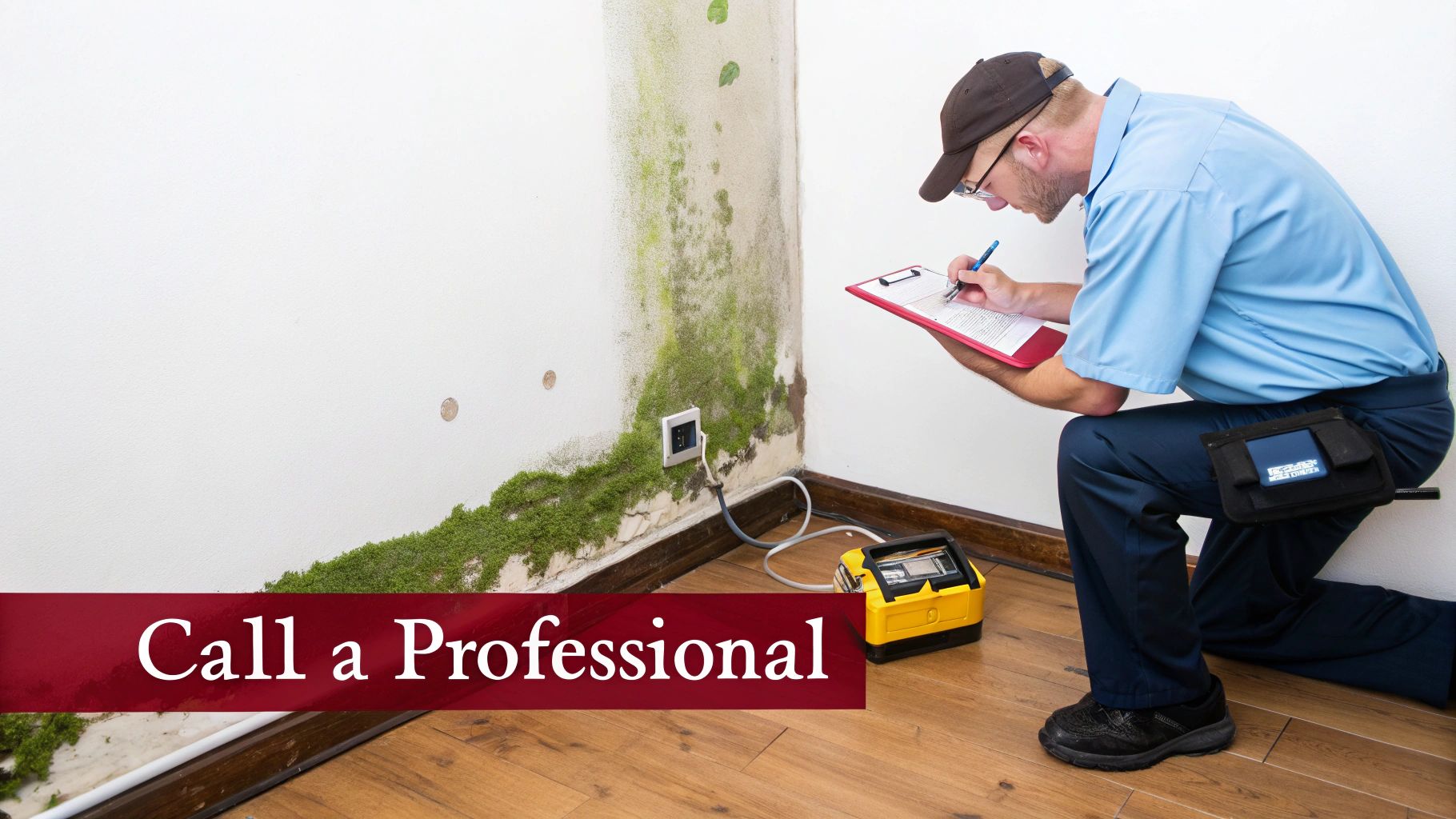
- Visible Dust, Mould, or Contaminants: If you can see it, you can bet it's in the air. Dust settling on every surface, signs of mould after a water leak, or noticeable fumes are all clear physical evidence of an airborne hazard that needs to be measured right away.
- After an Incident: Things like a chemical spill, a fire, a flood, or a major equipment failure can all pump harmful contaminants into the air. Testing after an incident is critical to confirm the area is safe for your team to return and that your cleanup efforts actually worked.
Case Study: A Cabinetry Workshop
Let's picture a cabinetry workshop that switches to a new, fast-drying glue to speed up production. It works great, but it has a much stronger chemical smell. Within a few weeks, several employees mention they're getting headaches by the end of every shift. This is a perfect trigger for air quality testing.
A professional hygienist would come in and test specifically for the VOCs coming off that new glue. They’d provide hard data to show if exposures are exceeding the Time-Weighted Average (TWA) and recommend control measures, like better ventilation, to fix the problem.
Scheduled and Compliance-Based Testing
Beyond reacting to sudden events, routine testing is a core part of managing risk in many industries. This isn't about responding to a problem; it’s about stopping one from ever happening in the first place. This is especially true for businesses that deal with known airborne hazards day in and day out.
High-risk industries like manufacturing, construction, and mining often have scheduled air quality testing built right into their annual safety plans. For example, a stonemasonry business has to conduct regular testing for respirable crystalline silica to protect workers from silicosis. This isn't just a good idea—it's a fundamental compliance requirement for keeping people safe.
Proactive, scheduled testing shows a real commitment to health and safety that goes beyond just ticking boxes. It gives you a baseline for your workplace’s air quality, making it much easier to spot when something is off and catch emerging issues before they turn into serious hazards.
Case Study: An Office After a Minor Flood
Imagine a small office where a pipe leaks over the weekend, leaving a section of carpet damp. It's dried out by Monday, but a musty smell is hanging in the air. That’s a clear sign you need to call in a professional.
Mould testing would be necessary to check for airborne spores, which can cause serious respiratory problems. The test results would either give the all-clear or confirm that proper remediation is needed to make the office a healthy space again.
These real-world examples highlight that air quality testing is so much more than a compliance chore. It’s an essential diagnostic process that gives you the clarity to make smart decisions. It helps you find the root cause of a problem, check that your safety controls are working, and ultimately, prove that you're providing a safe and healthy workplace.
The impact of major environmental events, like the 2019–20 Black Summer bushfires which led to huge spikes in airborne particulate matter, really drives home the critical need for solid monitoring. You can dig deeper into these trends with air quality data from the Australian Bureau of Statistics.
From Test Results to Real-World Solutions
Getting an air quality testing report back can feel a bit daunting. It’s often packed with numbers, acronyms, and scientific terms that don't mean much on their own. But hidden in that data is the key to creating a safer, healthier workplace. The real magic happens when we translate those numbers into a practical action plan that genuinely protects your team.
This is where the rubber hits the road. A good report will clearly show you how your workplace air stacks up against Australia’s legally mandated Workplace Exposure Standards (WES). It will pinpoint if any contaminant levels are getting close to—or have already crossed—the limits for Time-Weighted Average (TWA), Short-Term Exposure Limit (STEL), or Peak Limitation.
Once you have that clarity, the focus has to shift immediately to dealing with the problem at its source. For that, health and safety professionals rely on a time-tested framework: the hierarchy of controls.
Applying the Hierarchy of Controls
The hierarchy of controls is essentially a step-by-step game plan for managing workplace risks. It’s structured to prioritise the most effective and reliable solutions first. Think of it as a pyramid: the strongest, most permanent fixes are at the top, and the weakest are at the bottom. The goal is always to start as high up that pyramid as you can.
This approach is crucial because it stops businesses from jumping to the easiest but least effective fix, like just handing out masks. Instead, it forces a smarter conversation about fixing the root cause of the problem for good.
Level 1: Elimination
This is the gold standard. You completely remove the hazard from the workplace. If the hazard isn't there, it can't cause harm. Simple as that.
- Example: A commercial printer uses a powerful solvent to clean their presses, and testing shows high VOC levels in the air. After some research, they find a new, water-based cleaning agent that does the same job but is non-toxic. By making the switch, they've eliminated the hazardous solvent entirely. Problem solved.
Level 2: Substitution and Engineering Controls
If you can't get rid of the hazard completely, the next best thing is to either swap it for something safer or physically separate people from it using an engineering fix.
- Substitution Example: A furniture maker’s lacquer contains a high concentration of harmful chemicals. They find and switch to a new, low-VOC lacquer. The risk isn't gone, but it’s been drastically reduced.
- Engineering Control Example: A metal fabrication workshop is dealing with welding fumes. They install a local exhaust ventilation (LEV) system, placing hoods right over each welding station. This system sucks the fumes away at the source, before they ever reach the worker's breathing zone. You can find out more about these kinds of fixes in our guide on methods for improving indoor air quality.
Level 3: Administrative Controls
These controls involve changing how people work to minimise their exposure. You're not removing the hazard, but you are limiting your team's contact with it.
- Example: A factory has a particularly noisy machine that's essential to its operations. To manage the risk, the business brings in a job rotation schedule. Now, no single employee works in that high-noise area for more than two hours at a time, which keeps their individual daily exposure below the safe limit.
The hierarchy of controls provides a logical roadmap. It guides you away from temporary fixes and toward permanent, sustainable solutions that embed safety directly into your operations.
The Last Resort: Personal Protective Equipment (PPE)
Right at the bottom of the pyramid, you'll find Personal Protective Equipment (PPE)—things like masks, respirators, and gloves. While PPE is absolutely necessary in many situations, it is always the last line of defence.
Why? Because it relies entirely on people to work perfectly. A respirator that isn't fitted correctly, isn't worn every single time, or is the wrong type for the hazard offers little to no protection. It puts the burden of safety squarely on the individual worker instead of fixing the environment they're working in.
Tackling the problem at its source through elimination, substitution, or engineering controls is always the smarter, more reliable path to a safe workplace.
Got Questions About Air Quality Testing? We've Got Answers
Stepping into the world of occupational hygiene can feel a bit overwhelming, and it's natural to have questions. To help clear things up, we've tackled some of the most common queries we hear from business owners about professional air quality testing.
How Often Should I Get My Workplace Tested?
There's no one-size-fits-all answer here; it really comes down to your specific operations and the risks involved. Think of it this way: a construction site with workers cutting stone will need frequent monitoring for silica dust, whereas a standard office might only need a test if something specific pops up, like a mould issue after a leak.
So, when should you book a test? Key moments include:
- Introducing new chemicals or work processes.
- Responding to health complaints from your team.
- As part of a proactive, scheduled risk management plan.
A professional hygienist can work with you to figure out a testing schedule that’s practical and keeps your team safe.
Can't I Just Use a Cheap Monitor from the Hardware Shop?
While those off-the-shelf monitors are handy for a general idea of air quality at home, they just don't cut it for workplace safety and compliance. They simply lack the precision, calibration, and ability to detect specific contaminants that professional-grade equipment offers.
For occupational health, you need legally defensible data. Professional air quality testing uses highly specialised, lab-grade equipment that delivers precise results you can trust. This is what you need to make critical safety decisions and prove you’re meeting your obligations under Australian standards.
What Happens If We Get a Bad Result on an Air Quality Test?
If a test shows you’ve exceeded a Workplace Exposure Standard, you need to take swift, documented action. Your immediate priority is to put control measures in place to bring exposure levels down, always following the hierarchy of controls to find the most effective and lasting solution.
It doesn’t stop there. You’ll also need to dig into the root cause of the high reading and document every single step you take to fix it. A follow-up test is crucial to verify that your changes have worked and the air is safe for your employees again.
For expert guidance on creating a safe and compliant workplace, trust the professionals at Anitech. Our team provides comprehensive air quality testing and occupational hygiene services across Australia to help you protect your team and your business. Find out more at Anitech's Occupational Hygiene Services.


